Quick Answer
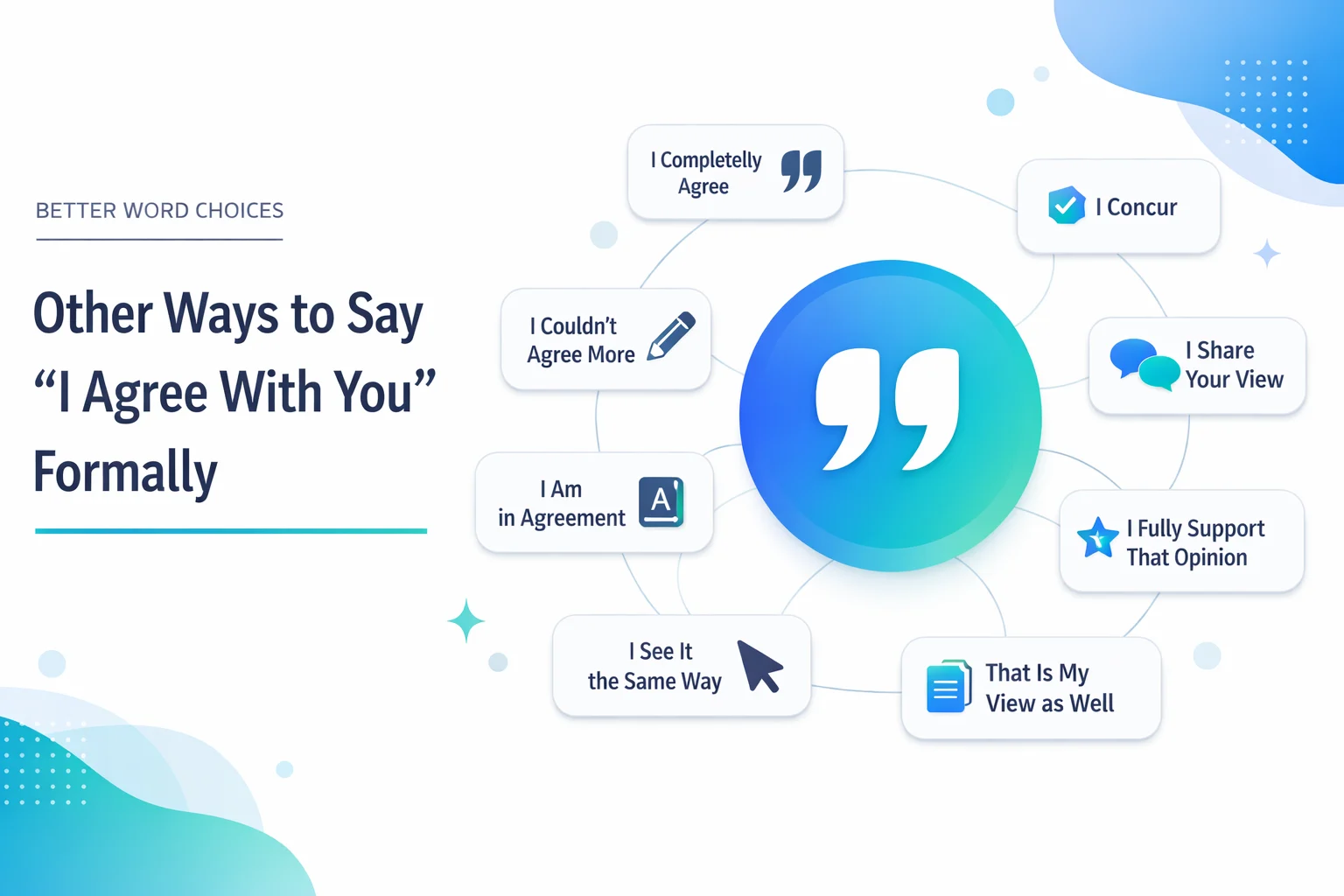
I concur, I am in full agreement, I share your perspective, I align with your view, and I am of the same mind.Use these formal alternatives to sound more professional, articulate, and confident in workplace discussions, emails, and meetings.
“I agree with you” is one of the most common phrases in English. It’s simple, direct, and gets the point across. But when you use it repeatedly especially in professional settings it can make you sound repetitive, unpolished, or even disengaged.
Learning alternatives to “I agree with you” is essential for anyone who wants to express excitement in English professionally or sound more articulate in meetings, presentations, and written correspondence. The right phrase at the right moment can elevate your credibility, build stronger rapport, and make your communication more memorable.
In this guide, you’ll discover 30+ formal and professional alternatives to “I agree with you,” complete with meanings, example sentences, and context tips to help you choose the perfect phrase every time.
Quick Categories
Formal Alternatives to “I Agree With You”
- I concur
- I am in full agreement
- I share your perspective
- I align with your view
- I am of the same mind
- I second that
- I endorse your position
- That aligns with my thinking
Professional Alternatives
- I support your proposal
- I am in accord with your assessment
- Your analysis is compelling
- I subscribe to that opinion
- I find your argument persuasive
- That resonates with my view
- I stand by your position
- I cannot dispute that
Casual Alternatives (Use with Caution in Formal Settings)
- Absolutely
- Exactly
- I couldn’t agree more
- My thoughts exactly
- You’re right
- That’s true
- For sure
- No doubt about it
Informal Expressions (Best for Conversations, Not Formal Writing)
- Spot on
- You nailed it
- Tell me about it
- Same here
- I’m with you on that
- Fair enough
Pro Tip:
In formal writing and professional meetings, always opt for phrases like “I concur” or “I share your perspective” over casual alternatives. The tone you choose signals your level of professionalism and respect for the conversation.
Common Mistakes People Make Using “I Agree With You”
1. Overusing it in formal writing
Repeating “I agree with you” multiple times in an email or report sounds unprofessional and lazy.
❌ “I agree with you on the budget. I agree with you on the timeline. I agree with you on the resources.”
2. Using it when you actually mean “I understand”
Agreement and understanding are different. Saying “I agree” when you only mean “I hear you” can mislead others.
❌ “I agree with your concern” (when you actually just acknowledge it).
3. Forgetting to add context
Simply saying “I agree” without explaining what you agree with leaves the other person guessing.
❌ “I agree with you.” (Agree with what, exactly?)
4. Using it in situations where a stronger phrase is needed
When you strongly support an idea, “I agree” feels weak and lacks conviction.
❌ “I agree with your proposal” (when you should say “I fully endorse your proposal”).
5. Mixing formal and informal tones
Using “I agree with you” in a formal email while the rest of your language is casual creates an inconsistent tone.
❌ “Hey team, just wanted to say I agree with you on the new policy.”
What Does “I Agree With You” Mean?
“I agree with you” means that you share the same opinion, viewpoint, or perspective as the person you are speaking with. It signals alignment, approval, or acknowledgment of their position.
Grammar note: “Agree with” is used when agreeing with a person or their opinion. “Agree to” is used when agreeing to a plan or proposal. “Agree on” is used when two or more parties reach a shared conclusion about a topic.
Example: “I agree with you on the importance of sustainable practices in our supply chain.”
When to Use “I Agree With You”
- Everyday conversations with friends, family, or colleagues in informal settings
- Quick responses in casual emails or team chats
- Initial reactions when you want to acknowledge someone’s point briefly
- Spoken English where simplicity and speed are valued over nuance
Spoken vs Written: More acceptable in spoken English; in written formal communication, alternatives are preferred.
Formal vs Informal: Casual and neutral; not the best choice for formal reports, academic papers, or high-stakes business correspondence.
Is It Professional or Polite to Say “I Agree With You”?
Polite? ✔️ Yes it is courteous and acknowledges the other person’s viewpoint.
Professional? ❌ Not in most cases it lacks the sophistication and nuance expected in formal business or academic settings.
Business-style example: “I agree with your assessment of the quarterly performance.” This is polite but could be strengthened to: “I concur with your assessment and support the recommended adjustments.”
Pros and Cons of Using “I Agree With You”
Pros
- Simple and natural easy to use in any conversation
- Friendly tone conveys warmth and approachability
- Common usage universally understood by all English speakers
- Easy to understand no risk of miscommunication
Cons
- Too informal for work lacks the polish expected in professional environments
- Overused sounds repetitive and uninspired
- Limited emotional range doesn’t convey enthusiasm, conviction, or deep alignment
- Not suitable for formal writing weakens your authority in reports, proposals, and academic papers
Other Ways to Say “I Agree With You” Formally
These 30+ alternatives will help you sound more fluent, confident, and natural in different situations. Use them according to tone, context, and audience to express agreement with precision and professionalism.
1. Phrase: I concur
Meaning: A formal way to say you agree, often used in professional or legal contexts.
Explanation: This is one of the most polished and widely recognized formal alternatives to “I agree.”
Example Sentence: “I concur with your assessment of the market trends.”
Best Use: Business meetings
Worst Use: Casual chats
Tone: Formal, professional
Context Variability: Professional “I concur with the committee’s decision.”
2. Phrase: I am in full agreement
Meaning: You completely share the same opinion without any reservations.
Explanation: Adds emphasis and conviction, showing you are wholly aligned.
Example Sentence: “I am in full agreement with the proposed strategy.”
Best Use: Formal proposals
Worst Use: Text messages
Tone: Strong, formal
Context Variability: Professional “I am in full agreement with the board’s direction.”
3. Phrase: I share your perspective
Meaning: You see the situation in the same way as the other person.
Explanation: Emphasizes mutual understanding and alignment of viewpoints.
Example Sentence: “I share your perspective on prioritizing customer experience.”
Best Use: Collaborative discussions
Worst Use: Quick replies
Tone: Respectful, collaborative
Context Variability: Professional “I share your perspective on this matter.”
4. Phrase: I align with your view
Meaning: Your opinions are in harmony with theirs.
Explanation: Suggests strategic or ideological alignment, common in business contexts.
Example Sentence: “I align with your view that we need to streamline operations.”
Best Use: Strategy meetings
Worst Use: Social conversations
Tone: Strategic, professional
Context Variability: Professional “I align with your view on this policy.”
5. Phrase: I am of the same mind
Meaning: You hold the same opinion or intention.
Explanation: A polished way to express shared thinking.
Example Sentence: “I am of the same mind regarding the expansion plan.”
Best Use: Formal discussions
Worst Use: Casual banter
Tone: Thoughtful, formal
Context Variability: Professional “I am of the same mind as you on this issue.”
6. Phrase: I second that
Meaning: You support a proposal or motion made by someone else.
Explanation: Commonly used in meetings when formally supporting an idea.
Example Sentence: “I second that the new timeline is much more realistic.”
Best Use: Decision-making meetings
Worst Use: Written reports
Tone: Decisive, formal
Context Variability: Professional “I second that motion.”
7. Phrase: I endorse your position
Meaning: You publicly support or approve their stance.
Explanation: Stronger than simple agreement; implies active backing.
Example Sentence: “I endorse your position on sustainability initiatives.”
Best Use: Policy discussions
Worst Use: Everyday talk
Tone: Supportive, formal
Context Variability: Professional “I fully endorse your position.”
8. Phrase: That aligns with my thinking
Meaning: Their idea matches your own thoughts.
Explanation: Shows that you have independently arrived at the same conclusion.
Example Sentence: “That aligns with my thinking on how to approach the client.”
Best Use: Brainstorming sessions
Worst Use: Quick acknowledgments
Tone: Collaborative, professional
Context Variability: Professional “That aligns with my thinking exactly.”
9. Phrase: I support your proposal
Meaning: You are in favor of their suggested plan.
Explanation: Goes beyond agreement to indicate active backing.
Example Sentence: “I support your proposal to restructure the department.”
Best Use: Project approvals
Worst Use: Casual conversations
Tone: Decisive, formal
Context Variability: Professional “I fully support your proposal.”
10. Phrase: I am in accord with your assessment
Meaning: Your evaluation matches theirs in a formal, harmonious way.
Explanation: “In accord” is a highly formal synonym for “in agreement.”
Example Sentence: “I am in accord with your assessment of the financial risks.”
Best Use: Audit and review contexts
Worst Use: Everyday emails
Tone: Highly formal, precise
Context Variability: Professional “I am in accord with your findings.”
11. Phrase: Your analysis is compelling
Meaning: Their reasoning is convincing and you agree with it.
Explanation: Praises their logic while expressing agreement.
Example Sentence: “Your analysis is compelling, and I agree with your conclusions.”
Best Use: Academic or analytical discussions
Worst Use: Quick responses
Tone: Intellectual, respectful
Context Variability: Professional “Your analysis is compelling and well-supported.”
12. Phrase: I subscribe to that opinion
Meaning: You adopt or adhere to that viewpoint.
Explanation: Suggests a deliberate, considered choice to agree.
Example Sentence: “I subscribe to that opinion on work-life balance policies.”
Best Use: Philosophical or policy debates
Worst Use: Casual talk
Tone: Formal, intellectual
Context Variability: Professional “I subscribe to that school of thought.”
13. Phrase: I find your argument persuasive
Meaning: Their reasoning has convinced you.
Explanation: Acknowledges the strength of their logic while expressing agreement.
Example Sentence: “I find your argument persuasive and will support your recommendation.”
Best Use: Debates and negotiations
Worst Use: Quick acknowledgments
Tone: Analytical, formal
Context Variability: Professional “I find your argument persuasive on all counts.”
14. Phrase: That resonates with my view
Meaning: Their opinion strikes a chord with you; you feel a strong connection to it.
Explanation: Adds an emotional or intuitive dimension to agreement.
Example Sentence: “That resonates with my view on company culture.”
Best Use: Values-based discussions
Worst Use: Technical reports
Tone: Empathetic, professional
Context Variability: Professional “That resonates with my perspective.”
15. Phrase: I stand by your position
Meaning: You firmly support and defend their stance.
Explanation: Implies loyalty and unwavering support.
Example Sentence: “I stand by your position on the contract negotiations.”
Best Use: High-stakes decisions
Worst Use: Casual chats
Tone: Loyal, formal
Context Variability: Professional “I stand by your position on this issue.”
16. Phrase: I cannot dispute that
Meaning: You acknowledge the truth or validity of their point.
Explanation: A gracious way to agree by conceding that their point is undeniable.
Example Sentence: “I cannot dispute that the data clearly supports your claim.”
Best Use: Fact-based discussions
Worst Use: Opinion-based conversations
Tone: Humble, formal
Context Variability: Professional “I cannot dispute your reasoning.”
17. Phrase: I see eye to eye with you
Meaning: You are in complete agreement.
Explanation: A slightly more conversational formal phrase indicating full alignment.
Example Sentence: “I see eye to eye with you on the project’s direction.”
Best Use: Team alignment meetings
Worst Use: Formal written reports
Tone: Friendly, professional
Context Variability: Professional “We see eye to eye on this.”
18. Phrase: I am inclined to agree
Meaning: You lean toward agreement, though perhaps with some reservation.
Explanation: Useful when you agree but want to leave room for discussion.
Example Sentence: “I am inclined to agree with your recommendation, pending further data.”
Best Use: Preliminary discussions
Worst Use: Final decisions
Tone: Cautious, professional
Context Variability: Professional “I am inclined to agree with you.”
19. Phrase: That’s precisely my viewpoint
Meaning: Their opinion matches yours exactly.
Explanation: Emphasizes exact alignment.
Example Sentence: “That’s precisely my viewpoint on the new marketing strategy.”
Best Use: Presentations
Worst Use: Quick replies
Tone: Confident, formal
Context Variability: Professional “That’s precisely my viewpoint as well.”
20. Phrase: I echo your sentiments
Meaning: You express the same feelings or opinions.
Explanation: A polished way to say you feel the same way.
Example Sentence: “I echo your sentiments regarding the importance of diversity.”
Best Use: Values-driven discussions
Worst Use: Technical conversations
Tone: Empathetic, formal
Context Variability: Professional “I echo your sentiments exactly.”
21. Phrase: I acknowledge and agree
Meaning: You recognize their point and express agreement.
Explanation: Combines acknowledgment with agreement for a complete response.
Example Sentence: “I acknowledge and agree with your concerns about the timeline.”
Best Use: Addressing concerns
Worst Use: Simple acknowledgments
Tone: Respectful, formal
Context Variability: Professional “I acknowledge and agree with your perspective.”
22. Phrase: I hold the same opinion
Meaning: Your opinion is identical to theirs.
Explanation: A straightforward, formal alternative.
Example Sentence: “I hold the same opinion regarding the budget cuts.”
Best Use: Formal correspondence
Worst Use: Casual conversations
Tone: Formal, neutral
Context Variability: Professional “I hold the same opinion on that matter.”
23. Phrase: Your point is well taken
Meaning: You understand and accept their point.
Explanation: Gracious way to agree while acknowledging their contribution.
Example Sentence: “Your point is well taken we will incorporate your feedback.”
Best Use: Feedback sessions
Worst Use: Debates
Tone: Gracious, professional
Context Variability: Professional “Your point is well taken and appreciated.”
24. Phrase: I have no objection
Meaning: You do not oppose their suggestion.
Explanation: A softer way to agree by indicating lack of opposition.
Example Sentence: “I have no objection to the proposed changes.”
Best Use: Approvals
Worst Use: Enthusiastic support
Tone: Neutral, formal
Context Variability: Professional “I have no objection to that plan.”
25. Phrase: That is a valid point
Meaning: Their point is logical and reasonable.
Explanation: Acknowledges the merit of their argument while agreeing.
Example Sentence: “That is a valid point, and I agree with your reasoning.”
Best Use: Discussions
Worst Use: Quick replies
Tone: Respectful, professional
Context Variability: Professional “That is a valid point worth considering.”
26. Phrase: I am convinced
Meaning: Their argument has fully persuaded you.
Explanation: Shows that agreement came after careful consideration.
Example Sentence: “I am convinced by your proposal and will support it.”
Best Use: Final decisions
Worst Use: Casual chats
Tone: Decisive, formal
Context Variability: Professional “I am convinced of your approach.”
27. Phrase: I take the same view
Meaning: You share the same perspective.
Explanation: A concise formal alternative.
Example Sentence: “I take the same view on the outsourcing decision.”
Best Use: Formal emails
Worst Use: Social media
Tone: Formal, direct
Context Variability: Professional “I take the same view as you.”
28. Phrase: I approve of your suggestion
Meaning: You formally endorse their idea.
Explanation: Indicates not just agreement but active approval.
Example Sentence: “I approve of your suggestion to expand our digital presence.”
Best Use: Approvals and endorsements
Worst Use: Casual conversations
Tone: Formal, supportive
Context Variability: Professional “I approve of your suggestion wholeheartedly.”
29. Phrase: I respect your position
Meaning: You value their stance and agree with it.
Explanation: Combines respect with agreement.
Example Sentence: “I respect your position on the ethical considerations.”
Best Use: Sensitive discussions
Worst Use: Quick replies
Tone: Respectful, formal
Context Variability: Professional “I respect your position on this matter.”
30. Phrase: We are on the same page
Meaning: We share the same understanding or opinion.
Explanation: A professional phrase indicating mutual alignment.
Example Sentence: “We are on the same page regarding the project timeline.”
Best Use: Team meetings
Worst Use: Formal written reports
Tone: Collaborative, professional
Context Variability: Professional “We are on the same page about this.”
“The right tone makes your English sound professional and confident. Master these alternatives and watch your credibility soar.”
Mini Quiz / Self-Check
1. You are in a board meeting and want to formally support a colleague’s proposal. Which phrase is most appropriate?
- A) “I agree with you.”
- B) “I second that.”
- C) “Same here.”
- D) “You nailed it.”
Answer: B “I second that” is the most appropriate formal phrase for supporting a proposal in a meeting.
2. You are writing a formal email to a client and want to acknowledge their point while agreeing. Which phrase should you use?
- A) “I’m with you on that.”
- B) “Your point is well taken.”
- C) “Spot on.”
- D) “Tell me about it.”
Answer: B “Your point is well taken” is professional and gracious for formal correspondence.
3. You strongly support a new policy and want to convey full commitment. Which phrase is best?
- A) “I concur.”
- B) “I stand by your position.”
- C) “That’s true.”
- D) “Fair enough.”
Answer: B “I stand by your position” conveys strong, committed support.
4. In a casual team chat, a colleague suggests a great idea. Which response is most natural?
- A) “I am in full agreement.”
- B) “I cannot dispute that.”
- C) “Exactly! That’s what I was thinking.”
- D) “I endorse your position.”
Answer: C “Exactly!” is natural and enthusiastic for casual team chats.
Comparison Table: Top 10 Alternatives
| Phrase | Tone | Best Use |
|---|---|---|
| I concur | Formal, professional | Business meetings, formal correspondence |
| I am in full agreement | Strong, formal | Proposals, board discussions |
| I share your perspective | Respectful, collaborative | Team discussions, strategy meetings |
| I align with your view | Strategic, professional | Policy decisions, planning |
| I second that | Decisive, formal | Voting, decision-making |
| I endorse your position | Supportive, formal | Policy support, approvals |
| Your analysis is compelling | Intellectual, formal | Academic discussions, reports |
| I see eye to eye with you | Friendly, professional | Team alignment, negotiations |
| I stand by your position | Loyal, formal | High-stakes decisions |
| We are on the same page | Collaborative, professional | Team meetings, project alignment |
FAQs
1. What is the most formal way to say “I agree with you”?
“I concur” and “I am in full agreement” are among the most formal alternatives. They are widely used in legal, academic, and high-level business contexts.
2. Can I say “I agree with you” in a professional email?
Yes, but it’s better to use more polished alternatives like “I share your perspective” or “I support your proposal” to sound more professional and articulate.
3. What is a polite way to agree without sounding too formal?
“I see eye to eye with you” or “We are on the same page” are polite and professional without being overly formal.
4. How do I agree with someone in a business meeting?
Use phrases like “I concur,” “I second that,” or “I align with your view” to sound confident and professional in meetings.
5. Is “I couldn’t agree more” formal or informal?
It is slightly informal but acceptable in semi-formal settings. For formal writing or high-stakes meetings, opt for “I am in full agreement” or “I concur” instead.
Conclusion
Mastering alternatives to “I agree with you” is one of the simplest yet most effective ways to elevate your English communication. Whether you’re in a boardroom, writing a formal email, or participating in an academic discussion, the right phrase can make you sound more confident, articulate, and professional.
Start by incorporating two or three of these formal alternatives into your daily conversations. Pay attention to the tone and context and soon, using varied expressions of agreement will feel completely natural. Remember, great communication isn’t just about what you say it’s about how you say it.
Read More Related Articles:
- Other Ways to Say Another Example | Like a Fluent English Speaker In 2026
- Other Ways to Say This Means | Express Your Ideas with Confidence In 2026
- Other Ways to Say “In the Text” | Upgrade Your Everyday Writing In 2026

Victoria Hughes is a content writer dedicated to making communication clearer and more effective. Through TextsResponse.com, she shares practical insights and thoughtfully crafted response ideas that help readers express themselves with confidence.