Quick Answer
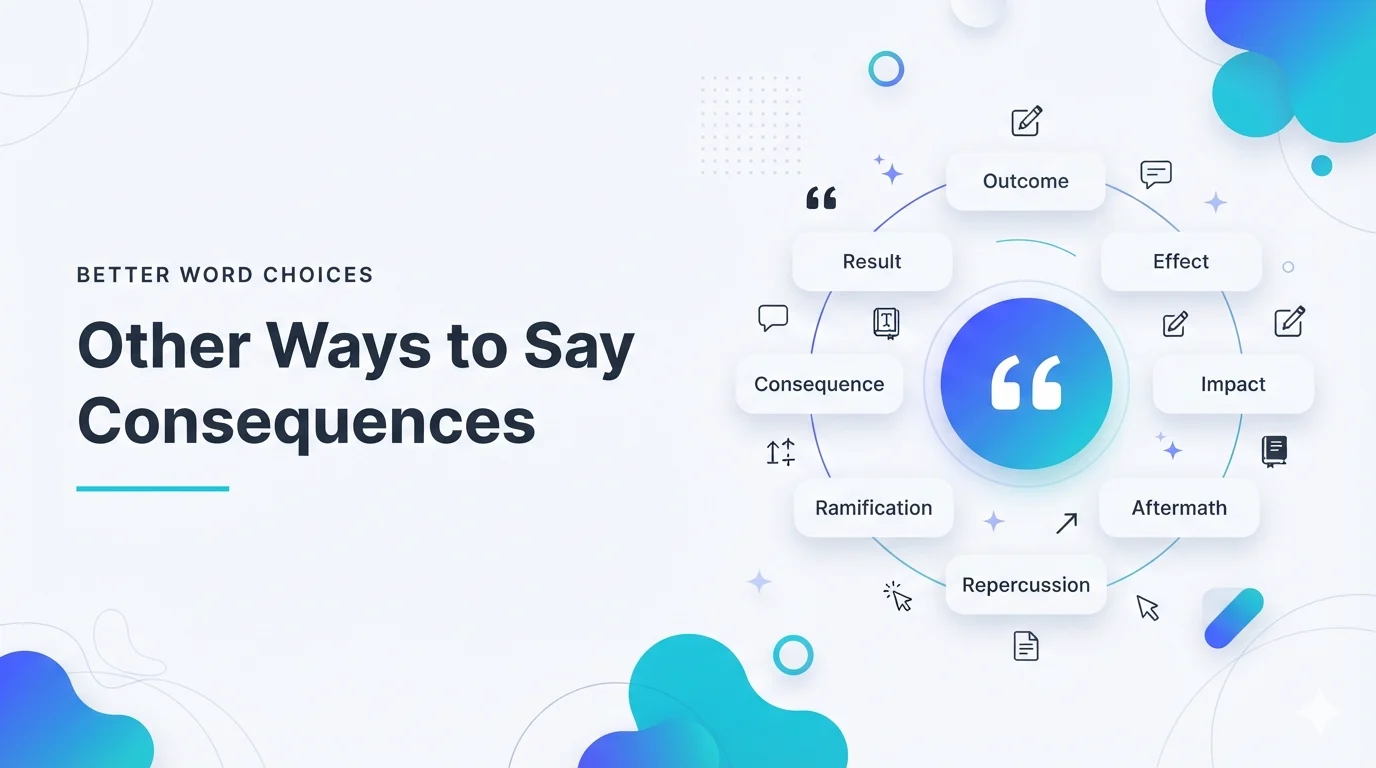
Looking for alternatives to “consequences”? Use these top picks: results, outcomes, effects, repercussions, and ramifications. Each fits different contexts from casual conversation to professional reports.
The word consequences appears constantly in everyday English. You hear it in news reports, workplace meetings, academic lectures, and casual conversations. But what does it really mean? Simply put, a consequence is something that happens as a result of a particular action or set of conditions. Every choice, decision, or event produces some form of consequence whether positive, negative, or neutral.
Why should you learn alternatives to “consequences”? Because using the same word repeatedly makes your English sound repetitive and limited. Expanding your vocabulary allows you to express excitement in English when discussing favorable outcomes, or convey seriousness when addressing negative results. Whether you are writing a business email, preparing an academic essay, or having a casual chat, knowing the right word for the right moment elevates your communication skills instantly.
“The right tone makes your English sound professional and confident.”
Quick Categories Section
Formal Alternatives to “Consequences”
- Ramifications
- Repercussions
- Implications
- Aftermath
- Concomitant effects
Casual Alternatives
- Results
- Outcomes
- What comes next
- The fallout
- The end result
Professional Alternatives
- Impact
- Outcomes
- Effects
- Resultant
- Bottom-line effects
Informal Expressions
- The blowback
- The fallout
- What happened next
- The wake
- The payoff
Common Mistakes Section
Many English learners misuse “consequences” in ways that sound unnatural or grammatically incorrect. Avoid these five common errors:
1. Using the wrong preposition
Incorrect: “He lost his job as a consequence for his actions.”
Correct: “He lost his job as a consequence of his actions.”
2. Using “consequences” as a verb
Incorrect: “This decision consequences the entire team.”
Correct: “This decision has consequences for the entire team.”
3. Being too vague
Incorrect: “Think about the consequences.”
Better: “Think about the consequences for your reputation and future career.”
4. Overusing negative collocations
Incorrect: “The consequences were very high.” (Consequences are not typically described as “high.”)
Better: “The consequences were serious/severe/dire.”
5. Confusing “consequence” with “punishment”
Incorrect: “The consequence for being late is detention.” (This frames it as a punishment.)
Better: “The consequence of being late is missing the first lesson.” (This frames it as a natural result.)
What Does “Consequences” Mean?
Consequences (noun, plural) are the results or effects that follow from an action, decision, or event. The word comes from the Latin consequentia, meaning “a following after.” In English, it functions primarily as a countable noun. It can also be used in the uncountable form to mean “importance” or “significance,” as in “a matter of no consequence”.
Example Sentence: “The new policy had far-reaching consequences for the entire organization.”
When to Use “Consequences”
Use “consequences” in these common contexts:
- Discussing cause and effect “Every action has consequences.”
- Warning about potential risks “There will be consequences if you break the rules.”
- Analyzing outcomes in reports “The consequences of the merger are still unclear.”
- Philosophical or ethical discussions “We must consider the consequences of our choices.”
| Context | Suitability |
|---|---|
| Spoken English | ✔️ Very common |
| Written English | ✔️ Widely used |
| Formal Settings | ✔️ Acceptable but overused |
| Informal Settings | ✔️ Natural and clear |
Is It Professional or Polite to Say “Consequences”?
Polite? ✔️ Yes the word itself is not rude or offensive.
Professional? ❌ No (in most cases) it is too general and overused in business writing.
In professional environments, “consequences” often sounds vague or even threatening. Instead of saying, “There will be consequences,” a business professional might say, “This decision will have significant implications for our quarterly targets.”
Business Example: “The effect of the policy change was immediate and measurable.”
Pros and Cons of Using “Consequences”
Pros
- Simple and universally understood
- Natural in both spoken and written English
- Commonly used across all English-speaking regions
- Easy to understand for intermediate learners
Cons
- Too informal for academic or professional writing
- Overused makes your language sound repetitive
- Limited emotional range doesn’t convey severity or nuance
- Not suitable for formal reports or executive summaries
Other Ways to Say Consequences
These 30 alternatives will help you sound more fluent, confident, and natural in different situations. Use them according to tone, context, and audience to express outcomes with precision and clarity.
1. Results
Meaning: What happens after an action or event.
Explanation: The most direct and neutral substitute for “consequences.”
Example Sentence: “The results of the survey exceeded our expectations.”
Best Use: General use
Worst Use: Formal academic writing
Tone: Neutral, clear
Context Variability: Casual: “The results were pretty good.” Professional: “We will review the results in tomorrow’s meeting.”
2. Outcomes
Meaning: The final result of a process or situation.
Explanation: Emphasizes the end point rather than the journey.
Example Sentence: “The outcome of the negotiations was favorable for both parties.”
Best Use: Business and academic contexts
Worst Use: Very casual conversation
Tone: Professional, neutral
Context Variability: Professional: “We are analyzing the possible outcomes.” Casual: “What was the outcome of your doctor’s visit?”
3. Effects
Meaning: Changes caused by an action or event.
Explanation: Focuses on the influence or impact rather than the result itself.
Example Sentence: “The new policy had an immediate effect on employee productivity.”
Best Use: Cause-and-effect explanations
Worst Use: When discussing final conclusions
Tone: Formal, analytical
Context Variability: Academic: “The study examined the effects of sleep deprivation.” Casual: “I can already feel the effects of that coffee.”
4. Repercussions
Meaning: Unintended, often negative results of an action.
Explanation: Carries a stronger negative connotation than “consequences.”
Example Sentence: “His careless comment had serious repercussions for his career.”
Best Use: Negative outcomes
Worst Use: Positive or neutral results
Tone: Serious, formal
Context Variability: Professional: “We must consider the legal repercussions.” Casual: “She’s still dealing with the repercussions of that decision.”
5. Ramifications
Meaning: Complex, far-reaching results that branch out from a single action.
Explanation: Suggests multiple, interconnected outcomes that may not be immediately obvious.
Example Sentence: “The CEO considered all the ramifications before approving the merger.”
Best Use: Strategic planning and policy analysis
Worst Use: Everyday casual conversation
Tone: Sophisticated, analytical
Context Variability: Professional: “The ramifications of this decision will be felt for years.” Academic: “The study explored the social ramifications of urbanization.”
6. Impact
Meaning: A strong or powerful effect.
Explanation: Emphasizes the force or significance of the result.
Example Sentence: “The new training program had a major impact on team performance.”
Best Use: Measuring significance
Worst Use: Minor or trivial outcomes
Tone: Strong, professional
Context Variability: Professional: “The impact of the policy was immediate.” Casual: “That movie had a huge impact on me.”
7. Aftermath
Meaning: The period or situation following a significant, often negative, event.
Explanation: Specifically refers to what happens after a disaster, crisis, or major change.
Example Sentence: “The aftermath of the storm required a massive cleanup effort.”
Best Use: Post-crisis situations
Worst Use: Routine or positive outcomes
Tone: Serious, dramatic
Context Variability: Professional: “The aftermath of the data breach was chaotic.” Casual: “We’re still dealing with the aftermath of the party.”
8. Fallout
Meaning: Unwanted negative results, especially those that emerge over time.
Explanation: Often used for political, social, or public relations disasters.
Example Sentence: “The political fallout from the scandal lasted for months.”
Best Use: Negative public or social consequences
Worst Use: Personal or trivial matters
Tone: Informal, slightly dramatic
Context Variability: Casual: “I’m still dealing with the fallout from that argument.” Professional: “The PR team managed the fallout effectively.”
9. Implications
Meaning: The likely future effects or meanings of an action.
Explanation: Suggests outcomes that are not yet fully realized but are anticipated.
Example Sentence: “The implications of this research could transform the industry.”
Best Use: Future-oriented analysis
Worst Use: Immediate or past results
Tone: Formal, forward-looking
Context Variability: Academic: “The implications of the findings are significant.” Professional: “Let’s discuss the budget implications.”
10. Byproduct
Meaning: A secondary or incidental result of a primary action.
Explanation: Suggests something that happens alongside the main outcome.
Example Sentence: “Increased collaboration was a positive byproduct of the new office layout.”
Best Use: Unexpected or secondary outcomes
Worst Use: Primary or intended results
Tone: Neutral, descriptive
Context Variability: Professional: “Cost savings were a welcome byproduct.” Casual: “Friendship was just a byproduct of working together.”
11. Side Effect
Meaning: An additional, often unintended, result.
Explanation: Commonly used in medical contexts but applicable broadly.
Example Sentence: “The medication helped, but the side effects were difficult.”
Best Use: Unintended secondary outcomes
Worst Use: Intended primary results
Tone: Neutral, cautionary
Context Variability: Medical: “Nausea is a common side effect.” Casual: “A side effect of my new hobby is that I’m always tired.”
12. Chain Reaction
Meaning: A series of events where each causes the next.
Explanation: Emphasizes the interconnected, domino-like nature of outcomes.
Example Sentence: “One small mistake triggered a chain reaction of errors.”
Best Use: Sequential cause-and-effect
Worst Use: Single, isolated outcomes
Tone: Descriptive, vivid
Context Variability: Professional: “The supply chain disruption caused a chain reaction.” Casual: “Her lie set off a chain reaction I never expected.”
13. End Result
Meaning: The final outcome after everything else has happened.
Explanation: Focuses on the conclusion rather than intermediate steps.
Example Sentence: “The end result of all our hard work was a successful product launch.
Best Use: Summarizing conclusions
Worst Use: Analyzing ongoing processes
Tone: Neutral, conclusive
Context Variability: Casual: “The end result was worth the effort.” Professional: “The end result exceeded our projections.”
14. Payoff
Meaning: The positive result or reward from effort or investment.
Explanation: Carries a strongly positive connotation.
Example Sentence: “All those late nights had a great payoff when we won the contract.”
Best Use: Positive outcomes
Worst Use: Negative or neutral results
Tone: Positive, informal
Context Variability: Casual: “The payoff was totally worth it.” Professional: “The long-term payoff justifies the initial cost.”
15. Product
Meaning: Something produced or caused by an action or process.
Explanation: Emphasizes the creation or generation aspect.
Example Sentence: “The project was a product of months of collaboration.”
Best Use: Results of creative or collaborative efforts
Worst Use: Negative outcomes
Tone: Neutral, descriptive
Context Variability: Professional: “This report is a product of extensive research.” Casual: “My anxiety is a product of too much caffeine.”
16. Development
Meaning: A new event or situation that arises from a previous one.
Explanation: Often used for news or unfolding situations.
Example Sentence: “The latest development in the case surprised everyone.”
Best Use: Evolving situations
Worst Use: Static or final outcomes
Tone: Neutral, informative
Context Variability: Professional: “We’ll update you on any new developments.” Casual: “There’s been a development she got the job!”
17. Upshot
Meaning: The main or final point of a series of events.
Explanation: A concise way to state the bottom line.
Example Sentence: “The upshot of all our discussions is that we need more funding.”
Best Use: Summarizing conclusions
Worst Use: Detailed analysis
Tone: Informal, conversational
Context Variability: Casual: “The upshot is, we’re going on vacation.” Professional: “The upshot of the meeting is a new strategy.”
18. Eventuality
Meaning: A possible result or future outcome.
Explanation: Emphasizes the uncertainty or possibility of the result.
Example Sentence: “We prepared for every eventuality before launching the product.
Best Use: Planning and risk management
Worst Use: Certain or guaranteed outcomes
Tone: Formal, forward-planning
Context Variability: Professional: “We must consider every eventuality.” Casual: “The worst eventuality didn’t happen.”
19. Legacy
Meaning: What remains or is left behind after an event or period.
Explanation: Often used for long-term, lasting impacts.
Example Sentence: “His leadership legacy was one of innovation and growth.”
Best Use: Long-term, enduring outcomes
Worst Use: Short-term or temporary results
Tone: Reflective, formal
Context Variability: Professional: “The company’s legacy of quality continues.” Casual: “My grandmother left a legacy of kindness.”
20. Influence
Meaning: The power to affect or change something.
Explanation: Focuses on the shaping or directing effect.
Example Sentence: “Her mentor’s influence was evident in her leadership style.”
Best Use: Subtle or indirect effects
Worst Use: Direct cause-and-effect
Tone: Neutral, descriptive
Context Variability: Professional: “Market trends have a strong influence on our strategy.” Casual: “My parents had a huge influence on my career choice.”
21. Resultant
Meaning: Something that follows as a direct consequence.
Explanation: Often used as an adjective, but can function as a noun in formal contexts.
Example Sentence: “The resultant damage from the flood was extensive.”
Best Use: Formal and technical writing
Worst Use: Casual conversation
Tone: Very formal
Context Variability: Academic: “The resultant effects were measured.” Technical: “The resultant force was calculated.”
22. Concomitant
Meaning: Something that naturally accompanies or results from something else.
Explanation: A highly formal word for outcomes that occur alongside.
Example Sentence: “Stress is a concomitant of a demanding career.”
Best Use: Academic and formal writing
Worst Use: Everyday speech
Tone: Highly formal, sophisticated
Context Variability: Academic: “Poverty is a concomitant of inequality.” Formal: “The concomitant benefits were significant.”
23. Aftereffect
Meaning: An effect that continues or appears after the main event has ended.
Explanation: Emphasizes the delayed or lingering nature.
Example Sentence: “The aftereffects of the recession were felt for years.”
Best Use: Delayed or lingering outcomes
Worst Use: Immediate results
Tone: Neutral, descriptive
Context Variability: Professional: “The aftereffects of the restructuring are still visible.” Casual: “I’m still feeling the aftereffects of that workout.”
24. Blowback
Meaning: Unintended negative consequences, especially in politics or public relations.
Explanation: Suggests a backlash or counter-reaction.
Example Sentence: “The company faced significant blowback after the controversial ad.”
Best Use: Public relations and political contexts
Worst Use: Personal or trivial matters
Tone: Informal, dramatic
Context Variability: Professional: “We need to anticipate the blowback.” Casual: “There was major blowback from that tweet.”
25. Backlash
Meaning: A strong negative reaction to an action or event.
Explanation: Emphasizes opposition or resistance.
Example Sentence: “The policy change provoked a backlash from employees.”
Best Use: Opposition or resistance
Worst Use: Neutral or positive outcomes
Tone: Strong, negative
Context Variability: Professional: “Management anticipated a backlash.” Casual: “There was a huge backlash against the new rules.”
26. Endgame
Meaning: The final stage or ultimate outcome of a process.
Explanation: Often used in strategic or competitive contexts.
Example Sentence: “The endgame of our negotiations is a mutually beneficial agreement.”
Best Use: Strategic planning
Worst Use: Routine or everyday situations
Tone: Strategic, formal
Context Variability: Professional: “We need to focus on the endgame.” Casual: “The endgame of all this studying is getting a good job.”
27. Denouement
Meaning: The final outcome or resolution of a complex series of events.
Explanation: Borrowed from French, often used in literary or dramatic contexts.
Example Sentence: “The denouement of the story was both surprising and satisfying.”
Best Use: Literary or narrative contexts
Worst Use: Business or professional settings
Tone: Literary, formal
Context Variability: Literary: “The novel’s denouement was beautifully written.” Casual: “The denouement of that whole situation was unexpected.”
28. Offshoot
Meaning: A secondary result or development from a primary source.
Explanation: Suggests something that branches off from the main outcome.
Example Sentence: “The new department was an offshoot of the company’s expansion.”
Best Use: Secondary or derivative outcomes
Worst Use: Primary or main results
Tone: Neutral, descriptive
Context Variability: Professional: “The research led to several offshoots.” Casual: “My interest in photography was an offshoot of my travels.”
29. Outgrowth
Meaning: A natural result or development from something else.
Explanation: Emphasizes organic or natural progression.
Example Sentence: “The new initiative was a natural outgrowth of our strategic planning.
Best Use: Organic or natural developments
Worst Use: Forced or artificial outcomes
Tone: Formal, organic
Context Variability: Professional: “This policy is an outgrowth of previous efforts.” Casual: “My love for hiking was an outgrowth of living near the mountains.”
30. Price
Meaning: What must be sacrificed or suffered to achieve something.
Explanation: Emphasizes the cost or sacrifice involved.
Example Sentence: “Success in this industry often comes at a price.”
Best Use: Outcomes involving sacrifice or cost
Worst Use: Free or effortless results
Tone: Serious, reflective
Context Variability: Professional: “The price of rapid growth is increased pressure.” Casual: “That was the price I paid for being careless.”
“Using varied vocabulary isn’t just about sounding smart it’s about being understood with precision.”
“The best communicators choose words that match their audience, not just their thesaurus.”
“In professional English, specificity is a sign of competence.”
Mini Quiz / Self-Check
Test your understanding of when to use each alternative.
1. You are writing a formal business report about potential risks. Which word is most appropriate?
A) Fallout
B) Ramifications
C) Payoff
D) Blowback
2. You are telling a friend about the positive result of your hard work. Which word fits best?
A) Aftermath
B) Repercussions
C) Payoff
D) Backlash
3. You are describing the negative public reaction to a company’s decision. Which word is most suitable?
A) Outgrowth
B) Backlash
C) Denouement
D) Byproduct
4. Which alternative carries the most formal, academic tone?
A) Upshot
B) Concomitant
C) Fallout
D) Payoff
Comparison Table: Top 10 Alternatives
| Phrase | Tone | Best Use |
|---|---|---|
| Results | Neutral | General, everyday use |
| Outcomes | Professional | Business and academic writing |
| Effects | Formal | Cause-and-effect explanations |
| Repercussions | Serious | Negative, unintended outcomes |
| Ramifications | Sophisticated | Complex, far-reaching results |
| Impact | Strong | Measuring significance |
| Aftermath | Dramatic | Post-crisis situations |
| Implications | Formal | Future-oriented analysis |
| Fallout | Informal | Negative social or political results |
| Payoff | Positive | Rewarding outcomes |
FAQs
1. What is the best formal alternative to “consequences”?
The best formal alternatives are ramifications, implications, and repercussions. These words carry a professional tone and are widely used in academic and business writing.
2. Can “consequences” be used for positive outcomes?
Yes, “consequences” can be neutral or positive. However, it is most frequently used to discuss negative results. For positive outcomes, consider payoff, benefits, or rewards.
3. What is the difference between “repercussions” and “ramifications”?
Repercussions usually refer to unintended negative results, while ramifications suggest complex, far-reaching outcomes that may include both positive and negative elements.
4. Is “consequences” acceptable in professional emails?
Yes, but it is often too vague. Professional alternatives like implications, outcomes, or effects sound more precise and business-like.
5. What is the most common synonym for “consequences”?
Results is the most common and direct synonym. It is neutral, widely understood, and works in almost every context.
Conclusion
Learning alternatives to “consequences” transforms your English from basic to sophisticated. Each synonym carries its own tone, nuance, and best-use case. By choosing the right word for the right situation, you communicate more precisely, sound more professional, and avoid the repetition that makes language dull.
Start incorporating these 30 alternatives into your daily speech and writing. Pay attention to context a word that works in a casual conversation may fall flat in a boardroom. With practice, choosing the perfect synonym will become second nature, and your English will shine with clarity and confidence.
Read More Related Articles:
- Other Ways to Say You’re Beautiful | Beyond the Ordinary Compliment In 2026
- Other Ways to Say I Love You in Spanish | Beyond the Usual Phrase In 2026
- Other Ways to Say I Love You in Other Languages | Beyond the Classic Three Words In 2026

Henry Walker is an American writer and blogger with a keen interest in communication, language and digital content. At TextsResponse.com, he creates informative and reader-focused resources designed to help people communicate with clarity, confidence and authenticity.