Quick Answer 🔥
Replace the vague word “thing” with more precise alternatives like object, item, matter, subject, element, device, tool, concept, feature, or aspect. For informal settings, try stuff, gadget, or thingamajig.
Looking for other ways to say “thing”? Although “thing” is common in everyday English, using a more specific word can make your writing clearer, stronger, and more professional.
The best alternative depends on what you are describing. Words such as “item,” “matter,” “subject,” “object,” and “aspect” can help you express the exact meaning while avoiding repetitive or vague language.
What Does “Thing” Mean?
The word “thing” is one of the most versatile nouns in English. It refers to any object, idea, event, or situation that you cannot or do not need to name precisely. It can describe physical items (“Pass me that thing”), abstract concepts (“Love is a beautiful thing”), or even circumstances (“The thing is, I’m busy”).
Grammar note: “Thing” is a countable noun (one thing, two things). It is neutral in tone but leans informal in many contexts.
Example: “I need to fix that thing on my desk before the meeting.”
When to Use “Thing”
Use “thing” when you are:
- Speaking casually with friends or family
- Referring to something whose exact name you don’t know
- Being intentionally vague or general
- Writing informal emails or text messages
- Using common expressions like “the thing is” or “how are things?”
However, in professional writing, academic work, or formal speeches, overusing “thing” can make your language sound weak and imprecise. That is why learning alternatives to “thing” is essential for fluency.
Is It Professional or Polite to Say “Thing”?
| Polite? | Professional? |
|---|---|
| ✔️ Yes (in most cases) | ❌ No (in most cases) |
“Thing” is not rude, but it is often too vague for professional environments. In business writing, precise language signals competence and clarity.
Business example (weak): “We need to discuss the thing from last week.”
Business example (strong): “We need to discuss the proposal we reviewed last week.”
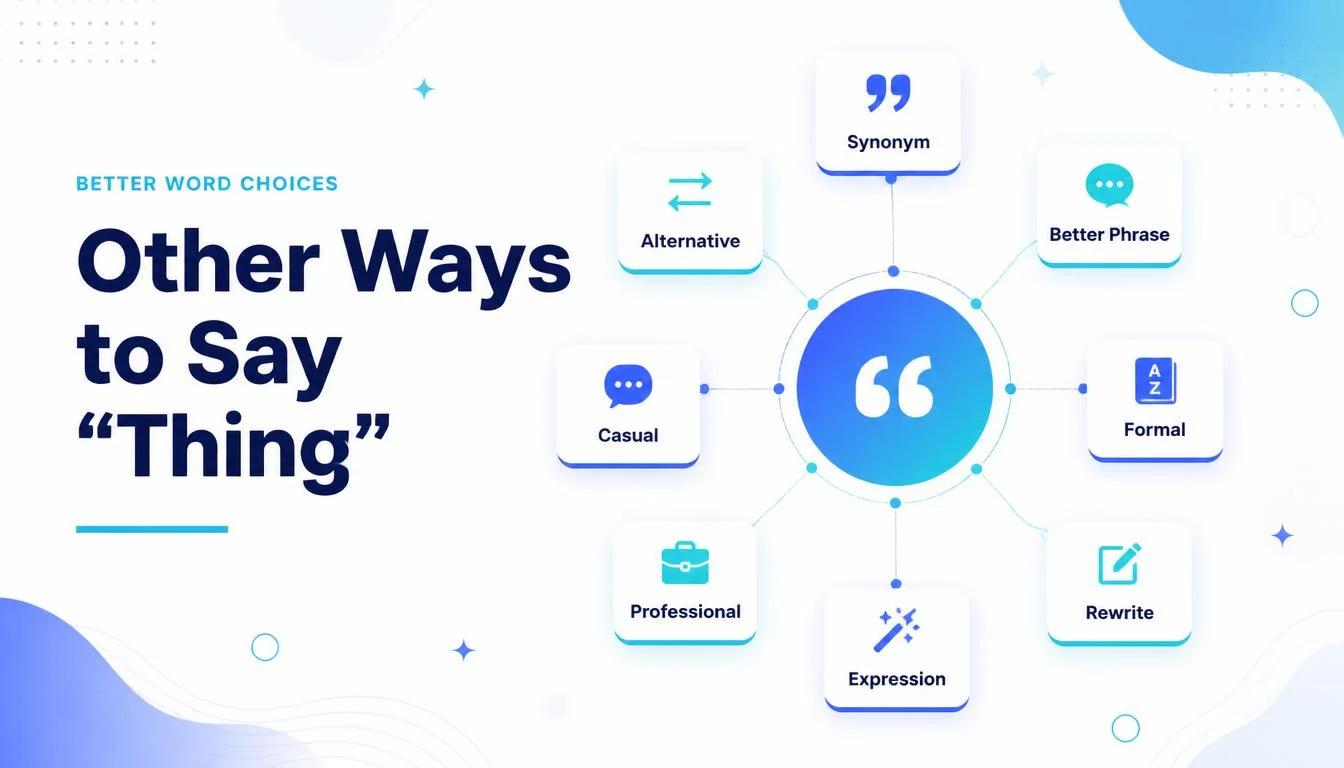
Quick Categories
Formal Alternatives to “Thing”
- Entity · Matter · Subject · Concept · Notion · Phenomenon · Circumstance · Article
Casual Alternatives
- Stuff · Item · Piece · Bit · Deal
Professional Alternatives
- Object · Component · Element · Factor · Feature · Aspect · Resource · Asset · Product · Device · Tool · Instrument
Informal Expressions
- Gadget · Gizmo · Contraption · Doodad · Thingamajig · Whatchamacallit · Doohickey
💡 Pro Tip: The more specific your word choice, the more confident and fluent you sound. Choose words that match what you are actually describing physical objects, abstract ideas, or parts of a whole.
Pros and Cons of Using “Thing”
Pros
- Simple and natural in everyday speech
- Friendly and approachable tone
- Very common and widely understood
- Easy to use without thinking
Cons
- Too informal for work or academic writing
- Overused and repetitive
- Limited emotional and descriptive range
- Not suitable for formal or precise communication
Common Mistakes People Make with “Thing”
1. Using “thing” repeatedly in one sentence
❌ “I bought a thing for the kitchen, and the thing broke after one use.”
✅ “I bought a gadget for the kitchen, and the device broke after one use.”
2. Using “thing” in formal emails
❌ “Regarding the thing we discussed in the meeting…”
✅ “Regarding the proposal we discussed in the meeting…”
3. Using “thing” when the exact word is available
❌ “Can you hand me that thing on the shelf?” (pointing at a book)
✅ “Can you hand me that book on the shelf?”
4. Using “thing” for abstract concepts in academic writing
❌ “The main thing of this theory is…”
✅ “The central concept of this theory is…”
5. Using “thing” in job interviews
❌ “My biggest thing is teamwork.”
✅ “My greatest strength is teamwork.”
Other Ways to Say “Thing”
These alternatives to “thing” will help you sound more fluent, confident, and natural in different situations. Use them according to tone, context, and audience to express yourself with clarity and precision.
1. Object
Meaning: A physical item you can see and touch.
Explanation: This is the most direct synonym for a tangible “thing.”
Example: “She found a strange object on the beach during her morning walk.”
Best Use: Physical items
Worst Use: Abstract ideas
Tone: Neutral, clear
2. Item
Meaning: A single thing in a group or list.
Explanation: Useful when you are counting or categorizing things.
Example: “Please review each item on the agenda before the meeting.”
Best Use: Lists, inventories
Worst Use: General conversation
Tone: Neutral, organized
3. Matter
Meaning: A situation, subject, or issue that needs attention.
Explanation: Often used in professional contexts to refer to problems or topics.
Example: “We need to address this matter before the end of the quarter.”
Best Use: Business discussions
Worst Use: Physical objects
Tone: Formal, serious
4. Subject
Meaning: A topic people talk about, study, or write about.
Explanation: Perfect for academic, educational, or discussion contexts.
Example: “The subject of today’s lecture is climate change policy.”
Best Use: Education, discussions
Worst Use: Physical items
Tone: Academic, neutral
5. Concept
Meaning: An abstract idea or general notion.
Explanation: Ideal for describing ideas that are not physical.
Example: “The concept of supply and demand is fundamental to economics.”
Best Use: Abstract ideas
Worst Use: Physical objects
Tone: Academic, intellectual
6. Entity
Meaning: Something that exists as a separate and independent unit.
Explanation: A formal word for anything with distinct existence.
Example: “The company is now a separate legal entity from its founders.”
Best Use: Legal, business, philosophical contexts
Worst Use: Casual conversation
Tone: Very formal
7. Element
Meaning: One basic part that helps form a whole.
Explanation: Great for breaking down complex systems or ideas.
Example: “Trust is a key element of any successful team.”
Best Use: Analysis, breakdowns
Worst Use: Whole items
Tone: Analytical, neutral
8. Component
Meaning: A part of a larger machine, system, or process.
Explanation: More technical than “element” and often used in engineering or business.
Example: “The new software has several components that work together seamlessly.”
Best Use: Technical, systems
Worst Use: Everyday objects
Tone: Technical, professional
9. Factor
Meaning: An element that contributes to a result or situation.
Explanation: Perfect for discussions about causes, influences, and decision-making.
Example: “Cost is the most important factor in our decision.”
Best Use: Analysis, decision-making
Worst Use: Physical objects
Tone: Analytical, business
10. Feature
Meaning: A distinctive quality, part, or characteristic of something.
Explanation: Often used in product descriptions and reviews.
Example: “The phone’s best feature is its camera quality.”
Best Use: Products, descriptions
Worst Use: Abstract concepts
Tone: Descriptive, neutral
11. Aspect
Meaning: One particular side, part, or feature of a larger thing.
Explanation: Useful for examining situations or problems from different angles.
Example: “We need to consider every aspect of this project before proceeding.”
Best Use: Analysis, evaluation
Worst Use: Single physical objects
Tone: Analytical, formal
12. Device
Meaning: A tool, machine, or piece of equipment made for a specific purpose.
Explanation: Best for electronic, mechanical, or technical tools.
Example: “This device measures your heart rate and tracks your sleep patterns.”
Best Use: Technology, equipment
Worst Use: Non-technical items
Tone: Technical, neutral
13. Tool
Meaning: Something used to help you perform a task or job.
Explanation: Can be physical (hammer) or abstract (software, method).
Example: “Excel is an essential tool for data analysis in our department.”
Best Use: Work, tasks
Worst Use: Decorative items
Tone: Practical, neutral
14. Instrument
Meaning: A tool or device used for delicate or precise work.
Explanation: Often used for medical, scientific, or musical contexts.
Example: “The surgeon used a precise instrument to perform the operation.”
Best Use: Medical, scientific, musical
Worst Use: Everyday items
Tone: Formal, precise
15. Product
Meaning: Something that is made, grown, or created to be used or sold.
Explanation: Standard term in business and marketing.
Example: “Our new product will launch next month in three international markets.”
Best Use: Business, commerce
Worst Use: Natural objects
Tone: Business, neutral
💡 Pro Tip: When writing reports or emails, replace vague nouns like “thing” with specific alternatives. Your readers will understand you faster and take you more seriously.
16. Resource
Meaning: Something useful that helps you achieve a goal.
Explanation: Often used in business, education, and project management.
Example: “Time is our most valuable resource on this project.”
Best Use: Business, planning
Worst Use: Physical knick-knacks
Tone: Professional, strategic
17. Asset
Meaning: Something valuable that belongs to a person or organization.
Explanation: A positive, value-focused word often used in finance and HR.
Example: “Her language skills are a huge asset to the international team.”
Best Use: Business, finance
Worst Use: Everyday items
Tone: Professional, positive
18. Article
Meaning: A single object, often part of a set or collection.
Explanation: Common in formal writing and inventory contexts.
Example: “The store sells various household articles, from cookware to linens.”
Best Use: Formal, inventory
Worst Use: Casual speech
Tone: Formal, neutral
19. Piece
Meaning: A small part or individual unit of something larger.
Explanation: Very versatile for physical and abstract items.
Example: “She wrote a brilliant piece on urban development for the journal.”
Best Use: Parts, writing, art
Worst Use: Large whole items
Tone: Neutral, conversational
20. Bit
Meaning: A small amount or piece of something.
Explanation: Casual and friendly, often used in British English.
Example: “Let me just grab a few bits from the shop before we go.”
Best Use: Casual conversation
Worst Use: Formal writing
Tone: Informal, friendly
21. Stuff
Meaning: A collection of various things, often unnamed.
Explanation: Very common in casual English but avoid in formal contexts.
Example: “I need to clear all this stuff out of my garage this weekend.”
Best Use: Casual, everyday
Worst Use: Professional writing
Tone: Informal, vague
22. Gadget
Meaning: A small, clever device or tool.
Explanation: Often used for electronic or innovative products.
Example: “He loves buying the latest tech gadgets as soon as they come out.”
Best Use: Technology, innovation
Worst Use: Traditional tools
Tone: Informal, enthusiastic
23. Gizmo
Meaning: A small device or tool whose name you do not know or remember.
Explanation: Playful and informal great for casual conversation.
Example: “What’s that gizmo on your desk? It looks like a mini printer.”
Best Use: Casual, unknown items
Worst Use: Formal writing
Tone: Informal, playful
24. Contraption
Meaning: A strange or complicated-looking device or machine.
Explanation: Often implies something unusual or homemade.
Example: “He built some contraption in his garage to water the plants automatically.”
Best Use: Unusual devices
Worst Use: Professional contexts
Tone: Informal, curious
25. Doodad
Meaning: A small object whose name you do not know.
Explanation: Very informal and lighthearted.
Example: “Can you hand me that doodad next to the stapler?”
Best Use: Casual, unnamed small items
Worst Use: Formal or professional
Tone: Informal, playful
26. Thingamajig / Thingamabob
Meaning: A word used when you cannot remember the name of something.
Explanation: Playful placeholders charming in speech but never in writing.
Example: “Pass me the thingamajig you know, the one with the red handle.”
Best Use: Casual conversation
Worst Use: Any formal setting
Tone: Informal, humorous
27. Whatchamacallit
Meaning: A placeholder for something whose name you cannot recall.
Explanation: Very common in American casual speech.
Example: “I need to pick up a whatchamacallit from the hardware store.”
Best Use: Everyday speech
Worst Use: Professional writing
Tone: Informal, conversational
28. Doohickey
Meaning: A small object or device whose name you do not know.
Explanation: Similar to “gizmo” and “thingamajig” informal and fun.
Example: “Where did I put that doohickey for opening the battery compartment?”
Best Use: Casual, unnamed items
Worst Use: Formal contexts
Tone: Informal, playful
29. Notion
Meaning: An idea, belief, or vague understanding of something.
Explanation: A more sophisticated alternative for abstract “things.”
Example: “The notion that hard work always leads to success is overly simplistic.”
Best Use: Abstract ideas, philosophy
Worst Use: Physical objects
Tone: Formal, intellectual
30. Phenomenon
Meaning: An observable fact, event, or situation.
Explanation: Used for remarkable, unusual, or scientifically observed events.
Example: “The phenomenon of remote work has transformed the global economy.”
Best Use: Science, social trends
Worst Use: Everyday objects
Tone: Formal, academic
💡 Pro Tip: The best alternatives to “thing” are the ones that add precision. Before you speak or write, ask yourself: Is this a physical object, an idea, a part of something, or a situation? Then choose the word that fits.
Comparison Table: Top 10 Alternatives
| Phrase | Tone | Best Use |
|---|---|---|
| Object | Neutral | Physical items you can see and touch |
| Item | Neutral | Lists, inventories, counting |
| Matter | Formal | Business issues, situations needing attention |
| Subject | Academic | Topics of discussion or study |
| Concept | Intellectual | Abstract ideas and theories |
| Entity | Very formal | Legal, philosophical, or business contexts |
| Element | Analytical | Parts of a larger whole |
| Device | Technical | Electronic or mechanical tools |
| Feature | Descriptive | Product characteristics and qualities |
| Stuff | Informal | Collections of various things |
Mini Quiz / Self-Check
1. Which alternative would you use in a formal business email?
- A. Gizmo
- B. Thingamajig
- C. Matter
- D. Stuff
Answer: C. Matter
2. You are describing a new smartphone in a product review. Which word fits best?
- A. Contraption
- B. Feature
- C. Notion
- D. Entity
Answer: B. Feature
3. You cannot remember the name of a small tool. What should you say in a casual conversation?
- A. Entity
- B. Phenomenon
- C. Thingamajig
- D. Component
Answer: C. Thingamajig
4. Which word is most appropriate for academic writing about an abstract idea?
- A. Gadget
- B. Concept
- C. Stuff
- D. Item
Answer: B. Concept
FAQs
1. What is the best alternative to “thing” in professional writing?
The best professional alternatives depend on context. Use “matter” for issues, “object” for physical items, “concept” for ideas, and “component” or “element” for parts of a whole.
2. Is “stuff” a synonym for “thing”?
Yes, “stuff” is a common informal synonym for “thing,” but it refers to collections of multiple things rather than a single item. Avoid it in professional writing.
3. Can I use “thingamajig” in formal writing?
No. “Thingamajig” is a playful placeholder used only in casual, spoken English. Never use it in emails, reports, or academic work.
4. Why should I avoid overusing “thing”?
Overusing “thing” makes your language vague, repetitive, and imprecise. Using specific alternatives to “thing” makes you sound more fluent, confident, and professional.
5. What is the most formal synonym for “thing”?
“Entity” and “phenomenon” are among the most formal synonyms. “Entity” refers to anything with independent existence, while “phenomenon” refers to observable facts or events.
Conclusion
Learning other ways to say “thing” is one of the fastest ways to improve your English fluency. The word “thing” is useful, but relying on it too much makes your speech and writing feel vague and unpolished. By choosing more precise alternatives whether you need a formal term like “entity,” a professional word like “component,” or a casual placeholder like “gizmo” you communicate with greater clarity and confidence.
Start small. Pick three new alternatives from this list and use them in your conversations this week. Pay attention to the tone and context of each situation. With consistent practice, these alternatives to “thing” will become second nature and your English will sound more sophisticated, natural, and professional.
Read More Related Articles:
- Other Ways to Say Having Sex | Common Phrases and What They Mean In 2026
- Other Ways to Say The End | Find the Perfect Phrase to Finish Strong In 2026
- Other Ways to Say Working Hard | Creative Phrases to Show Commitment In 2026

Henry Walker is an American writer and blogger with a keen interest in communication, language and digital content. At TextsResponse.com, he creates informative and reader-focused resources designed to help people communicate with clarity, confidence and authenticity.