Quick Answer
State, express, mention, declare, articulate. These five alternatives instantly upgrade your writing by replacing the overused verb “say” with more precise, professional language. Use them to add variety, clarity, and authority to your sentences.
The verb “say” is one of the most frequently used words in English. It appears in everyday conversation, academic essays, business reports, and creative writing. While “say” is simple and effective, overusing it makes your writing feel repetitive, dull, and amateurish.
Learning alternatives to “say” transforms your communication. Whether you are drafting a professional email, writing a research paper, or crafting a novel, varying your vocabulary demonstrates fluency, precision, and confidence. The right word can convey tone, emotion, and intent far more effectively than a generic “say” ever could. This guide gives you 30 powerful alternatives, organized by formality and context, so you can express yourself with clarity and sophistication in any situation.
Quick Categories
Formal Alternatives to “Say”
- State – for official or authoritative statements
- Declare – for public or emphatic announcements
- Assert – for confident claims or arguments
- Proclaim – for formal or official declarations
Pro Tip: Use formal alternatives in academic papers, business reports, and official correspondence. They signal authority and professionalism.
Casual Alternatives to “Say”
- Mention – for brief or casual references
- Remark – for incidental observations
- Add – for supplementary points
- Share – for personal or informal communication
Pro Tip: Casual alternatives work well in emails to colleagues, social media posts, and everyday conversation. They keep the tone friendly and approachable.
Professional Alternatives to “Say”
- Express – for conveying thoughts or feelings
- Articulate – for clear and effective communication
- Communicate – for general information exchange
- Convey – for transmitting messages or ideas
Pro Tip: Professional alternatives are ideal for workplace communication, presentations, and client-facing documents. They project competence and clarity.
Informal Expressions
- Put it – as in “put it bluntly”
- Come out with – for unexpected statements
- Blurt out – for speaking without thinking
- Spill – for revealing information casually
Pro Tip: Informal expressions are best reserved for casual conversations with friends or colleagues you know well. Avoid them in formal writing.
What Does “Say” Mean?
“Say” is a verb that means to utter words, express an opinion, or convey information verbally or in writing.
Grammar note: “Say” is an irregular verb (say – said – said). It is typically used with a direct object (the words spoken) and can be followed by “that” + a clause. Unlike “tell,” “say” does not require an indirect object (the person spoken to).
Example sentence:
She said she would arrive by noon.
When to Use “Say”
Common contexts for “say”:
- Everyday conversation – reporting what someone spoke
- Quoting sources – attributing statements in journalism or academia
- Narrative writing – dialogue attribution in fiction
- Explaining ideas – introducing opinions or facts
- Paraphrasing – summarizing what others have communicated
Spoken vs. Written: “Say” is used frequently in both spoken and written English, but written English benefits from more varied vocabulary.
Formal vs. informal: “Say” is neutral – it works in both formal and informal contexts, but it is often too plain for formal writing.
Is It Professional or Polite to Say “Say”?
polite? ✔️ Yes – “say” is generally neutral and polite.
Professional? ❌ No (in most cases) – while not incorrect, overusing “say” in professional writing makes your language sound basic and unrefined.
Business-style example:
Instead of: “The report says the data is accurate.”
Use: “The report indicates that the data is accurate.”
The second version sounds more authoritative and professional.
Pros and Cons of Using “Say”
Pros
- Simple and natural – easy for all English learners to understand
- Friendly tone – approachable and non-threatening
- Common usage – widely recognized and accepted
- Easy to understand – no confusion about meaning
Cons
- Too informal for work – lacks the weight needed in professional documents
- Overused – repetitive and boring for readers
- Limited emotional range – does not convey tone, attitude, or intensity
- Not suitable for formal writing – academic and business writing demands more precise vocabulary
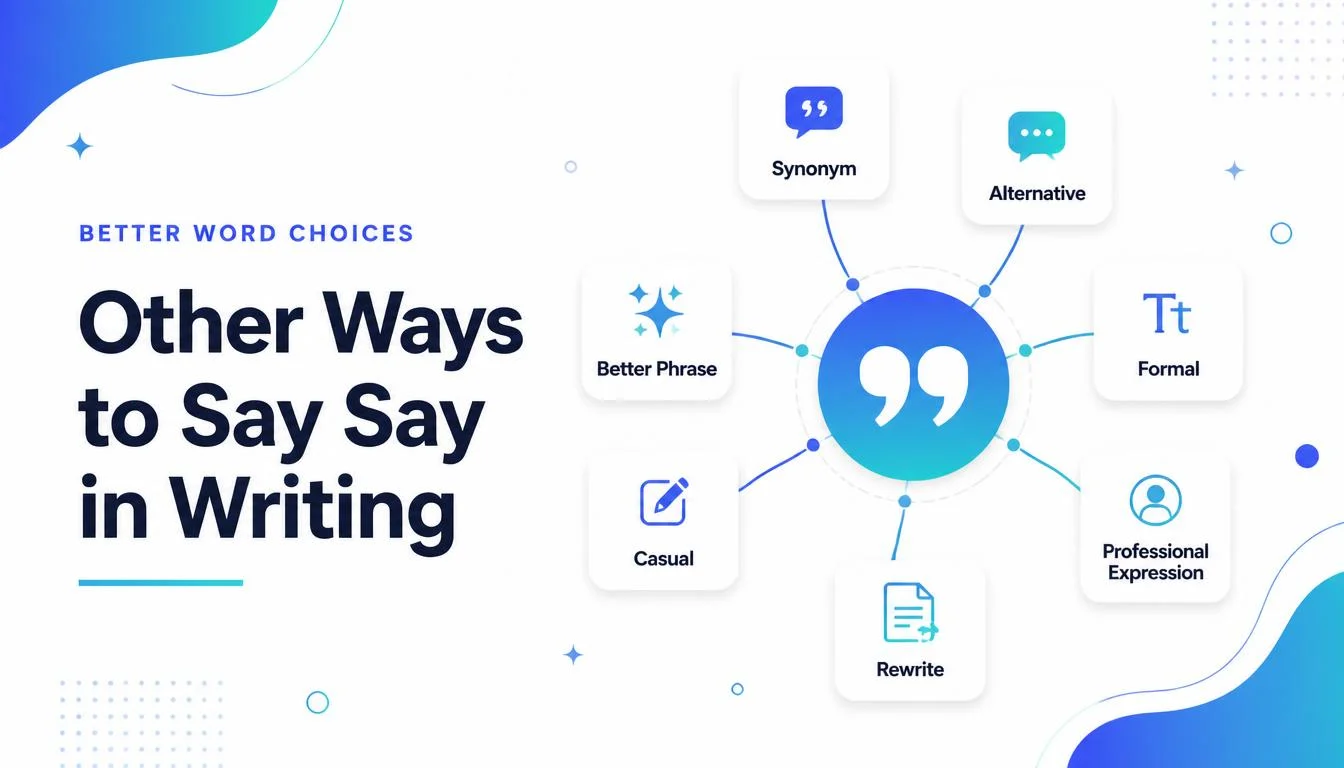
Other Ways to Say Say in Writing
These 30 alternatives will help you sound more fluent, confident, and natural in different situations. Use them according to tone, context, and audience to express yourself with precision and impact.
1. Phrase: State
Meaning: To express something formally or officially.
Explanation: “State” is one of the most common formal alternatives to “say” and is widely used in academic and business writing.
Example Sentence: The manager stated that the project would be completed by Friday.
Best Use: Formal reports
Worst Use: Casual conversation
Tone: Formal, authoritative
Context Variability: Professional / academic
2. Phrase: Express
Meaning: To convey a thought, feeling, or idea in words.
Explanation: “Express” focuses on the act of communicating internal thoughts or emotions.
Example Sentence: She expressed her concerns about the new policy during the meeting.
Best Use: Emotional or opinion-based communication
Worst Use: Neutral factual statements
Tone: Warm, articulate
Context Variability: Professional / personal
3. Phrase: Mention
Meaning: To refer to something briefly or casually.
Explanation: “Mention” is a versatile, neutral alternative that works in both spoken and written English.
Example Sentence: He mentioned that he would be late to the appointment.
Best Use: Brief references
Worst Use: Emphasizing important points
Tone: Neutral, casual
Context Variability: Casual / professional
4. Phrase: Declare
Meaning: To announce something officially or emphatically.
Explanation: “Declare” carries a sense of formality and certainty.
Example Sentence: The CEO declared a new era of innovation for the company.
Best Use: Official announcements
Worst Use: Everyday small talk
Tone: Formal, bold
Context Variability: Professional / formal
5. Phrase: Articulate
Meaning: To express an idea clearly and effectively in words.
Explanation: “Articulate” emphasizes clarity and eloquence.
Example Sentence: The professor articulated her theory with remarkable precision.
Best Use: Complex explanations
Worst Use: Simple, everyday statements
Tone: Sophisticated, precise
Context Variability: Academic / professional
6. Phrase: Assert
Meaning: To state a fact or belief confidently and forcefully.
Explanation: “Assert” is used when you want to emphasize conviction or defend a position.
Example Sentence: The lawyer asserted that her client was innocent.
Best Use: Arguments and debates
Worst Use: Neutral observations
Tone: Confident, firm
Context Variability: Formal / argumentative
7. Phrase: Proclaim
Meaning: To announce something publicly or officially.
Explanation: “Proclaim” has a grand, formal tone, often used for significant declarations.
Example Sentence: The governor proclaimed a state of emergency.
Best Use: Major public announcements
Worst Use: Private conversations
Tone: Formal, dramatic
Context Variability: Formal / official
8. Phrase: Remark
Meaning: To say something as an observation or comment.
Explanation: “Remark” is a neutral alternative often used for incidental or thoughtful comments.
Example Sentence: She remarked that the weather was unusually warm for October.
Best Use: Casual observations
Worst Use: Formal declarations
Tone: Neutral, observant
Context Variability: Casual / professional
9. Phrase: Add
Meaning: To say something further or in addition to what has already been said.
Explanation: “Add” is useful for building on previous points in conversation or writing.
Example Sentence: He added that he would send the documents by email.
Best Use: Supplementary information
Worst Use: Introducing new topics
Tone: Neutral, helpful
Context Variability: Casual / professional
10. Phrase: Communicate
Meaning: To share or exchange information, ideas, or feelings.
Explanation: “Communicate” is a broad, professional term for any act of conveying messages.
Example Sentence: The report communicates the company’s vision for the next five years.
Best Use: General information transfer
Worst Use: Quoting direct speech
Tone: Professional, neutral
Context Variability: Professional / formal
11. Phrase: Convey
Meaning: To make an idea, feeling, or message known or understandable.
Explanation: “Convey” focuses on the successful transmission of meaning.
Example Sentence: Her tone conveyed a sense of urgency.
Best Use: Expressing emotions or subtle meanings
Worst Use: Direct quotations
Tone: Expressive, articulate
Context Variability: Professional / creative
12. Phrase: Utter
Meaning: To make a sound or speak words.
Explanation: “Utter” is a somewhat formal word often used for spoken words, especially in literature.
Example Sentence: He uttered a single word before collapsing.
Best Use: Literary or dramatic contexts
Worst Use: Everyday business communication
Tone: Formal, literary
Context Variability: Creative / formal
13. Phrase: Announce
Meaning: To make a public or official statement.
Explanation: “Announce” is used for sharing news or important information with an audience.
Example Sentence: The company announced a new partnership with a leading tech firm.
Best Use: Public statements and news
Worst Use: Private, one-on-one conversations
Tone: Formal, newsworthy
Context Variability: Professional / formal
14. Phrase: Respond
Meaning: To say something in reply to a question or statement.
Explanation: “Respond” is a professional alternative to “answer” or “reply.”
Example Sentence: She responded to the client’s inquiry within an hour.
Best Use: Replies and answers
Worst Use: Initiating conversation
Tone: Professional, courteous
Context Variability: Professional / formal
15. Phrase: Reply
Meaning: To say something as an answer to someone.
Explanation: “Reply” is a straightforward alternative for direct responses.
Example Sentence: He replied that he would attend the conference.
Best Use: Direct answers
Worst Use: Formal reports
Tone: Neutral, direct
Context Variability: Casual / professional
16. Phrase: Acknowledge
Meaning: To accept or admit the existence or truth of something.
Explanation: “Acknowledge” is often used in formal contexts to recognize facts or contributions.
Example Sentence: The author acknowledged the contributions of her research team.
Best Use: Giving credit or admitting facts
Worst Use: Casual chatter
Tone: Formal, gracious
Context Variability: Academic / professional
17. Phrase: Admit
Meaning: To confess or acknowledge something, often reluctantly.
Explanation: “Admit” carries a tone of honesty or vulnerability.
Example Sentence: He admitted that he had made a mistake in the calculation.
Best Use: Confessions and honest admissions
Worst Use: Neutral statements
Tone: Honest, vulnerable
Context Variability: Casual / professional
18. Phrase: Suggest
Meaning: To put forward an idea or plan for consideration.
Explanation: “Suggest” is a polite and collaborative way to propose something.
Example Sentence: I suggest we review the data before making a decision.
Best Use: Proposals and recommendations
Worst Use: Reporting facts
Tone: Polite, collaborative
Context Variability: Casual / professional
19. Phrase: Propose
Meaning: To put forward an idea or plan for discussion or approval.
Explanation: “Propose” is more formal than “suggest” and often used in business or academic settings.
Example Sentence: The committee proposed a new framework for the project.
Best Use: Formal proposals
Worst Use: Casual conversation
Tone: Formal, strategic
Context Variability: Professional / formal
20. Phrase: Inform
Meaning: To give someone facts or information.
Explanation: “Inform” is a professional way to say “tell” when sharing important details.
Example Sentence: Please inform the team about the schedule change.
Best Use: Giving information
Worst Use: Informal chats
Tone: Professional, courteous
Context Variability: Professional / formal
21. Phrase: Notify
Meaning: To formally inform someone of something.
Explanation: “Notify” implies an official or required communication.
Example Sentence: The bank notified customers of the upcoming fee changes.
Best Use: Official notices
Worst Use: Casual remarks
Tone: Formal, official
Context Variability: Professional / formal
22. Phrase: Clarify
Meaning: To make something clearer or easier to understand.
Explanation: “Clarify” is used when explaining something that may be confusing.
Example Sentence: She clarified her position on the issue during the Q&A session.
Best Use: Explanations and disambiguation
Worst Use: Simple statements
Tone: Helpful, precise
Context Variability: Professional / academic
23. Phrase: Elaborate
Meaning: To explain something in more detail.
Explanation: “Elaborate” invites or provides further explanation on a topic.
Example Sentence: Could you elaborate on your initial proposal?
Best Use: Detailed explanations
Worst Use: Brief comments
Tone: Inquisitive, thorough
Context Variability: Professional / academic
24. Phrase: Specify
Meaning: To identify clearly and definitely.
Explanation: “Specify” is used when precision and exactness are required.
Example Sentence: The contract specifies the delivery date and payment terms.
Best Use: Detailed instructions
Worst Use: General observations
Tone: Precise, formal
Context Variability: Professional / legal
25. Phrase: Indicate
Meaning: To point out or show something.
Explanation: “Indicate” is a formal alternative often used in reports and data analysis.
Example Sentence: The findings indicate a significant improvement in performance.
Best Use: Data and evidence
Worst Use: Personal opinions
Tone: Formal, objective
Context Variability: Academic / professional
26. Phrase: Observe
Meaning: To say something as a comment or remark based on observation.
Explanation: “Observe” is a formal way to share an insight or comment.
Example Sentence: The critic observed that the film lacked emotional depth.
Best Use: Analytical comments
Worst Use: Everyday talk
Tone: Formal, thoughtful
Context Variability: Academic / professional
27. Phrase: Comment
Meaning: To express an opinion or reaction.
Explanation: “Comment” is a neutral alternative for sharing thoughts on a topic.
Example Sentence: Several experts commented on the new policy.
Best Use: Opinions and reactions
Worst Use: Reporting facts
Tone: Neutral, opinionated
Context Variability: Casual / professional
28. Phrase: Disclose
Meaning: To make secret or new information known.
Explanation: “Disclose” is used when revealing information that was previously hidden.
Example Sentence: The company disclosed its quarterly earnings to investors.
Best Use: Revealing confidential information
Worst Use: Everyday statements
Tone: Formal, serious
Context Variability: Professional / legal
29. Phrase: Recite
Meaning: To repeat aloud from memory.
Explanation: “Recite” is used for repeating memorized text or information.
Example Sentence: The student recited the poem from memory.
Best Use: Memorized or formal recitals
Worst Use: Spontaneous conversation
Tone: Formal, rehearsed
Context Variability: Academic / formal
30. Phrase: Allege
Meaning: To claim something without proof.
Explanation: “Allege” is used in legal and journalistic contexts when a claim is unverified.
Example Sentence: The prosecutor alleged that the defendant was involved in the crime.
Best Use: Unproven claims
Worst Use: Confirmed facts
Tone: Formal, cautious
Context Variability: Legal / journalistic
“The right word doesn’t just say more it says exactly what you mean.”
Common Mistakes People Make Using “Say”
1. Overusing “say” in formal writing
❌ “The study says that exercise improves mental health.”
✅ “The study indicates that exercise improves mental health.”
2. Using “say” instead of “tell” with an indirect object
❌ “She said me the news.”
✅ “She told me the news.”
3. Using “say” for written sources inappropriately
❌ “The email says the meeting is canceled.”
✅ “The email states that the meeting is canceled.”
4. Failing to vary vocabulary in dialogue
❌ “‘Hello,’ she said. ‘How are you?’ he said. ‘I’m fine,’ she said.”
✅ “‘Hello,’ she greeted. ‘How are you?’ he asked. ‘I’m fine,’ she replied.”
5. Using overly dramatic alternatives inappropriately
❌ “I proclaimed that I needed a coffee.” (too formal for the context)
✅ “I mentioned that I needed a coffee.”
“Choosing the right alternative to ‘say‘ is about matching your word to your audience and purpose.”
Mini Quiz / Self-Check
1. Which alternative is best for a formal business report?
A) Blurt out
B) State
C) Spill
D) Come out with
Answer: B) State
2. You are writing an email to a colleague. Which is most appropriate?
A) “I proclaim that the deadline is Friday.”
B) “I mention that the deadline is Friday.”
C) “I assert that the deadline is Friday.”
D) “I declare that the deadline is Friday.”
Answer: B) Mention
3. Which alternative conveys a sense of urgency or strong emotion?
A) State
B) Remark
C) Convey
D) Mention
Answer: C) Convey
4. In an academic paper, which is the most appropriate way to attribute a finding?
A) “The researcher said the data was significant.”
B) “The researcher mentioned the data was significant.”
C) “The researcher stated that the data was significant.”
D) “The researcher spilled that the data was significant.”
Answer: C) Stated
Comparison Table: Top 10 Alternatives
| Phrase | Tone | Best Use |
|---|---|---|
| State | Formal, authoritative | Academic papers, official statements |
| Express | Warm, articulate | Opinions, emotions, feedback |
| Mention | Neutral, casual | Brief references, everyday communication |
| Declare | Formal, bold | Public announcements, proclamations |
| Articulate | Sophisticated, precise | Complex explanations, presentations |
| Assert | Confident, firm | Arguments, debates, legal contexts |
| Convey | Expressive, articulate | Emotions, subtle meanings |
| Communicate | Professional, neutral | General information exchange |
| Suggest | Polite, collaborative | Proposals, recommendations |
| Indicate | Formal, objective | Data, evidence, reports |
FAQs
1. What is the best alternative to “say” in formal writing?
State, indicate, and declare are excellent formal alternatives. “State” is the most versatile and widely accepted in academic and business contexts.
2. Can I use “say” in academic writing?
Yes, but sparingly. Overusing “say” makes academic writing feel informal and repetitive. Use alternatives like “state,” “assert,” or “indicate” to maintain a scholarly tone.
3. What is a professional way to say “say” in an email?
Use “mention,” “inform,” or “communicate.” For example: “I would like to inform you that…” or “Please communicate your decision by Friday.”
4. How do I choose the right alternative to “say”?
Consider your audience, purpose, and tone. Formal writing demands precise, authoritative words like “state” or “assert.” Casual conversation welcomes simpler alternatives like “mention” or “add.” Always match your word to the context.
5. Is “said” more formal than “say”?
Yes, “said” is the past tense of “say” and is often considered slightly more formal, especially in reported speech and narrative writing. However, both are neutral and can be overused.
Conclusion
Learning alternatives to “say” is one of the quickest ways to elevate your English writing. Whether you are a student drafting an essay, a professional composing an email, or a creative writer building dialogue, varying your vocabulary demonstrates fluency, precision, and confidence.
Start by choosing two or three new alternatives from this list and practice using them this week. Pay attention to tone and context the right word in the right situation makes all the difference. With consistent practice, you will naturally move beyond “say” and express yourself with the clarity and sophistication that great communication demands.
Read More Related Articles:
- Other Ways to Say Thanks for Letting Me Know | Leave a Better Impression In 2026
- Other Ways to Say Thank You for Your Business | Customers Truly Appreciate In 2026
- Other Ways to Say “I Hope You’re Doing Well” | People Actually Enjoy Reading In 2026

Daniel Murphy is a professional writer and blogger specializing in digital communication and messaging trends. As a contributor to TextsResponse.com, he creates reader-focused content designed to help people find the right words at the right time.