Quick Answer:
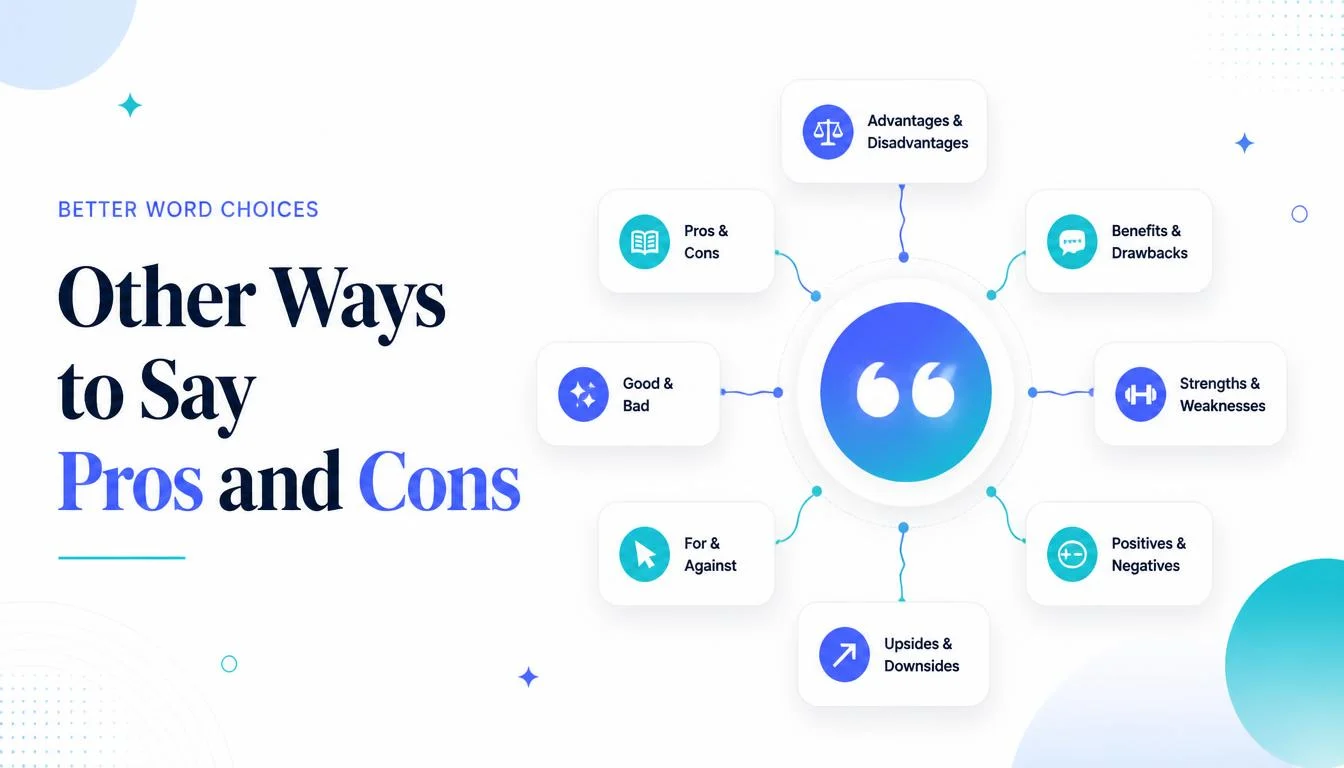
Looking for alternatives to “pros and cons”? Try advantages and disadvantages, benefits and drawbacks, strengths and weaknesses, upsides and downsides, or pluses and minuses. Each suits a different tone and context.
The phrase “pros and cons” is one of the most commonly used expressions in English. It refers to the positive and negative aspects of a decision, idea, or situation. People use it everywhere from casual conversations to business meetings when they want to weigh options before making a choice.
But relying on the same phrase repeatedly can make your English sound repetitive and less polished. Learning alternatives to pros and cons will help you express excitement in English with greater precision, adapt your tone to any audience, and sound more fluent and confident. Whether you are writing a formal report, preparing a presentation, or having a casual chat, having a rich vocabulary at your disposal is a game-changer.
Quick Categories
Formal Alternatives
- Advantages and disadvantages
- Benefits and drawbacks
- Strengths and weaknesses
- Merits and limitations
- Assets and liabilities
- Gains and trade-offs
- Opportunities and constraints
- Rewards and risks
- Favorable and unfavorable factors
- Value and risk considerations
Casual Alternatives
- Upsides and downsides
- Pluses and minuses
- The good and the bad
- Positives and negatives
- Highs and lows
- The bright side and the dark side
Professional Alternatives
- Value proposition and associated risks
- Benefits and costs
- Arguments for and against
- Supporting and opposing factors
- Positive and negative implications
- Strategic benefits and potential pitfalls
Informal Expressions
- Perks and pitfalls
- Boons and banes
- The upside and the downside
- Blessings and curses
- Silver linings and storm clouds
Pro Tip: Match your word choice to your audience. Use formal alternatives in reports and emails to senior stakeholders. Save casual expressions for team chats and everyday conversation.
Common Mistakes
- Using “pros and cons” in every situation
Example: “Let’s look at the pros and cons of this strategy, the pros and cons of that approach, and the pros and cons of our timeline.” → Vary your language to keep your communication engaging. - Using informal alternatives in formal writing
Example: “The upsides and downsides of the merger are significant.” → In a board report, prefer “advantages and disadvantages” or “benefits and drawbacks.” - Mixing singular and plural incorrectly
Example: “The pro and cons are clear.” → Correct: “The pros and cons are clear.” - Forgetting that “pro” and “con” are nouns
Example: “There are many pro to this plan.” → Correct: “There are many pros to this plan.” - Using “pros and cons” when a more precise phrase is needed
Example: “The pros and cons of the candidate include his experience.” → In a performance review, “strengths and weaknesses” is more appropriate.
What Does “Pros and Cons” Mean?
“Pros and cons” is a phrase used to list the positive (pro) and negative (con) aspects of something. It comes from the Latin pro et contra, meaning “for and against”.
Example: “Before we decide, let’s weigh the pros and cons of relocating the office.”
When to Use “Pros and Cons”
- Brainstorming sessions
- Casual team meetings
- Quick decision-making scenarios
- Informal emails and messages
- Everyday conversations with friends or colleagues
Spoken vs Written: More common in spoken English and informal writing.
Formal vs Informal: Acceptable in semi-formal contexts but often too casual for academic papers, executive reports, or legal documents.
Is It Professional or Polite to Say “Pros and Cons”?
Polite? ✔️ Yes it is friendly and approachable.
Professional? ❌ No in most formal business or academic settings, it is considered too informal.
Business-style example: “Let’s review the advantages and disadvantages of this proposal before we proceed.” (More professional than “Let’s look at the pros and cons.”)
Pros and Cons of Using “Pros and Cons”
Pros:
- Simple and natural
- Friendly tone
- Common usage
- Easy to understand
Cons:
- Too informal for work
- Overused
- Limited emotional range
- Not suitable for formal writing
Other Ways to Say Pros and Cons
These alternatives will help you sound more fluent, confident, and natural in different situations. Use them according to tone, context, and audience.
1. Advantages and Disadvantages
Meaning: The positive and negative features of something.
Explanation: The most direct and widely accepted formal alternative.
Example: “We need to analyze the advantages and disadvantages of expanding into new markets.”
Best Use: Reports, essays, proposals
Worst Use: Casual conversation
Tone: Highly formal
Context Variability: Professional, academic
2. Benefits and Drawbacks
Meaning: Helpful aspects versus obstacles.
Explanation: Concise and professional, ideal for decision-making.
Example: “The committee outlined the benefits and drawbacks of the new policy.”
Best Use: Business decisions, HR evaluations
Worst Use: Legal documents
Tone: Formal
Context Variability: Professional
3. Strengths and Weaknesses
Meaning: Areas of advantage and areas needing improvement.
Explanation: Commonly used in performance reviews and strategic analysis.
Example: “Each candidate has distinct strengths and weaknesses worth discussing.”
Best Use: Performance reviews, SWOT analysis
Worst Use: Informal speech
Tone: Formal
Context Variability: Professional, academic
4. Merits and Limitations
Meaning: Inherent values versus restrictive aspects.
Explanation: Ideal for academic and corporate analysis.
Example: “The study examines the merits and limitations of each methodology.”
Best Use: Academic papers, research reports
Worst Use: Customer-facing dialogue
Tone: Highly formal
Context Variability: Academic, professional
5. Assets and Liabilities
Meaning: Positive attributes versus obligations or disadvantages.
Explanation: Originating from accounting, effective in financial contexts.
Example: “Before the acquisition, we must assess all assets and liabilities.”
Best Use: Finance, business strategy
Worst Use: Everyday conversation
Tone: Formal
Context Variability: Professional, financial
6. Gains and Trade-offs
Meaning: Benefits acquired versus compromises required.
Explanation: Shows balanced strategic thinking.
Example: “We must evaluate the gains and trade-offs of reallocating resources.”
Best Use: Strategy, budget decisions
Worst Use: Simple pros/cons lists
Tone: Executive formal
Context Variability: Professional
7. Opportunities and Constraints
Meaning: Positive possibilities versus limiting factors.
Explanation: Ideal for project planning and forecasting.
Example: “Let’s examine the opportunities and constraints before proceeding.”
Best Use: Project management, research
Worst Use: Emotional topics
Tone: Professional
Context Variability: Professional
8. Rewards and Risks
Meaning: Potential benefits and potential negative outcomes.
Explanation: Works well when uncertainty is involved.
Example: “Investors weighed the rewards and risks of the new venture.”
Best Use: Investment, executive decisions
Worst Use: Casual chat
Tone: Strategic, formal
Context Variability: Professional, financial
9. Positives and Negatives
Meaning: The good and bad aspects.
Explanation: A simple and universally understood alternative.
Example: “Let’s list the positives and negatives of each option.”
Best Use: Team discussions, presentations
Worst Use: Academic papers
Tone: Neutral to informal
Context Variability: Casual, professional
10. Upsides and Downsides
Meaning: The good points and the limitations.
Explanation: A casual, everyday phrase.
Example: “There are upsides and downsides to working remotely.”
Best Use: Casual conversation, emails
Worst Use: Formal reports
Tone: Casual
Context Variability: Informal
11. Pluses and Minuses
Meaning: Positive and negative points.
Explanation: Simple and effective for quick comparisons.
Example: “Let’s quickly go over the pluses and minuses of this approach.”
Best Use: Quick meetings, brainstorming
Worst Use: Formal writing
Tone: Informal
Context Variability: Casual
12. The Good and the Bad
Meaning: The positive and negative aspects.
Explanation: The most straightforward and conversational option.
Example: “We need to consider the good and the bad before making a decision.”
Best Use: Everyday conversation
Worst Use: Professional documents
Tone: Very casual
Context Variability: Informal
13. Arguments for and Against
Meaning: Reasons supporting and opposing something.
Explanation: Often used in debates and discussions.
Example: “The panel presented arguments for and against the new legislation.”
Best Use: Debates, legal discussions
Worst Use: Casual conversation
Tone: Formal
Context Variability: Professional, academic
14. Supporting and Opposing Factors
Meaning: Elements that favor or work against something.
Explanation: Objective and impersonal.
Example: “The report lists supporting and opposing factors for each proposal.”
Best Use: Technical evaluations, reports
Worst Use: Emails to customers
Tone: Academic/formal
Context Variability: Professional
15. Favorable and Unfavorable Factors
Meaning: Elements contributing positively or negatively.
Explanation: Suitable for objective analysis.
Example: “We identified several favorable and unfavorable factors influencing the outcome.”
Best Use: Scientific evaluations, research
Worst Use: Informal speech
Tone: Academic/formal
Context Variability: Professional, academic
16. Benefits and Costs
Meaning: Positive outcomes versus what must be sacrificed.
Explanation: Often used in business and economics.
Example: “We must weigh the benefits and costs of this investment.”
Best Use: Financial analysis, business cases
Worst Use: Personal conversations
Tone: Formal
Context Variability: Professional
17. Value and Risk Considerations
Meaning: Potential benefits weighed against potential risks.
Explanation: Adds analytical depth for strategy or finance.
Example: “We should outline the value and risk considerations of entering this market.”
Best Use: Finance, executive decisions
Worst Use: Everyday conversation
Tone: Strategic, formal
Context Variability: Professional
18. Positive and Negative Implications
Meaning: The consequences both good and bad.
Explanation: Emphasizes the broader impact of a decision.
Example: “We must consider the positive and negative implications of this policy change.”
Best Use: Strategic planning, policy analysis
Worst Use: Casual talk
Tone: Formal
Context Variability: Professional, academic
19. Perks and Pitfalls
Meaning: Advantages and hidden dangers.
Explanation: A slightly informal but vivid expression.
Example: “Before you sign up, know the perks and pitfalls of the program.”
Best Use: Blogs, advice articles, casual advice
Worst Use: Formal business reports
Tone: Informal
Context Variability: Casual
20. Boons and Banes
Meaning: Blessings and curses; benefits and harms.
Explanation: A more literary or poetic alternative.
Example: “Technology has its boons and banes in modern society.”
Best Use: Essays, opinion pieces
Worst Use: Business communication
Tone: Literary/formal
Context Variability: Academic, creative
21. Highs and Lows
Meaning: The best and worst moments or aspects.
Explanation: Often used to describe experiences rather than decisions.
Example: “The project had its highs and lows, but we learned a lot.”
Best Use: Personal reflections, storytelling
Worst Use: Analytical reports
Tone: Casual
Context Variability: Informal
22. The Bright Side and the Dark Side
Meaning: The positive and negative sides of something.
Explanation: More figurative and expressive.
Example: “Every decision has its bright side and dark side.”
Best Use: Opinion pieces, casual discussions
Worst Use: Formal documents
Tone: Figurative, casual
Context Variability: Informal
23. Gains and Losses
Meaning: What you gain versus what you lose.
Explanation: Commonly used in financial and risk contexts.
Example: “We calculated the potential gains and losses of the merger.”
Best Use: Finance, investment
Worst Use: Everyday conversation
Tone: Formal
Context Variability: Professional
24. Advantages and Shortcomings
Meaning: Positive features and deficiencies.
Explanation: A balanced way to evaluate performance.
Example: “The review highlighted the advantages and shortcomings of the system.”
Best Use: Performance reviews, product evaluations
Worst Use: Casual chat
Tone: Formal
Context Variability: Professional
25. Opportunities and Obstacles
Meaning: Future possibilities and challenges.
Explanation: A staple in strategic planning.
Example: “We must identify the opportunities and obstacles in our path.”
Best Use: Strategic planning, project management
Worst Use: Personal conversations
Tone: Professional
Context Variability: Professional
26. Highlights and Challenges
Meaning: Standout positive aspects and difficulties.
Explanation: Often used in reports and reviews.
Example: “The annual report outlines the highlights and challenges of the past year.”
Best Use: Annual reports, reviews
Worst Use: Informal speech
Tone: Professional
Context Variability: Professional
27. Positive and Negative Aspects
Meaning: The good and bad elements.
Explanation: A neutral, clear alternative.
Example: “We should consider both positive and negative aspects of the proposal.”
Best Use: Any formal or neutral context
Worst Use: Creative writing
Tone: Neutral, formal
Context Variability: Professional, academic
28. Pros and Cons (with modifiers)
Meaning: Using the original phrase with adjectives to add nuance.
Explanation: You can modify it for specific contexts (e.g., “financial pros and cons”).
Example: “Let’s look at the financial pros and cons of this deal.”
Best Use: When you need to specify a domain
Worst Use: When you want to avoid the phrase entirely
Tone: Neutral
Context Variability: Any
29. Value Proposition and Associated Risks
Meaning: The core benefits versus the risks involved.
Explanation: A high-level business phrase.
Example: “The value proposition and associated risks must be communicated to stakeholders.”
Best Use: Executive presentations, investor communications
Worst Use: Casual conversation
Tone: Executive formal
Context Variability: Professional
30. Strategic Benefits and Potential Pitfalls
Meaning: Long-term advantages versus possible problems.
Explanation: Emphasizes strategic thinking.
Example: “We evaluated the strategic benefits and potential pitfalls of the partnership.”
Best Use: Strategy meetings, board presentations
Worst Use: Informal emails
Tone: Strategic, formal
Context Variability: Professional
“The right tone makes your English sound professional and confident.”
“Alternatives to pros and cons are not just synonyms they are tools for precision.”
“Knowing when to be formal and when to be casual is the mark of a fluent English speaker.”
Mini Quiz / Self-Check
1. Which phrase is most appropriate for an academic research paper?
A) Upsides and downsides
B) Merits and limitations
C) The good and the bad
Answer: B) Merits and limitations
2. You are writing a casual email to a colleague. Which alternative fits best?
A) Advantages and disadvantages
B) Assets and liabilities
C) Pluses and minuses
Answer: C) Pluses and minuses
3. In a financial report, which phrase would you use?
A) Strengths and weaknesses
B) Gains and trade offs
C) Highs and lows
Answer: B) Gains and trade offs
4. Which phrase is too informal for a boardroom presentation?
A) Benefits and drawbacks
B) The good and the bad
C) Opportunities and constraints
Answer: B) The good and the bad
Context decides whether a phrase sounds confident or careless.
Comparison Table: Top 10 Alternatives
| Phrase | Tone | Best Use |
|---|---|---|
| Advantages and disadvantages | Highly formal | Reports, essays, proposals |
| Benefits and drawbacks | Formal | Business decisions, HR |
| Strengths and weaknesses | Formal | Performance reviews, SWOT |
| Merits and limitations | Highly formal | Academic papers, research |
| Assets and liabilities | Formal | Finance, business strategy |
| Gains and trade-offs | Executive formal | Strategy, budget decisions |
| Opportunities and constraints | Professional | Project management, planning |
| Rewards and risks | Strategic, formal | Investment, executive decisions |
| Positives and negatives | Neutral | Team discussions, presentations |
| Upsides and downsides | Casual | Everyday conversation, emails |
FAQs
1. Is “pros and cons” formal enough for business writing?
“Pros and cons” is acceptable in semi-formal business contexts but is often considered too casual for formal reports, academic papers, or executive communications.
2. What is the most professional alternative to “pros and cons”?
“Advantages and disadvantages” is the most widely accepted professional alternative. “Benefits and drawbacks” and “strengths and weaknesses” are also excellent choices.
3. Can I use “upsides and downsides” in a presentation?
Yes, but only in informal or internal presentations. For external or formal presentations, prefer “advantages and disadvantages” or “benefits and drawbacks.”
4. What does “pros and cons” mean in simple terms?
It means the positive (pro) and negative (con) aspects of a situation, decision, or idea.
5. Why should I learn alternatives to “pros and cons”?
Learning alternatives helps you sound more fluent, adapt your tone to different audiences, and avoid repetitive language in both spoken and written English.
Conclusion
Mastering alternatives to pros and cons is a simple yet powerful way to elevate your English. Whether you are writing a formal business report, preparing a presentation, or having a casual conversation, the right phrase can make all the difference. It shows that you are not just fluent but also tone-aware and context-sensitive qualities that define advanced English speakers.
Start incorporating these alternatives into your daily communication. Practice with one or two new phrases each week. Soon, you will find yourself choosing the perfect expression naturally and confidently every time.
Read More Related Articles:
- Other Ways to Say Also in an Essay | Make Your Writing Shine In 2026
- Other Ways to Say “This Shows That” | Express Your Ideas with Confidence In 2026
- Other Ways to Say “Which” in English | Beyond the Common Choices In 2026

Daniel Murphy is a professional writer and blogger specializing in digital communication and messaging trends. As a contributor to TextsResponse.com, he creates reader-focused content designed to help people find the right words at the right time.