Quick Answer
“For your information” is a common phrase used to share facts, clarify a point, or add context to a conversation. If you want to sound more natural, polite, or professional, try these top alternatives: just so you know, for your reference, as a heads up, please note, and just to clarify.
For your information” is one of the most frequently used phrases in both spoken and written English. People use it to share a fact, correct a misunderstanding, or give background details that help the listener or reader understand a situation better. It shows up in emails, meetings, casual chats, and even social media captions.
Because the phrase can sound blunt or slightly sharp depending on tone, many speakers look for alternatives to “for your information” that match the situation more precisely. Whether you want to sound formal in a business email or relaxed in a text message, having a range of options makes your English more flexible and natural.
Learning these alternatives also helps you express excitement in English, add warmth to a message, or soften a correction. Small word choices like these are what separate confident English speakers from beginners.
The right tone makes your English sound professional and confident.”
Quick Categories
Formal Alternatives to “For Your Information”
- For your reference
- Please be advised
- Kindly note
- I would like to inform you
Pro Tip: Use formal alternatives in emails, reports, and official communication where a polished tone matters most.
Casual Alternatives
- Just so you know
- Heads up
- By the way
- FYI
Pro Tip: Casual alternatives work best with friends, coworkers you know well, or informal group chats.
Professional Alternatives
- Please note
- For clarification
- To confirm
- I wanted to flag
Pro Tip: Professional alternatives keep communication clear without sounding cold or robotic in workplace settings.
Informal Expressions
- Just letting you know
- Btw
- Quick note
- Fun fact
Pro Tip: Save informal expressions for social media captions, texts, or relaxed conversations with peers.
Small phrase changes can completely shift how professional you sound.”
Common Mistakes
- Overusing “FYI” in formal emails. Example: “FYI, the client meeting has been rescheduled to Monday.” (Sounds too casual for a formal client email.)
- Using “for your information” when correcting someone rudely. Example: “For your information, that is not correct.” (Can sound sarcastic or aggressive.)
- Mixing formal and informal tone in the same message. Example: “Please be advised, btw the report is late.” (Inconsistent tone confuses the reader.)
- Using it without context. Example: “For your information.” (Incomplete sentence with no supporting detail.)
- Repeating the same phrase throughout a document. Example: Using “for your information” five times in one email instead of varying the phrasing.
What Does “For Your Information” Mean?
“For your information” is a phrase used to introduce a fact, detail, or clarification that the listener may not already know. Grammatically, it functions as an introductory phrase, often placed at the beginning of a sentence and followed by a comma.
Example Sentence: For your information, the office will be closed on Friday for maintenance.
When to Use “For Your Information”
- Sharing a fact the other person may not know
- Clarifying a misunderstanding
- Adding background context to a decision
- Correcting incorrect information politely
Spoken vs Written
- Spoken: Often shortened to “FYI” in quick conversations or casual updates.
- Written: Commonly used in emails, memos, and notices, sometimes in its full form for clarity.
Formal vs Informal
- Formal: Used in official communication with phrases like “please be advised.”
- Informal: Used casually among friends or coworkers as “just so you know.”
Is It Professional or Polite to Say “For Your Information”?
The phrase can be polite when used to share helpful information. However, in certain tones, especially when correcting someone, it can sound sharp or condescending. In professional settings, softer alternatives are often preferred to maintain a respectful tone.
Business Example: “For your information, the deadline has been moved to next Thursday.” (Neutral and informative in this context.)
Polite? Yes Professional? No (in most direct or corrective situations)
Pros and Cons of Using “For Your Information”
Pros
- Simple and natural
- Widely understood
- Common in everyday usage
- Easy to insert into conversation
Cons
- Can sound blunt in certain tones
- Overused in casual and professional writing
- Limited emotional range
- Not always suitable for formal documents
Context decides whether a phrase sounds helpful or harsh.
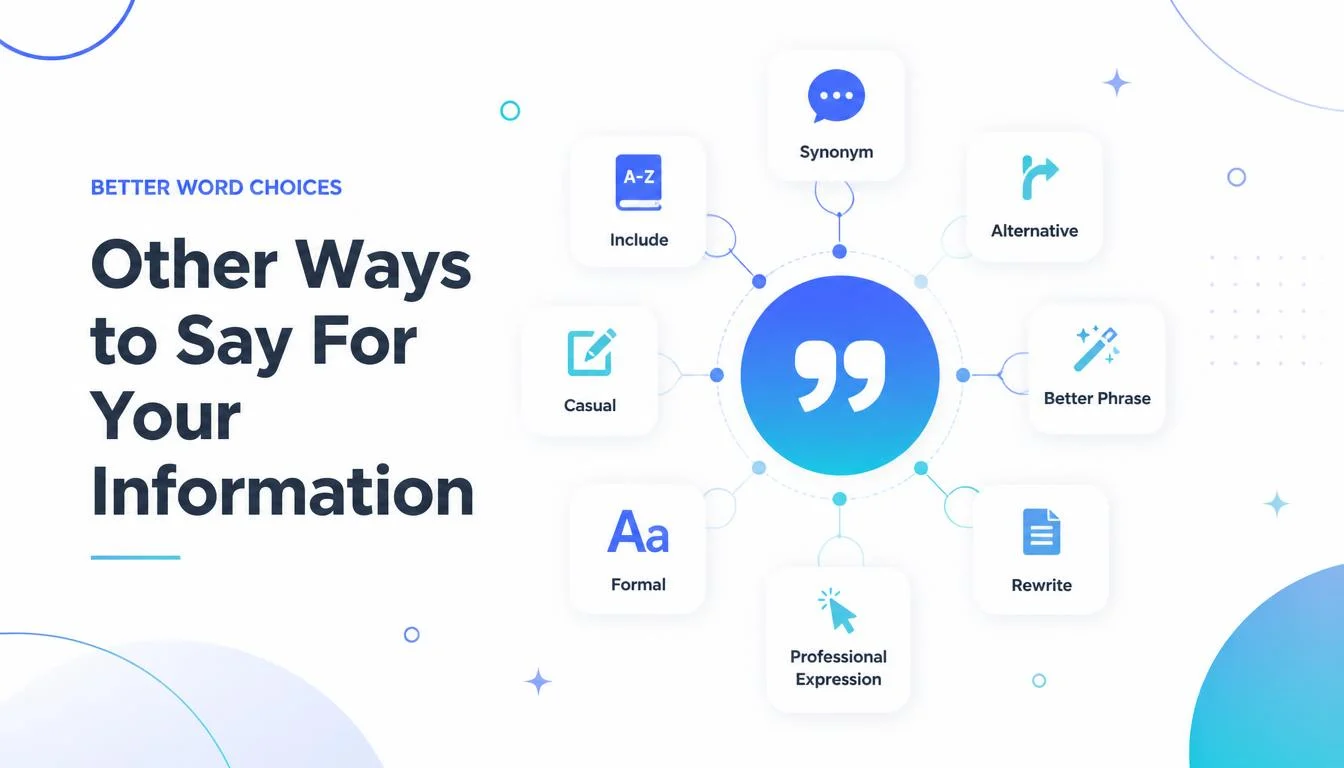
Other Ways to Say For Your Information
These alternatives will help you sound more fluent, confident, and natural in different situations. Use them according to tone, context, and audience to express excitement, admiration, or approval, or simply to share information smoothly.
1. Phrase: Just so you know
Meaning: A casual way to share information.
Explanation: Softer and friendlier than the original phrase.
Example Sentence: Just so you know, the meeting starts at 10 instead of 9.
Best Use: Casual conversations
Worst Use: Formal reports
Tone: Friendly, relaxed
Context Variability: casual, spoken
2. Phrase: For your reference
Meaning: Sharing information for future use.
Explanation: Common in professional and academic writing.
Example Sentence: For your reference, the attached file contains last month’s data.
Best Use: Emails, documents
Worst Use: Casual chats
Tone: Formal, neutral
Context Variability: professional
3. Phrase: Please be advised
Meaning: A formal way to introduce important information.
Explanation: Common in official notices and business writing.
Example Sentence: Please be advised that the office will close early today.
Best Use: Formal notices
Worst Use: Friendly texts
Tone: Formal, serious
Context Variability: professional
4. Phrase: Heads up
Meaning: A quick warning or piece of information.
Explanation: Very casual and commonly used at work among close teams.
Example Sentence: Heads up, the server will be down for an hour tonight.
Best Use: Team chats
Worst Use: Client emails
Tone: Casual, friendly
Context Variability: casual, professional
5. Phrase: Just to clarify
Meaning: Used to explain or correct information clearly.
Explanation: Helpful when adding detail to avoid confusion.
Example Sentence: Just to clarify, the payment is due by Friday, not Monday.
Best Use: Clarifications
Worst Use: Casual gossip
Tone: Clear, polite
Context Variability: professional, spoken
6. Phrase: Kindly note
Meaning: A polite, formal way to draw attention to information.
Explanation: Often used in business or customer service emails.
Example Sentence: Kindly note that the invoice must be paid within 10 days.
Best Use: Business emails
Worst Use: Informal chats
Tone: Polite, formal
Context Variability: professional
7. Phrase: I wanted to let you know
Meaning: A warm way to share information.
Explanation: Sounds considerate and personal.
Example Sentence: I wanted to let you know that your order has shipped.
Best Use: Customer updates
Worst Use: Legal documents
Tone: Warm, respectful
Context Variability: professional, spoken
8. Phrase: By the way
Meaning: Introduces additional or unrelated information.
Explanation: Common in casual conversation to add a side note.
Example Sentence: By the way, the parking lot is closed this weekend.
Best Use: Casual talk
Worst Use: Formal reports
Tone: Casual, light
Context Variability: casual, spoken
9. Phrase: To confirm
Meaning: Used to verify or restate information.
Explanation: Common in professional emails to avoid misunderstandings.
Example Sentence: To confirm, the workshop begins at 9 a.m. sharp.
Best Use: Business confirmations
Worst Use: Casual chats
Tone: Clear, professional
Context Variability: professional
10. Phrase: FYI
Meaning: Abbreviation for “for your information.”
Explanation: Extremely common in emails and messages.
Example Sentence: FYI, the file has been updated with new figures.
Best Use: Quick updates
Worst Use: Formal writing
Tone: Casual, direct
Context Variability: casual, professional
11. Phrase: Please note
Meaning: A polite way to highlight important details.
Explanation: Common in instructions and announcements.
Example Sentence: Please note that the store hours have changed.
Best Use: Notices
Worst Use: Personal messages
Tone: Formal, neutral
Context Variability: professional
12. Phrase: Just letting you know
Meaning: A friendly way to share an update.
Explanation: Softer and more personal than formal alternatives.
Example Sentence: Just letting you know I’ll be five minutes late.
Best Use: Personal updates
Worst Use: Legal notices
Tone: Friendly, casual
Context Variability: casual, spoken
13. Phrase: For clarification
Meaning: Explains a point in more detail.
Explanation: Useful when correcting or expanding on information.
Example Sentence: For clarification, the discount applies only to new members.
Best Use: Explanations
Worst Use: Casual talk
Tone: Formal, precise
Context Variability: professional
14. Phrase: I would like to inform you
Meaning: A formal introduction to important news.
Explanation: Common in official letters and announcements.
Example Sentence: I would like to inform you that your application was approved.
Best Use: Official letters
Worst Use: Texting friends
Tone: Formal, respectful
Context Variability: professional
15. Phrase: Quick note
Meaning: A brief way to introduce information.
Explanation: Simple and informal, often used in messages.
Example Sentence: Quick note, the meeting room has changed to Room 3.
Best Use: Short messages
Worst Use: Formal contracts
Tone: Casual, brief
Context Variability: casual
16. Phrase: I thought you should know
Meaning: Introduces information the listener might find important.
Explanation: Sounds thoughtful and considerate.
Example Sentence: I thought you should know the flight time has changed.
Best Use: Personal updates
Worst Use: Legal writing
Tone: Caring, sincere
Context Variability: spoken, professional
17. Phrase: As a heads up
Meaning: A casual warning about upcoming information.
Explanation: Commonly used before sharing a change or update.
Example Sentence: As a heads up, the system will be down tonight.
Best Use: Team updates
Worst Use: Formal documents
Tone: Casual, direct
Context Variability: casual, professional
18. Phrase: Worth noting
Meaning: Highlights something important or relevant.
Explanation: Often used in analysis or reports.
Example Sentence: It’s worth noting that sales increased by 20 percent.
Best Use: Reports, analysis
Worst Use: Casual texts
Tone: Analytical, neutral
Context Variability: professional
19. Phrase: In case you weren’t aware
Meaning: Introduces information the listener may not know.
Explanation: Slightly formal and considerate in tone.
Example Sentence: In case you weren’t aware, the policy changed last month.
Best Use: Clarifications
Worst Use: Casual jokes
Tone: Polite, informative
Context Variability: professional, spoken
20. Phrase: Just a heads up
Meaning: A friendly alert about upcoming information.
Explanation: Popular in workplace and social messages.
Example Sentence: Just a heads up, the printer is out of ink.
Best Use: Casual reminders
Worst Use: Legal notices
Tone: Friendly, casual
Context Variability: casual, professional
21. Phrase: I figured you’d want to know
Meaning: Introduces information the listener would care about.
Explanation: Sounds personal and thoughtful.
Example Sentence: I figured you’d want to know the event was postponed.
Best Use: Personal messages
Worst Use: Formal reports
Tone: Warm, casual
Context Variability: spoken
22. Phrase: To keep you informed
Meaning: Explains the purpose of sharing an update.
Explanation: Common in professional progress updates.
Example Sentence: To keep you informed, the project is on track for Friday.
Best Use: Status updates
Worst Use: Small talk
Tone: Professional, clear
Context Variability: professional
23. Phrase: Note that
Meaning: A short way to highlight key information.
Explanation: Common in instructions and technical writing.
Example Sentence: Note that all forms must be submitted by noon.
Best Use: Instructions
Worst Use: Emotional conversations
Tone: Direct, formal
Context Variability: professional
24. Phrase: Just to give you a heads up
Meaning: A longer, friendly way to introduce a warning or update.
Explanation: Slightly more detailed than “heads up” alone.
Example Sentence: Just to give you a heads up, traffic is heavy downtown today.
Best Use: Casual updates
Worst Use: Formal writing
Tone: Friendly, informative
Context Variability: casual, spoken
25. Phrase: For informational purposes
Meaning: Clarifies that the information is background only.
Explanation: Common in disclaimers and formal documents.
Example Sentence: This document is for informational purposes only.
Best Use: Disclaimers
Worst Use: Casual talk
Tone: Formal, neutral
Context Variability: professional
26. Phrase: I wanted to flag
Meaning: Draws attention to an issue or detail.
Explanation: Common in workplace communication.
Example Sentence: I wanted to flag a possible error in the report.
Best Use: Workplace updates
Worst Use: Casual chats
Tone: Professional, direct
Context Variability: professional
27. Phrase: Fun fact
Meaning: Introduces an interesting piece of information.
Explanation: Light and engaging, often used socially.
Example Sentence: Fun fact, honey never spoils if stored properly.
Best Use: Social conversation
Worst Use: Business reports
Tone: Playful, casual
Context Variability: casual
28. Phrase: Btw
Meaning: Short form of “by the way.”
Explanation: Common in texting and informal chats.
Example Sentence: Btw, the store closes early today.
Best Use: Texting
Worst Use: Formal emails
Tone: Casual, quick
Context Variability: casual
29. Phrase: I should mention
Meaning: Introduces relevant information politely.
Explanation: Common in conversations and professional discussions.
Example Sentence: I should mention the deadline moved up by two days.
Best Use: Conversations
Worst Use: Legal contracts
Tone: Polite, informative
Context Variability: spoken, professional
30. Phrase: Just to inform you
Meaning: A neutral way to share information.
Explanation: Slightly formal but still approachable.
Example Sentence: Just to inform you, the venue has changed for tomorrow.
Best Use: Updates
Worst Use: Casual jokes
Tone: Neutral, clear
Context Variability: professional, spoken
Learning alternatives to common phrases is one of the fastest ways to sound fluent.
Mini Quiz / Self-Check
1. Which phrase is most appropriate for a formal business email?
a) Btw
b) Please be advised
c) Fun fact
d) Heads up
2. Which phrase works best in a casual text to a friend?
a) For informational purposes
b) Kindly note
c) Just so you know
d) I would like to inform you
3. Which phrase softens a correction politely?
a) FYI
b) Just to clarify
c) Btw
d) Fun fact
4. Which phrase is best for a formal disclaimer?
a) Heads up
b) For informational purposes
c) Quick note
d) I figured you’d want to know
Comparison Table Top Alternatives
| Phrase | Tone | Best Use |
|---|---|---|
| Just so you know | Friendly, relaxed | Casual conversations |
| For your reference | Formal, neutral | Emails, documents |
| Please be advised | Formal, serious | Formal notices |
| Heads up | Casual, friendly | Team chats |
| Just to clarify | Clear, polite | Clarifications |
| Kindly note | Polite, formal | Business emails |
| FYI | Casual, direct | Quick updates |
| Please note | Formal, neutral | Notices |
| Worth noting | Analytical, neutral | Reports, analysis |
| For informational purposes | Formal, neutral | Disclaimers |
FAQs
What is another way to say “for your information” formally?
“Please be advised” or “for your reference” are common formal alternatives used in business and official writing.
Is “FYI” appropriate in professional emails?
“FYI” is acceptable in informal workplace messages but should be avoided in formal client or official communication.
What is a polite way to correct someone using this phrase?
Just to clarify” is a polite alternative that softens a correction without sounding blunt.
Can “for your information” sound rude?
Yes, depending on tone, it can sound sharp or sarcastic, especially when used to correct someone directly.
What is a casual alternative to “for your information”?
“Just so you know” or “heads up” are common casual alternatives used in everyday conversation.
Conclusion
Learning multiple ways to say “for your information” allows you to communicate more clearly and confidently in different situations. Whether you need a formal tone for business writing or a casual phrase for everyday conversation, having a range of alternatives helps you match your message to your audience.
Practicing these phrases daily, in speech and writing, builds natural fluency over time. Paying attention to tone ensures your English sounds polished, professional, and appropriate for every context you encounter.
Read More Related Articles:
- Other Ways to Say Mental Health | More Respectful Ways to Express It In 2026
- Other Ways to Say Oh My God | Say It With More Surprise and Emotion In 2026
- Other Ways to Say Make Love | Beautiful Phrases for Couples In 2026

Daniel Murphy is a professional writer and blogger specializing in digital communication and messaging trends. As a contributor to TextsResponse.com, he creates reader-focused content designed to help people find the right words at the right time.