Quick Answer:
Need alternatives to “excuse me” fast? Try: Pardon me, I beg your pardon, Sorry to interrupt, May I have a word?, and My apologies. Each fits a different situation choose based on how formal or casual you need to be.
“Excuse me” is one of the most frequently used phrases in English. You say it when you bump into someone, when you need to get past, when you interrupt a conversation, or when you didn’t hear what someone said. It’s your go-to polite phrase for dozens of everyday situations.
But here’s the problem: using “excuse me” for every situation can make you sound repetitive, unclear, or even too informal in professional settings. Learning other ways to say “excuse me” helps you match your tone to the context whether you’re in a boardroom, a crowded subway, or a casual coffee chat. The right alternative signals emotional intelligence, cultural awareness, and language fluency.
“The right tone makes your English sound professional and confident.”
Quick Categories
Formal Alternatives to “Excuse Me”
- I beg your pardon
- My apologies
- Forgive me
- Pardon me
- By your leave
- May I have a word?
- Do excuse me
Casual Alternatives to “Excuse Me”
- Sorry
- My bad
- Oops, sorry
- Hang on a sec
- Just a moment
- Mind if I…?
- Excuse me a second
Professional Alternatives to “Excuse Me”
- May I interrupt?
- Could I have a moment?
- I apologize for the interruption
- If you’ll excuse me
- Allow me
- I hope you don’t mind my asking
Informal Expressions in English
- Scuse me
- Sorry to bother you
- Sorry to jump in
- Coming through
- Heads up
- Let me just squeeze by
- I don’t mean to barge in
💡 Pro Tip: When in doubt, choose a slightly more formal alternative than you think you need. It’s easier to dial down than to recover from sounding too casual in a professional setting.
Common Mistakes
- Using “excuse me” when you should apologize – Saying “Excuse me” after accidentally stepping on someone’s foot is too weak. Incorrect: “Excuse me, I stepped on your foot.” → Correct: “I’m so sorry, I stepped on your foot.”
- Overusing “excuse me” in written communication – In emails, “excuse me” sounds awkward. Incorrect: “Excuse me, but I have a question about the report.” → Correct: “I have a quick question about the report.”
- Using “pardon” in overly casual settings – “Pardon?” sounds stiff among friends. Incorrect: “Pardon? I didn’t catch that” (to a friend). → Correct: “Sorry, what was that?”
- Forgetting to soften the interruption – Jumping in with just “Excuse me” can feel abrupt. Incorrect: “Excuse me, that’s wrong.” → Correct: “Sorry to interrupt, but I think there’s a correction.”
- Using “my bad” in professional contexts – This casual phrase can undermine your credibility. Incorrect: “My bad, I forgot the attachment” (to your boss). → Correct: “My apologies, I forgot to attach the file.”
What Does “Excuse Me” Mean?
“Excuse me” is a polite expression used to get someone’s attention, apologize for a minor offense, ask someone to repeat something, or request permission to pass or interrupt.
Grammar note: It functions as an interjection a short exclamation that stands alone or begins a sentence. It can also appear as part of a longer request: “Excuse me, could you help me?”
Example: “Excuse me, is this seat taken?”
When to Use “Excuse Me”
- To get someone’s attention – “Excuse me, do you know what time it is?”
- To pass through a crowded space – “Excuse me, just passing through.”
- To interrupt a conversation politely – “Excuse me, sorry to interrupt.”
- To ask someone to repeat themselves – “Excuse me, I didn’t catch that.”
- To apologize for a minor slip – “Excuse me, I didn’t mean to bump into you.”
- To politely disagree – “Excuse me, but I see it differently.”
| Context | Spoken vs Written | Formality |
|---|---|---|
| Getting attention | Spoken | Neutral |
| Passing through | Spoken | Neutral |
| Interrupting | Spoken | Neutral to polite |
| Asking to repeat | Spoken | Neutral |
| Minor apology | Spoken | Neutral |
| Written requests | Written | Avoid too informal |
Is It Professional or Polite to Say “Excuse Me”?
Polite? ✔️ Yes – “Excuse me” is universally recognized as a polite way to navigate social situations.
Professional? ❌ No – In most business contexts, “excuse me” is too informal. It works for quick, casual interactions but lacks the gravitas needed for formal correspondence or high-stakes meetings.
Business-style example: “I apologize for the interruption, but may I offer a quick observation?” – This sounds far more professional than “Excuse me, but I have something to say.”
Pros and Cons of Using “Excuse Me”
Pros:
- Simple and natural – everyone understands it
- Friendly tone – doesn’t sound aggressive
- Common usage – works in most everyday situations
- Easy to understand – no confusion about meaning
Cons:
- Too informal for work – lacks professional weight
- Overused – can sound repetitive and uncreative
- Limited emotional range – doesn’t convey sincerity or urgency
- Not suitable for formal writing – feels out of place in emails and reports
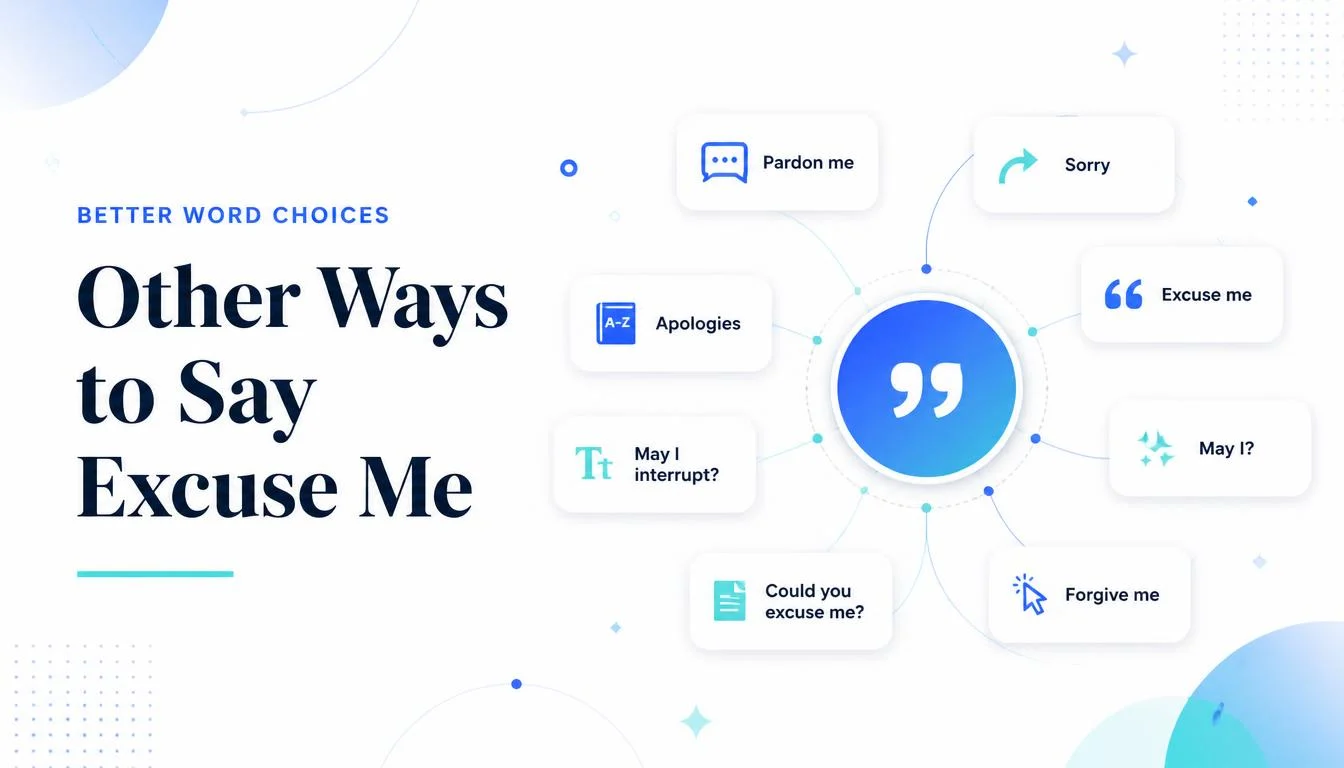
Other Ways to Say Excuse Me
These alternatives will help you sound more fluent, confident, and natural in different situations. Use them according to tone, context, and audience.
1. Phrase: Pardon Me
Meaning: A polite way to ask for forgiveness, attention, or repetition.
Explanation: Slightly more formal than “excuse me” and very common in both British and American English.
Example Sentence: “Pardon me, could you repeat that address?”
Best Use: Asking to repeat
Worst Use: Casual group settings
Tone: Polite, refined
Context Variability: Professional / Formal
2. Phrase: I Beg Your Pardon
Meaning: A very formal apology or request for repetition.
Explanation: One of the most formal alternatives to “excuse me.” Often used when you need to show deep respect or when you didn’t hear something important.
Example Sentence: “I beg your pardon I didn’t quite catch your name.”
Best Use: Formal situations
Worst Use: Casual conversations
Tone: Very formal, respectful
Context Variability: Professional / Formal
3. Phrase: My Apologies
Meaning: A formal way to say you’re sorry for something.
Explanation: Short, professional, and direct. Works well in both spoken and written English.
Example Sentence: “My apologies for the delay I had a scheduling conflict.”
Best Use: Professional apologies
Worst Use: Getting someone’s attention
Tone: Professional, sincere
Context Variability: Professional / Written
4. Phrase: Forgive Me
Meaning: A sincere request for pardon.
Explanation: Often used when you’re about to disagree with someone or when you’ve made a minor mistake.
Example Sentence: “Forgive me, but I think we need to reconsider this approach.”
Best Use: Disagreeing politely
Worst Use: Passing through a crowd
Tone: Sincere, humble
Context Variability: Professional / Formal
5. Phrase: Sorry
Meaning: A general apology or attention-getter.
Explanation: More casual than “excuse me” and widely used in British English for almost any minor slip.
Example Sentence: “Sorry, could I just squeeze past you?”
Best Use: Casual apologies
Worst Use: Formal business settings
Tone: Casual, friendly
Context Variability: Casual / Spoken
6. Phrase: May I Have a Word?
Meaning: A polite request for a brief conversation.
Explanation: Used when you need to speak with someone privately or momentarily.
Example Sentence: “May I have a word with you after the meeting?”
Best Use: Requesting private conversation
Worst Use: Passing through a crowd
Tone: Polite, professional
Context Variability: Professional / Formal
7. Phrase: Sorry to Interrupt
Meaning: An apology for breaking into a conversation.
Explanation: Softens the interruption and shows respect for the other person’s time.
Example Sentence: “Sorry to interrupt, but I have an urgent update.”
Best Use: Interrupting conversations
Worst Use: Getting attention in a store
Tone: Polite, considerate
Context Variability: Professional / Spoken
8. Phrase: If You’ll Excuse Me
Meaning: A polite way to announce you’re leaving.
Explanation: Used when you need to step away from a conversation or meeting.
Example Sentence: “If you’ll excuse me, I have another call in five minutes.”
Best Use: Excusing yourself
Worst Use: Asking someone to repeat
Tone: Polite, professional
Context Variability: Professional / Formal
9. Phrase: Allow Me
Meaning: A polite request for permission to do something.
Explanation: Often used when offering help or when you need to reach past someone.
Example Sentence: “Allow me to get that door for you.”
Best Use: Offering assistance
Worst Use: Asking someone to repeat
Tone: Courteous, formal
Context Variability: Formal / Professional
10. Phrase: Could I Have a Moment?
Meaning: A polite request for someone’s time.
Explanation: Professional and respectful signals that you value the other person’s time.
Example Sentence: “Could I have a moment to discuss the quarterly results?”
Best Use: Professional requests
Worst Use: Passing through a crowd
Tone: Professional, respectful
Context Variability: Professional / Formal
11. Phrase: I Apologize for the Interruption
Meaning: A formal apology for breaking into someone’s activity.
Explanation: Very professional shows awareness and respect.
Example Sentence: “I apologize for the interruption, but this is urgent.”
Best Use: Formal interruptions
Worst Use: Casual settings
Tone: Formal, professional
Context Variability: Professional / Formal
12. Phrase: Pardon My Interruption
Meaning: A polite way to acknowledge you’re interrupting.
Explanation: Slightly less formal than “I apologize for the interruption” but still professional.
Example Sentence: “Pardon my interruption I just wanted to add one point.”
Best Use: Professional meetings
Worst Use: Getting someone’s attention in public
Tone: Polite, professional
Context Variability: Professional / Spoken
13. Phrase: Sorry to Bother You
Meaning: A casual apology for disturbing someone.
Explanation: Very common in informal settings when you need someone’s attention.
Example Sentence: “Sorry to bother you do you have a pen I could borrow?”
Best Use: Casual attention-getting
Worst Use: Professional emails
Tone: Casual, friendly
Context Variability: Casual / Spoken
14. Phrase: My Bad
Meaning: An informal admission of fault.
Explanation: Very casual only use with friends or close colleagues.
Example Sentence: “My bad I completely forgot to send that email.”
Best Use: Casual apologies
Worst Use: Professional settings
Tone: Very casual, informal
Context Variability: Casual / Spoken
15. Phrase: Coming Through
Meaning: A warning that you’re about to pass through.
Explanation: Informa used in crowded spaces when you need people to move.
Example Sentence: “Coming through sorry, just need to get to the counter.”
Best Use: Crowded spaces
Worst Use: Any formal situation
Tone: Casual, direct
Context Variability: Casual / Spoken
16. Phrase: May I Pass?
Meaning: A polite request to move past someone.
Explanation: Clear, direct, and polite works in most public settings.
Example Sentence: “May I pass? I need to get to the exit.”
Best Use: Passing through
Worst Use: Interrupting a conversation
Tone: Polite, neutral
Context Variability: Neutral / Spoken
17. Phrase: Can I Get By?
Meaning: A casual request to pass someone.
Explanation: Very common in everyday situations like supermarkets or crowded hallways.
Example Sentence: “Can I get by? Thanks so much.”
Best Use: Passing through
Worst Use: Professional settings
Tone: Casual, friendly
Context Variability: Casual / Spoken
18. Phrase: Just a Moment
Meaning: A request for a brief pause or wait.
Explanation: Used when you need someone to hold on for a short time.
Example Sentence: “Just a moment I need to grab my notes.”
Best Use: Requesting a pause
Worst Use: Apologizing
Tone: Neutral, casual
Context Variability: Casual / Spoken
19. Phrase: Do Excuse Me
Meaning: A formal apology for a minor offense.
Explanation: More formal than plain “excuse me” often used in British English.
Example Sentence: “Do excuse me I didn’t see you there.”
Best Use: Formal apologies
Worst Use: Getting attention
Tone: Formal, polite
Context Variability: Formal / Spoken
20. Phrase: By Your Leave
Meaning: A very formal request for permission.
Explanation: Old-fashioned and highly formal used in extremely polite or ceremonial contexts.
Example Sentence: “By your leave, I’d like to address the committee.”
Best Use: Very formal requests
Worst Use: Everyday situations
Tone: Very formal, old-fashioned
Context Variability: Formal / Written
21. Phrase: Mind If I…?
Meaning: A casual way to ask permission.
Explanation: Short for “Do you mind if I…?” very common in informal speech.
Example Sentence: “Mind if I grab a chair?”
Best Use: Casual permission requests
Worst Use: Professional settings
Tone: Casual, friendly
Context Variability: Casual / Spoken
22. Phrase: Sorry to Jump In
Meaning: An apology for joining a conversation abruptly.
Explanation: Friendly and informal used when you need to add something to an ongoing discussion.
Example Sentence: “Sorry to jump in, but I just heard some news you should know.”
Best Use: Joining conversations
Worst Use: Formal meetings
Tone: Casual, friendly
Context Variability: Casual / Spoken
23. Phrase: I Don’t Mean to Barge In
Meaning: An apology for entering a conversation or space uninvited.
Explanation: Very casual acknowledges that you might be interrupting.
Example Sentence: “I don’t mean to barge in, but I overheard you talking about the project.”
Best Use: Casual interruptions
Worst Use: Professional contexts
Tone: Casual, self-aware
Context Variability: Casual / Spoken
24. Phrase: Let Me Just Squeeze By
Meaning: A request to pass through a tight space.
Explanation: Friendly and specific works well in crowded places.
Example Sentence: “Let me just squeeze by sorry about that.”
Best Use: Passing through crowds
Worst Use: Professional settings
Tone: Casual, friendly
Context Variability: Casual / Spoken
25. Phrase: Heads Up
Meaning: A warning that you’re approaching or about to do something.
Explanation: Very informal used to alert someone so they don’t get surprised.
Example Sentence: “Heads up I’m coming through with this tray.”
Best Use: Warning someone
Worst Use: Any formal situation
Tone: Very casual
Context Variability: Casual / Spoken
26. Phrase: Could You Repeat That?
Meaning: A polite request for someone to say something again.
Explanation: Direct and clear much better than just “excuse me?” when you didn’t hear.
Example Sentence: “Could you repeat that? I missed the last part.”
Best Use: Asking to repeat
Worst Use: Passing through
Tone: Polite, neutral
Context Variability: Neutral / Spoken
27. Phrase: I Hope You Don’t Mind My Asking
Meaning: A very polite preface to a question.
Explanation: Shows extra respect and consideration great for sensitive questions.
Example Sentence: “I hope you don’t mind my asking, but where did you get that data?”
Best Use: Sensitive questions
Worst Use: Passing through
Tone: Very polite, considerate
Context Variability: Professional / Formal
28. Phrase: Excuse Me a Second
Meaning: A request for a very brief pause.
Explanation: Slightly more casual than “just a moment” used when you need to step away briefly.
Example Sentence: “Excuse me a second I need to answer this.”
Best Use: Brief pauses
Worst Use: Formal settings
Tone: Casual, neutral
Context Variability: Casual / Spoken
29. Phrase: Scuse Me
Meaning: A shortened, very casual version of “excuse me.”
Explanation: Only use with friends or in extremely informal situations can sound rude with strangers.
Example Sentence: “Scuse me just need to grab that.”
Best Use: Very casual situations
Worst Use: Any professional context
Tone: Very casual
Context Variability: Casual / Spoken
30. Phrase: Oops, Sorry
Meaning: A quick, informal apology for a minor mistake.
Explanation: Light and friendly perfect for small slips like bumping into someone or dropping something.
Example Sentence: “Oops, sorry didn’t see you there.”
Best Use: Minor accidents
Worst Use: Professional settings
Tone: Casual, light
Context Variability: Casual / Spoken
“Learning alternatives to common phrases is the fastest way to sound like a native speaker.”
Mini Quiz / Self-Check
1. You’re in a boardroom meeting and need to ask a question. Which is most appropriate?
- A) “Scuse me, got a question.”
- B) “Sorry to interrupt, may I add something?”
- C) “Hey, excuse me.”
- Answer: B – Professional and respectful.
2. You accidentally bump into someone on the subway. What should you say?
- A) “I beg your pardon.”
- B) “Oops, sorry!”
- C) “My apologies for the inconvenience.”
- Answer: B – Casual and appropriate for a minor accident in public.
3. You didn’t hear what your colleague said in a meeting. What’s the best response?
- A) “What?”
- B) “Excuse me?”
- C) “Could you repeat that, please?”
- Answer: C – Polite, professional, and clear.
4. You need to get past someone in a crowded aisle. Which is best?
- A) “Coming through!”
- B) “Excuse me, may I pass?”
- C) “Move, please.”
- Answer: B – Polite and respectful.
Comparison Table: Top 10 Alternatives
| Phrase | Tone | Best Use |
|---|---|---|
| Pardon me | Polite, refined | Asking to repeat |
| I beg your pardon | Very formal | Formal apologies |
| My apologies | Professional | Professional apologies |
| Sorry to interrupt | Polite, considerate | Interrupting conversations |
| If you’ll excuse me | Polite, professional | Excusing yourself |
| Allow me | Courteous, formal | Offering assistance |
| May I have a word? | Polite, professional | Requesting private conversation |
| Sorry | Casual, friendly | Casual apologies |
| Could you repeat that? | Polite, neutral | Asking to repeat |
| Coming through | Casual, direct | Passing through crowds |
FAQs
1. What is the most professional way to say “excuse me”?
“I apologize for the interruption” or “May I have a moment?” are the most professional alternatives to “excuse me” in business settings.
2. Is “pardon me” more formal than “excuse me”?
Yes, “pardon me” is slightly more formal and is very common in British English. In American English, it’s also polite but can feel a bit old-fashioned.
3. Can I say “excuse me” in an email?
It’s best to avoid “excuse me” in written communication. Instead, use “I apologize for” or “Please forgive” for formal emails, or simply state your request directly.
4. What’s the difference between “sorry” and “excuse me”?
“Sorry” is used for apologizing after something has happened. “Excuse me” is used before interrupting, asking for attention, or for minor slips. In British English, “sorry” is often used in both cases.
5. Is “my bad” professional?
No, “my bad” is very informal and should only be used with friends or close colleagues. In professional settings, use “my apologies” or “I apologize.”
Conclusion
Mastering alternatives to “excuse me” is one of the simplest ways to elevate your English fluency. Each situation whether formal, professional, or casual calls for a different tone. The more alternatives you know, the more naturally you’ll navigate conversations, build rapport, and project confidence.
Start practicing today. Pick three new phrases from this list and use them this week. Pay attention to the context and the reaction you get. Over time, choosing the right alternative will become second nature and your English will sound more polished, professional, and fluent.
Read More Related Articles:
- Other Ways to Say “Next” in an Essay | Make Every Paragraph Shine In 2026
- Other Ways to Say “Due to the Fact That” | Like a Skilled Writer In 2026
- Other Ways to Say Good | Leave a Stronger Impression In 2026

Victoria Hughes is a content writer dedicated to making communication clearer and more effective. Through TextsResponse.com, she shares practical insights and thoughtfully crafted response ideas that help readers express themselves with confidence.