Quick Answer
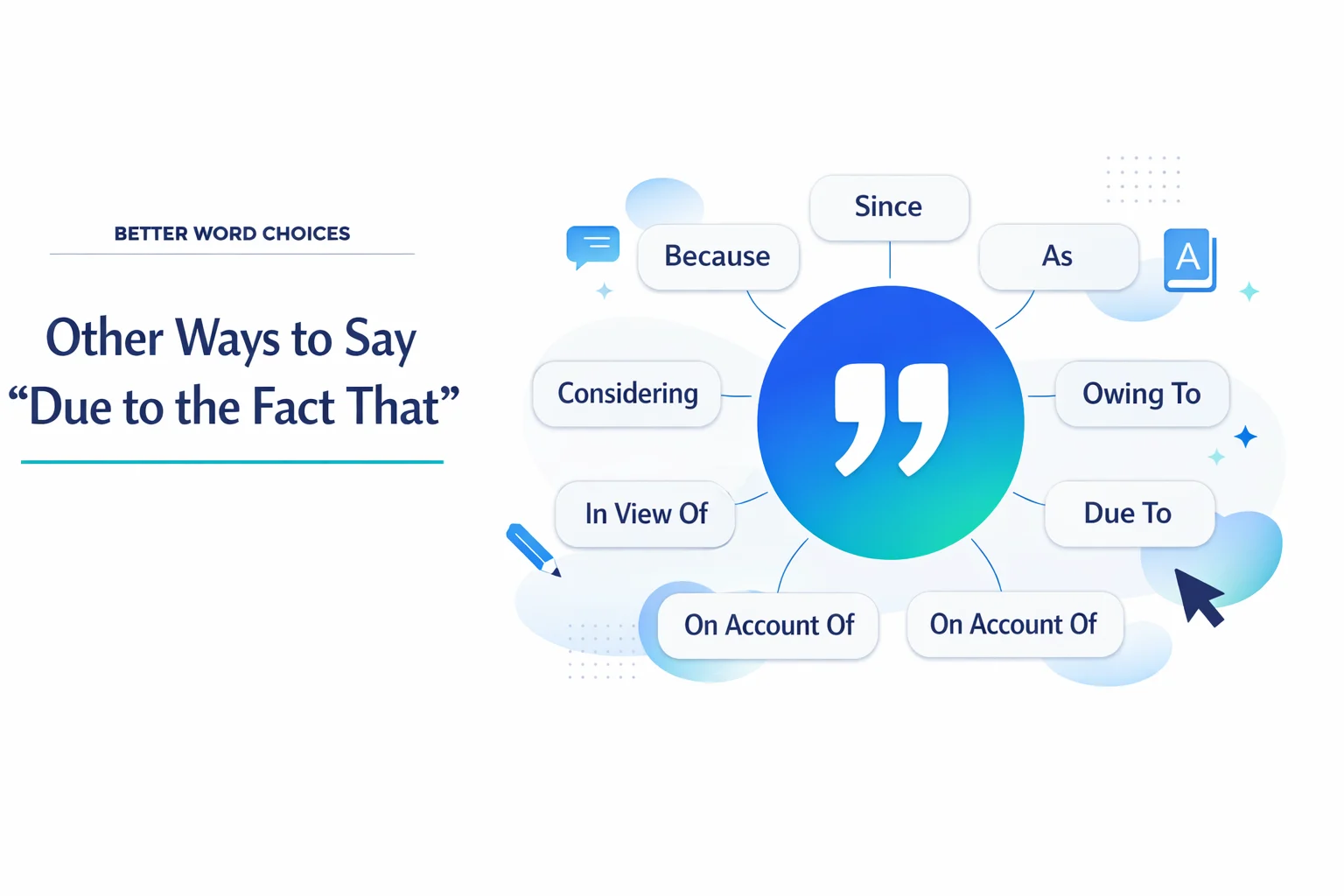
“Due to the fact that” is a wordy phrase used to explain a reason or cause.Instead of repeating it, try these top alternatives: because, since, as, owing to, given that.
Due to the fact that” is a common phrase English speakers use to introduce a reason or explanation for something. It appears often in essays, reports, emails, and everyday conversation whenever someone wants to explain why an event happened or a decision was made.
However, this phrase is longer than necessary. Learning alternatives to “due to the fact that” helps you sound more concise, confident, and fluent, whether you are writing a business email or trying to express excitement in English about a result caused by something specific. Native speakers rarely use the full phrase in casual speech, preferring shorter, more natural options.
Mastering these alternatives will sharpen your writing, improve your spoken fluency, and help you match your tone to the right audience, whether formal, professional, or casual.
“Shorter phrases often carry more confidence than longer ones.”
Quick Categories
Formal Alternatives to “Due to the Fact That”
- Owing to the fact that
- In light of the fact that
- On account of the fact that
- As a consequence of
Pro Tip: Use these in reports, academic writing, and formal emails where precision and professionalism matter.
Casual Alternatives
- Because
- Since
- Cause (spoken only)
- Seeing as
Pro Tip: In everyday conversation, “because” or “since” always sound more natural than longer formal phrases.
Professional Alternatives
- Given that
- As a result of
- In view of
- Considering that
Pro Tip: These work well in workplace emails and meetings when you need clarity without sounding overly casual.
Informal Expressions
- Cuz (very informal, spoken)
- On account of
- What with
- Being that (regional, informal)
Pro Tip: Save these for relaxed conversations with friends or close colleagues, not for formal writing.
The right tone makes your English sound professional and confident.”
Common Mistakes
- Overusing the full phrase in speech. Example: “I was late due to the fact that traffic was bad.” Sounds stiff; say “because traffic was bad” instead.
- Mixing formal and informal alternatives in the same sentence. Example: “Owing to the fact that I was cuz tired, I left early.” This mixes tone incorrectly.
- Using “due to the fact that” in casual texting. Example: A text saying “Can’t come due to the fact that I’m sick” feels overly formal for friends.
- Forgetting comma placement after the clause. Example: “Due to the fact that it rained the game was cancelled” needs a comma after “rained.”
- Using it redundantly with “because.” Example: “Because due to the fact that he was late, we started without him” repeats the same idea twice.
What Does “Due to the Fact That” Mean?
“Due to the fact that” is a conjunctive phrase used to introduce a reason or cause for something. Grammatically, it functions like “because” or “since,” connecting a cause to its effect within a sentence.
Example Sentence: She missed the meeting due to the fact that her flight was delayed.
When to Use “Due to the Fact That”
- Spoken English: Rarely used; “because” is far more natural in conversation.
- Written English: Common in formal essays, reports, and academic writing.
- Formal contexts: Business reports, academic papers, legal documents.
- Informal contexts: Generally avoided; sounds unnatural in casual speech or texting.
Is It Professional or Polite to Say “Due to the Fact That”?
The phrase is grammatically correct and polite, but it is often considered unnecessarily wordy in professional writing. Concise language is usually preferred in business communication.
Business Example: Instead of “Due to the fact that the vendor missed the deadline, we adjusted the schedule,” professionals often write “Because the vendor missed the deadline, we adjusted the schedule.”
Polite? Yes Professional? No (in most modern business writing, shorter alternatives are preferred)
Pros and Cons of Using “Due to the Fact That”
Pros
- Grammatically clear and correct
- Works in formal academic writing
- Easily understood by all English levels
- Signals a formal tone when needed
Cons
- Too wordy for everyday use
- Overused in student essays
- Limited stylistic variation
- Not ideal for concise professional writing
“Concise language builds stronger, clearer communication.”
Other Ways to Say “Due to the Fact That”
These alternatives will help you sound more fluent, confident, and natural in different situations. Use them according to tone, context, and audience to express excitement, admiration, or approval when explaining a cause.
1. Because
Meaning: Introduces a direct reason.
Explanation: The most common and natural way to explain why something happened.
Example Sentence: We stayed home because it was raining.
Best Use: Everyday conversations, informal writing
Worst Use: Highly formal academic essays
Tone: Neutral, natural
Context Variability: Casual, spoken
2. Since
Meaning: Gives a reason that is usually already understood.
Explanation: A softer alternative to because, suitable for both speech and writing.
Example Sentence: Since you’re here, let’s start the meeting.
Best Use: Conversations, emails, general writing
Worst Use: Highly formal reports requiring maximum precision
Tone: Friendly, conversational
Context Variability: Casual, professional
3. As
Meaning: Explains the reason for something.
Explanation: A concise alternative often used at the beginning of a sentence.
Example Sentence: As it was late, we ended the call.
Best Use: General writing, speeches
Worst Use: Statements requiring strong emphasis on the reason
Tone: Neutral, mild
Context Variability: Casual, professional
4. Owing to
Meaning: Indicates the cause of something.
Explanation: A formal expression commonly used in professional and academic writing.
Example Sentence: The delay occurred owing to heavy traffic.
Best Use: Reports, official documents
Worst Use: Casual conversations
Tone: Formal, precise
Context Variability: Professional, written
5. Given that
Meaning: Introduces a known fact or reason.
Explanation: Frequently used when making decisions or drawing conclusions.
Example Sentence: Given that sales dropped, we revised the budget.
Best Use: Business meetings, analytical writing
Worst Use: Informal texting
Tone: Analytical, professional
Context Variability: Professional, spoken
6. In light of
Meaning: Considering a particular fact or situation.
Explanation: Often used to explain why a decision was made.
Example Sentence: In light of recent events, the policy was updated.
Best Use: Official statements, business communication
Worst Use: Casual conversations
Tone: Formal, thoughtful
Context Variability: Professional, written
7. As a result of
Meaning: Expresses a clear cause-and-effect relationship.
Explanation: Frequently appears in reports, research, and news articles.
Example Sentence: As a result of the storm, flights were cancelled.
Best Use: Reports, news writing
Worst Use: Informal conversation
Tone: Formal, factual
Context Variability: Professional, written
8. On account of
Meaning: Explains why something happened.
Explanation: A slightly formal alternative that works in many situations.
Example Sentence: The trip was postponed on account of bad weather.
Best Use: General explanations
Worst Use: Highly academic writing
Tone: Neutral, explanatory
Context Variability: Casual, professional
9. Considering that
Meaning: Gives a reason based on a known fact.
Explanation: Often used when evaluating circumstances.
Example Sentence: Considering that it’s a holiday, traffic will be light.
Best Use: Discussions, planning
Worst Use: Very brief remarks
Tone: Thoughtful, professional
Context Variability: Professional, spoken
10. Seeing as
Meaning: Introduces a casual reason.
Explanation: Common in relaxed spoken English.
Example Sentence: Seeing as you’re free, let’s grab lunch.
Best Use: Friendly conversations
Worst Use: Formal writing
Tone: Casual, friendly
Context Variability: Casual, spoken
11. Because of
Meaning: Points directly to a cause.
Explanation: Used before a noun or noun phrase rather than a complete clause.
Example Sentence: The game was cancelled because of rain.
Best Use: Everyday writing and speech
Worst Use: Detailed analytical writing
Tone: Neutral, direct
Context Variability: Casual, professional
12. As a consequence of
Meaning: Indicates an outcome caused by something.
Explanation: A formal expression emphasizing cause and effect.
Example Sentence: As a consequence of the merger, roles changed.
Best Use: Academic papers, business reports
Worst Use: Casual conversations
Tone: Formal, analytical
Context Variability: Professional, written
13. In view of
Meaning: Taking something into consideration as a reason.
Explanation: Common in official notices and workplace communication.
Example Sentence: In view of the budget cuts, hiring was paused.
Best Use: Business announcements
Worst Use: Informal speech
Tone: Formal, cautious
Context Variability: Professional, written
14. Thanks to
Meaning: Gives credit for a positive result.
Explanation: Usually introduces a beneficial or favorable cause.
Example Sentence: Thanks to your help, we finished early.
Best Use: Positive situations, everyday communication
Worst Use: Negative explanations
Tone: Warm, appreciative
Context Variability: Casual, professional
15. Because of the fact that
Meaning: Gives a detailed explanation for a reason.
Explanation: A longer alternative that is often considered wordy.
Example Sentence: Because of the fact that he apologized, she forgave him.
Best Use: Informal writing
Worst Use: Concise professional writing
Tone: Neutral, wordy
Context Variability: Casual, written
16. For the reason that
Meaning: Formally introduces a cause.
Explanation: Common in legal and academic contexts.
Example Sentence: The claim was denied for the reason that it lacked evidence.
Best Use: Legal documents, formal writing
Worst Use: Everyday conversation
Tone: Formal, precise
Context Variability: Professional, written
17. Given the fact that
Meaning: Introduces a known circumstance or reason.
Explanation: Frequently used in analytical discussions and reports.
Example Sentence: Given the fact that prices rose, demand fell.
Best Use: Reports, business analysis
Worst Use: Quick conversations
Tone: Formal, analytical
Context Variability: Professional, written
18. What with
Meaning: Explains a reason involving multiple factors.
Explanation: A relaxed expression commonly heard in spoken English.
Example Sentence: What with the rain and the traffic, we were late.
Best Use: Storytelling, casual conversation
Worst Use: Formal writing
Tone: Casual, conversational
Context Variability: Casual, spoken
19. Being that
Meaning: Gives a reason in an informal way.
Explanation: Regional expression generally avoided in formal English.
Example Sentence: Being that it’s Friday, the office closes early.
Best Use: Informal regional speech
Worst Use: Professional writing
Tone: Informal, conversational
Context Variability: Casual, spoken
20. Due to
Meaning: Indicates the cause of something.
Explanation: Best used before a noun or noun phrase.
Example Sentence: The delay was due to a technical issue.
Best Use: Reports, formal writing
Worst Use: Very casual speech
Tone: Neutral, formal
Context Variability: Professional, written
21. As a function of
Meaning: Shows that one factor depends on another.
Explanation: Common in scientific, mathematical, and technical writing.
Example Sentence: Output changes as a function of temperature.
Best Use: Technical reports
Worst Use: Casual conversation
Tone: Technical, formal
Context Variability: Professional, written
22. In consequence of
Meaning: Indicates a direct cause and effect.
Explanation: A formal expression that is uncommon in everyday English.
Example Sentence: In consequence of the delay, the plan changed.
Best Use: Formal documents
Worst Use: Everyday speech
Tone: Formal, traditional
Context Variability: Professional, written
23. Resulting from
Meaning: Describes an effect caused by something.
Explanation: Commonly used in reports and news articles.
Example Sentence: Damage resulting from the flood was severe.
Best Use: Reports, journalism
Worst Use: Casual conversation
Tone: Formal, descriptive
Context Variability: Professional, written
24. Attributable to
Meaning: Assigns a result to a specific cause.
Explanation: Frequently used in scientific and business analysis.
Example Sentence: The rise in sales is attributable to marketing.
Best Use: Research papers, reports
Worst Use: Casual speech
Tone: Formal, precise
Context Variability: Professional, written
25. Stemming from
Meaning: Indicates the origin or source of something.
Explanation: Often used when discussing the root cause of an issue.
Example Sentence: The dispute stemmed from a misunderstanding.
Best Use: Explanations, reports
Worst Use: Very casual remarks
Tone: Descriptive, formal
Context Variability: Professional, written
26. Brought about by
Meaning: Means caused by or produced by something.
Explanation: Frequently appears in news reports and narratives.
Example Sentence: The change was brought about by public pressure.
Best Use: News articles, storytelling
Worst Use: Technical documentation
Tone: Narrative, formal
Context Variability: Professional, written
27. Prompted by
Meaning: Indicates that something triggered an action or decision.
Explanation: Often used when describing reactions to events.
Example Sentence: The apology was prompted by public criticism.
Best Use: News reports, formal writing
Worst Use: Casual conversations
Tone: Formal, reactive
Context Variability: Professional, written
28. In response to
Meaning: Explains that an action happened because of something else.
Explanation: Common in business, government, and news writing.
Example Sentence: The company changed its policy in response to customer complaints.
Best Use: Business communication, reports
Worst Use: Casual conversation
Tone: Formal, responsive
Context Variability: Professional, written
29. Simply because
Meaning: Gives a straightforward reason with emphasis.
Explanation: A natural conversational alternative that stresses the cause.
Example Sentence: We left simply because it was getting too loud.
Best Use: Casual explanations, everyday speech
Worst Use: Formal reports
Tone: Casual, direct
Context Variability: Casual, spoken
30. For this reason
Meaning: Refers back to a previously mentioned cause.
Explanation: A useful transition for introducing a conclusion or result.
Example Sentence: The roads were icy. For this reason, school was cancelled.
Best Use: Essays, reports, formal writing
Worst Use: Casual conversation
Tone: Formal, structured
Context Variability: Professional, written
Learning alternatives to common phrases sharpens both your writing and your speaking.”
Quick Quiz
1. Which alternative is the most natural for a casual conversation with a friend?
A) Owing to the fact that
B) Because
C) In consequence of
D) Attributable to
2. Which phrase is most appropriate in a formal business report?
A) Cuz
B) What with
C) As a result of
D) Being that
3. Which option sounds the most natural in everyday spoken English?
A) Since
B) In light of the fact that
C) On account of the fact that
D) Resulting from
4. Which phrase is best used to describe a positive outcome or benefit?
A) Thanks to
B) Owing to
C) In consequence of
D) Attributable to
Answers
- B
- C
- A
- A
“Confidence in English comes from choosing the right word for the right moment.”
Comparison Table: Top Alternatives
| Phrase | Tone | Best Use |
|---|---|---|
| Because | Neutral | Everyday speech |
| Since | Friendly | Conversation, writing |
| Owing to | Formal | Formal reports |
| Given that | Professional | Business meetings |
| In light of | Formal | Official statements |
| As a result of | Formal | Reports, news |
| On account of | Neutral | General explanations |
| Considering that | Professional | Discussions, planning |
| Seeing as | Casual | Friendly chats |
| Thanks to | Warm | Positive contexts |
FAQs
Is “due to the fact that” grammatically correct?
Yes, it is grammatically correct, but it is considered wordy and is usually replaced with “because” or “since” in modern writing.
What is the simplest alternative to “due to the fact that”?
“Because” is the simplest and most commonly used alternative in both speech and writing.
Can I use “due to the fact that” in academic writing?
Yes, but many style guides recommend shorter alternatives like “because” or “since” for clarity and conciseness.
Is “owing to the fact that” more formal than “due to the fact that”?
They are similarly formal, but “owing to” alone is often preferred as a shorter formal alternative.
Why should I learn other ways to say “due to the fact that”?
Learning alternatives improves your fluency, helps you match tone to context, and makes your English sound more natural and professional.
Conclusion
Learning alternatives to “due to the fact that” helps you communicate more clearly and confidently in both spoken and written English. From formal options like “owing to” and “in light of” to casual choices like “because” and “seeing as,” each phrase serves a different purpose depending on your audience and tone.
Practice using these alternatives daily in your conversations, emails, and writing. Paying attention to tone and context will help you sound more fluent, professional, and natural every time you explain a reason in English.
Read More Related Articles:
- Other Ways to Say “The Author Says” | Like a Skilled Academic Writer In 2026
- Other Ways to Say “In Summary” | Clearer and Stronger Conclusions In 2026
- Other Ways to Say “Similarly” | Smart Synonyms You’ll Use Every Day In 2026

Daniel Murphy is a professional writer and blogger specializing in digital communication and messaging trends. As a contributor to TextsResponse.com, he creates reader-focused content designed to help people find the right words at the right time.