Quick Answer
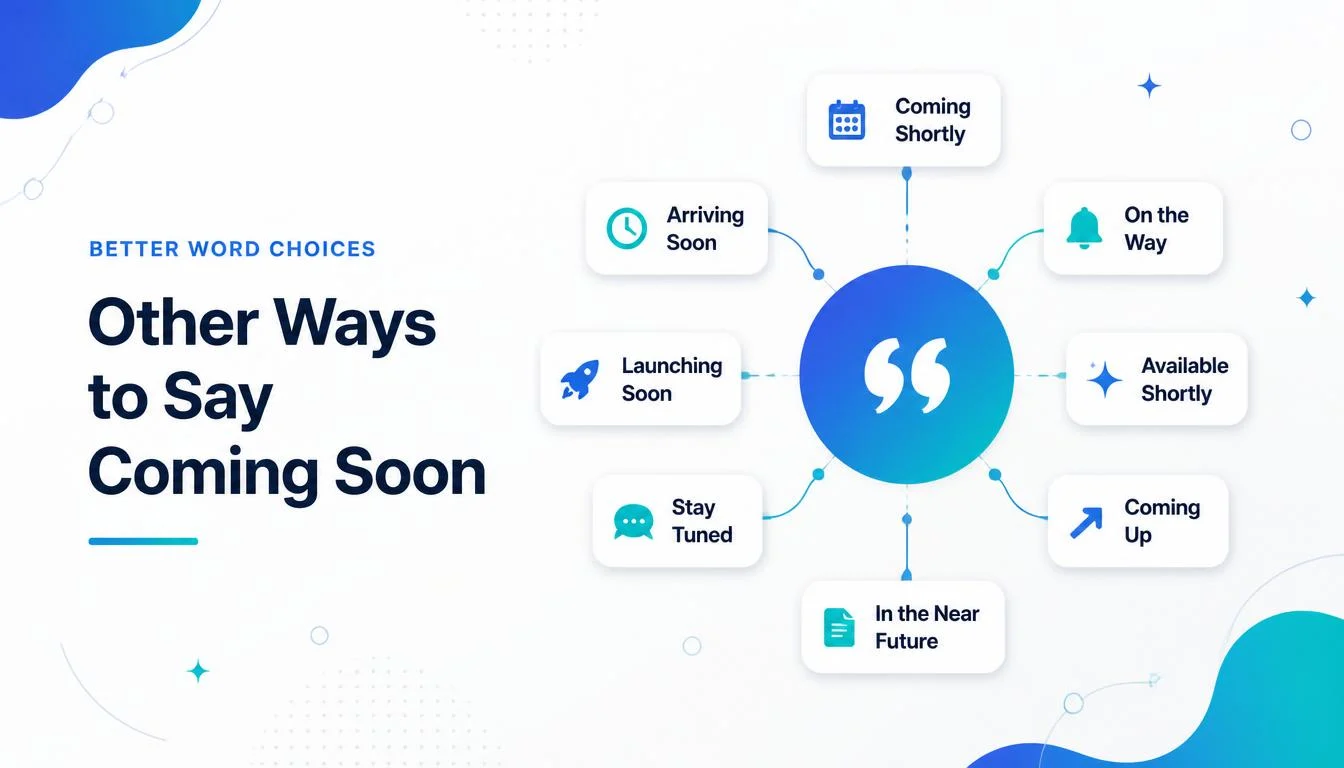
Other ways to say coming soon include arriving shortly, launching soon, available soon, on the way, and coming up. Choose the best phrase based on your audience and context.
Learning other ways to say coming soon helps you create more engaging announcements and communicate upcoming events, products, services, or projects clearly. Whether you are writing a social media caption, promoting a new product, or sharing an important update, the right phrase can capture attention and build excitement.
Instead of repeating “coming soon,” you can use expressions such as “launching shortly,” “stay tuned,” “arriving soon,” or “coming your way.” Some alternatives sound professional and informative, while others create curiosity and anticipation. Understanding these differences will help you choose the most suitable expression for emails, websites, marketing campaigns, and everyday conversations.
What Is “Coming Soon”? (Meaning, Grammar & Real Use)
Imagine a company preparing to launch a new product. Its website displays a message saying “Coming Soon,” while its social media account says, “Our new collection launches next week.” Both communicate that something is approaching, but the second phrase provides a clearer expectation.
The expression “coming soon” is widely used in everyday English, business announcements, marketing campaigns, entertainment promotions, and personal conversations. Learning alternatives to coming soon helps you communicate with greater precision, avoid repetitive wording, and express excitement in English without sounding unnatural.
Meaning
“Coming soon” means that something is expected to happen, appear, arrive, or become available in the near future. It does not necessarily specify an exact date.
Grammar and Usage
“Coming soon” is a phrase rather than a single part of speech. It commonly functions as a short announcement, a descriptive phrase, or a sentence fragment in promotional writing. “Coming” is the present participle of the verb “come,” while “soon” is an adverb of time.
Example: Our new website is coming soon.
The phrase is suitable for both casual and professional communication. However, a precise expression such as “available on October 20” is more informative when the date is confirmed.
Where and Why People Use It
People use this expression in website banners, product launches, event promotions, film trailers, newsletters, workplace announcements, and everyday conversations. Its main advantage is simplicity: readers immediately understand that something is expected in the near future.
When Should You Use “Coming Soon”?
The best expression depends on what you are announcing, your audience, and how much information you can share.
Common Contexts
- Product launches: Announce upcoming products, collections, apps, or services.
- Events: Build anticipation for conferences, workshops, concerts, and celebrations.
- Digital updates: Tell website visitors about new features, pages, or improvements.
- Entertainment: Promote upcoming films, shows, books, or music releases.
- Personal plans: Tell friends about an upcoming visit, announcement, or activity.
- Business communication: Inform customers about future services or availability.
Spoken vs. Written English
Spoken English: Use natural phrases such as “It’s almost here,” “It’s on the way,” or “You’ll see it shortly.
Written English: Choose “launching shortly,” “available soon,” or “scheduled for release” when writing announcements, emails, and website copy.
Formal vs. Informal English
Formal: “The service will become available shortly.”
Informal: “It’s almost here!”
Formal wording emphasizes clarity and reliability. Informal wording creates anticipation and sounds more conversational.
Is It Professional or Just Polite?
Coming soon” is both acceptable and professional in many business contexts. It works especially well in marketing, product announcements, and customer-facing messages. However, it may be too vague for project updates that require deadlines or accountability.
Business example: “Our updated customer portal will be available shortly. We will share the confirmed launch date by email.”
- Polite? ✔️ Yes
- Professional? ✔️ Yes, particularly for promotional announcements
Politeness vs. Professionalism
Politeness concerns how respectfully you communicate. Professionalism also involves accuracy, clarity, and appropriate expectations.
For example, “Something exciting is coming!” creates enthusiasm, while “The new service launches on October 20″ gives customers a specific commitment. Use the second version when the date is confirmed.
Pros and Cons of Using “Coming Soon”
Pros
- Simple and clear: Most English speakers understand the message immediately.
- Builds anticipation: It creates interest without revealing every detail.
- Widely accepted: It works across marketing, entertainment, and everyday communication.
- Flexible: It can introduce products, events, announcements, and future changes.
Cons
- Can be vague: Readers may wonder whether the launch is days or months away.
- May feel repetitive: Using it in every announcement makes content less engaging.
- Offers limited detail: It does not explain what is arriving or when.
- Can create unrealistic expectations: Audiences may assume an imminent release even when no timeline exists.
Practical advice: If possible, pair the phrase with a confirmed date, an estimated timeframe, or a useful next step.
Common Mistakes People Make
1. Using “Coming Soon” When a Date Is Confirmed
❌ Incorrect: “Our new service is coming soon on October 20.”
✔️ Correct: “Our new service launches on October 20.”
Why it matters: A confirmed date communicates more clearly than a vague announcement.
2. Using Formal Language in a Casual Conversation
❌ Incorrect: “The snacks shall become available shortly.”
✔️ Correct: “The snacks will be ready soon.”
Why it matters: Overly formal wording can make ordinary conversation sound stiff.
3. Promising an Unconfirmed Launch Date
❌ Incorrect: “Our app will launch next Monday.” (When the date is unconfirmed.)
✔️ Correct: “Our app is expected to launch soon.”
Why it matters: Avoid presenting uncertain plans as guaranteed commitments.
4. Confusing “Coming Soon” With “Available Now”
❌ Incorrect: “Our new collection is available now.” (When it has not launched.)
✔️ Correct: “Our new collection will be available soon.”
Why it matters: Accurate wording protects customer trust.
5. Repeating the Same Phrase in Every Announcement
❌ Incorrect: “New features coming soon. New designs coming soon. New services coming soon.”
✔️ Correct: “New features are on the way. Fresh designs arrive next week, and additional services are planned for the coming months.”
Why it matters: Varied language keeps promotional content engaging while communicating different timelines.
Alternatives by Category
The following preview highlights useful options for different audiences and situations. Each phrase also appears in the complete list below.
Formal alternatives to “Coming Soon”
- Available shortly
- Scheduled for release
- Expected in the near future
Pro Tip: Use these phrases in formal notices, official correspondence, and announcements where clarity matters more than excitement.
Casual alternatives
- Almost here
- On the way
- Around the corner
Pro Tip: Choose familiar expressions that sound natural when speaking with friends, colleagues, or regular customers.
Professional alternatives
- Launching shortly
- Launching soon
- Set to launch
Pro Tip: Match the phrase to the actual stage of your project, and avoid implying that a launch date is confirmed when it is not.
Informal expressions
- Stay tuned
- It’s almost here
- Just around the corner
Pro Tip: Use informal expressions in social media captions and friendly announcements, but provide extra details when your audience needs a timeline.
“Formal and informal English aren’t about correctness. They’re about context.”
Other Ways to Say “Coming Soon” (Full List with Examples)
These 30 alternatives help you communicate upcoming events, releases, and announcements with greater fluency. Some build excitement, while others emphasize timing, availability, or professionalism.
1. Phrase: Available Shortly
Meaning: Ready to access in the near future.
Explanation: A professional option for products, services, and digital resources.
Example Sentence: The updated report will be available shortly.
Best Use: Business announcements
Worst Use: Casual banter
Tone: Formal, professional
Context Variability: professional, written, spoken
2. Phrase: Launching Soon
Meaning: Beginning operations or becoming available soon.
Explanation: Common in marketing and product announcements.
Example Sentence: Our new online store is launching soon.
Best Use: Product promotions
Worst Use: Casual storytelling
Tone: Professional, enthusiastic
Context Variability: professional, written, spoken
3. Phrase: Arriving Soon
Meaning: Expected to reach a destination or audience shortly.
Explanation: Works well for deliveries, new collections, and entertainment releases.
Example Sentence: Our winter collection is arriving soon.
Best Use: Retail announcements
Worst Use: Confirmed deadlines
Tone: Friendly, neutral
Context Variability: casual, professional, written
4. Phrase: On the Way
Meaning: Already in progress or expected to arrive.
Explanation: A natural phrase for upcoming changes, products, and personal plans.
Example Sentence: A major website update is on the way.
Best Use: Friendly updates
Worst Use: Formal reports
Tone: Casual, reassuring
Context Variability: casual, professional, spoken
5. Phrase: Just Around the Corner
Meaning: Likely to happen very soon.
Explanation: Creates a sense of anticipation without giving an exact date.
Example Sentence: The holiday season is just around the corner.
Best Use: Seasonal promotions
Worst Use: Technical documents
Tone: Warm, conversational
Context Variability: casual, professional, spoken
6. Phrase: Stay Tuned
Meaning: Keep watching or listening for further information.
Explanation: Encourages audiences to follow upcoming announcements.
Example Sentence: Stay tuned for details about our new membership program.
Best Use: Social promotions
Worst Use: Formal contracts
Tone: Engaging, informal
Context Variability: casual, professional, written
7. Phrase: Expected in the Near Future
Meaning: Anticipated within a forthcoming period.
Explanation: Communicates an expectation without promising an exact date.
Example Sentence: The revised policy is expected in the near future.
Best Use: Official updates
Worst Use: Urgent instructions
Tone: Formal, cautious
Context Variability: professional, written, spoken
8. Phrase: Set to Launch
Meaning: Planned or prepared to begin.
Explanation: Suggests a launch is planned, although unexpected delays remain possible.
Example Sentence: The new platform is set to launch this autumn.
Best Use: Launch announcements
Worst Use: Unplanned projects
Tone: Confident, professional
Context Variability: professional, written, spoken
9. Phrase: Coming Up
Meaning: Happening or appearing in the near future.
Explanation: A versatile expression for events, announcements, and scheduled activities.
Example Sentence: We have an exciting announcement coming up next week.
Best Use: Event previews
Worst Use: Legal notices
Tone: Casual, upbeat
Context Variability: casual, professional, spoken
10. Phrase: Almost Here
Meaning: Very close to arriving or happening.
Explanation: Highlights anticipation and works particularly well in friendly promotional messages.
Example Sentence: Our new learning course is almost here.
Best Use: Teaser campaigns
Worst Use: Long-term plans
Tone: Excited, informal
Context Variability: casual, professional, spoken
11. Phrase: Releasing Soon
Meaning: Making a product or creative work available soon.
Explanation: Particularly useful for books, apps, music, and films.
Example Sentence: We are releasing our new language-learning app soon.
Best Use: Media promotions
Worst Use: General greetings
Tone: Informative, professional
Context Variability: professional, written, spoken
12. Phrase: Available in the Coming Weeks
Meaning: Expected to become accessible within the next several weeks.
Explanation: Provides a more helpful timeframe than a general announcement.
Example Sentence: The new training materials will be available in the coming weeks.
Best Use: Project updates
Worst Use: Immediate releases
Tone: Professional, informative
Context Variability: professional, written, spoken
13. Phrase: Coming Your Way
Meaning: Something will soon reach or be offered to the audience.
Explanation: Creates a personal connection in promotional messages and announcements.
Example Sentence: More practical English lessons are coming your way.
Best Use: Audience engagement
Worst Use: Formal correspondence
Tone: Friendly, enthusiastic
Context Variability: casual, professional, spoken
14. Phrase: In the Pipeline
Meaning: Being developed, prepared, or planned.
Explanation: Suggests ongoing work rather than a guaranteed imminent release.
Example Sentence: Several new customer features are in the pipeline.
Best Use: Business updates
Worst Use: Immediate deadlines
Tone: Professional, neutral
Context Variability: professional, written, spoken
15. Phrase: Due for Release
Meaning: Expected or scheduled to be released.
Explanation: Suitable for products, publications, films, and software with a planned release period.
Example Sentence: The next edition is due for release in November.
Best Use: Release schedules
Worst Use: Uncertain plans
Tone: Formal, informative
Context Variability: professional, written, spoken
16. Phrase: Coming Up Next
Meaning: The next item or event is about to happen.
Explanation: Often used by presenters, teachers, and event hosts to introduce the next segment.
Example Sentence: Coming up next, we will explore five useful business expressions.
Best Use: Presentations, broadcasts
Worst Use: Product deadlines
Tone: Engaging, conversational
Context Variability: casual, professional, spoken
17. Phrase: On the Horizon
Meaning: Likely to happen or appear in the foreseeable future.
Explanation: Often suggests a promising development or a change that is approaching.
Example Sentence: New career development opportunities are on the horizon.
Best Use: Strategic updates
Worst Use: Exact schedules
Tone: Optimistic, professional
Context Variability: professional, written, spoken
18. Phrase: Shortly to Be Announced
Meaning: Expected to be officially revealed soon.
Explanation: Use it when information will be announced, rather than when a product itself will become available.
Example Sentence: The winners will be shortly announced.
Best Use: Official announcements
Worst Use: Casual conversation
Tone: Formal, informative
Context Variability: professional, written, spoken
19. Phrase: Launching Shortly
Meaning: Beginning or becoming available in a short time.
Explanation: A concise choice for business updates when a launch is approaching.
Example Sentence: Our new booking system is launching shortly.
Best Use: Business promotions
Worst Use: Distant launches
Tone: Professional, direct
Context Variability: professional, written, spoken
20. Phrase: Just About to Arrive
Meaning: Expected to arrive very soon.
Explanation: Emphasizes that a person, product, or event is nearly here.
Example Sentence: The next shipment is just about to arrive.
Best Use: Delivery updates
Worst Use: Long-term plans
Tone: Conversational, expectant
Context Variability: casual, professional, spoken
21. Phrase: In the Works
Meaning: Currently being developed or prepared.
Explanation: Useful when something is being created but is not ready for release.
Example Sentence: A new series of writing guides is in the works.
Best Use: Early previews
Worst Use: Final confirmations
Tone: Casual, professional
Context Variability: casual, professional, spoken
22. Phrase: Scheduled for Release
Meaning: Assigned a planned release date or time.
Explanation: Communicates a formal schedule, especially when the details have been confirmed.
Example Sentence: The software update is scheduled for release on October 20.
Best Use: Release notices
Worst Use: Unconfirmed plans
Tone: Formal, precise
Context Variability: professional, written, spoken
23. Phrase: Approaching Fast
Meaning: Getting closer quickly.
Explanation: Highlights urgency or excitement about an approaching event or deadline.
Example Sentence: Our annual conference is approaching fast.
Best Use: Event reminders
Worst Use: Neutral notices
Tone: Energetic, conversational
Context Variability: casual, professional, spoken
24. Phrase: Ready Before Long
Meaning: Expected to become ready soon.
Explanation: Understandable, but less idiomatic than “ready soon” or “ready before long.” Use the latter mainly in conversational or literary contexts.
Example Sentence: Your custom design should be ready before long.
Best Use: Friendly updates
Worst Use: Formal schedules
Tone: Conversational, reassuring
Context Variability: casual, professional, spoken
25. Phrase: Coming in the Next Update
Meaning: Planned for inclusion in a forthcoming update.
Explanation: Ideal for software features, digital products, and ongoing services.
Example Sentence: Dark mode is coming in the next update.
Best Use: Software announcements
Worst Use: Unrelated events
Tone: Informative, professional
Context Variability: professional, written, spoken
26. Phrase: In the Near Future
Meaning: At some point relatively soon.
Explanation: A flexible phrase for plans and developments without a specific deadline.
Example Sentence: We hope to expand our services in the near future.
Best Use: Business planning
Worst Use: Exact deadlines
Tone: Formal, neutral
Context Variability: professional, written, spoken
27. Phrase: Around the Corner
Meaning: Likely to happen soon.
Explanation: A shorter alternative to “just around the corner,” often used for seasons, events, and opportunities.
Example Sentence: Exam season is around the corner.
Best Use: Timely reminders
Worst Use: Technical specifications
Tone: Casual, friendly
Context Variability: casual, professional, spoken
28. Phrase: Soon to Be Unveiled
Meaning: About to be revealed publicly.
Explanation: Works well for new designs, major announcements, and confidential projects nearing their reveal.
Example Sentence: Our redesigned company logo will soon be unveiled.
Best Use: Brand announcements
Worst Use: Everyday plans
Tone: Formal, anticipatory
Context Variability: professional, written, spoken
29. Phrase: The Wait Is Almost Over
Meaning: Something people have been anticipating will happen soon.
Explanation: Builds excitement when an audience has been waiting for a release or announcement.
Example Sentence: The wait is almost over: our new course opens next Monday.
Best Use: Anticipated launches
Worst Use: Routine notices
Tone: Excited, persuasive
Context Variability: casual, professional, written
30. Phrase: Set to Arrive Soon
Meaning: Expected to arrive in the near future.
Explanation: Combines a sense of preparation with an approaching arrival.
Example Sentence: The new collection is set to arrive soon.
Best Use: Retail announcements
Worst Use: Uncertain deliveries
Tone: Professional, optimistic
Context Variability: casual, professional, written
Comparison Table: Top 10 Alternatives at a Glance
Use this table to select an expression based on your audience, purpose, and communication style.
| Phrase | Tone | Best Use |
|---|---|---|
| Available shortly | Formal | Business announcements |
| Launching soon | Professional | Product launches |
| Arriving soon | Neutral | Retail promotions |
| On the way | Casual | Friendly updates |
| Just around the corner | Conversational | Seasonal events |
| Stay tuned | Engaging | Social media |
| Expected in the near future | Formal | Official updates |
| Set to launch | Professional | Business launches |
| Coming up | Friendly | Event previews |
| Almost here | Excited | Promotional campaigns |
How to Choose the Right Phrase
- Choose available shortly when communicating expected availability.
- Choose launching soon when introducing a new product or service.
- Choose stay tuned when encouraging your audience to follow future announcements.
- Choose scheduled for release when communicating a confirmed release schedule.
- Choose the wait is almost over when building excitement around an anticipated launch.
For more vocabulary ideas, explore See also: Other Ways to Say “Amazing”.
Quick Self-Check (Mini Quiz)
Test your understanding by choosing the most appropriate expression for each situation.
Question 1
You are writing a professional email about a new service that will become accessible shortly. Which phrase is the best fit?
- A. It’s almost here!
- B. Available shortly
- C. The wait is almost over
Correct answer: B. Available shortly.
Why: It is concise, professional, and appropriate for customer-facing business communication.
Question 2
Your team is developing new website features, but no release date has been confirmed. Which expression is most appropriate?
- A. Scheduled for release tomorrow
- B. Available now
- C. In the pipeline
Correct answer: C. In the pipeline.
Why: It indicates that work is underway without promising a specific release date.
Question 3
You want to build excitement about a new course on social media. Which phrase is most engaging?
- A. The wait is almost over
- B. Subject to future availability
- C. Expected within a forthcoming period
Correct answer: A. The wait is almost over.
Why: It creates anticipation and sounds natural in promotional content.
Question 4
Your company has confirmed that its new platform will launch on October 20. Which sentence communicates the timing most clearly?
- A. Something exciting is on the horizon.
- B. Our new platform is scheduled to launch on October 20.
- C. Our new platform may arrive someday.
Correct answer: B. Our new platform is scheduled to launch on October 20.
Why: It communicates the planned date directly and avoids unnecessary uncertainty.
FAQs
1. What are the best alternatives to “coming soon”?
Popular alternatives include “launching soon,” “available shortly,” “arriving soon,” “on the way,” and “stay tuned.” The best option depends on whether you are announcing a product, event, service, or personal plan.
2. How do you say “coming soon” professionally?
Use expressions such as “launching shortly,” “scheduled for release,” “expected in the near future,” or “available shortly.” When possible, include a confirmed date to make your announcement more informative.
3. What is a catchy way to say “coming soon”?
The wait is almost over,” “it’s almost here,” and “stay tuned” are catchy choices for promotional content. They create anticipation without requiring a lengthy announcement.
4. How can I say “coming soon” without giving an exact date?
Try “on the horizon,” “in the pipeline,” “in the near future,” or “expected soon.” These expressions communicate that something is planned or anticipated without making a specific time commitment.
5. Is “coming soon” appropriate for business emails?
Yes. It is suitable for many professional announcements, especially product launches and service updates. For project management or formal customer communication, a more precise phrase or confirmed timeline may be preferable.
Conclusion
Learning different expressions for upcoming events and announcements helps you communicate more naturally in English. Instead of relying on the same phrase repeatedly, choose wording that matches your audience, purpose, and timeline. Professional announcements benefit from precise language, while promotional messages can use more energetic expressions to build anticipation.
Practice these phrases in emails, conversations, social media captions, and workplace updates. Pay attention to whether your message needs clarity, excitement, or reassurance, and choose an expression that communicates your meaning accurately.
Read More Related Articles:
- Other Ways to Say Circle Back | Improve Your Workplace Communication In 2026
- Other Ways to Say Welcome to the Team | Warm First Impression In 2026
- Other Ways to Say I Hope All Is Well | Make a Better First Impression In 2026

Henry Walker is an American writer and blogger with a keen interest in communication, language and digital content. At TextsResponse.com, he creates informative and reader-focused resources designed to help people communicate with clarity, confidence and authenticity.