Quick Answer
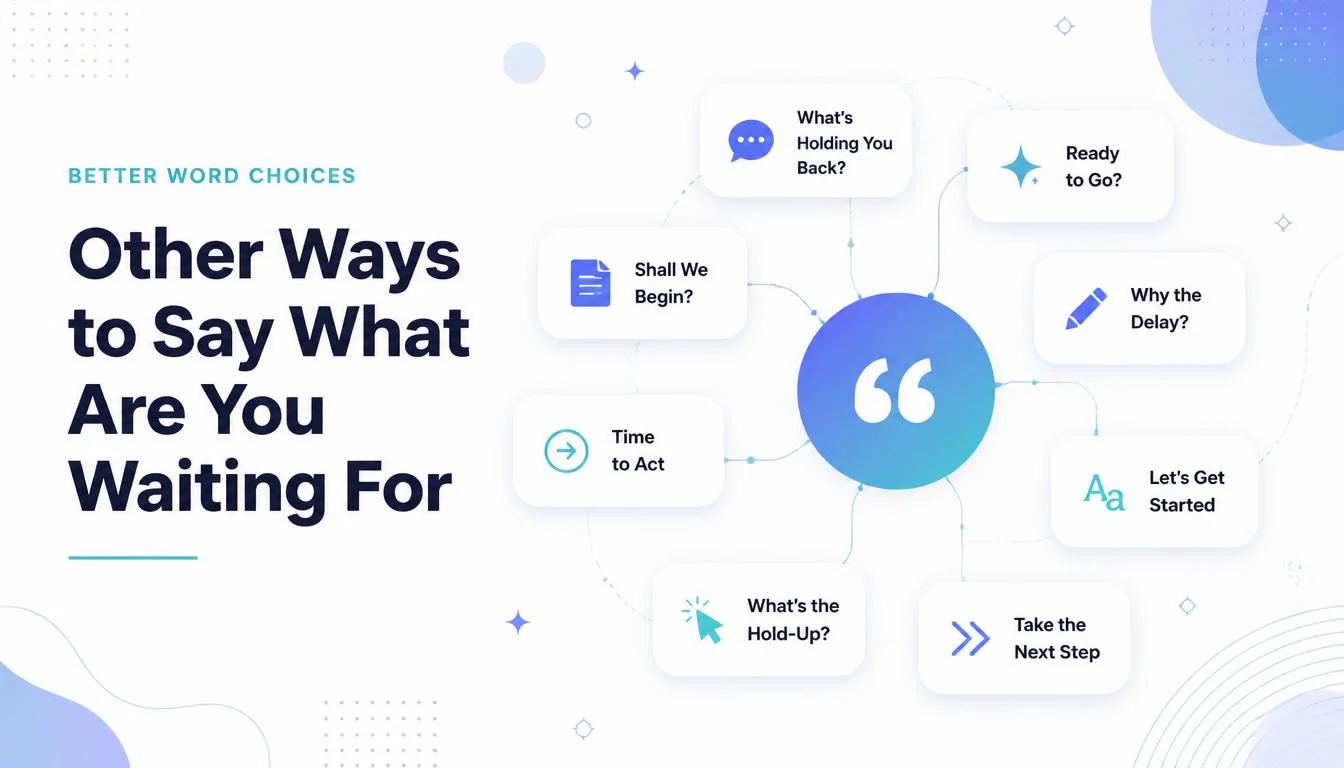
Other ways to say what are you waiting for include “What’s holding you back?”, “Why wait?”, “Ready to get started?”, and “What’s stopping you?” Choose an expression that matches your tone and situation.
Learning other ways to say what are you waiting for can make your English conversations more natural, engaging, and expressive. This common phrase encourages someone to take action, make a decision, or begin something without further delay. Depending on your tone, it can sound friendly, excited, impatient, or persuasive.
Whether you are talking with friends, motivating a colleague, or encouraging someone to try a new opportunity, choosing the right alternative helps you communicate effectively. Expressions such as “Why wait?”, “What’s holding you back?”, and “Shall we get started?” offer different ways to inspire action while keeping your message suitable for the situation.
What Is “What Are You Waiting For”? (Meaning, Grammar & Real Use)
Imagine your friend has an exciting opportunity but keeps postponing the application. You might ask, “What are you waiting for?” to encourage them to take action. Similarly, a colleague may hesitate to share an idea during a meeting, and a supportive comment can help them move forward. This expression is common in everyday English because it communicates encouragement, urgency, or curiosity in just a few words.
Learning alternatives to this phrase helps you communicate with greater precision. Some expressions sound supportive, while others may feel impatient or demanding. Understanding these differences helps English learners choose appropriate words in personal conversations, workplace discussions, and written communication.
If you want to express excitement in English, you can use encouraging phrases such as “Go for it!” or “The time is right.” For professional situations, softer alternatives can motivate people without putting unnecessary pressure on them.
Meaning: “What are you waiting for?” asks why someone has not started an action or encourages them to act without delay.
Grammar: It is an interrogative sentence in the present continuous tense. It can be a genuine question or a rhetorical prompt. Its tone ranges from friendly and enthusiastic to impatient.
Example: “You have prepared for this opportunity, so what are you waiting for?”
People use it in spoken English, informal messages, advertising, motivational writing, and occasional workplace conversations.
When Should You Use “What Are You Waiting For”?
Choose this expression according to your relationship with the listener and the situation.
Common contexts
- Encouraging action: Motivate a friend to apply for a job or try something new.
- Creating urgency: Remind someone that an opportunity may not last forever.
- Showing enthusiasm: Encourage a person to join an activity or pursue a goal.
- Asking about hesitation: Find out why someone is delaying a decision.
- Promoting a product or service: Invite customers to take advantage of an offer.
- Supporting personal growth: Encourage someone to begin learning a skill or building a habit.
Spoken vs. written English
In conversation, the phrase sounds natural and energetic. In writing, it works well in social media captions, promotional messages, personal emails, and motivational content.
For formal reports, academic writing, or sensitive professional messages, a more precise expression is usually better.
Formal vs. informal English
Informal expressions such as “Why wait?” work well with friends and family. Formal alternatives such as “What is preventing you from proceeding?” are more appropriate when discussing obstacles in professional settings.
Is It Professional or Just Polite?
“What are you waiting for?” can be polite when delivered warmly, but it may sound impatient if the listener faces genuine obstacles.
Politeness vs. professionalism: Politeness depends on respect and consideration. Professionalism also requires suitable wording, awareness of workplace relationships, and respect for another person’s decision-making process.
Business example: “You have completed the proposal. Would you be ready to submit it today?”
- Polite? ✔️ Yes, when used with a supportive tone.
- Professional? ✔️ Yes, in suitable contexts, although a more specific request may be preferable.
Pros and Cons of Using “What Are You Waiting For?”
Pros
- Simple and memorable: The expression is easy to understand and use.
- Encouraging: It can inspire someone to act on an opportunity.
- Widely recognized: Native and proficient English speakers commonly understand it.
- Emotionally engaging: It can communicate enthusiasm, urgency, or excitement.
Cons
- Potentially pushy: It can make hesitant people feel pressured.
- Limited precision: It does not explain the next step or address an obstacle.
- Tone-dependent: The same words can sound supportive or impatient.
- Unsuitable in some formal situations: Sensitive decisions may require a more considerate question.
Common Mistakes People Make
1. Using the phrase when someone needs help
❌ Incorrect: “What are you waiting for?” when a colleague cannot access the required files.
✔️ Correct: “Is there anything preventing you from moving forward?”
Why: The corrected version identifies a possible obstacle instead of assuming the person is delaying unnecessarily.
2. Confusing encouragement with an order
❌ Incorrect: “What are you waiting for? Submit the report now!” when making a polite request.
✔️ Correct: “Could you submit the report today, please?”
Why: A direct but respectful request communicates the required action more clearly.
3. Using the expression in sensitive situations
❌ Incorrect: “What are you waiting for?” to pressure someone into making a personal decision.
✔️ Correct: “Would you like more time to think about it?”
Why: Sensitive decisions require patience and respect for personal boundaries.
4. Using an overly casual alternative in a formal email
❌ Incorrect: “Go on, what are you waiting for?” in a formal client email.
✔️ Correct: “Please let me know if you are ready to proceed.”
Why: Professional messages benefit from specific, respectful language.
5. Forgetting the question mark
❌ Incorrect: “What are you waiting for.”
✔️ Correct: “What are you waiting for?”
Why: The phrase is grammatically a question, even when it functions as encouragement.
“Small tone mistakes can make confident English sound careless.”
Alternatives by Category
The following examples preview useful expressions from the complete list below.
Formal alternatives to “What Are You Waiting For?”
- What is preventing you from proceeding?
- Is there anything holding you back?
- When would you like to move forward?
Pro Tip: Use neutral questions when discussing deadlines, decisions, or potential obstacles with colleagues and clients.
Casual alternatives
- Why wait?
- Go for it!
- What’s stopping you?
Pro Tip: Choose an encouraging expression when speaking with friends, but avoid pressuring someone who seems uncomfortable.
Professional alternatives
- Are you ready to proceed?
- What would help you move forward?
- Shall we take the next step?
Pro Tip: In meetings, connect encouragement to a specific action or decision.
Informal expressions
- Come on, give it a try!
- Jump right in!
- Now’s your chance!
Pro Tip: Use energetic expressions with people who appreciate enthusiasm and informal conversation.
“Formal and informal English aren’t about correctness. They’re about context.”
Other Ways to Say “What Are You Waiting For” (Full List with Examples)
These 30 alternatives help you communicate encouragement, urgency, motivation, or curiosity while adapting your language to different relationships and situations.
1. Phrase: Why Wait?
Meaning: Why delay?
Explanation: Encourages immediate action when there is little reason to postpone.
Example Sentence: “The course starts today. Why wait?”
Best Use: Everyday encouragement
Worst Use: Sensitive decisions
Tone: Confident and casual
Context Variability: casual / professional / spoken
2. Phrase: What’s Stopping You?
Meaning: What is preventing you from acting?
Explanation: Invites someone to identify an obstacle or reconsider unnecessary hesitation.
Example Sentence: “You have the qualifications. What’s stopping you?”
Best Use: Identifying obstacles
Worst Use: Emotional conversations
Tone: Direct and curious
Context Variability: casual / professional / spoken
3. Phrase: Go for It!
Meaning: Take the opportunity.
Explanation: A short, enthusiastic expression that encourages action or risk-taking.
Example Sentence: “You want to audition? Go for it!”
Best Use: Personal encouragement
Worst Use: High-risk decisions
Tone: Energetic and supportive
Context Variability: casual / professional / spoken
4. Phrase: Take the First Step
Meaning: Begin an action or process.
Explanation: Emphasizes starting rather than waiting for perfect circumstances.
Example Sentence: “Take the first step by sending your application.”
Best Use: Goal setting
Worst Use: Immediate emergencies
Tone: Motivational and constructive
Context Variability: casual / professional / spoken
5. Phrase: There’s No Time Like the Present
Meaning: Now is a good time to act.
Explanation: Encourages action by reminding someone that the present moment is valuable.
Example Sentence: “You have planned this project for months. There’s no time like the present.”
Best Use: Starting projects
Worst Use: Urgent crises
Tone: Encouraging and reflective
Context Variability: casual / professional / spoken
6. Phrase: What Is Preventing You From Proceeding?
Meaning: What is stopping you from continuing?
Explanation: A formal question that seeks practical reasons for a delay.
Example Sentence: “What is preventing you from proceeding with the proposal?”
Best Use: Workplace discussions
Worst Use: Friendly banter
Tone: Formal and neutral
Context Variability: professional / written / spoken
7. Phrase: Is Anything Holding You Back?
Meaning: Is something preventing you from acting?
Explanation: Opens a supportive conversation about concerns, resources, or uncertainty.
Example Sentence: “Is anything holding you back from applying for the position?”
Best Use: Supportive discussions
Worst Use: Forceful negotiations
Tone: Considerate and curious
Context Variability: casual / professional / spoken
8. Phrase: Are You Ready to Proceed?
Meaning: Are you prepared to continue?
Explanation: Checks readiness without placing unnecessary pressure on the listener.
Example Sentence: “Are you ready to proceed with the next stage?”
Best Use: Business decisions
Worst Use: Casual excitement
Tone: Professional and neutral
Context Variability: professional / written / spoken
9. Phrase: Let’s Get Started
Meaning: Begin now.
Explanation: Invites a group or individual to move from preparation to action.
Example Sentence: “Everyone has reviewed the agenda. Let’s get started.”
Best Use: Meetings and projects
Worst Use: Unresolved conflicts
Tone: Positive and decisive
Context Variability: casual / professional / spoken
10. Phrase: Make Your Move
Meaning: Take action at the right moment.
Explanation: Encourages someone to act strategically instead of waiting indefinitely.
Example Sentence: “The position is available, so make your move.”
Best Use: Strategic opportunities
Worst Use: Formal correspondence
Tone: Bold and assertive
Context Variability: casual / professional / spoken
11. Phrase: Seize the Opportunity
Meaning: Take advantage of a favorable situation.
Explanation: Highlights the value of acting while an opportunity is available.
Example Sentence: “Seize the opportunity to present your ideas to the director.”
Best Use: Career development
Worst Use: Uncertain commitments
Tone: Motivational and formal
Context Variability: professional / written / spoken
12. Phrase: Take the Plunge
Meaning: Commit to something despite uncertainty.
Explanation: Suggests making a significant decision after careful consideration.
Example Sentence: “After months of planning, she decided to take the plunge and start her business.”
Best Use: Major life changes
Worst Use: Routine tasks
Tone: Encouraging and informal
Context Variability: casual / professional / spoken
13. Phrase: Jump Right In
Meaning: Begin immediately.
Explanation: Encourages participation without excessive preparation or hesitation.
Example Sentence: “You already understand the basics, so jump right in.”
Best Use: Learning activities
Worst Use: Complex negotiations
Tone: Friendly and energetic
Context Variability: casual / professional / spoken
14. Phrase: Get the Ball Rolling
Meaning: Start a process or activity.
Explanation: Often used when a project needs an initial action to make progress.
Example Sentence: “Let’s schedule the first meeting to get the ball rolling.”
Best Use: Team projects
Worst Use: Formal academic essays
Tone: Collaborative and casual
Context Variability: casual / professional / spoken
15. Phrase: Now’s Your Chance
Meaning: This is your opportunity to act.
Explanation: Draws attention to a favorable moment that may not last.
Example Sentence: “The manager is accepting applications today. Now’s your chance.”
Best Use: Timely opportunities
Worst Use: Personal pressure
Tone: Urgent and encouraging
Context Variability: casual / professional / spoken
16. Phrase: Don’t Hesitate
Meaning: Feel free to act or ask.
Explanation: Reassures someone that taking action or seeking help is welcome.
Example Sentence: “Don’t hesitate to contact me if you need assistance.”
Best Use: Customer communication
Worst Use: Risky commitments
Tone: Reassuring and professional
Context Variability: professional / written / spoken
17. Phrase: What Would Help You Move Forward?
Meaning: What support or change do you need?
Explanation: Focuses on solutions rather than criticizing a delay.
Example Sentence: “What would help you move forward with the assignment?”
Best Use: Coaching conversations
Worst Use: Immediate action demands
Tone: Supportive and constructive
Context Variability: professional / written / spoken
18. Phrase: Shall We Take the Next Step?
Meaning: Should we continue to the next stage?
Explanation: A collaborative question that seeks agreement before proceeding.
Example Sentence: “We have reviewed the proposal. Shall we take the next step?”
Best Use: Business meetings
Worst Use: Individual decisions
Tone: Polite and collaborative
Context Variability: professional / written / spoken
19. Phrase: Let’s Move Forward
Meaning: Continue toward a goal.
Explanation: Encourages progress after a decision or discussion.
Example Sentence: “We have agreed on the changes. Let’s move forward.”
Best Use: Project planning
Worst Use: Unresolved concerns
Tone: Decisive and professional
Context Variability: professional / written / spoken
20. Phrase: Are You Ready to Take the Next Step?
Meaning: Are you prepared to continue?
Explanation: Checks readiness while keeping the focus on a specific next action.
Example Sentence: “Are you ready to take the next step in your career?”
Best Use: Career guidance
Worst Use: Unwanted commitments
Tone: Encouraging and respectful
Context Variability: professional / written / spoken
21. Phrase: What Are You Waiting For?
Meaning: Why haven’t you acted yet?
Explanation: The original expression can communicate enthusiasm, curiosity, or impatience depending on delivery.
Example Sentence: “You have everything you need. What are you waiting for?”
Best Use: Friendly motivation
Worst Use: Sensitive discussions
Tone: Energetic and direct
Context Variability: casual / professional / spoken
22. Phrase: Come On, Give It a Try!
Meaning: Make an attempt.
Explanation: Offers friendly encouragement to someone who feels hesitant.
Example Sentence: “Come on, give it a try! You might enjoy the class.”
Best Use: Friendly encouragement
Worst Use: Serious objections
Tone: Warm and informal
Context Variability: casual / professional / spoken
23. Phrase: There’s Nothing to Lose
Meaning: Trying may involve little risk.
Explanation: Encourages action by emphasizing that an attempt may be worthwhile.
Example Sentence: “Apply for the scholarship. There’s nothing to lose.”
Best Use: Low-risk opportunities
Worst Use: Major investments
Tone: Reassuring and casual
Context Variability: casual / professional / spoken
24. Phrase: Why Not Give It a Shot?
Meaning: Why not try?
Explanation: Suggests experimenting with an idea without expecting guaranteed success.
Example Sentence: “You enjoy writing. Why not give it a shot?”
Best Use: New experiences
Worst Use: Formal directives
Tone: Friendly and relaxed
Context Variability: casual / professional / spoken
25. Phrase: Don’t Put It Off
Meaning: Do not postpone it.
Explanation: Reminds someone to complete an action before unnecessary delays create problems.
Example Sentence: “Don’t put off submitting your application until the deadline.”
Best Use: Deadline reminders
Worst Use: Sensitive decisions
Tone: Direct and cautionary
Context Variability: casual / professional / spoken
26. Phrase: It’s Time to Take Action
Meaning: The moment to act has arrived.
Explanation: Signals that planning or discussion should lead to practical steps.
Example Sentence: “We have discussed the issue for weeks. It’s time to take action.”
Best Use: Strategic planning
Worst Use: Premature decisions
Tone: Assertive and professional
Context Variability: professional / written / spoken
27. Phrase: Step Up and Take the Lead
Meaning: Accept responsibility and act.
Explanation: Encourages someone to demonstrate initiative or guide others.
Example Sentence: “You understand the project well. Step up and take the lead.”
Best Use: Leadership situations
Worst Use: Unequal authority
Tone: Assertive and motivating
Context Variability: professional / spoken / written
28. Phrase: Take Advantage of the Opportunity
Meaning: Make good use of an available opportunity.
Explanation: Encourages someone to benefit from a favorable situation.
Example Sentence: “Take advantage of the opportunity to attend the training.”
Best Use: Professional development
Worst Use: Exploitative situations
Tone: Practical and encouraging
Context Variability: professional / written / spoken
29. Phrase: Don’t Let Fear Hold You Back
Meaning: Do not allow fear to prevent progress.
Explanation: Offers emotional encouragement when uncertainty or anxiety causes hesitation.
Example Sentence: “Don’t let fear hold you back from sharing your ideas.”
Best Use: Personal growth
Worst Use: Genuine safety concerns
Tone: Supportive and motivational
Context Variability: casual / professional / spoken
30. Phrase: The Time Is Right
Meaning: Conditions are suitable for action.
Explanation: Suggests that circumstances are favorable for beginning or making a decision.
Example Sentence: “You have gained the necessary experience, and the time is right to apply.”
Best Use: Career decisions
Worst Use: Uncertain conditions
Tone: Reassuring and confident
Context Variability: professional / written / spoken
Comparison Table: Top 10 Alternatives at a Glance
| Phrase | Tone | Best Use |
|---|---|---|
| Why Wait? | Casual, encouraging | Everyday motivation |
| What’s Stopping You? | Direct, curious | Identifying obstacles |
| Go for It! | Energetic, supportive | Encouraging action |
| Take the First Step | Motivational | Starting goals |
| There’s No Time Like the Present | Reflective, encouraging | Overcoming delays |
| Is Anything Holding You Back? | Considerate | Discussing concerns |
| Are You Ready to Proceed? | Professional, neutral | Business decisions |
| Let’s Get Started | Positive, decisive | Meetings and projects |
| Seize the Opportunity | Motivational, formal | Career development |
| What Would Help You Move Forward? | Supportive, constructive | Coaching and teamwork |
Quick Self-Check (Mini Quiz)
Test your understanding by choosing the phrase that best fits each situation.
1. You want to encourage a friend to audition for a play.
Which expression sounds most natural?
A. What is preventing you from proceeding?
B. Go for it!
C. Shall we take the next step?
Correct answer: B. “Go for it!” expresses friendly enthusiasm and encouragement.
2. A colleague has delayed a project because they lack resources.
Which question is most helpful?
A. What would help you move forward?
B. Make your move!
C. Why wait?
Correct answer: A. It encourages the colleague to identify practical needs and possible solutions.
3. You want to check whether a client agrees to continue with a proposal.
Which expression is most professional?
A. Jump right in!
B. Come on, give it a try!
C. Are you ready to proceed?
Correct answer: C. It checks readiness without applying unnecessary pressure.
4. Your friend is considering a new hobby but feels unsure.
Which phrase offers casual encouragement?
A. Why not give it a shot?
B. What is preventing you from proceeding?
C. It’s time to take action.
Correct answer: A. It suggests trying something new in a relaxed, friendly way.
FAQs
1. What are the best alternatives to “What Are You Waiting For”?
Good alternatives include “Why wait?”, “Go for it!”, “What’s stopping you?”, “Take the first step,” and “There’s no time like the present.” The best choice depends on the context and tone.
2. How can I say “What Are You Waiting For” professionally?
Try “Are you ready to proceed?”, “What would help you move forward?”, or “Shall we take the next step?” These expressions are more suitable for workplace conversations.
3. Is “What Are You Waiting For” rude?
Not necessarily. It can sound enthusiastic and supportive, but it may seem impatient or demanding when someone needs more time or faces genuine obstacles.
4. What is a polite way to encourage someone to act?
Use expressions such as “Whenever you’re ready, we can begin,” “Would you like to take the next step?”, or “Let me know how I can help.”
5. What are some informal expressions in English for encouraging action?
Common informal expressions include “Go for it!”, “Jump right in!”, “Why not give it a shot?”, and “Come on, give it a try!” Use them with people who are comfortable with a friendly tone.
Conclusion
Learning different ways to encourage action makes your English more flexible and effective. Instead of repeating the same question, you can choose a phrase that communicates enthusiasm, offers support, identifies obstacles, or invites a professional decision. Understanding tone is just as important as understanding meaning.
Practice these expressions in everyday conversations, workplace messages, and writing exercises. Notice how the same intention can sound different depending on your word choice, relationship with the listener, and situation.
Read More Related Articles:
- Other Ways to Say You’re Beautiful | Beyond the Ordinary Compliment In 2026
- Other Ways to Say I Love You in Spanish | Beyond the Usual Phrase In 2026
- Other Ways to Say I Love You in Other Languages | Beyond the Classic Three Words In 2026

Daniel Murphy is a professional writer and blogger specializing in digital communication and messaging trends. As a contributor to TextsResponse.com, he creates reader-focused content designed to help people find the right words at the right time.