Quick Answer
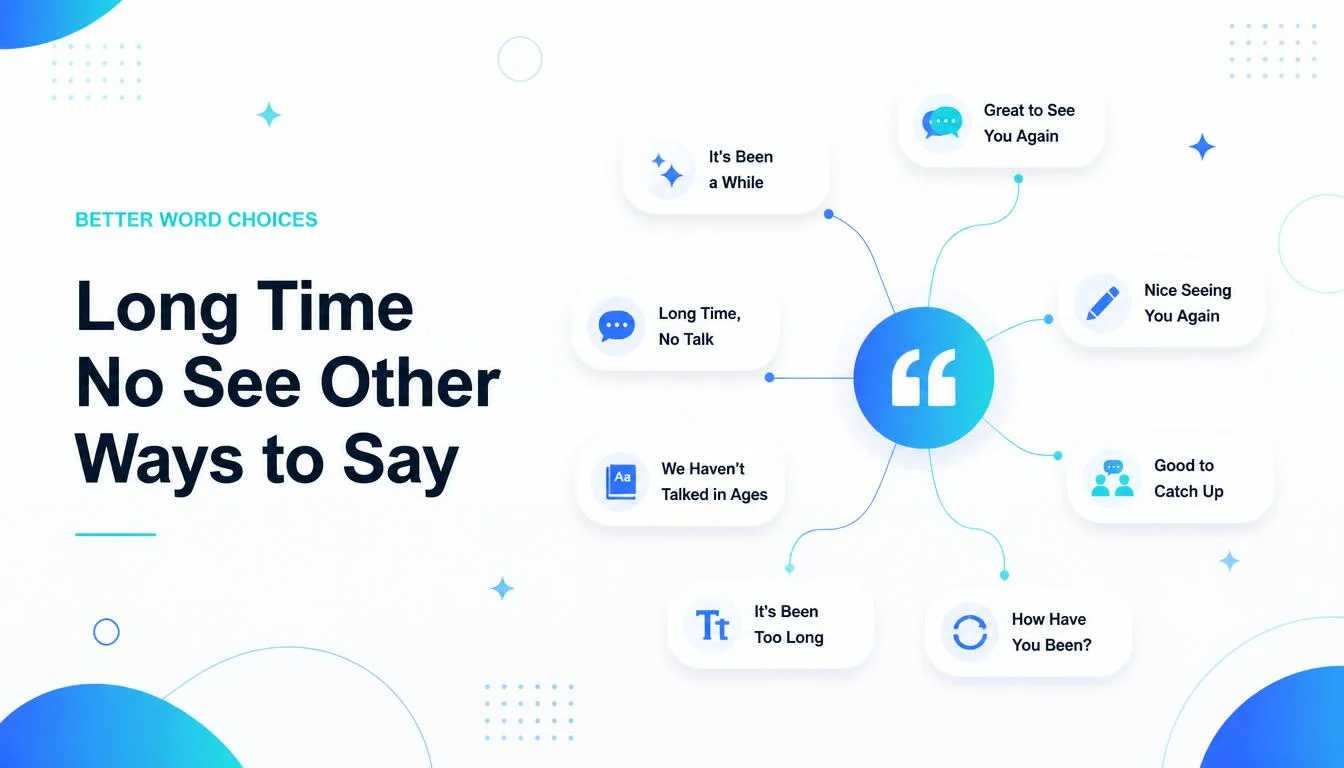
Other ways to say “long time no see” include “It’s been a while,” “It’s been ages,” “Nice to see you again,” and “It’s been so long!”
Looking for other ways to say “long time no see” can help you sound more natural and expressive when reconnecting with someone. The right phrase depends on your relationship, tone, and situation.
Whether you are greeting an old friend, meeting a former colleague, or reconnecting with someone you have not seen recently, these alternatives give you more ways to express warmth and familiarity.
What Is “Long Time No See”? Meaning, Grammar & Real Use
Imagine running into an old colleague at a conference after several years, meeting a former classmate at a café, or reconnecting with a friend you have not spoken to recently. In each situation, “long time no see” immediately communicates recognition and familiarity. It is short, natural, and widely understood in everyday English.
However, English speakers have many alternatives to long time no see, and the best choice depends on your relationship with the person and the setting. A close friend may appreciate a warm expression such as “It’s been ages,” while a professional contact may prefer “It’s good to see you again.” Learning several options can also help you express excitement in English without repeating the same greeting.
“Long time no see” means that you have not seen someone for a considerable period.
Grammatically, it functions as a fixed informal greeting rather than a complete conventional sentence. It is mainly used in spoken English and casual messages.
Example: “Long time no see! How have you been?”
The expression is especially common in friendly, informal conversations. It can also appear in casual workplace interactions when colleagues already know each other well.
When Should You Use “Long Time No See”?
The expression works best when you unexpectedly meet or reconnect with someone after an extended period.
Spoken vs Written
- Spoken: Very natural when greeting a friend, former classmate, or familiar colleague.
- Text messages: Common in casual chats and social messages.
- Emails: Possible in friendly correspondence, but less appropriate for formal business emails.
- Social media: Natural when commenting on or messaging someone you have not seen recently.
Formal vs Informal
- Informal: “Long time no see!” sounds friendly and conversational.
- Neutral: “It’s been a while” works in many everyday situations.
- Professional: “It’s good to see you again” is safer for business settings.
- Formal: “It is a pleasure to see you again” suits more formal interactions.
Is It Professional or Just Polite?
Politeness and professionalism are related, but they are not identical. An expression can be perfectly polite while still sounding too casual for a formal workplace situation.
For example, when greeting a former business contact at an industry event, you could say:
“It’s great to see you again. How have things been?”
This sounds welcoming without being overly familiar.
- Polite? ✔️ Yes
- Professional? ❌ Not usually the best choice for formal communication
“Long time no see” is generally friendly and acceptable among familiar colleagues, but more neutral alternatives are better when speaking with clients, senior professionals, or new business contacts.
Pros and Cons of Using “Long Time No See”
Pros
- Simple: The meaning is immediately clear.
- Friendly: It creates a warm, relaxed atmosphere.
- Common: Many English speakers recognize and use it.
- Natural: It sounds conversational in casual situations.
Cons
- Informal: It may sound too casual in formal business settings.
- Limited tone: It does not communicate much about the relationship.
- Repetitive: Frequent use can make greetings sound predictable.
- Context-dependent: It may not suit a formal email or first professional meeting.
Common Mistakes People Make
Understanding the expression is easy, but learners sometimes use it in contexts where another greeting would sound more natural.
1. Using it with someone you just met
Incorrect: “Long time no see!” to someone you met for the first time today.
Correct: “It’s nice to meet you.”
The expression assumes that you have seen the person before.
2. Using it in a formal business email
Incorrect: “Long time no see. I wanted to discuss the proposal.”
Correct: “It has been a while since we last spoke. I wanted to follow up on the proposal.”
The second version better matches professional written communication.
3. Using it immediately after seeing someone
Incorrect: “Long time no see!” to a colleague you saw yesterday.
Correct: “Good to see you again!”
“Long time no see” normally suggests a meaningful gap between meetings.
4. Treating it as formal grammar
Incorrect: “Long time no see” as a formal sentence in an academic report.
Correct: Use a complete expression such as “It had been several months since we last met.”
The original expression is a fixed conversational greeting.
5. Assuming every alternative has the same tone
Incorrect: Using “It’s been ages” in a formal client meeting.
Correct: “It’s good to see you again.”
Different alternatives communicate different levels of familiarity.
Pull Quote: “Small tone mistakes can make confident English sound careless.”
Alternatives by Category
The best other ways to say long time no see depend on how formal, warm, or casual you want to sound.
Formal alternatives to “Long Time No See”
- It is a pleasure to see you again
- It is good to see you again
- It has been some time since we last met
Pro Tip: For formal situations, choose a complete sentence that acknowledges the time gap without sounding overly familiar.
Casual alternatives
- It’s been a while
- Great to see you again
- How have you been?
Pro Tip: Use these with friends and familiar people when you want your greeting to sound relaxed and natural.
Professional alternatives
- It’s good to see you again
- It’s great to reconnect
- It has been a while since we last spoke
Pro Tip: In professional settings, focus on reconnecting rather than emphasizing the length of the absence.
Informal expressions
- It’s been ages
- Where have you been?
- Look who it is!
Pro Tip: Save playful expressions for people you know well, especially when the relationship supports a humorous tone.
Pull Quote: “Formal and informal English aren’t about correctness. They’re about context.”
Other Ways to Say “Long Time No See”: Full List with Examples
These 30 alternatives help you build fluency and choose the right tone when reconnecting with someone. Some work for casual conversations, while others suit professional situations.
1. Phrase: It’s Been a While
Meaning: A moderate amount of time has passed.
Explanation: A natural, versatile greeting.
Example Sentence: “It’s been a while. How have you been?”
Best Use: Everyday greetings
Worst Use: Formal reports
Tone: Warm, neutral
Context Variability: casual / professional / spoken
2. Phrase: Great to See You Again
Meaning: Happiness about seeing someone again.
Explanation: Shows genuine warmth without being overly casual.
Example Sentence: “Great to see you again after all this time.”
Best Use: Friendly reunions
Worst Use: Formal letters
Tone: Warm, friendly
Context Variability: casual / professional / spoken
3. Phrase: It’s Good to See You Again
Meaning: Pleasure at seeing someone again.
Explanation: A reliable choice for both social and professional settings.
Example Sentence: “It’s good to see you again. How have things been?”
Best Use: Professional greetings
Worst Use: Casual joking
Tone: Polite, neutral
Context Variability: casual / professional / spoken
4. Phrase: How Have You Been?
Meaning: Asking about someone since your last meeting.
Explanation: Naturally follows a reunion greeting.
Example Sentence: “How have you been? It feels like ages.”
Best Use: Personal reunions
Worst Use: First meetings
Tone: Friendly, caring
Context Variability: casual / professional / spoken
5. Phrase: It’s Been Ages
Meaning: A very long time has passed.
Explanation: Emphasizes a lengthy separation.
Example Sentence: “It’s been ages! What have you been up to?”
Best Use: Close friends
Worst Use: Client meetings
Tone: Casual, expressive
Context Variability: casual / professional / spoken
6. Phrase: It’s Been So Long
Meaning: A significant amount of time has passed.
Explanation: Expresses surprise or warmth about the reunion.
Example Sentence: “It’s been so long since we last met.”
Best Use: Personal reunions
Worst Use: Formal reports
Tone: Warm, reflective
Context Variability: casual / professional / spoken
7. Phrase: Nice to See You Again
Meaning: Pleasure at meeting someone again.
Explanation: Simple and polite without sounding overly formal.
Example Sentence: “Nice to see you again after several months.”
Best Use: Familiar contacts
Worst Use: First introductions
Tone: Polite, friendly
Context Variability: casual / professional / spoken
8. Phrase: It’s Wonderful to See You Again
Meaning: Strong pleasure at a reunion.
Explanation: Adds warmth and enthusiasm to the greeting.
Example Sentence: “It’s wonderful to see you again after all these years.”
Best Use: Warm reunions
Worst Use: Routine meetings
Tone: Warm, enthusiastic
Context Variability: casual / professional / spoken
9. Phrase: It’s Great to Have You Back
Meaning: Happiness that someone has returned.
Explanation: Best when the person has returned to a place or group.
Example Sentence: “It’s great to have you back on the team.”
Best Use: Returning colleagues
Worst Use: Random encounters
Tone: Welcoming, positive
Context Variability: casual / professional / spoken
10. Phrase: It’s Good to Reconnect
Meaning: Pleasure at restoring contact.
Explanation: Particularly useful for professional relationships.
Example Sentence: “It’s good to reconnect after so much time.”
Best Use: Business contacts
Worst Use: Close friends
Tone: Professional, warm
Context Variability: casual / professional / spoken
11. Phrase: It’s Great to Reconnect
Meaning: Strong positive feeling about renewed contact.
Explanation: Friendly enough for networking and professional relationships.
Example Sentence: “It’s great to reconnect at this conference.”
Best Use: Networking events
Worst Use: Formal documents
Tone: Positive, professional
Context Variability: casual / professional / spoken
12. Phrase: It Has Been Some Time
Meaning: A considerable period has passed.
Explanation: A restrained alternative suitable for professional situations.
Example Sentence: “It has been some time since our last meeting.”
Best Use: Business conversations
Worst Use: Casual jokes
Tone: Formal, neutral
Context Variability: casual / professional / spoken
13. Phrase: It Has Been a While Since We Last Spoke
Meaning: You have not talked recently.
Explanation: Clearly focuses on communication rather than meeting physically.
Example Sentence: “It has been a while since we last spoke.”
Best Use: Professional follow-ups
Worst Use: Quick greetings
Tone: Polite, professional
Context Variability: casual / professional / spoken
14. Phrase: It Is a Pleasure to See You Again
Meaning: Formal expression of happiness about a reunion.
Explanation: Suitable for formal professional or ceremonial situations.
Example Sentence: “It is a pleasure to see you again, Dr. Khan.”
Best Use: Formal meetings
Worst Use: Close friends
Tone: Formal, courteous
Context Variability: casual / professional / spoken
15. Phrase: I’m Glad to See You Again
Meaning: You feel happy about meeting again.
Explanation: Directly communicates positive emotion.
Example Sentence: “I’m glad to see you again after so long.”
Best Use: Friendly reunions
Worst Use: Formal reports
Tone: Warm, sincere
Context Variability: casual / professional / spoken
16. Phrase: Good to Catch Up Again
Meaning: Pleasant to talk after time apart.
Explanation: Implies conversation about recent experiences and news.
Example Sentence: “Good to catch up again after the holidays.”
Best Use: Familiar colleagues
Worst Use: Formal introductions
Tone: Casual, friendly
Context Variability: casual / professional / spoken
17. Phrase: It’s Nice Catching Up With You
Meaning: Enjoyment of reconnecting and talking.
Explanation: Focuses on the conversation rather than simply seeing someone.
Example Sentence: “It’s nice catching up with you after all this time.”
Best Use: Friendly conversations
Worst Use: Formal correspondence
Tone: Warm, conversational
Context Variability: casual / professional / spoken
18. Phrase: We Haven’t Seen Each Other in a While
Meaning: You have not met recently.
Explanation: A direct and natural description of the situation.
Example Sentence: “We haven’t seen each other in a while. How are things?”
Best Use: Personal reunions
Worst Use: Formal reports
Tone: Neutral, friendly
Context Variability: casual / professional / spoken
19. Phrase: It’s Been Too Long
Meaning: You feel the separation lasted longer than desired.
Explanation: Adds emotional warmth to a reunion.
Example Sentence: “It’s been too long! We should catch up soon.”
Best Use: Close relationships
Worst Use: Formal meetings
Tone: Warm, expressive
Context Variability: casual / professional / spoken
20. Phrase: How Long Has It Been?
Meaning: Asking about the time since your last meeting.
Explanation: Useful when the gap feels surprisingly long.
Example Sentence: “How long has it been? I think it’s been years.”
Best Use: Unexpected reunions
Worst Use: Formal emails
Tone: Casual, surprised
Context Variability: casual / professional / spoken
21. Phrase: Where Have You Been?
Meaning: Asking playfully about someone’s absence.
Explanation: Can sound humorous or genuinely curious depending on tone.
Example Sentence: “Where have you been? I haven’t seen you in months!”
Best Use: Close friends
Worst Use: Formal contacts
Tone: Playful, informal
Context Variability: casual / professional / spoken
22. Phrase: Look Who It Is!
Meaning: A playful reaction to seeing someone unexpectedly.
Explanation: Creates a lighthearted reunion moment.
Example Sentence: “Look who it is! What brings you here?”
Best Use: Surprise encounters
Worst Use: Business meetings
Tone: Playful, informal
Context Variability: casual / professional / spoken
23. Phrase: I Haven’t Seen You in Forever
Meaning: It feels like an extremely long time.
Explanation: Hyperbolic and conversational rather than literal.
Example Sentence: “I haven’t seen you in forever. How are you?”
Best Use: Close friends
Worst Use: Formal settings
Tone: Casual, expressive
Context Variability: casual / professional / spoken
24. Phrase: It Feels Like Forever
Meaning: The separation seems very long.
Explanation: Expresses emotion rather than measuring exact time.
Example Sentence: “It feels like forever since we last met.”
Best Use: Emotional reunions
Worst Use: Formal emails
Tone: Warm, expressive
Context Variability: casual / professional / spoken
25. Phrase: We Go Way Back
Meaning: You have known someone for a long time.
Explanation: Highlights a long-standing relationship rather than only recent absence.
Example Sentence: “We go way back, so it’s great to see her again.”
Best Use: Personal connections
Worst Use: Formal introductions
Tone: Casual, familiar
Context Variability: casual / professional / spoken
26. Phrase: It’s Been Quite Some Time
Meaning: A significant period has passed.
Explanation: A more polished way to acknowledge a long gap.
Example Sentence: “It’s been quite some time since our last discussion.”
Best Use: Professional settings
Worst Use: Casual jokes
Tone: Polished, neutral
Context Variability: casual / professional / spoken
27. Phrase: It’s Been a Long Time
Meaning: A long period has passed since the last meeting.
Explanation: Direct and neutral without the informality of the original phrase.
Example Sentence: “It’s been a long time. How have things been?”
Best Use: General reunions
Worst Use: First meetings
Tone: Neutral, warm
Context Variability: casual / professional / spoken
28. Phrase: It’s Been a Long Time Since We Met
Meaning: You have not met for a considerable period.
Explanation: A complete, clear alternative that works in many contexts.
Example Sentence: “It’s been a long time since we met. How are you?”
Best Use: General conversations
Worst Use: First introductions
Tone: Neutral, polite
Context Variability: casual / professional / spoken
29. Phrase: We Should Catch Up
Meaning: You would like to talk and reconnect.
Explanation: Often follows a reunion and suggests future conversation.
Example Sentence: “It’s great to see you. We should catch up soon.”
Best Use: Future plans
Worst Use: Formal greetings
Tone: Friendly, casual
Context Variability: casual / professional / spoken
30. Phrase: It’s Good to Have the Chance to See You Again
Meaning: Appreciation for another opportunity to meet.
Explanation: A polished option for professional relationships.
Example Sentence: “It’s good to have the chance to see you again.”
Best Use: Professional reunions
Worst Use: Casual greetings
Tone: Polished, courteous
Context Variability: casual / professional / spoken
Comparison Table: Top 10 Alternatives at a Glance
| Phrase | Tone | Best Use |
|---|---|---|
| It’s Been a While | Neutral, friendly | Everyday greetings |
| Great to See You Again | Warm, friendly | Friendly reunions |
| It’s Good to See You Again | Polite, neutral | Professional greetings |
| How Have You Been? | Friendly, caring | Personal reunions |
| It’s Been Ages | Casual, expressive | Close friends |
| It’s Been So Long | Warm, reflective | Personal reunions |
| Nice to See You Again | Polite, friendly | Familiar contacts |
| It’s Good to Reconnect | Professional, warm | Business contacts |
| It Has Been Some Time | Formal, neutral | Business conversations |
| It’s Great to Reconnect | Positive, professional | Networking events |
Quick Self-Check
Test whether you can choose the right expression for each situation.
Question 1
You unexpectedly meet a close friend you have not seen for three years. Which option sounds most natural?
A. It is a pleasure to see you again.
B. It’s been ages!
C. It has been some time since our correspondence.
D. It is good to have the chance to see you again.
Answer: B
Question 2
You meet a former client at a professional conference. Which greeting is safest?
A. Look who it is!
B. Where have you been?
C. It’s good to see you again.
D. I haven’t seen you in forever!
Answer: C
Question 3
You want to suggest meeting a friend for a longer conversation after unexpectedly seeing them. What should you say?
A. We should catch up.
B. It is a pleasure to see you again.
C. It has been some time.
D. It has been a while since our last meeting.
Answer: A
Question 4
Which expression is most formal?
A. It’s been ages.
B. Look who it is!
C. It is a pleasure to see you again.
D. Where have you been?
Answer: C
FAQs
What are the best other ways to say “long time no see”?
Popular options include “It’s been a while,” “It’s good to see you again,” “Great to see you again,” and “How have you been?”
What is a professional way to say “long time no see”?
Use “It’s good to see you again,” “It’s good to reconnect,” or “It has been some time since we last spoke” in professional situations.
Is “long time no see” formal or informal?
“Long time no see” is informal. It is common in friendly spoken English but is generally less suitable for formal writing.
Can I use “long time no see” in an email?
You can use it in a casual email to someone you know well. For professional emails, “It has been a while since we last spoke” is usually more appropriate.
What can I say instead of “long time no see” to a friend?
Try “It’s been ages,” “It’s been so long,” “I haven’t seen you in forever,” or “Great to see you again.”
conclusion
Knowing different alternatives helps you sound more natural and flexible when reconnecting with people. Instead of relying on one greeting, choose an expression that matches your relationship, the length of time apart, and the setting.
For everyday conversations, friendly phrases such as “It’s been a while” work well. In professional situations, expressions such as “It’s good to see you again” or “It’s good to reconnect” provide a more polished impression. Regularly practicing these professional reaction phrases alongside informal expressions in English will make your spoken communication more adaptable.
Read More Related Articles:
- Other Ways to Say “Let’s Go Team” | Games, Work and More In 2026
- Other Ways to Say Problem Solving Skills | Make Your Resume Stronger In 2026
- Other Ways to Say No in Spanish | Simple Ways to Sound Fluent In 2026

Daniel Murphy is a professional writer and blogger specializing in digital communication and messaging trends. As a contributor to TextsResponse.com, he creates reader-focused content designed to help people find the right words at the right time.