Quick Answer
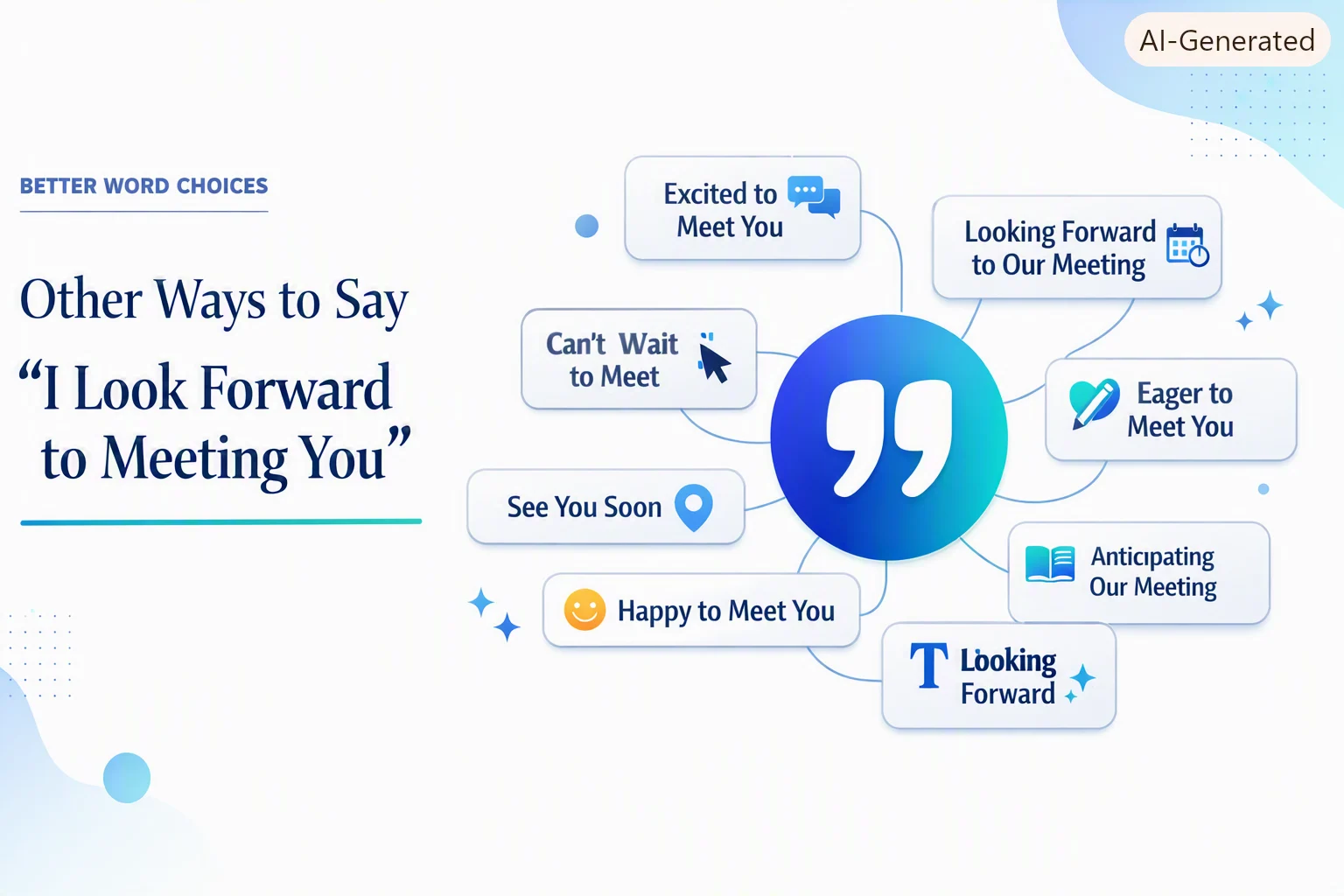
If you want fresh ways to express anticipation before meeting someone, try phrases like excited to connect, can’t wait to meet you, looking forward to our conversation, eager to meet in person, or anticipating our meeting. Each option carries a slightly different tone, so choosing the right one helps you sound more fluent and situationally aware.Top 5 alternatives: excited to connect, can’t wait to meet you, looking forward to our conversation, eager to meet in person, anticipating our meeting.
“I look forward to meeting you” is one of the most common closing lines in emails, introductions, and professional messages. It signals politeness, enthusiasm, and readiness for an upcoming interaction. People use it in job interviews, networking emails, client introductions, and casual social plans alike.
Because this phrase appears so often, repeating it constantly can make your writing feel flat or generic. Learning alternatives to “I look forward to meeting you” allows you to match your tone precisely, whether you’re writing a formal business email or a friendly text message. It also helps you express excitement in English in a way that feels natural rather than repetitive.
Mastering these variations is a small but powerful step toward sounding more confident, polished, and native-like in both spoken and written English.
Quick Categories
Formal Alternatives to “I Look Forward to Meeting You”
- I look forward to our meeting
- I am eager to make your acquaintance
- I anticipate our meeting with great interest
- It will be a pleasure to meet you
Pro Tip: Use formal alternatives in emails to executives, clients, or new business contacts to maintain a polished, respectful tone.
Casual Alternatives
- Can’t wait to meet you
- So excited to see you soon
- Looking forward to hanging out
- Can’t wait for this
Pro Tip: Save casual phrases for friends, peers, or informal social settings where a relaxed tone fits naturally.
Professional Alternatives
- Looking forward to our conversation
- Eager to connect with you
- I welcome the opportunity to meet
- Looking forward to collaborating with you
Pro Tip: Professional alternatives work best in workplace emails, interviews, and networking messages where warmth and formality must balance.
Informal Expressions
- Stoked to meet you
- Pumped for this
- Can’t wait, see you soon
- This is going to be great
Pro Tip: Informal expressions suit texts or chats with close contacts, but avoid them in first-time professional introductions.
The right tone makes your English sound professional and confident.
Common Mistakes
- Overusing the exact phrase in every email. Example: Writing “I look forward to meeting you” in three consecutive messages to the same person.
- Using casual phrases in formal settings. Example: “Can’t wait to meet you!” sent to a company CEO during a first introduction.
- Mismatching tone with context. Example: Using “stoked to meet you” in a legal or academic email.
- Forgetting subject-verb agreement in longer variations. Example: “I am looking forward meeting you” instead of “I am looking forward to meeting you.”
- Adding excessive enthusiasm in serious business contexts. Example: “I am beyond thrilled and cannot wait!!!” in a formal proposal email.
What Does “I Look Forward to Meeting You” Mean?
This phrase expresses polite anticipation about an upcoming meeting or introduction. Grammatically, “look forward to” is followed by a gerund (verb + ing), not a base verb, so it becomes “meeting” rather than “meet.”
Example Sentence: I look forward to meeting you at next week’s conference.
When to Use “I Look Forward to Meeting You”
- Closing a professional email before a first meeting
- Responding to a job interview invitation
- Introducing yourself to a new client or partner
- Confirming attendance at an event or appointment
Spoken vs Written
- Spoken: Often shortened to “Looking forward to it” in conversation.
- Written: Typically used in full form at the end of emails or letters.
Formal vs Informal
- Formal: “I look forward to meeting you at the scheduled time.”
- Informal: “Can’t wait to meet you!”
Is It Professional or Polite to Say “I Look Forward to Meeting You”?
This phrase is both polite and professional in most contexts. It works well in emails, cover letters, and business introductions because it conveys respect without being overly casual.
Business Example: “Thank you for confirming the interview. I look forward to meeting you on Thursday.”
Polite? Yes Professional? Yes
Pros and Cons of Using “I Look Forward to Meeting You”
Pros
- Simple and natural
- Friendly tone
- Common usage
- Easy to understand
Cons
- Overused in emails
- Limited emotional range
- Can sound repetitive if used often
- Doesn’t adapt well to very casual settings
Other Ways to Say I Look Forward to Meeting You
These alternatives will help you sound more fluent, confident, and natural in different situations. Use them according to tone, context, and audience to express excitement, admiration, or approval.
1. Phrase: Excited to Connect
Meaning: Eager to begin interacting or communicating.
Explanation: A modern, professional way to show enthusiasm for a first meeting.
Example Sentence: “Excited to connect and discuss the project details.”
Best Use: Networking emails
Worst Use: Formal legal letters
Tone: Warm, modern, professional
Context Variability: Professional / Spoken
2. Phrase: Can’t Wait to Meet You
Meaning: Strong enthusiasm about an upcoming meeting.
Explanation: A casual, energetic phrase that shows genuine excitement.
Example Sentence: “Can’t wait to meet you at the event this weekend.”
Best Use: Casual messages
Worst Use: Formal interviews
Tone: Enthusiastic, casual, friendly
Context Variability: Casual / Spoken
3. Phrase: Looking Forward to Our Conversation
Meaning: Anticipating a discussion or dialogue.
Explanation: Ideal when the meeting will focus on talking or exchanging ideas.
Example Sentence: “Looking forward to our conversation about the new proposal.”
Best Use: Business calls
Worst Use: Short text messages
Tone: Professional, thoughtful, calm
Context Variability: Professional / Written
4. Phrase: Eager to Meet in Person
Meaning: Wanting to meet face-to-face rather than virtually.
Explanation: Useful when transitioning from online communication to an in-person meeting.
Example Sentence: “After our calls, I’m eager to meet in person.”
Best Use: Client relationships
Worst Use: Casual chats
Tone: Sincere, professional, warm
Context Variability: Professional / Spoken
5. Phrase: Anticipating Our Meeting
Meaning: Formally expecting an upcoming meeting.
Explanation: A more formal, slightly reserved way to express anticipation.
Example Sentence: “I am anticipating our meeting next Monday.”
Best Use: Formal emails
Worst Use: Casual conversations
Tone: Formal, composed, respectful
Context Variability: Professional / Written
6. Phrase: I Am Eager to Make Your Acquaintance
Meaning: Looking forward to being introduced formally.
Explanation: A classic, formal phrase commonly used in traditional business writing.
Example Sentence: “I am eager to make your acquaintance at the summit.”
Best Use: Formal introductions
Worst Use: Text messages
Tone: Formal, polished, respectful
Context Variability: Professional / Written
7. Phrase: It Will Be a Pleasure to Meet You
Meaning: Expressing that the meeting will be enjoyable.
Explanation: A polite and warm phrase often used in client-facing communication.
Example Sentence: “It will be a pleasure to meet you at the conference.”
Best Use: Client emails
Worst Use: Informal texts
Tone: Polite, warm, formal
Context Variability: Professional / Written
8. Phrase: So Excited to See You Soon
Meaning: Strong personal excitement about meeting someone.
Explanation: A friendly, upbeat phrase for personal or semi-formal situations.
Example Sentence: “So excited to see you soon at the reunion.”
Best Use: Personal messages
Worst Use: Formal reports
Tone: Cheerful, casual, warm
Context Variability: Casual / Spoken
9. Phrase: Looking Forward to Hanging Out
Meaning: Anticipating spending casual time together.
Explanation: A strictly informal phrase used between friends or close acquaintances.
Example Sentence: “Looking forward to hanging out this weekend.”
Best Use: Friend groups
Worst Use: Business settings
Tone: Relaxed, playful, casual
Context Variability: Casual / Spoken
10. Phrase: Welcome the Opportunity to Meet
Meaning: Appreciating the chance to meet someone.
Explanation: A respectful, slightly formal way to express openness.
Example Sentence: “I welcome the opportunity to meet and discuss the next steps.”
Best Use: Job interviews
Worst Use: Casual chats
Tone: Respectful, professional, gracious
Context Variability: Professional / Written
11. Phrase: Eager to Connect with You
Meaning: Wanting to establish a connection or relationship.
Explanation: Common in networking and LinkedIn-style communication.
Example Sentence: “Eager to connect with you at the upcoming summit.”
Best Use: LinkedIn messages
Worst Use: Formal letters
Tone: Friendly, professional, modern
Context Variability: Professional / Spoken
12. Phrase: Looking Forward to Collaborating with You
Meaning: Anticipating working together.
Explanation: Best used when the meeting is tied to a shared project or task.
Example Sentence: “Looking forward to collaborating with you on this campaign.”
Best Use: Teamwork emails
Worst Use: First-time introductions
Tone: Professional, positive, collaborative
Context Variability: Professional / Written
13. Phrase: Stoked to Meet You
Meaning: Very excited to meet someone.
Explanation: A slang-based, high-energy phrase for informal use.
Example Sentence: “Stoked to meet you at the concert tonight.”
Best Use: Casual texts
Worst Use: Business emails
Tone: Energetic, slang, casual
Context Variability: Casual / Spoken
14. Phrase: Pumped for This
Meaning: Extremely excited about the upcoming event or meeting.
Explanation: Informal slang commonly used among younger speakers.
Example Sentence: “Pumped for this—see you Friday!”
Best Use: Friend chats
Worst Use: Formal settings
Tone: Slang, enthusiastic, casual
Context Variability: Casual / Spoken
15. Phrase: This Is Going to Be Great
Meaning: Expressing positive expectations about the meeting.
Explanation: An indirect but effective way to show anticipation.
Example Sentence: “This is going to be great—I can’t wait to catch up.”
Best Use: Informal plans
Worst Use: Professional emails
Tone: Casual, optimistic, relaxed
Context Variability: Casual / Spoken
16. Phrase: Really Looking Forward to It
Meaning: A stronger version of the standard phrase.
Explanation: Adds emphasis while remaining neutral and professional.
Example Sentence: “Really looking forward to it. Thanks for setting this up.”
Best Use: Semi-formal emails
Worst Use: Legal documents
Tone: Warm, sincere, neutral
Context Variability: Professional / Spoken
17. Phrase: Delighted at the Prospect of Meeting You
Meaning: Formally pleased about a future meeting.
Explanation: An elegant, slightly old-fashioned phrase ideal for formal correspondence.
Example Sentence: “I am delighted at the prospect of meeting you next week.”
Best Use: Formal correspondence
Worst Use: Casual texting
Tone: Formal, elegant, polite
Context Variability: Professional / Written
18. Phrase: Excited for What’s Ahead
Meaning: Anticipating both the meeting and future opportunities.
Explanation: Suggests optimism about ongoing collaboration.
Example Sentence: “Excited for what’s ahead as we begin working together.”
Best Use: Partnership emails
Worst Use: Brief introductions
Tone: Hopeful, professional, forward-looking
Context Variability: Professional / Written
19. Phrase: Can Hardly Wait
Meaning: Expressing strong excitement and impatience.
Explanation: A vivid, expressive phrase for informal situations.
Example Sentence: “I can hardly wait to see everyone at the meetup.”
Best Use: Personal messages
Worst Use: Corporate emails
Tone: Expressive, casual, eager
Context Variability: Casual / Spoken
20. Phrase: Honored to Meet You Soon
Meaning: Expressing respect and anticipation together.
Explanation: Ideal when meeting someone senior or highly respected.
Example Sentence: “I am honored to meet you soon at the ceremony.”
Best Use: Formal introductions
Worst Use: Casual meetups
Tone: Respectful, formal, humble
Context Variability: Professional / Written
21. Phrase: Looking Forward to Putting a Face to the Name
Meaning: Excited to meet someone previously known only online or by phone.
Explanation: A friendly idiom commonly used in professional networking.
Example Sentence: “Looking forward to putting a face to the name at the conference.”
Best Use: Remote work introductions
Worst Use: Very formal letters
Tone: Friendly, professional, conversational
Context Variability: Professional / Spoken
22. Phrase: Thrilled About Our Upcoming Meeting
Meaning: Very excited about a scheduled meeting.
Explanation: A stronger, upbeat professional alternative.
Example Sentence: “I’m thrilled about our upcoming meeting next Tuesday.”
Best Use: Client updates
Worst Use: Neutral internal memos
Tone: Enthusiastic, professional, warm
Context Variability: Professional / Written
23. Phrase: Can’t Wait for Us to Finally Meet
Meaning: Expressing excitement after a long wait or delay.
Explanation: Ideal when the meeting has been postponed or long anticipated.
Example Sentence: “Can’t wait for us to finally meet after all these calls.”
Best Use: Long-distance contacts
Worst Use: First-time formal emails
Tone: Warm, casual, sincere
Context Variability: Casual / Spoken
24. Phrase: Looking Forward to the Introduction
Meaning: Anticipating being formally introduced.
Explanation: Useful when a third party is arranging the meeting.
Example Sentence: “Looking forward to the introduction next week.”
Best Use: Mutual connections
Worst Use: Direct personal messages
Tone: Formal, neutral, professional
Context Variability: Professional / Written
25. Phrase: Keen to Meet You
Meaning: Interested and eager to meet someone.
Explanation: Common in British English and slightly more formal than excited.
Example Sentence: “I’m keen to meet you and discuss the role further.”
Best Use: Interview follow-ups
Worst Use: Very casual texts
Tone: Professional, polite, interested
Context Variability: Professional / Spoken
26. Phrase: Looking Forward to the Pleasure of Your Company
Meaning: A formal, elegant way to anticipate someone’s presence.
Explanation: A traditional phrase suited for invitations and formal events.
Example Sentence: “We look forward to the pleasure of your company at the gala.”
Best Use: Formal invitations
Worst Use: Everyday emails
Tone: Formal, elegant, ceremonial
Context Variability: Professional / Written
27. Phrase: Excited to Finally Meet Face to Face
Meaning: Emphasizing the shift from virtual to in-person contact.
Explanation: Ideal for remote teams or online connections meeting in person.
Example Sentence: “Excited to finally meet face to face after months of calls.”
Best Use: Remote collaborations
Worst Use: Formal legal contexts
Tone: Warm, genuine, professional
Context Variability: Professional / Spoken
28. Phrase: Really Excited About This Meeting
Meaning: A direct, simple expression of enthusiasm.
Explanation: Neutral enough for both semi-formal and casual settings.
Example Sentence: “Really excited about this meeting—see you soon.”
Best Use: Everyday professional communication
Worst Use: Highly formal documents
Tone: Sincere, upbeat, neutral
Context Variability: Professional / Casual
29. Phrase: Awaiting Our Meeting with Anticipation
Meaning: Formally expressing eagerness for an upcoming meeting.
Explanation: A slightly literary, formal alternative.
Example Sentence: “I am awaiting our meeting with anticipation.”
Best Use: Formal letters
Worst Use: Informal texts
Tone: Formal, literary, composed
Context Variability: Professional / Written
30. Phrase: Looking Forward to Seeing You in Person
Meaning: Emphasizing the in-person nature of an upcoming meeting.
Explanation: A clear and natural phrase often used when confirming meeting arrangements.
Example Sentence: “Looking forward to seeing you in person next Friday.”
Best Use: Confirming meeting logistics
Worst Use: Purely virtual meetings
Tone: Neutral, professional, clear
Context Variability: Professional / Spoken
“Small changes in wording create big changes in tone.”
“Excitement sounds more genuine when your words match the moment.”
Mini Quiz
1. Which phrase is most appropriate for a formal business email to a new client?
A) Stoked to meet you
B) I look forward to our meeting
C) Pumped for this
Answer: B
2. Which alternative best fits a text message to a close friend?
A) Looking forward to the pleasure of your company
B) Can’t wait to meet you
C) Anticipating our meeting
Answer: B
3. Which phrase suits a remote team meeting someone in person for the first time?
A) Looking forward to putting a face to the name
B) This is going to be great
C) Awaiting our meeting with anticipation
Answer: A
4. Which phrase is grammatically correct?
A) I look forward to meet you
B) I look forward to meeting you
C) I looking forward meeting you
Answer: B
Comparison Table: Top Alternatives
| Phrase | Tone | Best Use |
|---|---|---|
| Excited to connect | warm, modern | networking emails |
| Can’t wait to meet you | enthusiastic, casual | casual messages |
| Looking forward to our conversation | professional, calm | business calls |
| Eager to meet in person | sincere, professional | client relationships |
| Anticipating our meeting | formal, composed | formal emails |
| I am eager to make your acquaintance | formal, polished | formal introductions |
| Welcome the opportunity to meet | respectful, professional | job interviews |
| Eager to connect with you | friendly, modern | LinkedIn messages |
| Keen to meet you | professional, polite | interview follow-ups |
| Looking forward to seeing you in person | neutral, clear | confirming logistics |
FAQs
Is “I look forward to meeting you” grammatically correct?
Yes, it is correct because “look forward to” is followed by a gerund, as in “meeting.”
What is a more formal alternative to “I look forward to meeting you”?
“I anticipate our meeting with great interest” or “I am eager to make your acquaintance” are strong formal alternatives.
What is a casual way to say “I look forward to meeting you”?
“Can’t wait to meet you” or “So excited to see you soon” work well in casual contexts.
Can I use “excited to connect” in a job application email?
Yes, it is a professional and modern phrase suitable for networking or interview follow-ups.
Why should I use different alternatives instead of repeating the same phrase?
Using varied alternatives to “I look forward to meeting you” keeps your writing engaging and shows stronger English fluency.
Conclusion
Learning multiple ways to express anticipation, such as alternatives to “I look forward to meeting you,” strengthens both your written and spoken English. It allows you to match tone precisely, whether you’re writing a formal business email or sending a friendly message.
Practice using a few of these phrases daily in real conversations or emails. Paying attention to tone, context, and audience will help you sound more confident, natural, and professional every time you communicate.
Read More Related Articles:
- Other Ways to Say “Next” in an Essay | Make Every Paragraph Shine In 2026
- Other Ways to Say “Due to the Fact That” | Like a Skilled Writer In 2026
- Other Ways to Say Good | Leave a Stronger Impression In 2026
Victoria Hughes is a content writer dedicated to making communication clearer and more effective. Through TextsResponse.com, she shares practical insights and thoughtfully crafted response ideas that help readers express themselves with confidence.