Quick Answer:
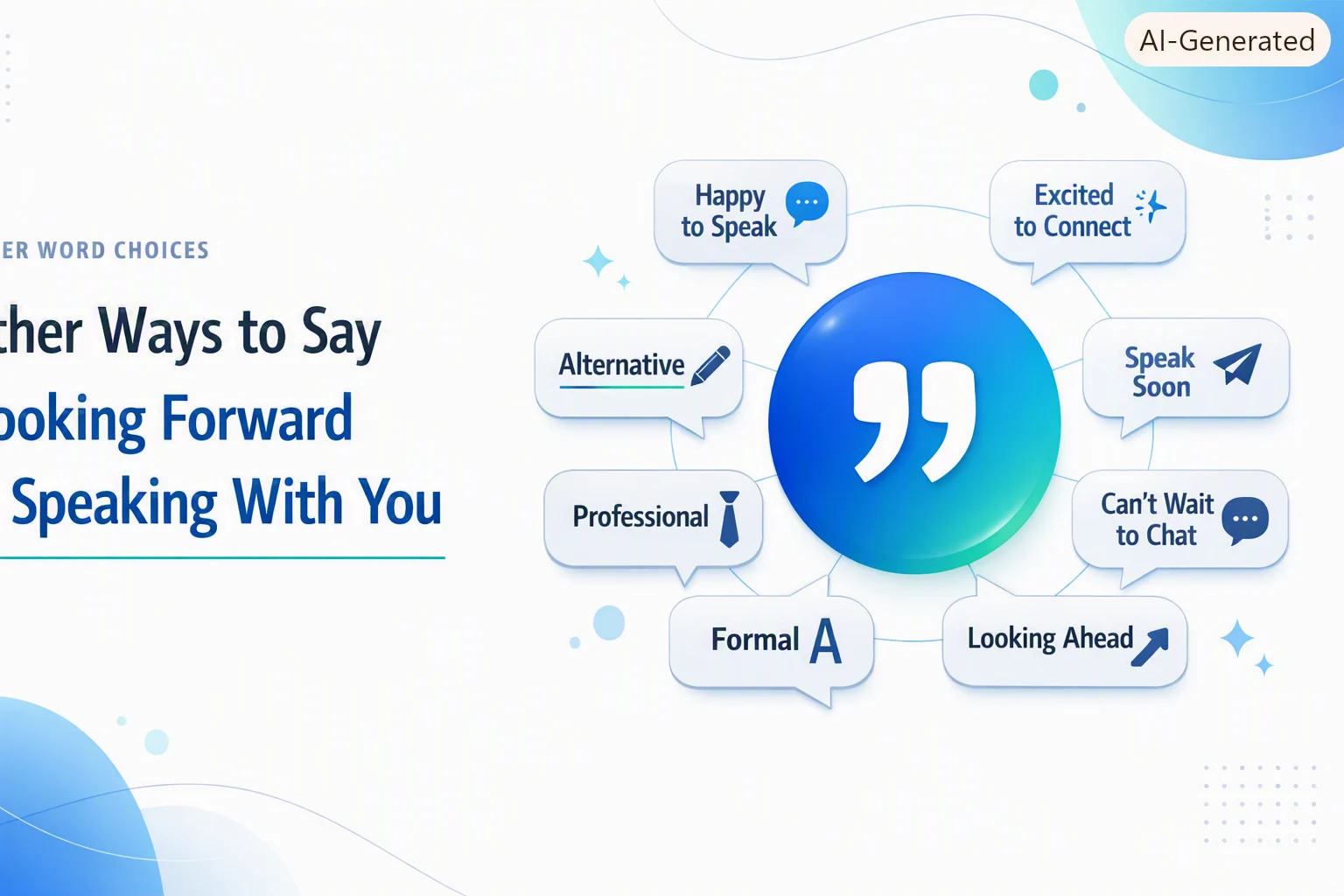
Looking for alternatives to looking forward to speaking with you? Here are 5 top options: I eagerly await our conversation, I’m excited to connect with you, I anticipate our discussion, I’m eager to speak with you, and Looking forward to our call.
The phrase “looking forward to speaking with you” is one of the most common closings in professional emails, meeting confirmations, and business correspondence. It expresses anticipation, positivity, and respect toward an upcoming conversation. But here’s the problem: it’s overused. When you rely on the same phrase repeatedly, your message can start to sound generic, robotic, and impersonal.
Learning Other Ways to Say “Looking Forward to Speaking With You” does more than just expand your vocabulary it transforms how others perceive you. Using varied phrases shows emotional intelligence, cultural awareness, and communication flexibility. It helps you express excitement in English with precision, whether you’re writing to a CEO, a team member, or a potential client.
“The right tone makes your English sound professional and confident.”
Quick Categories
Formal Alternatives to “Looking Forward to Speaking With You”
- I eagerly await our conversation
- I anticipate our discussion
- I look forward to our forthcoming dialogue
- I await the opportunity to speak with you
Casual Alternatives
- Can’t wait to chat
- Excited to catch up
- Talk soon!
- Looking forward to our chat
Professional Alternatives
- I’m eager to speak with you
- I’m excited to connect with you
- I’m keen to discuss this with you
- I’m enthusiastic about our upcoming conversation
Informal Expressions
- Can’t wait to talk!
- Excited to finally chat
- Looking forward to catching up
- Chat soon!
💡 Pro Tip: Match your phrase to your relationship with the recipient. A formal alternative builds respect with senior leaders; a casual one builds rapport with teammates.
What Does “Looking Forward to Speaking With You” Mean?
The phrase “looking forward to speaking with you” expresses positive anticipation and respect toward an upcoming conversation. It signals that you value the interaction and are genuinely interested in what the other person has to say.
Grammar note: “Look forward to” is always followed by a gerund (-ing form), not an infinitive. So it’s “looking forward to speaking” never “looking forward to speak.”
Example:
“Thank you for scheduling this meeting. I look forward to speaking with you about the project timeline.”
When to Use “Looking Forward to Speaking With You”
Common contexts:
- Before job interviews to express readiness and respect
- In client emails to confirm meetings and show professionalism
- In follow-up messages to keep the conversation warm
- In networking correspondence to build new connections
Spoken vs Written: More common in written communication (emails, LinkedIn messages, formal letters). In spoken English, people often use shorter, more casual alternatives.
Formal vs Informal: The phrase sits in a neutral to slightly formal register. It works in both business and semi-formal personal contexts, but it’s not ideal for very casual chats with friends.
Is It Professional or Polite to Say “Looking Forward to Speaking With You”?
Polite? ✔️ Yes it conveys respect and courtesy.
Professional? ⚠️ In most cases yes, but it’s not always the best choice. While widely accepted in business communication, using it too often can make you sound formulaic rather than genuinely engaged.
Business-style example:
“I appreciate your time today and look forward to speaking with you further about this opportunity.”
“Professional communication isn’t about using the right phrase it’s about using the right phrase for the right person.”
Pros and Cons of Using “Looking Forward to Speaking With You”
Pros:
- Simple and natural
- Friendly and approachable tone
- Widely understood and accepted
- Easy to use in any written context
Cons:
- Too informal for very formal documents (e.g., legal correspondence)
- Overused can sound generic
- Limited emotional range doesn’t convey real enthusiasm
- Not suitable for academic or highly formal writing
Other Ways to Say “Looking Forward to Speaking With You”
These 30 alternatives will help you sound more fluent, confident, and natural in different situations. Use them according to tone, context, and audience to express excitement in English with precision.
1. Phrase: I eagerly await our conversation.
Meaning: Expresses strong, patient anticipation for an upcoming discussion.
Explanation: This is one of the most formal alternatives, ideal for executive-level communication.
Example Sentence: “I eagerly await our conversation regarding the merger next Thursday.”
Best Use: Executive emails
Worst Use: Casual team chats
Tone: Formal, polished, respectful
Context Variability: Professional / Written
2. Phrase: I anticipate our discussion with great interest.
Meaning: Shows you are intellectually curious about the upcoming dialogue.
Explanation: Adds a layer of sophistication and genuine curiosity.
Example Sentence: “I anticipate our discussion with great interest and have prepared several proposals.”
Best Use: Business proposals
Worst Use: Quick check-ins
Tone: Intellectual, professional
Context Variability: Professional / Written & Spoken
3. Phrase: I await our discussion.
Meaning: A direct, formal way to say you’re waiting for the conversation.
Explanation: Slightly more formal and traditional than “look forward to.”
Example Sentence: “I await our discussion regarding the new policy implementation.”
Best Use: Official correspondence
Worst Use: Friendly emails
Tone: Traditional, formal
Context Variability: Professional / Written
4. Phrase: I look forward to our forthcoming dialogue.
Meaning: Anticipates a formal, structured exchange of ideas.
Explanation: “Forthcoming” and “dialogue” elevate the level of formality.
Example Sentence: “I look forward to our forthcoming dialogue on the strategic direction.”
Best Use: Board meetings
Worst Use: Casual catch-ups
Tone: Elevated, professional
Context Variability: Professional / Written
5. Phrase: I am enthusiastic about our upcoming discussion.
Meaning: Expresses genuine excitement in a polished, professional way.
Explanation: Balances professionalism with warmth.
Example Sentence: “I am enthusiastic about our upcoming discussion and the possibilities it holds.”
Best Use: Partnership talks
Worst Use: Routine updates
Tone: Warm, professional
Context Variability: Professional / Written & Spoken
6. Phrase: I’m excited to connect with you.
Meaning: Shows genuine enthusiasm about establishing a professional connection.
Explanation: Adds energy while remaining workplace-appropriate.
Example Sentence: “I’m excited to connect with you during tomorrow’s strategy session.”
Best Use: Networking, collaborations
Worst Use: Complaint emails
Tone: Upbeat, professional
Context Variability: Professional / Written & Spoken
7. Phrase: I’m eager to speak with you.
Meaning: Conveys keen interest in the upcoming conversation.
Explanation: A versatile, professional alternative that works in most business contexts.
Example Sentence: “I’m eager to speak with you about the upcoming project milestones.”
Best Use: Project discussions
Worst Use: Very formal legal correspondence
Tone: Engaged, professional
Context Variability: Professional / Written & Spoken
8. Phrase: I’m keen to discuss this with you.
Meaning: Shows strong interest, particularly common in British English.
Explanation: Adds a touch of personality while remaining professional.
Example Sentence: “I’m keen to discuss this with you during our next call.”
Best Use: British business contexts
Worst Use: American casual settings
Tone: Eager, professional
Context Variability: Professional / Written & Spoken
9. Phrase: I’m looking forward to our discussion.
Meaning: A polished variation that emphasizes the dialogue itself.
Explanation: Slightly more formal than the original by focusing on “discussion.”
Example Sentence: “I’m looking forward to our discussion about the new marketing strategy.”
Best Use: Meeting confirmations
Worst Use: Personal messages
Tone: Professional, respectful
Context Variability: Professional / Written
10. Phrase: I’m excited about our upcoming conversation.
Meaning: Combines professionalism with genuine enthusiasm.
Explanation: Works well when you want to show you care about the interaction.
Example Sentence: “I’m excited about our upcoming conversation regarding the partnership.”
Best Use: Client meetings
Worst Use: Difficult negotiations
Tone: Enthusiastic, professional
Context Variability: Professional / Written & Spoken
11. Phrase: I value the chance to speak with you.
Meaning: Expresses gratitude and respect for the opportunity.
Explanation: Shows humility and appreciation, making it excellent for interviews.
Example Sentence: “I value the chance to speak with you about this position.”
Best Use: Interviews
Worst Use: Internal team updates
Tone: Grateful, respectful
Context Variability: Professional / Written
12. Phrase: I’m grateful for the opportunity to talk.
Meaning: Emphasizes appreciation for the upcoming interaction.
Explanation: Warm and professional, showing you don’t take the person’s time for granted.
Example Sentence: “I’m grateful for the opportunity to talk and learn more about your work.”
Best Use: Networking
Worst Use: Routine check-ins
Tone: Appreciative, warm
Context Variability: Professional / Written & Spoken
13. Phrase: Looking forward to touching base.
Meaning: A professional way to indicate a follow-up or check-in.
Explanation: Casual yet professional, perfect for ongoing projects.
Example Sentence: “Looking forward to touching base on the project’s progress next week.”
Best Use: Project updates
Worst Use: First-time meetings
Tone: Friendly, professional
Context Variability: Professional / Written
14. Phrase: I’m thrilled to speak with you soon.
Meaning: Expresses high enthusiasm in a polished way.
Explanation: Stronger than “excited” and best used when you genuinely mean it.
Example Sentence: “I’m thrilled to speak with you soon about the collaboration.”
Best Use: Positive announcements
Worst Use: Serious or somber topics
Tone: Enthusiastic, professional
Context Variability: Professional / Written
15. Phrase: I’m eager to continue our conversation.
Meaning: Signals interest in ongoing dialogue and relationship-building.
Explanation: Perfect for follow-ups and mentoring relationships.
Example Sentence: “I’m eager to continue our conversation about your career goals.”
Best Use: Coaching, mentoring
Worst Use: First-time contacts
Tone: Supportive, engaged
Context Variability: Professional / Written & Spoken
16. Phrase: Excited to share ideas with you.
Meaning: Shows enthusiasm for exchanging thoughts and perspectives.
Explanation: Emphasizes collaboration and mutual value.
Example Sentence: “Excited to share ideas with you during our brainstorming session.”
Best Use: Brainstorming sessions
Worst Use: Formal reviews
Tone: Collaborative, energetic
Context Variability: Semi-formal / Written & Spoken
17. Phrase: Can’t wait to exchange thoughts with you.
Meaning: Expresses eagerness for a two-way intellectual exchange.
Explanation: Creative and engaging, showing you value the other person’s input.
Example Sentence: “Can’t wait to exchange thoughts with you on the new strategy.”
Best Use: Creative collaborations
Worst Use: Formal board meetings
Tone: Creative, enthusiastic
Context Variability: Semi-formal / Written
18. Phrase: Looking forward to collaborating through our conversation.
Meaning: Emphasizes teamwork and partnership.
Explanation: Great for project-based discussions where collaboration is key.
Example Sentence: “Looking forward to collaborating through our conversation on the joint initiative.”
Best Use: Partnership discussions
Worst Use: One-way presentations
Tone: Collaborative, professional
Context Variability: Professional / Written
19. Phrase: I’m looking forward to exchanging ideas.
Meaning: Anticipates a productive, mutual exchange of perspectives.
Explanation: Shows you value both giving and receiving input.
Example Sentence: “I’m looking forward to exchanging ideas about the industry trends.”
Best Use: Conferences, panels
Worst Use: Status updates
Tone: Intellectual, collaborative
Context Variability: Professional / Written & Spoken
20. Phrase: Eager to collaborate with you.
Meaning: Shows willingness and enthusiasm for teamwork.
Explanation: Direct and action-oriented, making it ideal for project kickoffs.
Example Sentence: “Eager to collaborate with you on the new product launch.”
Best Use: Project kickoffs
Worst Use: Individual tasks
Tone: Team-oriented, enthusiastic
Context Variability: Professional / Written
21. Phrase: I’m happy we’ll have the chance to talk.
Meaning: Expresses genuine pleasure about the upcoming interaction.
Explanation: Warm and personal while remaining professional.
Example Sentence: “I’m happy we’ll have the chance to talk about your experience.”
Best Use: Networking events
Worst Use: Formal negotiations
Tone: Warm, personable
Context Variability: Semi-formal / Written & Spoken
22. Phrase: I’m glad we’ll be speaking soon.
Meaning: Expresses pleasant anticipation.
Explanation: Simple, warm, and professional enough for many situations.
Example Sentence: “I’m glad we’ll be speaking soon about the next steps.”
Best Use: Follow-up emails
Worst Use: First-time formal contacts
Tone: Warm, professional
Context Variability: Semi-formal / Written
23. Phrase: I appreciate the chance to speak with you.
Meaning: Shows gratitude for the opportunity.
Explanation: Polite and respectful, making it excellent for informational interviews.
Example Sentence: “I appreciate the chance to speak with you and learn about your organization.”
Best Use: Informational interviews
Worst Use: Team meetings
Tone: Grateful, professional
Context Variability: Professional / Written
24. Phrase: Looking forward to connecting soon.
Meaning: Anticipates building or strengthening a connection.
Explanation: Modern and professional, widely used in digital communication.
Example Sentence: “Looking forward to connecting soon about the proposal.”
Best Use: LinkedIn messages
Worst Use: Formal legal documents
Tone: Friendly, professional
Context Variability: Semi-formal / Written
25. Phrase: I’m delighted to engage in this discussion.
Meaning: Expresses joy and enthusiasm for the conversation.
Explanation: Slightly elevated language that conveys genuine pleasure.
Example Sentence: “I’m delighted to engage in this discussion about your research.”
Best Use: Academic or intellectual settings
Worst Use: Quick updates
Tone: Delighted, polished
Context Variability: Formal to Semi-formal / Written
26. Phrase: Can’t wait to chat with you.
Meaning: Expresses strong, informal anticipation.
Explanation: Best for friends, close colleagues, or relaxed settings.
Example Sentence: “Can’t wait to chat with you about your trip!”
Best Use: Personal messages
Worst Use: Formal job interviews
Tone: Warm, casual
Context Variability: Informal / Written & Spoken
27. Phrase: Excited to catch up!
Meaning: Shows enthusiasm for reconnecting.
Explanation: Perfect for reconnecting with friends or former colleagues.
Example Sentence: “Excited to catch up and hear about your recent experiences.”
Best Use: Reconnecting
Worst Use: First-time professional contacts
Tone: Friendly, enthusiastic
Context Variability: Informal / Written & Spoken
28. Phrase: Looking forward to catching up with you.
Meaning: Anticipates a warm, relaxed conversation.
Explanation: Friendly while still appropriate in semi-professional situations.
Example Sentence: “Looking forward to catching up with you after the conference.”
Best Use: Social-professional settings
Worst Use: Formal business meetings
Tone: Warm, relaxed
Context Variability: Semi-formal / Written
29. Phrase: Talk soon!
Meaning: A short, friendly way to end a message.
Explanation: Casual and efficient, ideal for quick emails or text messages.
Example Sentence: “Thanks for your time—talk soon!”
Best Use: Quick follow-ups
Worst Use: Formal correspondence
Tone: Casual, friendly
Context Variability: Informal / Written
30. Phrase: Can’t wait to connect with you.
Meaning: Expresses eagerness to establish or continue a connection.
Explanation: Slightly more professional than “Can’t wait to chat with you” while remaining friendly.
Example Sentence: “Can’t wait to connect with you and explore potential collaborations.”
Best Use: Networking
Worst Use: Official documents
Tone: Enthusiastic, casual
Context Variability: Informal to Semi-formal / Written
“Variety in language isn’t just about sounding smart it’s about sounding human.”
Common Mistakes
1. Using the wrong preposition
❌ “I look forward to speak with you.”
✅ “I look forward to speaking with you.”
“Look forward to” is always followed by a gerund (-ing form), not an infinitive.
2. Overusing the phrase in one email
❌ “I look forward to speaking with you. I also look forward to speaking with you about the details.”
✅ Use one alternative and move on repetition sounds robotic.
3. Using a casual alternative in a formal setting
❌ “Can’t wait to chat!” in a job interview email
✅ “I look forward to our conversation regarding the position.”
4. Using a formal alternative with a close colleague
❌ “I eagerly await our forthcoming dialogue.” to a teammate
✅ “Looking forward to our chat about the project!”
5. Forgetting to specify the topic
❌ “I look forward to speaking with you.” (vague)
✅ “I look forward to speaking with you about the quarterly results.” (specific and engaged)
Mini Quiz / Self-Check
1. Which phrase would you use in a formal email to a CEO?
A) Can’t wait to chat!
B) I eagerly await our conversation.
C) Talk soon!
Answer: B “I eagerly await our conversation” is formal, respectful, and well-suited for executive communication.
2. A close colleague asks to catch up over coffee. Which alternative fits best?
A) I anticipate our discussion with great interest.
B) Excited to catch up!
C) I await our discussion.
Answer: B “Excited to catch up!” is warm, friendly, and perfect for casual conversations with colleagues.
3. You’re writing a project follow-up email to a client. Which is most appropriate?
A) Can’t wait to connect with you.
B) I’m eager to continue our conversation.
C) Talk soon!
Answer: B “I’m eager to continue our conversation” is professional and shows ongoing engagement with the client.
4. Which phrase is grammatically correct?
A) I look forward to speak with you.
B) I look forward to speaking with you.
C) I look forward for speaking with you.
Answer: B “Look forward to” is always followed by a gerund (-ing form), making “I look forward to speaking with you” the correct expression.
Comparison Table: Top 10 Alternatives
| Phrase | Tone | Best Use |
|---|---|---|
| I eagerly await our conversation | Formal | Executive emails |
| I anticipate our discussion | Formal | Business proposals |
| I’m excited to connect with you | Professional | Networking, collaborations |
| I’m eager to speak with you | Professional | Project discussions |
| I’m keen to discuss this with you | Professional | British business contexts |
| Looking forward to touching base | Professional | Project updates |
| I’m thrilled to speak with you soon | Professional | Positive announcements |
| Can’t wait to chat with you | Casual | Personal messages |
| Excited to catch up! | Casual | Reconnecting with colleagues |
| Talk soon! | Informal | Quick follow-ups |
FAQs
1. Is “looking forward to speaking with you” grammatically correct?
Yes, it is grammatically correct. The phrase uses “look forward to” followed by the gerund “speaking,” which is the proper structure.
2. What is the best formal alternative to “looking forward to speaking with you”?
“I eagerly await our conversation” and “I anticipate our discussion” are excellent formal alternatives for executive-level or official communication.
3. Can I use “looking forward to speaking with you” in a job interview email?
Yes, it’s appropriate for job interview emails. However, using a more specific alternative like “I value the chance to speak with you about this position” can make you stand out.
4. What’s the difference between “speaking with” and “talking to”?
“Speaking with” is slightly more formal and implies a two-way conversation, while “talking to” is more casual. Choose based on your relationship with the recipient.
5. Is it rude to say “looking forward to speaking with you”?
No, it’s not rude at all. It’s a polite and widely accepted phrase. The only issue is that it can feel overused or generic if you rely on it too often.
Conclusion
Learning other ways to say looking forward to speaking with you is one of the simplest ways to elevate your professional English. Each alternative you’ve discovered in this guide carries a distinct tone from the polished formality of “I eagerly await our conversation” to the warm approachability of “Excited to catch up!” The key is matching your phrase to your audience and context.
Start small. Pick three alternatives from this list and practice them this week one formal, one professional, and one casual. Pay attention to how people respond. You’ll notice that varied, thoughtful language makes your communication feel more genuine, confident, and human
Read More Related Articles:
- Other Ways to Say “Next” in an Essay | Make Every Paragraph Shine In 2026
- Other Ways to Say “Due to the Fact That” | Like a Skilled Writer In 2026
- Other Ways to Say Good | Leave a Stronger Impression In 2026

Henry Walker is an American writer and blogger with a keen interest in communication, language and digital content. At TextsResponse.com, he creates informative and reader-focused resources designed to help people communicate with clarity, confidence and authenticity.