Quick Answer
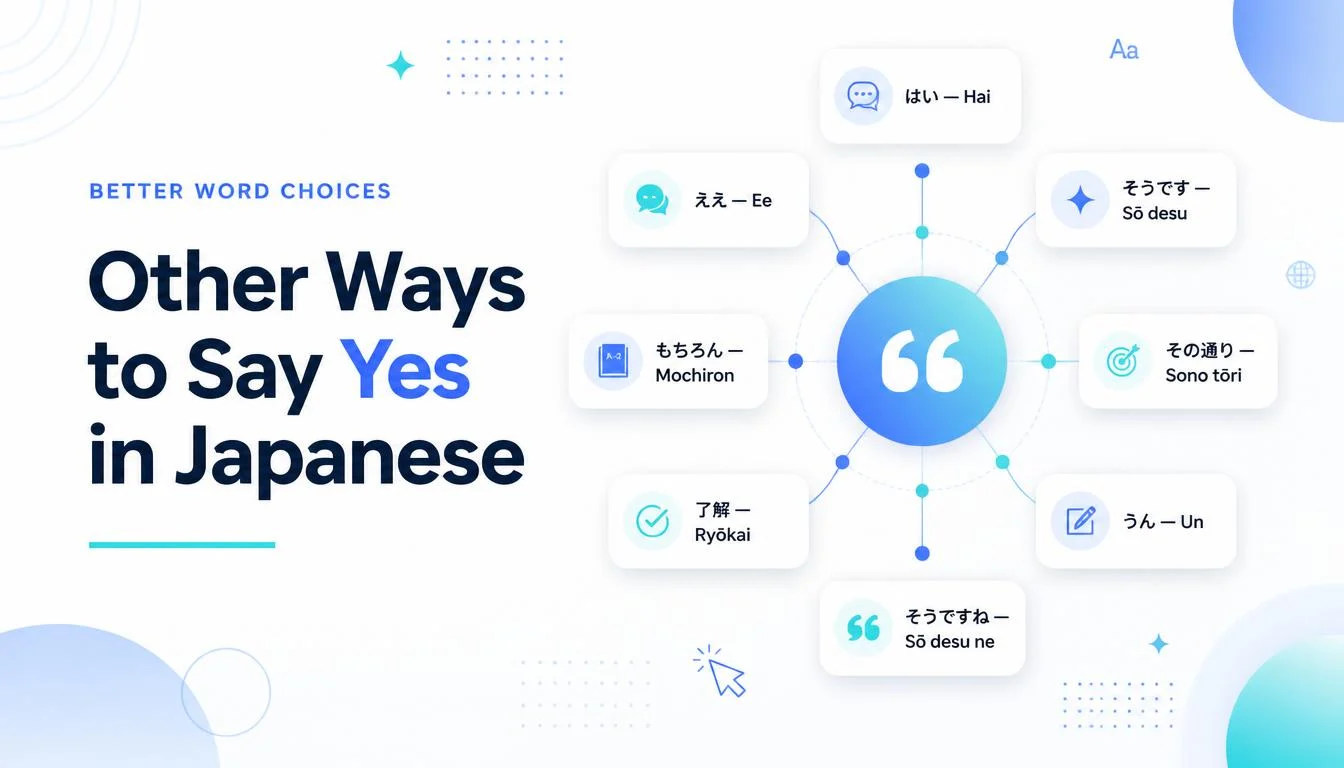
The most common ways to say yes in Japanese are hai (formal), ee (polite casual), un (informal), sō desu (“that’s right”), and mochiron (“of course”). Choose based on your relationship with the listener and the setting.
If you have ever studied Japanese, you almost certainly learned hai (はい) as the standard translation for “yes.” While hai is perfectly correct and widely used, relying on it alone makes your speech sound repetitive and overly textbook-like. Native Japanese speakers use a rich variety of affirmative expressions depending on the situation, the person they are talking to, and the emotional tone they wish to convey.
Learning alternatives to “Other Ways to Say Yes in Japanese” will transform your communication from robotic to natural. Just as you would not say “yes” in the same way to your boss, your best friend, and a customer service representative, Japanese has distinct expressions for every context. Mastering these nuances helps you express excitement in English (and Japanese) more authentically and builds genuine rapport with native speakers.
Quick Categories
Formal Alternatives
- Hai (はい)
- Sō desu (そうです)
- Kashikomarimashita (かしこまりました)
- Shōchishimashita (承知しました)
- Yoroshii desu (よろしいです)
Casual Alternatives
- Un (うん)
- Ee (ええ)
- Sou sou (そうそう)
- Unun (うんうん)
- Ii yo (いいよ)
Professional / Business Alternatives
- Wakarimashita (わかりました)
- Ryōkai shimashita (了解しました)
- Zehi (ぜひ)
- Ossharu tōri desu (おっしゃる通りです)
- Mochiron (もちろん)
Informal / Slang Expressions
- Okkee (オッケー)
- Yoshi (よし)
- Hai hai (はいはい)
- Hei hei (へいへい)
- Sō da (そうだ)
What Does “Yes” in Japanese Mean?
In Japanese, words for “yes” function as aizuchi (相槌) interjections that show the listener is paying attention, understanding, and engaging with the speaker. Unlike English “yes,” which primarily signals agreement, Japanese affirmative expressions often serve as conversation facilitators that encourage the speaker to continue.
Grammar Note: Most “yes” expressions in Japanese are interjections or sentence-ending particles. They can stand alone as complete responses or precede a full sentence.
Example:
Hai, wakarimashita. (はい、わかりました。) Yes, I understand.
When to Use “Yes” in Japanese
- Formal settings (business meetings, speaking with superiors, customer service) → Use hai, sō desu, or kashikomarimashita
- Casual conversations (friends, family, peers) → Use un, ee, or sou sou
- Showing active listening → Use hai, un, or sō desu ne as aizuchi
- Expressing strong agreement → Use mochiron, sou sou, or sono tōri
- Accepting requests or invitations → Use ii desu, daijōbu desu, or zehi
Spoken vs Written: Spoken Japanese uses a wide range of affirmative interjections. Written Japanese (especially formal documents) typically uses hai or sō desu.
Is It Professional or Polite to Say “Yes” in Japanese?
Polite? ✔️ Yes Hai is universally polite and appropriate in almost any situation.
Professional? ❌ Not always While hai is professional, overusing it can make you sound like a textbook robot. In business settings, phrases like wakarimashita (understood), kashikomarimashita (certainly), and shōchishimashita (acknowledged) convey greater professionalism and attentiveness.
Business Example:
Kashikomarimashita. Sugu ni taisaku itashimasu. (かしこまりました。すぐに対策いたします。) Certainly. I will take action immediately.
Pro Tip: In Japanese business culture, saying hai alone can sometimes signal “I hear you” rather than “I agree.” Follow up with action-oriented phrases like wakarimashita to show genuine commitment.
Pros and Cons of Using “Yes” in Japanese
Pros:
- Simple and universally understood
- Polite and respectful in most contexts
- Safe choice for beginners
- Works in both formal and casual settings
Cons:
- Can sound overly textbook or robotic
- Does not convey enthusiasm or emotional nuance
- May be misinterpreted as “I hear you” rather than “I agree”
- Overuse signals limited vocabulary
“The right affirmative expression can turn a simple ‘yes’ into a genuine connection.”
Other Ways to Say Yes in Japanese
These alternatives will help you sound more fluent, confident, and natural in different situations. Use them according to tone, context, and audience to express excitement, admiration, or approval.
1. Phrase: はい (Hai)
Meaning: Yes the standard, all-purpose affirmative.
Explanation: The most common and safest way to say yes in Japanese. Appropriate for formal, neutral, and even casual situations.
Example Sentence: Hai, sō desu. (はい、そうです。) Yes, that’s right.
Best Use: Any situation
Worst Use: When you want to sound casual and relaxed
Tone: Neutral, polite, standard
Context Variability: Formal / Professional / Spoken
2. Phrase: ええ (Ee)
Meaning: Yes a polite but slightly relaxed affirmative.
Explanation: Less formal than hai but still polite. Often used by adults in everyday conversation.
Example Sentence: Ee, kekkō desu. (ええ、結構です。) Yes, that’s fine.
Best Use: Casual polite settings
Worst Use: Very formal business meetings
Tone: Polite, warm, natural
Context Variability: Casual / Spoken
3. Phrase: うん (Un)
Meaning: Yeah / Uh-huh a casual, informal yes.
Explanation: Used among close friends, family, and peers. Similar to “uh-huh” in English.
Example Sentence: Un, tabeta. (うん、食べた。) Yeah, I ate.
Best Use: Friends and family
Worst Use: Bosses, strangers, formal events
Tone: Casual, friendly, relaxed
Context Variability: Casual / Spoken
4. Phrase: そうです (Sō desu)
Meaning: That’s right confirming that what was said is correct.
Explanation: Used when you agree with or confirm a statement made by someone else.
Example Sentence: Sō desu, watashi mo sō omoimasu. (そうです、私もそう思います。) That’s right, I think so too.
Best Use: Agreement and confirmation
Worst Use: Simple yes/no questions
Tone: Confirmatory, polite, thoughtful
Context Variability: Formal / Professional / Spoken
5. Phrase: もちろん (Mochiron)
Meaning: Of course an emphatic, enthusiastic yes.
Explanation: Expresses strong agreement or willingness. Adds energy to your response.
Example Sentence: Mochiron, ikimasu! (もちろん、行きます!) Of course, I’ll go!
Best Use: Enthusiastic agreement
Worst Use: Neutral or reluctant responses
Tone: Enthusiastic, confident, emphatic
Context Variability: Formal / Casual / Spoken
6. Phrase: わかりました (Wakarimashita)
Meaning: Understood / Got it a professional way to acknowledge instructions.
Explanation: Indicates you have comprehended what was said and will act accordingly.
Example Sentence: Wakarimashita. Sugu ni shori shimasu. (わかりました。すぐに処理します。) Understood. I’ll handle it right away.
Best Use: Business and professional settings
Worst Use: Casual conversations with friends
Tone: Professional, attentive, responsive
Context Variability: Formal / Professional / Spoken
7. Phrase: かしこまりました (Kashikomarimashita)
Meaning: Certainly / I understand very formal and humble.
Explanation: The most polite way to acknowledge instructions, used in customer service and with superiors.
Example Sentence: Kashikomarimashita. Shōshō omachi kudasai. (かしこまりました。少々お待ちください。) Certainly. Please wait a moment.
Best Use: Customer service, superiors
Worst Use: Friends or casual settings
Tone: Humble, formal, respectful
Context Variability: Formal / Professional
8. Phrase: 承知しました (Shōchishimashita)
Meaning: I’ve got it / Acknowledged very polite and formal.
Explanation: Similar to kashikomarimashita but slightly more direct. Used in business correspondence.
Example Sentence: Shōchishimashita. Keikaku o jikkō shimasu. (承知しました。計画を実行します。) Acknowledged. I will execute the plan.
Best Use: Formal business communication
Worst Use: Everyday conversation
Tone: Formal, respectful, precise
Context Variability: Formal / Professional
9. Phrase: 了解しました (Ryōkai shimashita)
Meaning: I understand / Roger professional but less formal.
Explanation: Common in workplace settings to confirm receipt of information.
Example Sentence: Ryōkai shimashita. Taiō shimasu. (了解しました。対応します。) Understood. I’ll respond accordingly.
Best Use: Workplace, team communication
Worst Use: Very formal ceremonies
Tone: Professional, clear, efficient
Context Variability: Professional / Spoken
10. Phrase: そうですね (Sō desu ne)
Meaning: That’s right, isn’t it? thoughtful agreement.
Explanation: Used to agree while also showing you are considering the speaker’s point. Common as a filler phrase.
Example Sentence: Sō desu ne, totemo ii to omoimasu. (そうですね、とてもいいと思います。) Yes, I think it’s really good.
Best Use: Thoughtful conversations
Worst Use: Quick, decisive responses
Tone: Thoughtful, reflective, polite
Context Variability: Formal / Casual / Spoken
11. Phrase: そうそう (Sō sō)
Meaning: Yes, that’s right! enthusiastic confirmation.
Explanation: Used to strongly agree or confirm something with energy and reassurance.
Example Sentence: Sō sō! Sore ga iitai n da. (そうそう!それが言いたいんだ。) Yes, exactly! That’s what I wanted to say.
Best Use: Enthusiastic agreement
Worst Use: Formal or professional settings
Tone: Enthusiastic, energetic, casual
Context Variability: Casual / Spoken
12. Phrase: その通り (Sono tōri)
Meaning: Exactly precise and strong agreement.
Explanation: Confirms that the speaker’s statement is completely correct.
Example Sentence: Sono tōri desu. Kansha shite imasu. (その通りです。感謝しています。) Exactly. I appreciate it.
Best Use: Strong, precise agreement
Worst Use: Casual, throwaway responses
Tone: Precise, strong, confident
Context Variability: Formal / Casual / Spoken
13. Phrase: いいです (Ii desu)
Meaning: Sounds good / That’s fine accepting a proposal.
Explanation: Used to accept invitations, suggestions, or permission requests.
Example Sentence: Ii desu, yoroshiku onegai shimasu. (いいです、よろしくお願いします。) Sounds good, please go ahead.
Best Use: Accepting offers and suggestions
Worst Use: Simple yes/no confirmation
Tone: Accepting, agreeable, polite
Context Variability: Formal / Casual / Spoken
14. Phrase: 大丈夫です (Daijōbu desu)
Meaning: It’s okay / No problem reassuring agreement.
Explanation: Confirms that something is acceptable or that you are fine with a proposal.
Example Sentence: Daijōbu desu. Watashi ga yarimasu. (大丈夫です。私がやります。) No problem. I’ll do it.
Best Use: Reassuring responses
Worst Use: Formal business agreements
Tone: Reassuring, casual-polite, friendly
Context Variability: Casual / Spoken
15. Phrase: ぜひ (Zehi)
Meaning: By all means / Definitely eager agreement.
Explanation: Expresses strong willingness and enthusiasm to accept an invitation or suggestion.
Example Sentence: Zehi onegai shimasu! (ぜひお願いします!) By all means, please!
Best Use: Accepting invitations eagerly
Worst Use: Neutral or reluctant situations
Tone: Enthusiastic, eager, positive
Context Variability: Formal / Casual / Spoken
16. Phrase: よし (Yoshi)
Meaning: Alright / OK a casual, self-directed affirmative.
Explanation: Often used as an exclamation before starting an action. Can also mean “good” or “fine”.
Example Sentence: Yoshi, iko u! (よし、行こう!) Alright, let’s go!
Best Use: Self-motivation, casual settings
Worst Use: Formal responses to others
Tone: Energetic, casual, self-directed
Context Variability: Casual / Spoken
17. Phrase: オッケー (Okkē)
Meaning: OK borrowed from English, used casually.
Explanation: Widely understood and used in casual Japanese conversation, especially among younger speakers.
Example Sentence: Okkē, wakatta. (オッケー、わかった。) OK, got it.
Best Use: Casual, informal settings
Worst Use: Formal or professional situations
Tone: Casual, modern, relaxed
Context Variability: Casual / Spoken
18. Phrase: はいはい (Hai hai)
Meaning: Yes, yes but can sound dismissive.
Explanation: Repeating hai can indicate impatience or annoyance. Use with caution.
Example Sentence: Hai hai, wakatteru yo. (はいはい、わかってるよ。) Yes, yes, I know.
Best Use: Only with close friends (if at all)
Worst Use: Any formal or respectful context
Tone: Dismissive, impatient, casual
Context Variability: Casual / Spoken (use sparingly)
19. Phrase: へいへい (Hei hei)
Meaning: Gotcha / Sure thing very casual acknowledgment.
Explanation: A playful, informal way to say “OK” or “got it.
Example Sentence: Hei hei, yatte miru yo. (へいへい、やってみるよ。) Sure thing, I’ll give it a try.
Best Use: Close friends, very casual
Worst Use: Any formal situation
Tone: Playful, casual, lighthearted
Context Variability: Casual / Spoken
20. Phrase: 左様 (Sayō)
Meaning: Yes / That’s so formal and somewhat old-fashioned.
Explanation: An archaic or very formal way of saying “yes” or “that’s right”.
Example Sentence: Sayō de gozaimasu. (左様でございます。) That is so.
Best Use: Very formal, traditional settings
Worst Use: Everyday conversation
Tone: Formal, traditional, respectful
Context Variability: Formal
21. Phrase: うんうん (Un un)
Meaning: Yes, yes / Uh-huh repeated casual agreement.
Explanation: Used to show active listening and encouragement for the speaker to continue.
Example Sentence: Un un, sō da ne. (うんうん、そうだね。) Uh-huh, that’s right.
Best Use: Active listening with friends
Worst Use: Formal situations
Tone: Encouraging, casual, attentive
Context Variability: Casual / Spoken
22. Phrase: いいよ (Ii yo)
Meaning: Sure / Go ahead casual acceptance.
Explanation: A relaxed way to give permission or agree to a request.
Example Sentence: Ii yo, dōzo. (いいよ、どうぞ。) Sure, go ahead.
Best Use: Casual permission and agreement
Worst Use: Formal or professional contexts
Tone: Casual, friendly, permissive
Context Variability: Casual / Spoken
23. Phrase: そうしよう (Sō shiyō)
Meaning: Let’s do that agreement on a course of action.
Explanation: Used when you agree with a suggestion and decide to proceed accordingly.
Example Sentence: Sō shiyō. Ashita kara hajimeru. (そうしよう。明日から始める。) Let’s do that. We’ll start tomorrow.
Best Use: Collaborative decision-making
Worst Use: Simple yes/no questions
Tone: Decisive, collaborative, casual
Context Variability: Casual / Spoken
24. Phrase: よろしいです (Yoroshii desu)
Meaning: That’s fine / That’s acceptable polite and formal.
Explanation: A more formal version of ii desu, used in business and polite contexts.
Example Sentence: Yoroshii desu. Sonomama susumete kudasai. (よろしいです。そのまま進めてください。) That’s fine. Please proceed as is.
Best Use: Formal permission and agreement
Worst Use: Casual conversations
Tone: Polite, formal, respectful
Context Variability: Formal / Professional
25. Phrase: おっしゃる通りです (Ossharu tōri desu)
Meaning: Exactly as you say very respectful agreement.
Explanation: A humble and polite way to agree with a superior or client.
Example Sentence: Ossharu tōri desu. Sō jisshi shimasu. (おっしゃる通りです。そう実施します。) Exactly as you say. I will implement it that way.
Best Use: Business, superiors, clients
Worst Use: Casual or peer conversations
Tone: Humble, respectful, formal
Context Variability: Formal / Professional
26. Phrase: 確かに (Tashika ni)
Meaning: Certainly / Indeed neutral agreement.
Explanation: Expresses agreement with a statement, acknowledging its truth.
Example Sentence: Tashika ni, sō desu ne. (確かに、そうですね。) Certainly, that’s true.
Best Use: Thoughtful agreement
Worst Use: Enthusiastic or emotional responses
Tone: Neutral, thoughtful, confirming
Context Variability: Formal / Casual / Spoken
27. Phrase: なるほど (Naruhodo)
Meaning: I see / That makes sense acknowledgment of new information.
Explanation: Used when you understand or are convinced by what the speaker has said.
Example Sentence: Naruhodo, sō iu koto ka. (なるほど、そういうことか。) I see, so that’s how it is.
Best Use: Showing understanding
Worst Use: Direct agreement with a proposal
Tone: Understanding, thoughtful, engaged
Context Variability: Formal / Casual / Spoken
28. Phrase: いいね (Ii ne)
Meaning: Sounds good / Nice casual approval.
Explanation: A friendly way to express agreement or approval, often used among peers.
Example Sentence: Ii ne, sore yarou! (いいね、それやろう!) Sounds good, let’s do that!
Best Use: Casual agreement with friends
Worst Use: Formal or professional settings
Tone: Friendly, approving, casual
Context Variability: Casual / Spoken
29. Phrase: わかった (Wakatta)
Meaning: Got it / OK casual understanding.
Explanation: The casual version of wakarimashita, used with friends and peers.
Example Sentence: Wakatta, ato de yaru. (わかった、後でやる。) Got it, I’ll do it later.
Best Use: Friends, casual settings
Worst Use: Bosses or formal situations
Tone: Casual, direct, relaxed
Context Variability: Casual / Spoken
30. Phrase: ああ (Ā)
Meaning: Ah / Oh yes a natural, spontaneous affirmative.
Explanation: A spontaneous interjection showing realization or agreement, often used in casual speech.
Example Sentence: Ā, sō ka! (ああ、そうか!) Oh yes, I see!
Best Use: Spontaneous agreement or realization
Worst Use: Formal or planned responses
Tone: Spontaneous, natural, casual
Context Variability: Casual / Spoken
Pro Tip: When in doubt, stick with hai. It is never wrong. As you gain confidence, experiment with ee in casual polite settings and un with friends to sound more natural.
Common Mistakes When Saying “Yes” in Japanese
1. Overusing hai in every situation
Using hai repeatedly can make you sound robotic and unnatural. Mix in other expressions like ee or sō desu.
❌ Hai. Hai. Hai, wakarimashita.
✅ Hai, wakarimashita. (One confident response is enough.)
2. Using un with superiors or strangers
Un is casual and can be disrespectful if used with someone of higher status.
❌ Un, wakatta. (to your boss)
✅ Hai, wakarimashita. (to your boss)
3. Confusing un (yes) with uun (no)
The length and intonation differ. Un is short; uun is longer and means “no”.
❌ Uun when you mean un
✅ Un (short) for yes; uun (longer) for no
4. Using hai hai in professional settings
Repeating hai can sound dismissive or impatient.
❌ Hai hai, wakarimashita. (to a client)
✅ Kashikomarimashita. (to a client)
5. Forgetting that hai can mean “I hear you,” not “I agree”
In Japanese, hai often signals attention rather than consent.
❌ Assuming hai always means full agreement
✅ Follow up with action-oriented phrases like wakarimashita to show genuine commitment
Mini Quiz / Self-Check
1. You are in a business meeting with a client. Which response is most appropriate?
- A) Un
- B) Hai hai
- C) Kashikomarimashita
- D) Okkē
Answer: C Kashikomarimashita is the most respectful and professional.
2. Your close friend suggests going to a movie. Which is the most natural casual response?
- A) Sō desu ne
- B) Un, ii ne!
- C) Kashikomarimashita
- D) Okkē
Answer: B Un, ii ne! is friendly and enthusiastic for a casual setting.
3. You want to show enthusiastic agreement with a colleague’s idea. Which phrase best expresses excitement?
- A) Hai
- B) Sō sō!
- C) Wakarimashita
- D) Naruhodo
Answer: B Sō sō! conveys strong, energetic agreement.
4. Your boss gives you a task. Which response shows you have understood and will act?
- A) Un, wakatta
- B) Wakarimashita
- C) Sō desu ne
- D) Ii yo
Answer: B Wakarimashita is professional and shows comprehension.
Comparison Table: Top 10 Alternatives
| Phrase | Tone | Best Use |
|---|---|---|
| はい (Hai) | Neutral, polite | Any situation |
| ええ (Ee) | Polite, warm | Casual polite settings |
| うん (Un) | Casual, friendly | Friends and family |
| そうです (Sō desu) | Confirmatory, polite | Agreement and confirmation |
| もちろん (Mochiron) | Enthusiastic, emphatic | Strong agreement |
| わかりました (Wakarimashita) | Professional, responsive | Business and work |
| かしこまりました (Kashikomarimashita) | Humble, formal | Customer service, superiors |
| そうそう (Sō sō) | Energetic, casual | Enthusiastic agreement |
| いいです (Ii desu) | Accepting, polite | Accepting offers |
| ぜひ (Zehi) | Eager, positive | Accepting invitations |
“Mastering tone is the difference between sounding like a student and sounding like a native.”
FAQs
1. What is the most common way to say yes in Japanese?
Hai (はい) is the most common and versatile way to say yes in Japanese. It is appropriate in formal, neutral, and even casual situations.
2. How do you say yes casually in Japanese?
Un (うん) is the most casual way to say yes, similar to “yeah” or “uh-huh” in English. Use it only with close friends, family, and peers.
3. What is the polite way to say yes in Japanese business settings?
In business, use wakarimashita (わかりました) for “understood,” kashikomarimashita (かしこまりました) for “certainly,” or shōchishimashita (承知しました) for “acknowledged”.
4. Can you say “OK” in Japanese?
Yes, okkē (オッケー) is commonly used and understood, especially among younger speakers. However, it is casual and not appropriate for formal situations.
5. What does hai actually mean in Japanese?
Hai means “yes,” but it can also signal “I hear you,” “I’m listening,” or “present” during roll call. It does not always indicate full agreement.
Conclusion
Learning alternatives to “Other Ways to Say Yes in Japanese” is one of the fastest ways to move from textbook Japanese to natural, confident communication. Each expression carries its own tone, nuance, and appropriate context from the formal respect of kashikomarimashita to the casual warmth of un.
Practice using a few new phrases each day. Pay attention to who you are speaking with and adjust your response accordingly. The more you vary your affirmatives, the more fluent and engaging you will sound. Remember, the right tone makes your Japanese sound professional, confident, and genuinely connected.
Read More Related Articles:
- Other Ways to Say “It Was a Pleasure Meeting You” | Make a Strong Final Impression In 2026
- Other Ways to Say Looking Forward to Seeing You | Leave a Great Impression In 2026
- Other Ways to Say “LOL” | When Something Is Actually Hilarious In 2026

Victoria Hughes is a content writer dedicated to making communication clearer and more effective. Through TextsResponse.com, she shares practical insights and thoughtfully crafted response ideas that help readers express themselves with confidence.