Quick Answer
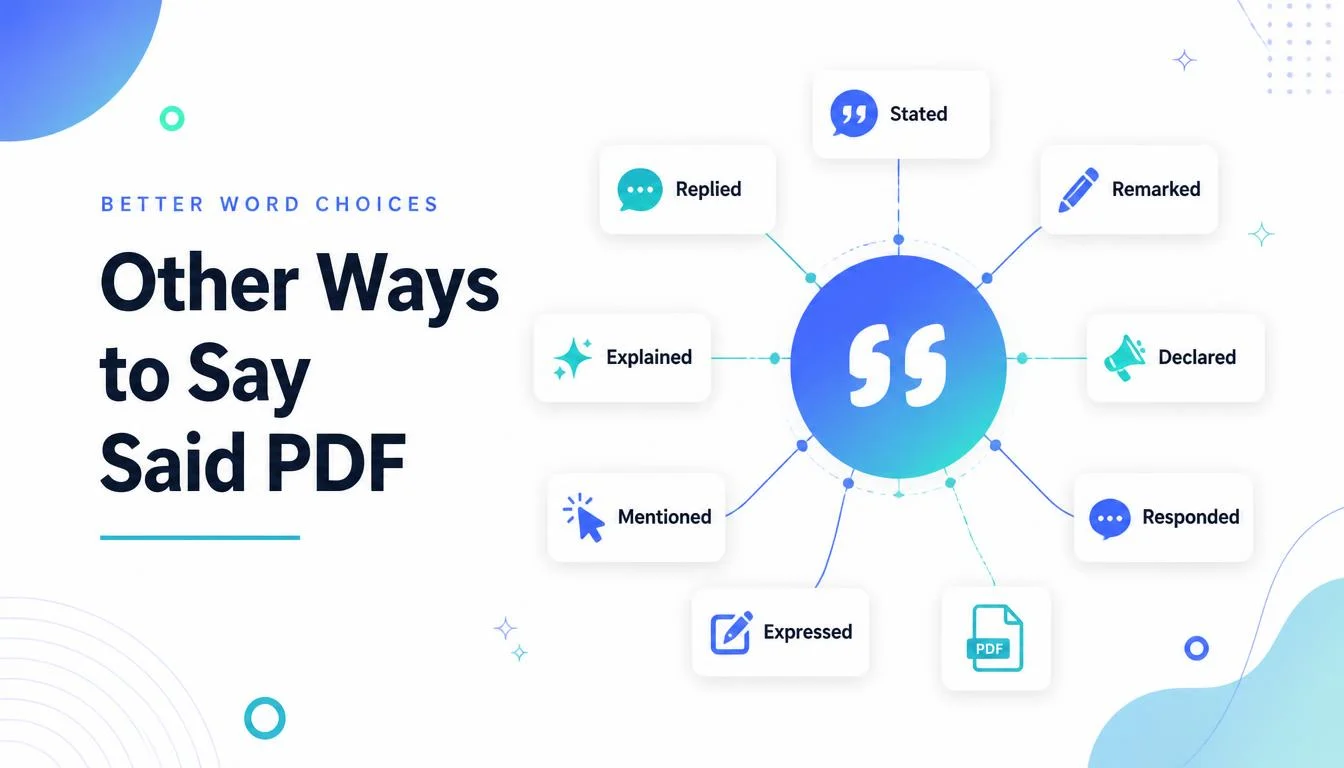
Other ways to say said PDF include stated, explained, mentioned, remarked, declared, and noted. Use these alternatives to make your writing clearer, more descriptive, and less repetitive.
Learning other ways to say said PDF can help students, writers, and English learners improve their vocabulary and make their writing more effective. Whether you are writing essays, creating stories, or completing school assignments, choosing the right alternative can make your sentences more interesting and precise.
The word “said” is commonly used in dialogue, academic writing, and everyday communication, but repeating it too often can make writing feel monotonous. Alternatives such as “replied,” “whispered,” “announced,” and “suggested” help communicate different emotions, intentions, and speaking styles. A useful PDF guide can make these alternatives easier to learn, review, and apply in your writing.
What Is “Other Ways to Say Said PDF”? Meaning, Grammar and Real Use
When writing an essay, creating a short story, or preparing a school assignment, you may notice that the word “said” appears again and again. Although “said” is grammatically correct, repeating it throughout a paragraph can make your writing feel less varied. Choosing a more precise verb can help readers understand not only who is speaking but also how a message is delivered.
A PDF guide containing alternatives to “said” can be useful for students, teachers, writers, and English learners who want a quick reference while editing their work. These alternatives range from neutral words such as “stated” and “mentioned” to expressive verbs such as “whispered,” “argued,” and “exclaimed.”
Learning these expressions also strengthens your ability to communicate professionally, describe conversations naturally, and express excitement in English when the situation calls for it.
Definition: Alternatives to “said” are verbs that describe speaking, responding, explaining, questioning, or expressing an emotion through words.
Grammar note: “Said” is the past-tense form of “say.” Most alternatives in this guide are also past-tense reporting verbs. Their formality depends on the word and context.
Example: Instead of writing, “The manager said the deadline had changed,” you could write, “The manager announced that the deadline had changed.”
Writers use these verbs in essays, dialogue, emails, reports, fiction, and everyday conversations. The key is to choose a word that accurately represents the speaker’s action.
When Should You Use Alternatives to “Said”?
Use a more specific speaking verb when it adds meaning or improves clarity.
- Academic essays: Use “stated,” “argued,” or “explained” to introduce claims and supporting information.
- Professional reports: Choose “reported,” “confirmed,” or “announced” when communicating facts or decisions.
- Creative writing: Use “whispered,” “muttered,” or “shouted” to help readers imagine a conversation.
- Everyday conversations: Choose “replied,” “asked,” or “mentioned” to describe common exchanges.
- Persuasive writing: Use “insisted,” “claimed,” or “emphasized” when the speaker’s intention matters.
Spoken vs. Written
In conversation, people often use “say,” “tell,” and “ask.” In written dialogue, more specific verbs can prevent repetition and clarify the interaction.
For example, “She replied calmly” gives a different impression from “She snapped angrily.”
Formal vs. Informal
Formal writing favors words such as “stated,” “indicated,” and “confirmed.” Informal dialogue may use “muttered,” “chipped in,” or “pointed out,” depending on the situation.
Choose precision over variety for its own sake. A simple “said” is often better than an inaccurate or overly dramatic synonym.
Is Using “Said” Professional or Just Polite?
“Said” is both professional and neutral. It is not inherently informal, impolite, or unsuitable for business communication. In fact, it is often the best choice when the manner of speaking is unimportant.
Politeness concerns how respectfully a message is delivered. Professionalism concerns whether the wording is appropriate, clear, and effective for the workplace.
Business example: “The project manager confirmed that the revised schedule would be shared on Friday.”
This sentence communicates a specific action more clearly than “The project manager said the schedule would be shared on Friday,” provided that the manager actually confirmed it.
- Polite? ✔️ Yes
- Professional? ✔️ Yes
Use a more descriptive verb only when it accurately reflects the original message.
Pros and Cons of Using “Said”
Pros
- Simple: Readers understand it immediately.
- Neutral: It does not impose an emotion or judgment on the speaker.
- Widely accepted: It works in academic, professional, and creative writing.
- Easy to read: Frequent use does not necessarily distract readers from the message.
Cons
- Repetitive: Too many dialogue tags can make writing feel monotonous.
- Less descriptive: It may not communicate whether a person whispered, argued, or questioned something.
- Limited emotional detail: Readers may need additional context to understand the speaker’s attitude.
- Less precise in some contexts: Verbs such as “confirmed” or “admitted” can communicate the specific purpose of a statement more efficiently.
The goal is not to eliminate “said.” It is to combine neutral reporting verbs with accurate, meaningful alternatives.
Common Mistakes People Make
1. Using an emotional verb without evidence
Incorrect: “She screamed that the meeting was at noon.”
Correct: “She stated that the meeting was at noon.”
Use “screamed” only when the person actually raised their voice dramatically.
2. Confusing “said” with “told”
Incorrect: “He told that he was busy.”
Correct: “He said that he was busy.”
Use “told” with an object when identifying the listener: “He told me that he was busy.”
3. Using “asked” for a statement
Incorrect: “She asked that the office was closed.”
Correct: “She said that the office was closed.”
Use “asked” for questions or requests, not ordinary statements.
4. Choosing an overly dramatic synonym
Incorrect: “The teacher exclaimed the homework instructions.”
Correct: “The teacher explained the homework instructions.”
“Exclaimed” suggests a strong emotional reaction. “Explained” is more suitable for clear instructions.
5. Replacing every instance of “said”
Incorrect: “He declared hello, and she announced hi.”
Correct: “He said hello, and she replied with a smile.”
Natural writing uses a mixture of simple and descriptive verbs. Replacing every occurrence can make dialogue sound artificial.
“Small tone mistakes can make confident English sound careless.”
Alternatives by Category
The following preview highlights useful choices for different writing situations. Each phrase also appears in the complete list below.
Formal alternatives to “said”
- Stated: For presenting information directly.
- Asserted: For expressing a position confidently.
- Declared: For making a clear or important announcement.
Pro Tip: Use formal reporting verbs in academic and official writing, but ensure they reflect the speaker’s actual intention.
Casual alternatives
- Mentioned: For introducing information naturally.
- Replied: For responding to someone.
- Pointed out: For drawing attention to a fact.
Pro Tip: Choose everyday verbs that make dialogue sound natural rather than unnecessarily complicated.
Professional alternatives
- Confirmed: For verifying information.
- Explained: For clarifying a process or idea.
- Reported: For communicating findings or events.
Pro Tip: In business writing, select verbs that describe the communication action precisely.
Informal expressions
- Muttered: For speaking quietly or unclearly.
- Whispered: For speaking in a very low voice.
- Chipped in: For joining a conversation.
Pro Tip: Use informal expressions in dialogue when they suit the character, relationship, and situation.
“Formal and informal English aren’t about correctness. They’re about context.”
Other Ways to Say “Said”: Full List of 30 Alternatives With Examples
This list provides 30 practical alternatives for essays, dialogue, emails, and professional documents. These verbs help you communicate information, show reactions, and express excitement in English when the context supports it.
If you are using an other ways to say said PDF reference sheet, choose the verb that matches the original meaning instead of selecting a synonym simply to avoid repetition.
1. Phrase: Stated
Meaning: Expressed something clearly.
Explanation: A neutral, formal option for factual statements.
Example Sentence: The report stated that sales had increased.
Best Use: Formal reports
Worst Use: Emotional dialogue
Tone: Clear, neutral
Context Variability: Professional, written, spoken
2. Phrase: Explained
Meaning: Made something understandable.
Explanation: Use when a speaker provides reasons, details, or clarification.
Example Sentence: She explained why the deadline had changed.
Best Use: Clear instructions
Worst Use: Simple greetings
Tone: Helpful, informative
Context Variability: Professional, written, spoken
3. Phrase: Mentioned
Meaning: Referred to something briefly.
Explanation: Suitable when information is introduced without extensive detail.
Example Sentence: He mentioned the upcoming training session.
Best Use: Brief updates
Worst Use: Detailed arguments
Tone: Casual, neutral
Context Variability: Casual, professional, spoken
4. Phrase: Replied
Meaning: Responded to someone.
Explanation: Identifies a response in a conversation or exchange.
Example Sentence: “I agree,” she replied.
Best Use: Dialogue responses
Worst Use: Initial announcements
Tone: Neutral, conversational
Context Variability: Casual, professional, spoken
5. Phrase: Remarked
Meaning: Made a comment.
Explanation: Introduces an observation or opinion, often with a thoughtful tone.
Example Sentence: He remarked that the room looked brighter.
Best Use: Personal observations
Worst Use: Urgent warnings
Tone: Reflective, neutral
Context Variability: Casual, written, spoken
6. Phrase: Announced
Meaning: Made information public.
Explanation: Use for important news, decisions, or planned events.
Example Sentence: The director announced the new policy.
Best Use: Official news
Worst Use: Private whispers
Tone: Formal, decisive
Context Variability: Professional, written, spoken
7. Phrase: Asserted
Meaning: Stated something confidently.
Explanation: Often emphasizes a firm position or belief.
Example Sentence: The researcher asserted that more evidence was needed.
Best Use: Strong arguments
Worst Use: Casual greetings
Tone: Firm, confident
Context Variability: Professional, written, spoken
8. Phrase: Declared
Meaning: Announced something firmly.
Explanation: Suggests a clear, emphatic, or significant statement.
Example Sentence: She declared that the project was complete.
Best Use: Major announcements
Worst Use: Routine updates
Tone: Strong, emphatic
Context Variability: Formal, written, spoken
9. Phrase: Reported
Meaning: Provided information about an event or finding.
Explanation: Common in journalism, research, workplace updates, and official records.
Example Sentence: The team reported a technical problem.
Best Use: Progress updates
Worst Use: Personal greetings
Tone: Factual, professional
Context Variability: Professional, written, spoken
10. Phrase: Confirmed
Meaning: Verified that something was true or settled.
Explanation: Use when a speaker validates information rather than merely mentioning it.
Example Sentence: The assistant confirmed the appointment.
Best Use: Verified details
Worst Use: Uncertain claims
Tone: Clear, professional
Context Variability: Professional, written, spoken
11. Phrase: Admitted
Meaning: Acknowledged something, often reluctantly.
Explanation: Can imply that the information is difficult, embarrassing, or unfavorable.
Example Sentence: He admitted that he had made a mistake.
Best Use: Acknowledging errors
Worst Use: Neutral facts
Tone: Candid, reluctant
Context Variability: Casual, professional, written
12. Phrase: Claimed
Meaning: Stated something as true.
Explanation: Often signals that a statement has not been independently verified.
Example Sentence: The company claimed that the product was safe.
Best Use: Disputed statements
Worst Use: Verified facts
Tone: Skeptical, neutral
Context Variability: Professional, written, spoken
13. Phrase: Suggested
Meaning: Put forward an idea or possibility.
Explanation: Useful for recommendations that are not presented as commands.
Example Sentence: Maya suggested meeting earlier.
Best Use: Gentle recommendations
Worst Use: Firm declarations
Tone: Diplomatic, helpful
Context Variability: Casual, professional, spoken
14. Phrase: Emphasized
Meaning: Gave special importance to a point.
Explanation: Signals that a speaker considers an idea particularly significant.
Example Sentence: The instructor emphasized the importance of revision.
Best Use: Key points
Worst Use: Minor details
Tone: Insistent, focused
Context Variability: Professional, written, spoken
15. Phrase: Observed
Meaning: Made a thoughtful comment about something noticed.
Explanation: Suitable for analytical, descriptive, and reflective writing.
Example Sentence: The reviewer observed that the argument lacked evidence.
Best Use: Analytical comments
Worst Use: Casual greetings
Tone: Thoughtful, measured
Context Variability: Formal, written, spoken
16. Phrase: Pointed Out
Meaning: Drew attention to a fact or detail.
Explanation: Helps identify an important observation or correction.
Example Sentence: Liam pointed out an error in the calculation.
Best Use: Useful corrections
Worst Use: Sensitive criticism
Tone: Direct, practical
Context Variability: Casual, professional, spoken
17. Phrase: Asked
Meaning: Put a question or request to someone.
Explanation: Use for questions and requests rather than ordinary statements.
Example Sentence: She asked whether the office was open.
Best Use: Direct questions
Worst Use: Factual reporting
Tone: Neutral, inquisitive
Context Variability: Casual, professional, spoken
18. Phrase: Questioned
Meaning: Asked about or expressed doubt regarding something.
Explanation: Can suggest investigation, uncertainty, or a challenge to an idea.
Example Sentence: The editor questioned the accuracy of the figures.
Best Use: Critical discussion
Worst Use: Simple answers
Tone: Inquisitive, skeptical
Context Variability: Professional, written, spoken
19. Phrase: Argued
Meaning: Presented reasons supporting a position.
Explanation: In academic writing, it can describe reasoning without implying an angry disagreement.
Example Sentence: The author argued that public transport needed investment.
Best Use: Academic arguments
Worst Use: Neutral greetings
Tone: Persuasive, assertive
Context Variability: Professional, written, spoken
20. Phrase: Insisted
Meaning: Stated something firmly despite possible disagreement.
Explanation: Highlights determination or refusal to change a position.
Example Sentence: She insisted that the figures were correct.
Best Use: Firm positions
Worst Use: Neutral introductions
Tone: Forceful, determined
Context Variability: Casual, professional, spoken
21. Phrase: Recalled
Meaning: Remembered and described something from the past.
Explanation: Appropriate when someone shares a memory or past statement.
Example Sentence: He recalled meeting the author years earlier.
Best Use: Personal memories
Worst Use: Future plans
Tone: Reflective, personal
Context Variability: Casual, written, spoken
22. Phrase: Whispered
Meaning: Spoke in a very quiet voice.
Explanation: Useful when secrecy, privacy, or softness matters in a scene.
Example Sentence: “Keep it a secret,” she whispered.
Best Use: Quiet dialogue
Worst Use: Public announcements
Tone: Soft, intimate
Context Variability: Informal, written, spoken
23. Phrase: Muttered
Meaning: Spoke quietly, often unclearly.
Explanation: Can suggest irritation, embarrassment, or reluctance, depending on context.
Example Sentence: He muttered an apology and left.
Best Use: Tense dialogue
Worst Use: Formal presentations
Tone: Low, reluctant
Context Variability: Informal, written, spoken
24. Phrase: Shouted
Meaning: Spoke in a very loud voice.
Explanation: Indicates high volume, often because of distance, urgency, or strong emotion.
Example Sentence: “Watch out!” she shouted.
Best Use: Urgent warnings
Worst Use: Quiet meetings
Tone: Loud, urgent
Context Variability: Informal, written, spoken
25. Phrase: Exclaimed
Meaning: Spoke suddenly with strong emotion.
Explanation: Often introduces surprise, excitement, admiration, or alarm.
Example Sentence: “What wonderful news!” he exclaimed.
Best Use: Emotional reactions
Worst Use: Routine reports
Tone: Excited, expressive
Context Variability: Informal, written, spoken
26. Phrase: Murmured
Meaning: Spoke in a soft, low voice.
Explanation: Similar to “whispered,” but does not always imply secrecy.
Example Sentence: She murmured a quiet thank-you.
Best Use: Gentle dialogue
Worst Use: Loud debates
Tone: Soft, subdued
Context Variability: Informal, written, spoken
27. Phrase: Snapped
Meaning: Spoke abruptly or irritably.
Explanation: Conveys a sharp response, often revealing impatience or anger.
Example Sentence: “Leave me alone,” he snapped.
Best Use: Angry exchanges
Worst Use: Diplomatic emails
Tone: Irritated, sharp
Context Variability: Informal, written, spoken
28. Phrase: Promised
Meaning: Gave an assurance about future action.
Explanation: Use when someone commits to doing something or ensuring an outcome.
Example Sentence: She promised to send the files by Monday.
Best Use: Future commitments
Worst Use: Uncertain predictions
Tone: Reassuring, committed
Context Variability: Casual, professional, spoken
29. Phrase: Advised
Meaning: Recommended a course of action.
Explanation: Appropriate when a speaker offers guidance based on knowledge or judgment.
Example Sentence: The consultant advised the team to review its budget.
Best Use: Expert guidance
Worst Use: Casual greetings
Tone: Helpful, authoritative
Context Variability: Professional, written, spoken
30. Phrase: Reassured
Meaning: Helped someone feel less worried.
Explanation: Shows that a speaker offered comfort or confidence about a concern.
Example Sentence: The manager reassured staff that their questions would be addressed.
Best Use: Reducing concerns
Worst Use: Harsh criticism
Tone: Calm, supportive
Context Variability: Casual, professional, spoken
Comparison Table: Top 10 Alternatives at a Glance
Use this table as a quick reference when editing an essay, preparing a report, or writing dialogue.
| Phrase | Tone | Best Use |
|---|---|---|
| Stated | Formal, neutral | Official reports |
| Explained | Helpful, informative | Instructions and clarification |
| Mentioned | Casual, neutral | Brief updates |
| Replied | Conversational | Dialogue responses |
| Announced | Formal, decisive | News and decisions |
| Confirmed | Professional, clear | Verifying information |
| Reported | Factual, professional | Findings and updates |
| Suggested | Diplomatic, helpful | Recommendations |
| Emphasized | Focused, assertive | Important points |
| Pointed out | Direct, practical | Highlighting details |
For more vocabulary-building ideas, explore See also: Other Ways to Say “Amazing” and See also: Professional English Communication Guide.
Quick Self-Check: Mini Quiz
Test your understanding by choosing the most suitable reporting verb for each situation.
Question 1
Your manager verifies that your meeting is scheduled for 10 a.m. Which verb fits best?
- A. Muttered
- B. Confirmed
- C. Shouted
- D. Exclaimed
Question 2
A character speaks very quietly because they do not want anyone else to hear. Which verb is most appropriate?
- A. Announced
- B. Declared
- C. Whispered
- D. Reported
Question 3
An academic writer presents reasons to support a particular position. Which verb works best?
- A. Argued
- B. Murmured
- C. Reassured
- D. Recalled
Question 4
A colleague offers an idea for improving a presentation without insisting that everyone follow it. Which verb is the best choice?
- A. Snapped
- B. Insisted
- C. Suggested
- D. Shouted
Question 1A. MutteredB. ConfirmedC. ShoutedD. Exclaimed
Question 2A. AnnouncedB. DeclaredC. WhisperedD. Reported
Question 3A. ArguedB. MurmuredC. ReassuredD. Recalled
Question 4A. SnappedB. InsistedC. SuggestedD. Shouted
Check answersReset quiz
FAQs
1. What are the best alternatives to “said” in English?
Some useful alternatives are stated, explained, mentioned, replied, confirmed, reported, and remarked. The best choice depends on the speaker’s intention and the context.
2. What is a formal word for “said”?
“Stated” is a useful formal alternative for presenting information clearly. “Asserted,” “declared,” and “reported” may also work when their specific meanings match the situation.
3. How can I avoid repeating “said” in an essay?
Use precise reporting verbs such as “argued,” “explained,” “observed,” and “emphasized.” You can also restructure sentences or use quotations without unnecessary dialogue tags.
4. Is “said” acceptable in academic writing?
Yes. “Said” is grammatically correct, but academic writing often benefits from more specific verbs. For example, use “argued” for a position or “observed” for an analytical comment.
5. Can I use a PDF guide to learn alternatives to “said”?
Yes. A printable vocabulary reference can help you review meanings, compare tones, and practice examples while writing. Check each verb’s meaning before using it in an assignment or professional document.
Conclsion
Learning different reporting verbs helps you write more clearly, describe conversations accurately, and avoid unnecessary repetition. However, you do not need to replace every occurrence of “said.” Simple language is often the strongest choice when a more descriptive verb adds no useful information.
Keep a vocabulary reference nearby, practice using a few new verbs each day, and pay attention to whether each expression suits the audience and situation. If you are preparing an other ways to say said pdf resource for study, save the comparison table and example sentences as a quick revision sheet.
Read More Related Articles:
- Other Ways to Say You’re Beautiful | Beyond the Ordinary Compliment In 2026
- Other Ways to Say I Like You | Words They’ll Never Forget In 2026
- Other Ways to Say I Love You | Melt Hearts and Strengthen Your Bond In 2026

Henry Walker is an American writer and blogger with a keen interest in communication, language and digital content. At TextsResponse.com, he creates informative and reader-focused resources designed to help people communicate with clarity, confidence and authenticity.