Quick Answer
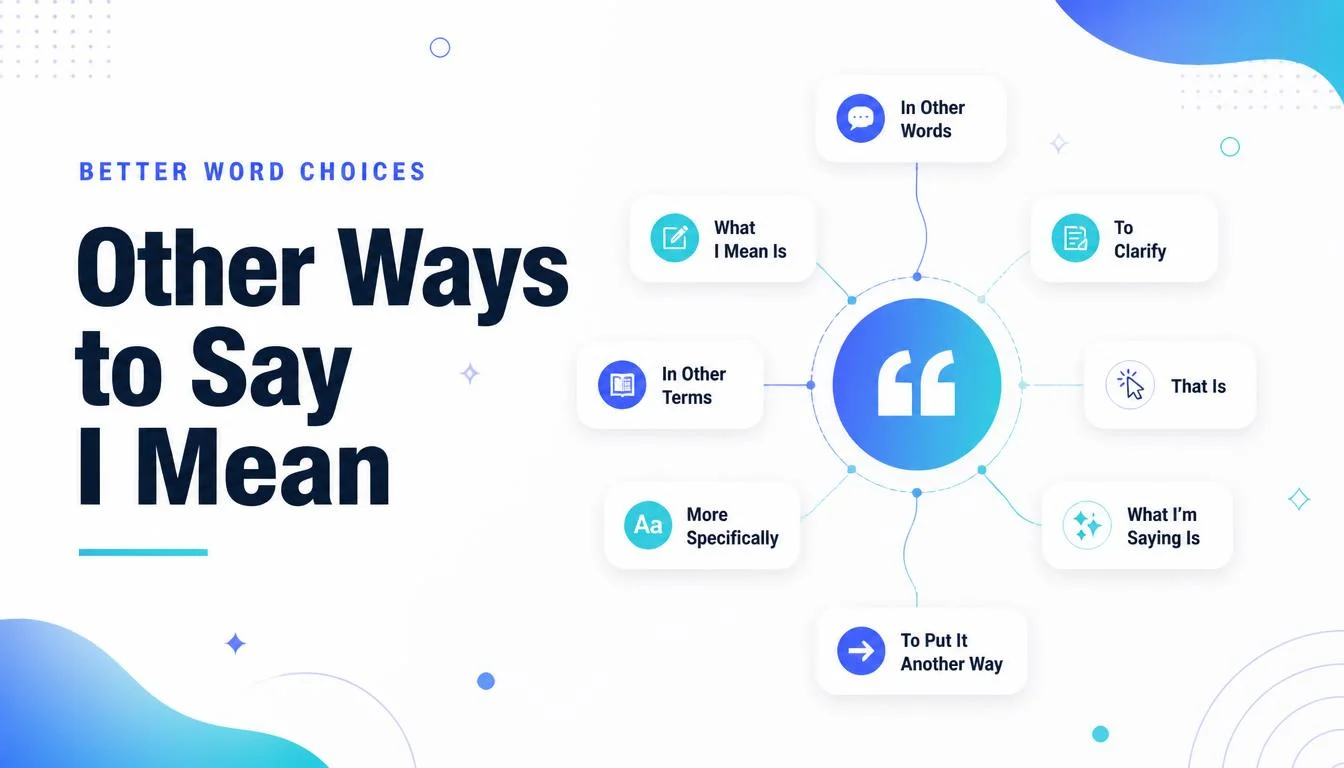
Other ways to say I mean include in other words, what I’m saying is, that is, to clarify, and what I’m trying to say is.
Knowing other ways to say I mean can help you express yourself more clearly and naturally. The best alternative depends on whether you are clarifying an idea, correcting yourself, or emphasizing a point.
Using different expressions can also make your English sound more polished and flexible. From casual conversations to professional communication, these alternatives help you explain exactly what you want to say.
What Is “I Mean”? (Meaning, Grammar & Real Use)
Imagine you are explaining an idea to a colleague and realize that your first sentence did not communicate exactly what you intended. You might naturally say, “I mean, we could finish it tomorrow,” to clarify your point. In another conversation, you might use “I mean” to emphasize an opinion, correct yourself, or introduce a more precise explanation.
The phrase is extremely common in spoken English, which is why learners often look for alternatives to “I mean” when they want to avoid repetition or sound more polished. Choosing the right expression can also help you express excitement in English or communicate hesitation, clarification, agreement, or emphasis more naturally.
“I mean” usually signals that the speaker is refining or explaining a previous statement.
Grammatically, it is a conversational phrase rather than a formal sentence structure. It is especially common in speech and informal writing.
Example: “I mean, we should probably check the figures again.”
People use it when clarifying, correcting, emphasizing, or slightly changing what they have just said.
When Should You Use “I Mean”?
Use the phrase when you need to make your meaning clearer or adjust what you have just said.
- Clarifying: Explain what you really intended.
- Correcting: Fix a word, number, or detail.
- Rephrasing: Present the same idea more clearly.
- Emphasizing: Draw attention to an important point.
- Adding context: Give listeners more information.
- Casual conversation: Keep speech natural and spontaneous.
- Spoken English: Use it naturally when thinking aloud.
- Informal writing: It can work in messages, personal posts, and conversational writing.
Spoken vs. Written
“I mean” is much more common in conversation than in formal writing. In writing, phrases such as “in other words” or “more precisely” often sound cleaner.
Formal vs. Informal
The phrase is generally informal and conversational. It is not incorrect, but repeated use can make professional communication sound less polished.
Is It Professional or Just Polite?
Politeness and professionalism are different. “I mean” is not rude, but it can sound conversational and spontaneous rather than carefully structured.
Business example: “To clarify, I mean that we should review the proposal before Friday.”
- Polite? ✔️ Yes
- Professional? ✔️ Sometimes, but better alternatives are often available
For polished workplace communication, consider using “to clarify,” “in other words,” or “more precisely.”
Pros and Cons of Using “I Mean”
Pros
- Easy to understand: Most English speakers recognize it immediately.
- Natural: It is very common in everyday conversation.
- Flexible: It can clarify, correct, or emphasize an idea.
- Friendly: It can make spontaneous speech feel relaxed.
Cons
- Can become repetitive: Frequent use may sound like a verbal habit.
- Less formal: It may not fit polished business writing.
- Can weaken statements: Overuse may make speech sound uncertain.
- Limited precision: More specific phrases can communicate the speaker’s intention better.
Common Mistakes People Make
1. Using “I mean” in every sentence
Incorrect: “I mean, I think, I mean, we should, I mean, start now.”
Correct: “I think we should start now.”
2. Using it when a formal transition is needed
Incorrect: “I mean, the report demonstrates a significant improvement.”
Correct: “In other words, the report demonstrates a significant improvement.”
3. Confusing clarification with correction
Incorrect: “I mean, Tuesday. Actually, I mean Monday.”
Correct: “I mean Monday, not Tuesday.”
4. Using it repeatedly in presentations
Incorrect: “I mean, our results, I mean, show that, I mean, sales increased.”
Correct: “Our results show that sales increased.”
5. Treating it as a substitute for precise language
Incorrect: “I mean, the problem is kind of complicated.”
Correct: “More precisely, the problem involves several technical issues.”
“Small tone mistakes can make confident English sound careless.”
Alternatives by Category
Formal alternatives to “I Mean”
- More precisely
- In other words
- To clarify
Pro Tip: Use these when writing reports, academic responses, or formal explanations.
Casual alternatives
- What I’m saying is
- What I’m trying to say is
- Basically
Pro Tip: Choose these when talking with friends or explaining an idea naturally.
Professional alternatives
- To clarify
- What I’m suggesting is
- More specifically
Pro Tip: In workplace conversations, choose the phrase that explains your exact purpose.
Informal expressions
- Actually
- Let me put it another way
- What I’m getting at is
Pro Tip: Use these conversational expressions when you want to rephrase without sounding overly formal.
“Formal and informal English aren’t about correctness. They’re about context.”
Other Ways to Say “I Mean” (Full List with Examples)
These alternatives build fluency and help you clarify, rephrase, emphasize, or refine your meaning according to tone and context.
1. Phrase: In other words
Meaning: A different explanation.
Explanation: Rephrases an idea clearly.
Example Sentence: In other words, we need more time.
Best Use: Clear explanations
Worst Use: Casual banter
Tone: Neutral, clear
Context Variability: professional / spoken
2. Phrase: To clarify
Meaning: To make something clearer.
Explanation: Signals precise clarification.
Example Sentence: To clarify, the meeting starts at ten.
Best Use: Workplace communication
Worst Use: Casual chatter
Tone: Professional, direct
Context Variability: professional / spoken
3. Phrase: More precisely
Meaning: More accurately.
Explanation: Introduces a correction or refinement.
Example Sentence: More precisely, the deadline is Thursday.
Best Use: Precise explanations
Worst Use: Friendly conversation
Tone: Formal, precise
Context Variability: professional / written
4. Phrase: What I’m saying is
Meaning: My intended point is.
Explanation: Introduces a clearer version of your idea.
Example Sentence: What I’m saying is, we need another option.
Best Use: Clarifying ideas
Worst Use: Formal reports
Tone: Conversational, clear
Context Variability: casual / spoken
5. Phrase: What I mean is
Meaning: My intended meaning is.
Explanation: A direct replacement that sounds natural.
Example Sentence: What I mean is, we need more evidence.
Best Use: Everyday clarification
Worst Use: Formal writing
Tone: Neutral, conversational
Context Variability: casual / spoken
6. Phrase: What I’m trying to say is
Meaning: My intended message is.
Explanation: Useful when expressing a difficult idea.
Example Sentence: What I’m trying to say is that we need patience.
Best Use: Personal explanations
Worst Use: Formal documents
Tone: Friendly, thoughtful
Context Variability: casual / spoken
7. Phrase: Let me rephrase that
Meaning: Say something differently.
Explanation: Clearly signals a revised explanation.
Example Sentence: Let me rephrase that so it is clearer.
Best Use: Clarifying statements
Worst Use: Casual greetings
Tone: Neutral, professional
Context Variability: professional / spoken
8. Phrase: Let me put it another way
Meaning: Explain differently.
Explanation: Invites a clearer restatement.
Example Sentence: Let me put it another way: we need to act now.
Best Use: Complex explanations
Worst Use: Short answers
Tone: Conversational, clear
Context Variability: casual / spoken
9. Phrase: Basically
Meaning: In simple terms.
Explanation: Summarizes the central point.
Example Sentence: Basically, we need to start again.
Best Use: Simple summaries
Worst Use: Academic analysis
Tone: Casual, simple
Context Variability: casual / spoken
10. Phrase: Essentially
Meaning: At its core.
Explanation: Highlights the fundamental point.
Example Sentence: Essentially, the plan remains unchanged.
Best Use: Professional summaries
Worst Use: Friendly chatter
Tone: Neutral, polished
Context Variability: professional / written
11. Phrase: To put it simply
Meaning: In simple terms.
Explanation: Makes a complicated point accessible.
Example Sentence: To put it simply, costs are increasing.
Best Use: Clear explanations
Worst Use: Technical details
Tone: Neutral, accessible
Context Variability: professional / spoken
12. Phrase: Specifically
Meaning: In exact terms.
Explanation: Narrows an explanation to a particular detail.
Example Sentence: Specifically, we need two more employees.
Best Use: Precise details
Worst Use: Casual reactions
Tone: Direct, professional
Context Variability: professional / written
13. Phrase: More specifically
Meaning: With greater detail.
Explanation: Refines a general statement.
Example Sentence: More specifically, we need marketing support.
Best Use: Detailed clarification
Worst Use: Casual jokes
Tone: Professional, precise
Context Variability: professional / written
14. Phrase: What I’m getting at is
Meaning: My main point is.
Explanation: Leads toward the intended message.
Example Sentence: What I’m getting at is that we need consistency.
Best Use: Spoken explanations
Worst Use: Formal reports
Tone: Informal, conversational
Context Variability: casual / spoken
15. Phrase: What I’m suggesting is
Meaning: My proposed idea is.
Explanation: Clearly introduces a recommendation.
Example Sentence: What I’m suggesting is a shorter deadline.
Best Use: Workplace discussions
Worst Use: Casual greetings
Tone: Professional, measured
Context Variability: professional / spoken
16. Phrase: What I’m referring to is
Meaning: The specific thing mentioned.
Explanation: Identifies the intended reference.
Example Sentence: What I’m referring to is the final paragraph.
Best Use: Precise discussions
Worst Use: Casual conversation
Tone: Formal, precise
Context Variability: professional / written
17. Phrase: To be clear
Meaning: To remove confusion.
Explanation: Emphasizes the intended interpretation.
Example Sentence: To be clear, this is only a draft.
Best Use: Important clarification
Worst Use: Casual small talk
Tone: Direct, professional
Context Variability: professional / spoken
18. Phrase: To put it differently
Meaning: Using different wording.
Explanation: Restates an idea without changing its meaning.
Example Sentence: To put it differently, quality matters more than speed.
Best Use: Explanations
Worst Use: Brief replies
Tone: Neutral, polished
Context Variability: professional / written
19. Phrase: In simple terms
Meaning: Without complexity.
Explanation: Makes information easier to understand.
Example Sentence: In simple terms, the system saves time.
Best Use: Teaching concepts
Worst Use: Advanced analysis
Tone: Clear, neutral
Context Variability: professional / spoken
20. Phrase: In essence
Meaning: At the most basic level.
Explanation: Summarizes the core idea.
Example Sentence: In essence, the proposal reduces unnecessary costs.
Best Use: Formal summaries
Worst Use: Casual conversation
Tone: Formal, concise
Context Variability: professional / written
21. Phrase: Actually
Meaning: In fact or more accurately.
Explanation: Can correct or refine information.
Example Sentence: Actually, I meant Friday.
Best Use: Gentle corrections
Worst Use: Formal analysis
Tone: Casual, corrective
Context Variability: casual / spoken
22. Phrase: Rather
Meaning: More accurately.
Explanation: Replaces or adjusts a previous statement.
Example Sentence: It was challenging, rather, it was extremely demanding.
Best Use: Refined corrections
Worst Use: Casual speech
Tone: Formal, precise
Context Variability: professional / written
23. Phrase: In fact
Meaning: More accurately or truthfully.
Explanation: Adds emphasis or correction.
Example Sentence: In fact, the results were better than expected.
Best Use: Emphasis
Worst Use: Repeated clarification
Tone: Neutral, assertive
Context Variability: professional / written
24. Phrase: To be more specific
Meaning: Giving exact details.
Explanation: Narrows a broad statement.
Example Sentence: To be more specific, we need three additional weeks.
Best Use: Detailed clarification
Worst Use: Casual greetings
Tone: Professional, precise
Context Variability: professional / spoken
25. Phrase: Let me clarify
Meaning: Explain more clearly.
Explanation: Directly signals that clarification follows.
Example Sentence: Let me clarify what I meant earlier.
Best Use: Professional discussion
Worst Use: Casual banter
Tone: Polite, professional
Context Variability: professional / spoken
26. Phrase: To explain further
Meaning: Add more explanation.
Explanation: Develops an existing point.
Example Sentence: To explain further, the change affects all departments.
Best Use: Detailed explanations
Worst Use: Quick conversations
Tone: Formal, clear
Context Variability: professional / written
27. Phrase: My point is
Meaning: The main idea is.
Explanation: Directly emphasizes your central message.
Example Sentence: My point is that we need better planning.
Best Use: Strong emphasis
Worst Use: Sensitive discussions
Tone: Direct, assertive
Context Variability: casual / spoken
28. Phrase: The point I’m making is
Meaning: The idea being emphasized.
Explanation: Makes your central argument explicit.
Example Sentence: The point I’m making is that timing matters.
Best Use: Discussions, debates
Worst Use: Short messages
Tone: Assertive, clear
Context Variability: casual / spoken
29. Phrase: If I may clarify
Meaning: Politely introduce clarification.
Explanation: Softens a professional correction or explanation.
Example Sentence: If I may clarify, the figures cover only one quarter.
Best Use: Formal discussions
Worst Use: Casual chats
Tone: Polite, formal
Context Variability: professional / spoken
30. Phrase: In short
Meaning: Briefly summarized.
Explanation: Gives the main point concisely.
Example Sentence: In short, we need a better strategy.
Best Use: Concise summaries
Worst Use: Detailed explanations
Tone: Neutral, concise
Context Variability: professional / written
Comparison Table: Top 10 Alternatives at a Glance
| Phrase | Tone | Best Use |
|---|---|---|
| In other words | Neutral, clear | Rephrasing ideas |
| To clarify | Professional, direct | Workplace communication |
| More precisely | Formal, precise | Corrections |
| What I mean is | Conversational, clear | Everyday speech |
| Let me rephrase that | Professional, neutral | Clarification |
| Essentially | Neutral, polished | Summaries |
| To be clear | Direct, professional | Important points |
| More specifically | Professional, precise | Detailed explanations |
| Let me clarify | Polite, professional | Workplace discussions |
| In short | Neutral, concise | Final summaries |
Quick Self-Check (Mini Quiz)
1. Which phrase best fits a formal business email?
A. Basically
B. To clarify
C. What I’m getting at is
D. I mean
Answer: B. To clarify
2. You accidentally give the wrong day. Which phrase works best?
A. More specifically
B. In essence
C. Actually, I meant Monday
D. In short
Answer: C. Actually, I meant Monday
3. You want to explain a complicated idea in simpler language.
A. Let me put it another way
B. Specifically
C. In fact
D. Rather
Answer: A. Let me put it another way
4. Which phrase is most suitable for a concise formal summary?
A. What I’m saying is
B. In short
C. Basically
D. What I’m getting at is
Answer: B. In short
FAQs
What are the best alternatives to “I mean”?
Some of the most useful alternatives are “in other words,” “to clarify,” “what I mean is,” “more precisely,” and “let me rephrase that.”
What is a professional way to say “I mean”?
Use “to clarify,” “more specifically,” “what I’m suggesting is,” or “let me clarify” in professional conversations and workplace communication.
Is “I mean” informal English?
Yes. “I mean” is primarily conversational and informal, although it is perfectly understandable and acceptable in everyday speech.
Can I use “I mean” in formal writing?
You can, but it is usually better to choose a more precise phrase such as “in other words,” “more precisely,” or “to clarify.”
What are some informal expressions in English for “I mean”?
Natural informal options include “basically,” “what I’m getting at is,” “what I’m trying to say is,” and “let me put it another way.”
conclusion
Learning different ways to express the same idea gives you greater control over tone, clarity, and confidence. Instead of repeating “I mean,” choose an expression that matches your purpose, whether you are correcting a detail, explaining an idea, or communicating professionally.
Practice switching between conversational and formal alternatives in everyday situations. This will make your English sound more flexible and intentional.
Read More Related Articles:
- Other Ways to Say You’re Beautiful | Beyond the Ordinary Compliment In 2026
- Other Ways to Say I Love You in Spanish | Beyond the Usual Phrase In 2026
- Other Ways to Say I Love You in Other Languages | Beyond the Classic Three Words In 2026
Victoria Hughes is a content writer dedicated to making communication clearer and more effective. Through TextsResponse.com, she shares practical insights and thoughtfully crafted response ideas that help readers express themselves with confidence.