Quick Answer
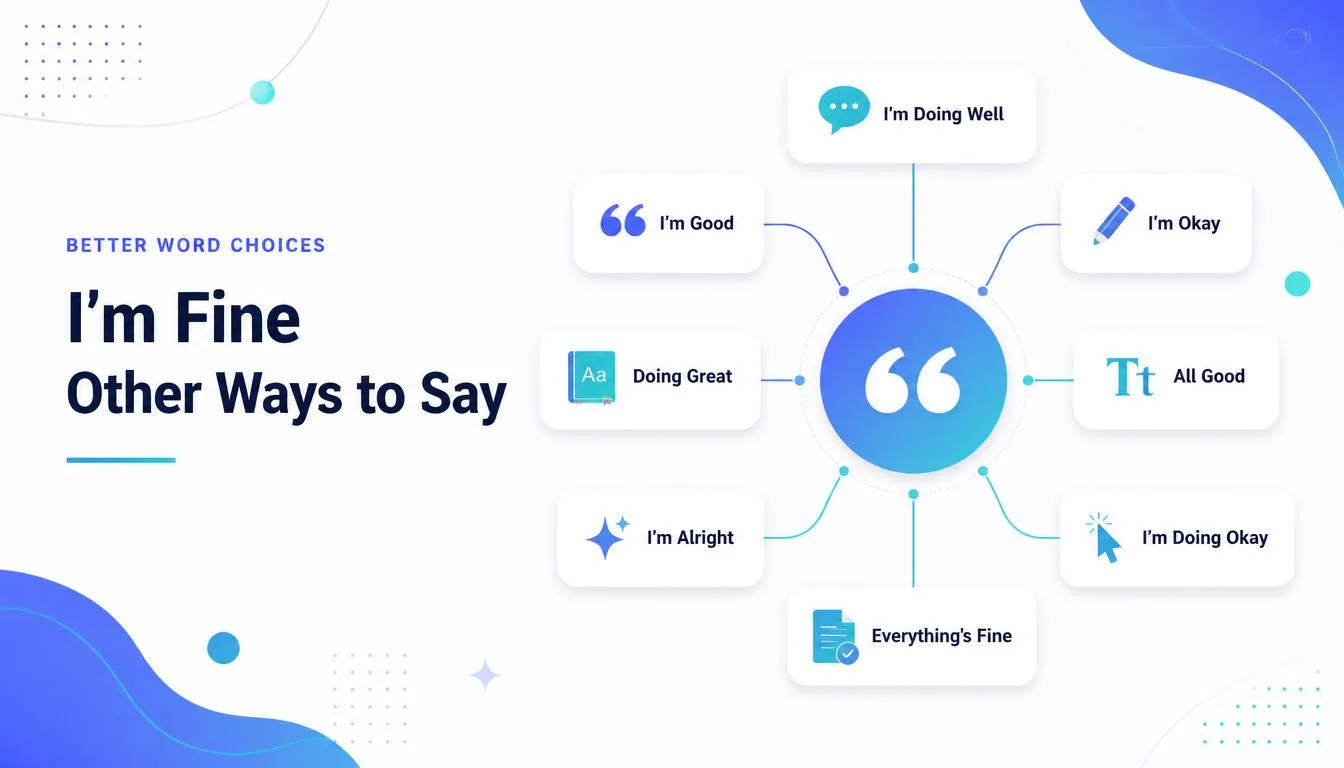
Other ways to say “I’m fine” include I’m doing well, I’m good, I’m doing great, I’m all right, and I’m doing okay.
Knowing other ways to say “I’m fine” can help you sound more natural, confident, and expressive in everyday English. While “I’m fine” is perfectly correct, different alternatives can better match your mood, relationship, and situation.
Whether you are talking with friends, responding to a colleague, or having a casual conversation, learning other ways to say “I’m fine” gives you more flexibility in English. These expressions range from friendly and casual to polite and professional.
What Is “I’m Fine Other Ways to Say”? (Meaning, Grammar & Real Use)
Imagine someone asks, “How are you?” at work, at school, or during a casual conversation with a friend. Saying “I’m fine” is grammatically correct, but repeating the same response can sometimes make your English sound limited or overly neutral. Native and fluent speakers naturally vary their responses according to the situation, their mood, and their relationship with the listener.
Learning alternatives to I’m fine other ways to say can help you respond more naturally without changing the basic meaning. You may want to sound warmer with a friend, more confident with a colleague, or more positive when someone asks about your progress. In other situations, you may simply want a neutral answer without giving too much personal information.
These expressions are also useful when learning how to express excitement in English, because a simple response such as “I’m doing fantastic” can communicate much more enthusiasm than “I’m fine.
Definition: “I’m fine” is a common response meaning that you are well, okay, or experiencing no significant problem.
Grammar: “Fine” is an adjective, while “I’m” is the contraction of “I am.” The expression is common in both spoken and written English, although some alternatives sound more natural in particular settings.
Example: “Thanks for asking. I’m doing well.”
People commonly use the expression when answering greetings, responding to concern, or briefly describing their current condition.
When Should You Use “I’m Fine”?
The expression works in many everyday situations, but choosing an alternative can help you communicate your exact tone more effectively.
Common contexts
- Answering “How are you?”
- Responding to a colleague’s greeting
- Reassuring someone who asks whether you are okay
- Giving a brief update about your general well-being
- Keeping a conversation short and polite
- Responding when you do not want to discuss personal details
Spoken vs Written
Spoken English: “I’m good,” “I’m doing well,” and “I’m all right” are common conversational choices.
Written English: “I’m doing well” and “I’m doing quite well” can sound more polished in emails or professional messages.
Formal vs Informal
Formal: “I’m doing well,” “I’m quite well, thank you,” and “I’m doing very well.”
Informal: “I’m good,” “I’m great,” and “I’m doing okay.”
The best choice depends on who you are speaking to and what you want your response to communicate.
Is It Professional or Just Polite?
“I’m fine” is polite, but it is not especially professional or formal by itself. It is a general-purpose expression that works in ordinary conversation and many workplace situations.
Professional communication often benefits from a slightly more polished response, particularly when speaking with clients, managers, interviewers, or formal contacts.
Business example: “Thank you for asking. I’m doing well and looking forward to today’s meeting.”
Polite? ✔️ Yes
Professional? ✔️ Yes, depending on context
The phrase itself is acceptable at work, but a more specific response can sound warmer or more polished.
Pros and Cons of Using “I’m Fine”
Pros
- Simple: It is quick and easy to understand.
- Polite: It provides a courteous response to a greeting.
- Common: Almost every English learner encounters it early.
- Flexible: It works in many everyday situations.
Cons
- Can sound neutral: It does not reveal much about your mood.
- Can feel repetitive: Using it every time can make conversations less varied.
- Limited emotional range: It does not clearly communicate enthusiasm or concern.
- May sound reserved: Depending on tone, listeners may interpret it as emotionally distant.
Using different responses helps you communicate more precisely without making your English unnecessarily complicated.
Common Mistakes People Make
1. Using “I’m fine” when you mean “I’m doing well”
Less natural: “I am fine in my new job.”
Correct: “I’m doing well in my new job.”
Use “fine” for your condition and “doing well” when describing how something is progressing.
2. Confusing “I’m good” with “I’m well” in every context
Less appropriate: “I’m good with the flu.”
Correct: “I’m feeling better now.”
Good” is common in casual conversation, while “well” can describe someone’s state or health more specifically.
3. Giving an overly casual response in a formal setting
Less suitable: “I’m great!” to a highly formal business contact.
Better: “I’m doing very well, thank you.”
A professional setting may call for a more measured response.
4. Saying “I’m fine” when you actually mean “I’m not okay”
Unclear: “I’m fine,” while clearly upset.
Better: “I’m having a difficult day.”
If you want someone to understand your real situation, choose an expression that reflects your feelings.
5. Repeating the same phrase in every conversation
Repetitive: “I’m fine.” “I’m fine.” “I’m fine.”
Better: “I’m doing well.” “I’m pretty good.” “Things are going well.”
Varying your vocabulary makes everyday communication sound more natural.
Small tone mistakes can make confident English sound careless.
Alternatives by Category
Formal alternatives to “I’m Fine”
- I’m doing well.
- I’m doing very well.
- I’m quite well, thank you.
Pro Tip: Use a measured response when speaking with clients, interviewers, or senior colleagues.
Casual alternatives
- I’m good.
- I’m great.
- I’m doing okay.
Pro Tip: Use relaxed phrases with friends and familiar colleagues when the conversation is informal.
Professional alternatives
- I’m doing well, thank you.
- I’m doing quite well.
- Things are going well.
Pro Tip: Add a brief positive detail when you want to sound engaged rather than simply polite.
Informal expressions
- I’m all right.
- I’m pretty good.
- Can’t complain.
Pro Tip: Match informal expressions to relationships where relaxed conversation is already established.
“Formal and informal English aren’t about correctness. They’re about context.”
Other Ways to Say “I’m Fine” (Full List with Examples)
These alternatives build fluency and give you more ways to communicate your mood, confidence, satisfaction, or general well-being in different contexts.
1. Phrase: I’m Doing Well
Meaning: I am in a good condition.
Explanation: A natural and versatile alternative to “I’m fine.
Example Sentence: “Thanks for asking. I’m doing well.”
Best Use: Professional greetings
Worst Use: Highly emotional moments
Tone: Polite, positive
Context Variability: professional / spoken / written
2. Phrase: I’m Good
Meaning: I am okay or well.
Explanation: A very common casual response to “How are you?
Example Sentence: “I’m good, thanks. How about you?”
Best Use: Casual conversations
Worst Use: Formal correspondence
Tone: Casual, friendly
Context Variability: casual / spoken / professional
3. Phrase: I’m Doing Great
Meaning: I am doing very well.
Explanation: Shows more positivity and energy than “I’m fine.”
Example Sentence: “I’m doing great since starting my new role.”
Best Use: Positive updates
Worst Use: Serious situations
Tone: Upbeat, confident
Context Variability: casual / spoken / professional
4. Phrase: I’m Doing Very Well
Meaning: I am in a very good state.
Explanation: A polished response suitable for professional conversations.
Example Sentence: “I’m doing very well, thank you.”
Best Use: Formal greetings
Worst Use: Very casual chats
Tone: Polished, positive
Context Variability: professional / spoken / written
5. Phrase: I’m All Right
Meaning: I am okay.
Explanation: A neutral expression that can indicate general well-being.
Example Sentence: “Don’t worry about me. I’m all right.”
Best Use: Reassuring someone
Worst Use: Formal reports
Tone: Neutral, reassuring
Context Variability: casual / spoken / professional
6. Phrase: I’m Okay
Meaning: I am fine or not experiencing a major problem.
Explanation: Simple and flexible, but sometimes emotionally neutral.
Example Sentence: “Thanks for checking. I’m okay.”
Best Use: Reassurance
Worst Use: Formal introductions
Tone: Neutral, calm
Context Variability: casual / spoken / professional
7. Phrase: I’m Pretty Good
Meaning: I am doing fairly well.
Explanation: A relaxed response that expresses moderate positivity.
Example Sentence: “I’m pretty good these days.”
Best Use: Friendly conversations
Worst Use: Formal interviews
Tone: Relaxed, positive
Context Variability: casual / spoken / professional
8. Phrase: I’m Quite Well
Meaning: I am doing well.
Explanation: A somewhat formal way to describe your condition.
Example Sentence: “I’m quite well, thank you.”
Best Use: Polite exchanges
Worst Use: Casual banter
Tone: Formal, reserved
Context Variability: professional / spoken / written
9. Phrase: I’m Feeling Good
Meaning: I feel positive or healthy.
Explanation: Focuses more directly on your current feeling.
Example Sentence: “I’m feeling good after getting some rest.”
Best Use: Personal updates
Worst Use: Formal reports
Tone: Positive, natural
Context Variability: casual / spoken / professional
10. Phrase: I’m Feeling Better
Meaning: My condition has improved.
Explanation: Use this when you were previously unwell or struggling.
Example Sentence: “I’m feeling better after taking some time off.”
Best Use: Health updates
Worst Use: Routine greetings
Tone: Reassuring, positive
Context Variability: casual / spoken / professional
11. Phrase: Things Are Going Well
Meaning: My circumstances are progressing positively.
Explanation: Useful when discussing life, work, or projects.
Example Sentence: “Things are going well at the new office.”
Best Use: Progress updates
Worst Use: Simple greetings
Tone: Positive, composed
Context Variability: professional / spoken / written
12. Phrase: Everything Is Going Well
Meaning: Everything is progressing positively.
Explanation: Gives a broader response than simply describing your feelings.
Example Sentence: “Everything is going well with the project.”
Best Use: Work updates
Worst Use: Personal distress
Tone: Positive, reassuring
Context Variability: professional / spoken / written
13. Phrase: I’m Doing Okay
Meaning: I am managing reasonably well.
Explanation: Often suggests that things are acceptable rather than excellent.
Example Sentence: “I’m doing okay after the busy week.”
Best Use: Honest updates
Worst Use: Formal presentations
Tone: Neutral, honest
Context Variability: casual / spoken / professional
14. Phrase: I’m Doing Pretty Well
Meaning: I am doing fairly well.
Explanation: A natural conversational alternative with moderate positivity.
Example Sentence: “I’m doing pretty well, thanks.”
Best Use: Friendly greetings
Worst Use: Formal letters
Tone: Casual, positive
Context Variability: casual / spoken / professional
15. Phrase: I’m Great
Meaning: I am feeling very good.
Explanation: A short, enthusiastic response that expresses strong positivity.
Example Sentence: “I’m great, thanks for asking.”
Best Use: Friendly greetings
Worst Use: Serious situations
Tone: Enthusiastic, positive
Context Variability: casual / spoken / professional
16. Phrase: I’m Fantastic
Meaning: I am feeling exceptionally good.
Explanation: Expresses a high level of enthusiasm and satisfaction.
Example Sentence: “I’m fantastic after that successful presentation.”
Best Use: Positive moments
Worst Use: Difficult situations
Tone: Enthusiastic, energetic
Context Variability: casual / spoken / professional
17. Phrase: I’m Excellent
Meaning: I am doing exceptionally well.
Explanation: A strongly positive response that can sound polished.
Example Sentence: “I’m excellent, thank you.”
Best Use: Positive exchanges
Worst Use: Sensitive situations
Tone: Positive, confident
Context Variability: professional / spoken / casual
18. Phrase: I’m Quite Good
Meaning: I am doing fairly well.
Explanation: A measured expression that communicates moderate satisfaction.
Example Sentence: “I’m quite good, thank you.”
Best Use: Polite conversations
Worst Use: Emotional discussions
Tone: Measured, positive
Context Variability: professional / spoken / written
19. Phrase: I’m In Good Shape
Meaning: I am healthy or doing well.
Explanation: Often refers to physical condition or general readiness.
Example Sentence: “After training, I’m in good shape.”
Best Use: Health, fitness
Worst Use: Formal greetings
Tone: Positive, confident
Context Variability: casual / spoken / professional
20. Phrase: I’m Holding Up Well
Meaning: I am coping successfully with a difficult situation.
Explanation: Particularly useful when circumstances are challenging.
Example Sentence: “Despite the changes, I’m holding up well.”
Best Use: Difficult periods
Worst Use: Routine greetings
Tone: Resilient, calm
Context Variability: casual / spoken / professional
21. Phrase: I’m Managing Well
Meaning: I am coping successfully.
Explanation: Suggests that a situation may be demanding but manageable.
Example Sentence: “The workload is heavy, but I’m managing well.”
Best Use: Challenging situations
Worst Use: Casual greetings
Tone: Calm, capable
Context Variability: professional / spoken / written
22. Phrase: I’m Keeping Well
Meaning: I remain healthy and well.
Explanation: A polite expression that is more common in certain varieties of English.
Example Sentence: “I hope you’re keeping well.”
Best Use: Polite correspondence
Worst Use: Very casual chats
Tone: Polite, traditional
Context Variability: professional / written / spoken
23. Phrase: Can’t Complain
Meaning: Things are reasonably good.
Explanation: A relaxed response suggesting there are no major problems.
Example Sentence: “Can’t complain. Work has been busy, though.”
Best Use: Casual greetings
Worst Use: Formal interviews
Tone: Relaxed, understated
Context Variability: casual / spoken / professional
24. Phrase: I’m Doing Just Fine
Meaning: I am completely okay.
Explanation: Adds reassurance and confidence to the basic idea of being fine.
Example Sentence: “Thanks for worrying, but I’m doing just fine.”
Best Use: Reassurance
Worst Use: Formal reports
Tone: Reassuring, confident
Context Variability: casual / spoken / professional
25. Phrase: I’m Doing Nicely
Meaning: I am doing well.
Explanation: A friendly alternative that sounds warm and positive.
Example Sentence: “I’m doing nicely in my new position.”
Best Use: Friendly updates
Worst Use: Formal reports
Tone: Warm, positive
Context Variability: casual / spoken / professional
26. Phrase: I’m Happy and Well
Meaning: I am both content and healthy.
Explanation: Adds an emotional dimension to a general well-being response.
Example Sentence: “I’m happy and well in my new home.”
Best Use: Personal updates
Worst Use: Formal greetings
Tone: Warm, positive
Context Variability: casual / spoken / professional
27. Phrase: I’m Well, Thank You
Meaning: I am well.
Explanation: A traditional and polite response to a greeting or inquiry.
Example Sentence: “I’m well, thank you. How are you?”
Best Use: Formal greetings
Worst Use: Casual texting
Tone: Polite, formal
Context Variability: professional / spoken / written
28. Phrase: I’m Doing Better Than Ever
Meaning: I am doing better than previously.
Explanation: Communicates noticeable improvement and strong positivity.
Example Sentence: “I’m doing better than ever since changing jobs.”
Best Use: Positive progress
Worst Use: Negative situations
Tone: Confident, optimistic
Context Variability: casual / spoken / professional
29. Phrase: I’m Doing Just Fine, Thanks
Meaning: I am perfectly okay.
Explanation: A reassuring response that can sound slightly emphatic.
Example Sentence: “I’m doing just fine, thanks for checking.”
Best Use: Reassurance
Worst Use: Formal documents
Tone: Friendly, confident
Context Variability: casual / spoken / professional
30. Phrase: I’m Doing Really Well
Meaning: I am doing very well.
Explanation: A natural and versatile response with clear positive energy.
Example Sentence: “I’m doing really well in my new role.”
Best Use: Everyday updates
Worst Use: Serious discussions
Tone: Positive, natural
Context Variability: casual / spoken / professional
Comparison Table: Top 10 Alternatives at a Glance
| Phrase | Tone | Best Use |
|---|---|---|
| I’m Doing Well | Polite, positive | Professional greetings |
| I’m Good | Casual, friendly | Everyday conversation |
| I’m Doing Great | Upbeat, confident | Positive updates |
| I’m Doing Very Well | Polished, positive | Formal situations |
| I’m All Right | Neutral, reassuring | Reassurance |
| I’m Okay | Neutral, calm | Everyday responses |
| Things Are Going Well | Positive, composed | Work updates |
| I’m Doing Okay | Honest, neutral | Personal updates |
| I’m Feeling Better | Reassuring, positive | Health updates |
| I’m Doing Really Well | Positive, natural | Everyday conversation |
Quick Self-Check (Mini Quiz)
1. You are answering a client who asks how you are before a meeting. Which response is most appropriate?
A. I’m pretty good.
B. I’m doing very well, thank you.
C. Can’t complain.
D. I’m great!
Answer: B
2. Your friend asks how your weekend has been. Which response sounds naturally casual?
A. I’m doing very well, thank you.
B. I’m quite well.
C. I’m pretty good.
D. I’m well, thank you.
Answer: C
3. You were sick yesterday but feel healthier today. Which response fits best?
A. I’m feeling better.
B. I’m fantastic.
C. I’m excellent.
D. I’m quite good.
Answer: A
4. You want to describe positive progress at work. Which response is most suitable?
A. I’m all right.
B. Things are going well.
C. I’m okay.
D. Can’t complain.
Answer: B
FAQs
What are the most natural alternatives to “I’m fine”?
Common alternatives include “I’m doing well,” “I’m good,” “I’m doing great,” “I’m okay,” and “I’m all right.” The best choice depends on your relationship with the listener and the situation.
What is a professional way to say “I’m fine”?
I’m doing well, thank you” is a natural professional alternative. “I’m doing very well” can also work in more formal conversations.
Is “I’m good” correct English?
Yes. I’m good” is widely used in everyday spoken English to mean that you are okay or doing well. It is generally more casual than “I’m doing well.”
How can I avoid repeating “I’m fine”?
Vary your response according to the situation. You can say “I’m doing well,” “I’m feeling better,” “Things are going well,” or “I’m doing great” when those meanings accurately reflect your situation.
What are some informal expressions in English for “I’m fine”?
Informal expressions include “I’m good,” “I’m pretty good,” “I’m doing okay,” “I’m all right,” and “Can’t complain.” Choose according to how casual the conversation is.
conclusion
Knowing different ways to respond to “How are you?” helps you move beyond repetitive English and communicate your mood more precisely. A small change from “I’m fine” to “I’m doing well,” “I’m feeling better,” or “Things are going well” can make your speech sound more natural and context-aware.
For professional communication, focus on clarity and politeness. In casual conversations, you have more freedom to use relaxed expressions. The goal is not to replace “I’m fine” completely, but to build enough vocabulary to choose the response that fits the moment.
Read More Related Articles:
- Other Ways to Say Circle Back | Improve Your Workplace Communication In 2026
- Other Ways to Say Welcome to the Team | Warm First Impression In 2026
- Other Ways to Say I Hope All Is Well | Make a Better First Impression In 2026

Victoria Hughes is a content writer dedicated to making communication clearer and more effective. Through TextsResponse.com, she shares practical insights and thoughtfully crafted response ideas that help readers express themselves with confidence.