Quick Answer
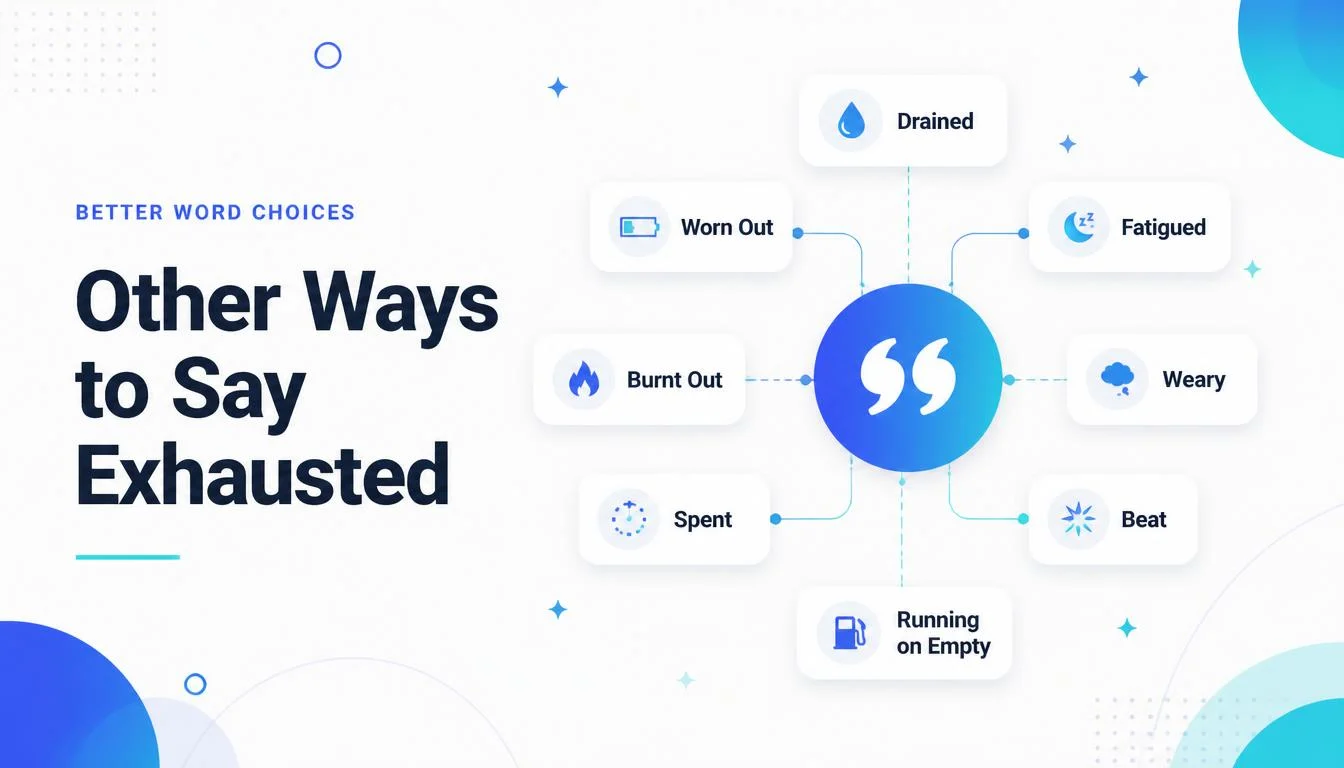
Other ways to say exhausted include worn out, drained, fatigued, spent, and completely wiped out. These alternatives help you describe physical tiredness or mental fatigue naturally.
Learning other ways to say exhausted can help you express tiredness more clearly and make your English vocabulary more varied. Whether you feel physically worn out after a long day or mentally drained after demanding work, choosing the right expression helps communicate exactly how you feel.
Different alternatives to “exhausted” suit different situations. For example, “fatigued” sounds more formal, “worn out” works well in everyday conversations, and “completely wiped out” expresses intense tiredness informally. Understanding these expressions can improve your speaking, writing, and professional communication.
What Is “Exhausted”? (Meaning, Grammar & Real Use)
Imagine finishing a long workday, attending several meetings, and spending hours completing an important project. When someone asks how you feel, saying “I’m exhausted” communicates more than ordinary tiredness. It suggests that you have used most of your physical or mental energy and need time to recover.
Learning alternatives to exhausted helps you describe that feeling more precisely. You might feel physically worn out after exercising, mentally drained after studying, or emotionally depleted after handling a difficult situation. Choosing the right expression makes your English sound more natural and helps listeners understand what you mean.
These expressions are useful for everyday conversations, workplace discussions, academic writing, and personal messages. They also help English learners understand how word choice changes according to tone and context. Just as people learn to express excitement in English with different levels of enthusiasm, they can describe tiredness with different levels of intensity.
Definition: Exhausted means extremely tired or completely lacking energy, whether physically, mentally, or emotionally.
Grammar note: Exhausted is an adjective, often used after linking verbs such as be, feel, and seem. It is appropriate in both formal and informal English.
Example: “I’m exhausted after working on the report all afternoon.”
People use the word in spoken conversations and written communication whenever ordinary words such as tired do not fully express the intensity of their fatigue.
When Should You Use “Exhausted”?
The word works in many situations, but choosing a more specific expression can make your message clearer.
Common contexts
- After physical activity: Use worn out, physically drained, or beat after exercise, travel, or demanding work.
- After mental effort: Choose mentally drained, mentally fatigued, or mentally spent after studying or solving complex problems.
- After emotional stress: Use emotionally drained or depleted when difficult experiences leave you with little emotional energy.
- During a demanding workday: Expressions such as fatigued and worn out can communicate tiredness without sounding overly dramatic.
- After insufficient rest: Say sleep-deprived when a lack of sleep is the specific cause.
- During casual conversations: Phrases such as beat and dead tired sound natural with friends and family.
Spoken vs. written English
In conversation, expressions such as “I’m wiped out” and “I’m completely worn out” sound natural. In formal writing, fatigued or physically exhausted may be more suitable.
Formal vs. informal English
Formal English favors precise expressions such as experiencing significant fatigue. Informal English often uses beat, wiped out, or dead tired.
Choose the expression that matches both the situation and the degree of tiredness you want to communicate.
Is It Professional or Just Polite?
Exhausted is a standard English adjective, so it is not inherently unprofessional. However, in workplace communication, the context determines whether it is the best choice.
Politeness concerns how respectfully you communicate. Professionalism concerns how clearly and appropriately you communicate within a work setting.
For example, telling a colleague that you are exhausted after completing a demanding project is perfectly acceptable. However, if you are writing a formal report, fatigued or experiencing fatigue may sound more objective.
Business example: “The team is experiencing significant fatigue following an intensive project schedule, so we recommend adjusting the upcoming deadlines.”
- Polite? ✔️ Yes
- Professional? ✔️ Yes, when appropriate to the context
For more guidance on workplace language, see the Professional English Communication Guide.
Pros and Cons of Using “Exhausted”
Pros
- Clear meaning: Most English speakers understand that exhausted means extremely tired.
- Strong emphasis: It communicates more intense tiredness than the word tired.
- Versatile usage: It works in conversations, emails, personal writing, and many professional settings.
- Natural expression: It helps you describe your condition without needing a long explanation.
Cons
- Can sound dramatic: Using it for minor tiredness may exaggerate your condition.
- Limited specificity: It does not always explain whether your fatigue is physical, mental, or emotional.
- May feel repetitive: Using the same adjective frequently can make your writing less varied.
- Not always precise: In medical, technical, or workplace reports, a more specific description may be necessary.
The solution is not to avoid the word. Instead, use a more precise alternative when the situation calls for it.
Common Mistakes People Make
English learners sometimes use similar expressions interchangeably, even when their meanings or grammatical patterns differ.
1. Confusing “exhausted” with ordinary tiredness
Incorrect: “I’m exhausted because I walked for two minutes.”
Better: “I’m a little tired because I walked for two minutes.”
Exhausted usually suggests a high level of fatigue, so use it when the intensity justifies the word.
2. Using “burned out” for every tiring activity
Incorrect: “I’m burned out after one short walk.”
Better: “I’m tired after one short walk.”
Burned out often describes prolonged stress or overwork rather than brief physical effort.
3. Using “sleep-deprived” as a general synonym
Incorrect: “I’m sleep-deprived after running for an hour.”
Better: “I’m physically exhausted after running for an hour.”
Sleep-deprived specifically refers to insufficient sleep, not every cause of tiredness.
4. Forgetting the adjective’s grammatical pattern
Incorrect: “I feel exhaustion after work.”
Better: “I feel exhausted after work.”
Both exhaustion and exhausted are correct words, but they serve different grammatical functions. Exhaustion is a noun; exhausted is an adjective.
5. Choosing informal expressions in formal reports
Incorrect: “The employees were totally beat after the shift.”
Better: “The employees experienced significant fatigue after the shift.”
Informal expressions work well in casual speech, but formal reports generally benefit from neutral, precise language.
“Small tone mistakes can make confident English sound careless.”
Alternatives by Category
These categories provide a preview of the expressions covered in the complete list below. Each phrase communicates tiredness differently, so consider the audience and situation before choosing one.
Formal alternatives to “exhausted”
- Fatigued
- Physically depleted
- Experiencing significant fatigue
Pro Tip: In reports and formal correspondence, describe the type or cause of fatigue whenever that detail is relevant.
Casual alternatives
- Worn out
- Drained
- Beat
Pro Tip: Use familiar expressions in everyday conversations, but avoid exaggerating your condition when a milder word is more accurate.
Professional alternatives
- Mentally fatigued
- Physically exhausted
- Running low on energy
Pro Tip: In workplace communication, connect tiredness to workload, recovery needs, or scheduling when it helps explain a practical concern.
Informal expressions
- Wiped out
- Dead tired
- Spent
Pro Tip: Match informal expressions to your relationship with the listener, especially when communicating with colleagues you do not know well.
“Formal and informal English aren’t about correctness. They’re about context.”
Other Ways to Say “Exhausted” (Full List with Examples)
The following 30 alternatives help you describe physical, mental, and emotional tiredness more accurately. Learning these phrases will also expand your vocabulary for everyday conversation and professional communication.
1. Phrase: Extremely Tired
Meaning: Very tired.
Explanation: A clear, widely understood alternative that emphasizes the intensity of your fatigue without sounding overly technical.
Example Sentence: “I’m extremely tired after preparing for tomorrow’s presentation.”
Best Use: Everyday conversations
Worst Use: Technical reports
Tone: Neutral, direct
Context Variability: casual / professional / spoken
2. Phrase: Worn Out
Meaning: Very tired from effort or activity.
Explanation: Commonly describes physical tiredness after a demanding day, exercise, travel, or repetitive work.
Example Sentence: “The long journey left us completely worn out.”
Best Use: Daily conversations
Worst Use: Formal documentation
Tone: Casual, natural
Context Variability: casual / spoken / written
3. Phrase: Drained
Meaning: Having little energy left.
Explanation: Often describes mental or emotional fatigue, although it can also refer to physical tiredness.
Example Sentence: “I feel drained after spending the entire afternoon resolving customer complaints.”
Best Use: Emotional fatigue
Worst Use: Technical records
Tone: Neutral, expressive
Context Variability: casual / professional / spoken
4. Phrase: Fatigued
Meaning: Experiencing tiredness or reduced energy.
Explanation: A relatively formal alternative suited to workplace discussions, health-related contexts, and objective descriptions.
Example Sentence: “Several employees felt fatigued after the extended shift.”
Best Use: Formal communication
Worst Use: Friendly chats
Tone: Formal, objective
Context Variability: professional / written / spoken
5. Phrase: Burned Out
Meaning: Experiencing prolonged exhaustion associated with ongoing stress or excessive demands.
Explanation: Often used when sustained work pressure leaves someone feeling depleted and less motivated.
Example Sentence: “She felt burned out after months of working without adequate breaks.”
Best Use: Ongoing stress
Worst Use: Brief exertion
Tone: Serious, conversational
Context Variability: casual / professional / spoken
6. Phrase: Wiped Out
Meaning: Completely exhausted.
Explanation: An informal expression for extreme tiredness after physical activity, travel, or a demanding day.
Example Sentence: “I’m wiped out after moving all the furniture.”
Best Use: Casual conversations
Worst Use: Formal reports
Tone: Informal, emphatic
Context Variability: casual / spoken / informal
7. Phrase: Beat
Meaning: Very tired.
Explanation: A familiar informal expression, especially in American English. It usually describes physical or general tiredness.
Example Sentence: “I’m beat, so I’m going to head home early.”
Best Use: Friendly conversations
Worst Use: Formal presentations
Tone: Informal, relaxed
Context Variability: casual / spoken / informal
8. Phrase: Dead Tired
Meaning: Extremely tired.
Explanation: An emphatic idiom that exaggerates tiredness for effect. It does not mean that someone is literally dead.
Example Sentence: “We were dead tired after hiking all afternoon.”
Best Use: Casual storytelling
Worst Use: Formal correspondence
Tone: Informal, emphatic
Context Variability: casual / spoken / informal
9. Phrase: Sleep-Deprived
Meaning: Suffering from insufficient sleep.
Explanation: Use this expression when lack of sleep is the main reason for your tiredness.
Example Sentence: “I’m sleep-deprived after several nights of interrupted rest.”
Best Use: Sleep-related fatigue
Worst Use: Exercise fatigue
Tone: Neutral, specific
Context Variability: casual / professional / written
10. Phrase: Mentally Drained
Meaning: Having little mental energy remaining.
Explanation: Appropriate after demanding intellectual tasks, complicated decisions, or prolonged concentration.
Example Sentence: “I feel mentally drained after studying for six hours.”
Best Use: Mental effort
Worst Use: Minor exertion
Tone: Neutral, descriptive
Context Variability: casual / professional / spoken
11. Phrase: Physically Depleted
Meaning: Having very little physical energy left.
Explanation: Emphasizes bodily fatigue after strenuous activity or prolonged physical demands.
Example Sentence: “The athletes felt physically depleted after the competition.”
Best Use: Physical demands
Worst Use: Routine greetings
Tone: Formal, descriptive
Context Variability: professional / written / spoken
12. Phrase: Exhausted Beyond Words
Meaning: So tired that words seem insufficient to describe it.
Explanation: An expressive phrase for communicating extreme fatigue, especially in personal conversations or informal writing.
Example Sentence: “After the overnight journey, I was exhausted beyond words.”
Best Use: Personal storytelling
Worst Use: Technical documents
Tone: Expressive, emphatic
Context Variability: casual / spoken / written
13. Phrase: Running on Empty
Meaning: Continuing with almost no energy remaining.
Explanation: This idiom suggests that someone is pushing through tasks despite needing rest.
Example Sentence: “I’ve been running on empty since the project deadline was moved forward.”
Best Use: Work pressure
Worst Use: Formal assessments
Tone: Conversational, vivid
Context Variability: casual / professional / spoken
14. Phrase: Spent
Meaning: Having used up your available energy.
Explanation: A concise alternative for physical, mental, or emotional tiredness.
Example Sentence: “After the difficult negotiation, I felt completely spent.”
Best Use: General fatigue
Worst Use: Formal medical records
Tone: Neutral, expressive
Context Variability: casual / professional / spoken
15. Phrase: Weary
Meaning: Tired, especially after prolonged effort or difficulty.
Explanation: This word can suggest both physical fatigue and emotional weariness. It also appears frequently in literary writing.
Example Sentence: “The weary travelers finally reached their hotel.”
Best Use: Descriptive writing
Worst Use: Casual announcements
Tone: Reflective, slightly formal
Context Variability: written / professional / spoken
16. Phrase: Physically Exhausted
Meaning: Extremely tired in the body.
Explanation: More specific than exhausted because it identifies physical effort as the relevant type of fatigue.
Example Sentence: “I was physically exhausted after carrying boxes upstairs.”
Best Use: Physical activity
Worst Use: Emotional strain
Tone: Neutral, precise
Context Variability: casual / professional / spoken
17. Phrase: Emotionally Drained
Meaning: Having little emotional energy left.
Explanation: Describes fatigue after stressful interactions, personal difficulties, or emotionally demanding experiences.
Example Sentence: “She felt emotionally drained after the difficult family discussion.”
Best Use: Emotional stress
Worst Use: Physical exertion
Tone: Sensitive, descriptive
Context Variability: casual / professional / spoken
18. Phrase: Mentally Fatigued
Meaning: Tired from sustained mental effort.
Explanation: Suitable for describing reduced mental energy after studying, analyzing information, or making difficult decisions.
Example Sentence: “The team was mentally fatigued after reviewing the complex data.”
Best Use: Intellectual work
Worst Use: Casual greetings
Tone: Formal, objective
Context Variability: professional / written / spoken
19. Phrase: Dog-Tired
Meaning: Extremely tired.
Explanation: An informal idiom used to emphasize strong tiredness, usually after a long day or substantial effort.
Example Sentence: “I’m dog-tired after working a double shift.”
Best Use: Informal conversation
Worst Use: Business reports
Tone: Informal, emphatic
Context Variability: casual / spoken / informal
20. Phrase: Bone-Tired
Meaning: Deeply and completely tired.
Explanation: Suggests profound fatigue that seems to affect the whole body. It often appears in descriptive or personal writing.
Example Sentence: “After days of travel, he felt bone-tired.”
Best Use: Personal narratives
Worst Use: Technical writing
Tone: Expressive, vivid
Context Variability: casual / spoken / written
21. Phrase: Depleted
Meaning: Having used up much of your available energy or resources.
Explanation: A flexible term that can describe a person’s energy levels or other resources. Context clarifies the intended meaning.
Example Sentence: “After the extended shift, the staff felt depleted.”
Best Use: Formal descriptions
Worst Use: Light conversation
Tone: Formal, measured
Context Variability: professional / written / spoken
22. Phrase: Low on Energy
Meaning: Having less energy than usual.
Explanation: A mild, natural expression that communicates tiredness without suggesting complete exhaustion.
Example Sentence: “I’m a little low on energy today, so I’ll take a short break.”
Best Use: Everyday updates
Worst Use: Severe fatigue descriptions
Tone: Neutral, gentle
Context Variability: casual / professional / spoken
23. Phrase: Running Out of Steam
Meaning: Losing energy, motivation, or momentum.
Explanation: This idiom works when someone begins a task with energy but struggles to maintain the same pace.
Example Sentence: “I’m running out of steam after working on this assignment all morning.”
Best Use: Ongoing tasks
Worst Use: Formal records
Tone: Conversational, vivid
Context Variability: casual / professional / spoken
24. Phrase: Overworked
Meaning: Required to work too much.
Explanation: Focuses on excessive workload rather than tiredness alone. It can suggest an ongoing problem with working conditions.
Example Sentence: “The employees felt overworked during the busy season.”
Best Use: Workload concerns
Worst Use: One workout
Tone: Neutral, serious
Context Variability: professional / written / spoken
25. Phrase: Fatigued and Weary
Meaning: Very tired after prolonged effort or difficulty.
Explanation: This combination adds emphasis and suits descriptive writing, although it can sound repetitive in concise professional communication.
Example Sentence: “The fatigued and weary crew returned after a demanding voyage.”
Best Use: Descriptive narratives
Worst Use: Concise emails
Tone: Formal, descriptive
Context Variability: written / professional / spoken
26. Phrase: Completely Drained
Meaning: Having almost no energy remaining.
Explanation: Intensifies drained and can describe physical, mental, or emotional fatigue.
Example Sentence: “I was completely drained after managing several urgent requests.”
Best Use: Intense fatigue
Worst Use: Minor tiredness
Tone: Neutral, emphatic
Context Variability: casual / professional / spoken
27. Phrase: Weighed Down by Fatigue
Meaning: Feeling heavily affected by tiredness.
Explanation: A descriptive phrase that emphasizes how fatigue interferes with someone’s ability to continue comfortably.
Example Sentence: “He felt weighed down by fatigue after several demanding days.”
Best Use: Descriptive writing
Worst Use: Brief messages
Tone: Reflective, formal
Context Variability: written / professional / spoken
28. Phrase: Physically Worn Out
Meaning: Extremely tired because of bodily effort.
Explanation: More specific than worn out, making it useful when physical activity is the clear cause.
Example Sentence: “The construction workers were physically worn out after the long shift.”
Best Use: Labor-intensive tasks
Worst Use: Mental fatigue
Tone: Neutral, descriptive
Context Variability: casual / professional / spoken
29. Phrase: Mentally Spent
Meaning: Having no mental energy left.
Explanation: A conversational way to describe the feeling that concentration and decision-making have become difficult after prolonged mental effort.
Example Sentence: “I’m mentally spent after preparing for three examinations.”
Best Use: Studying, planning
Worst Use: Formal reports
Tone: Casual, expressive
Context Variability: casual / spoken / professional
30. Phrase: Experiencing Significant Fatigue
Meaning: Experiencing a substantial level of tiredness.
Explanation: An objective, professional expression for reports, workplace discussions, or formal descriptions where measured language is appropriate.
Example Sentence: “Several team members are experiencing significant fatigue due to extended working hours.”
Best Use: Formal communication
Worst Use: Friendly chats
Tone: Formal, objective
Context Variability: professional / written / spoken
Comparison Table: Top 10 Alternatives at a Glance
Use this table to select a phrase based on the situation, audience, and degree of tiredness you want to communicate.
| Phrase | Tone | Best Use |
|---|---|---|
| Extremely tired | Neutral | Everyday communication |
| Worn out | Casual | Physical activity |
| Drained | Neutral | Emotional fatigue |
| Fatigued | Formal | Workplace writing |
| Burned out | Serious | Prolonged stress |
| Wiped out | Informal | Casual conversations |
| Sleep-deprived | Neutral | Lack of sleep |
| Mentally drained | Descriptive | Intellectual effort |
| Low on energy | Gentle | Mild tiredness |
| Completely drained | Emphatic | Intense fatigue |
Quick Self-Check (Mini Quiz)
Test your understanding by choosing the expression that best fits each situation.
1. You want to tell a friend that you are extremely tired after moving house. Which phrase sounds most natural?
Experiencing significant fatigueWiped outSleep-deprived
2. A formal report describes employees who are tired after long shifts. Which phrase is most appropriate?
Dog-tiredDead tiredExperiencing significant fatigue
3. You have not slept enough for several nights. Which phrase best explains the cause of your tiredness?
Sleep-deprivedOverworkedBone-tired
4. After months of excessive workload and ongoing stress, you feel depleted and less motivated. Which phrase fits best?
A little tiredBurned outLow on energy
FAQs
1. What are the best alternatives to exhausted?
Some of the best alternatives are extremely tired, worn out, drained, fatigued, and wiped out. The most appropriate choice depends on the cause and intensity of your tiredness.
2. What is a more professional word for exhausted?
Fatigued is a useful professional alternative. In formal reports, experiencing significant fatigue can sound more objective and precise.
3. What is a casual way to say exhausted?
You can say wiped out, beat, dead tired, or dog-tired. These expressions are common in informal conversations, although their suitability depends on your audience.
4. What is the difference between tired, exhausted, and burned out?
Tired describes a general need for rest. Exhausted suggests extreme tiredness, while burned out often refers to prolonged stress and depletion associated with ongoing demands.
5. How can I use alternatives to exhausted in a sentence?
Choose an expression that matches the context. For example, say “I’m mentally drained after studying” for intellectual fatigue or “I’m physically worn out after exercising” for bodily tiredness.
Conclusion
Expanding your vocabulary with different expressions for tiredness helps you communicate more accurately in everyday conversations, academic writing, and professional settings. Instead of relying on one adjective, consider whether you feel physically exhausted, mentally drained, emotionally depleted, or simply low on energy.
Practice using one new expression each day. Pay attention to its tone, meaning, and typical context so your English sounds natural rather than memorized. With consistent practice, you can describe your feelings clearly and confidently.
Read More Related Articles:
- Other Ways to Say Contact Us on Website | Natural Phrases to Use In 2026
- Other Ways to Say Bless You After a Sneeze | Clever Ways to Respond In 2026
- Other Ways to Say I Hope You Feel Better Soon | Comforting Messages for Anyone In 2026

Victoria Hughes is a content writer dedicated to making communication clearer and more effective. Through TextsResponse.com, she shares practical insights and thoughtfully crafted response ideas that help readers express themselves with confidence.