Quick Answer
“Please let me know” is a polite request for information or a response, used in both spoken and written English. It works well in emails, conversations, and workplace communication when you want someone to follow up with you.Top 5 alternatives: Keep me posted, Please advise, Let me know your thoughts, Get back to me, Keep me in the loop.
Please let me know” is one of the most common phrases in English communication. People use it to ask someone to share information, confirm a decision, or respond once something is finalized. It appears constantly in emails, meetings, and everyday conversation because it is polite, direct, and easy to understand.
Learning alternatives to please let me know helps you avoid sounding repetitive, especially in professional writing where the same phrase can appear several times in one email thread. Different situations call for different tones, whether you need a formal business request or a relaxed message to a friend.
Building a wider vocabulary also helps you express excitement in English, show professionalism, or soften a request depending on who you are speaking to. The more alternatives you know, the more naturally you can adjust your tone to fit any context.
The right tone makes your English sound professional and confident.”
Quick Categories
Formal alternatives to “Please Let Me Know”
- Kindly inform me
- Please advise
- I would appreciate an update
- Please notify me at your earliest convenience
Pro Tips Box: Use formal alternatives in emails to clients, managers, or official institutions where politeness and professionalism matter most.
Casual alternatives
- Let me know
- Give me a heads-up
- Keep me posted
- Ping me when you’re free
Pro Tips Box: Casual alternatives work best with friends, close colleagues, or informal team chats where a relaxed tone is expected.
Professional alternatives
- Please keep me informed
- Let me know your thoughts
- Please confirm at your convenience
- I look forward to your update
Pro Tips Box: In professional settings, pair these phrases with a clear deadline, such as “by Friday,” to sound organized and confident.
Informal expressions
- Shoot me a message
- Hit me up
- Drop me a line
- Loop me in
Pro Tips Box: Save informal expressions for texting or casual conversation, they can sound unprofessional in business emails.
“Alternatives to a phrase are not just synonyms, they are tone adjustments.”
Common Mistakes Section
- Overusing “please let me know” in one email. Example: “Please let me know if you agree. Also please let me know the time. Please let me know soon.”
- Using informal alternatives in formal emails. Example: “Hit me up when the report is ready” sent to a client.
- Forgetting to specify what response is needed. Example: “Please let me know” without saying about what.
- Mixing tone within the same message. Example: “Kindly inform me, or just hit me up whenever.”
- Using it as a demand instead of a request. Example: “Let me know now” sounds abrupt without softening words like “please” or “whenever you can.”
What Does “Please Let Me Know” Mean?
Please let me know” means you are politely asking someone to inform you about something, usually a decision, update, or piece of information. Grammatically, it combines the polite marker “please” with the imperative phrase “let me know,” where “let” functions as a causative verb followed by the object “me” and the base verb “know.
Example Sentence: Please let me know if you can attend the meeting on Thursday.
When to Use “Please Let Me Know”
- Requesting confirmation of plans or attendance
- Asking for updates on a task or project
- Inviting someone to share feedback or opinions
- Closing an email politely while inviting a response
Spoken vs Written
- Spoken: Often shortened to “let me know” without “please,” especially among friends or coworkers.
- Written: “Please let me know” is more common in emails because it maintains politeness in text form.
Formal vs Informal
- Formal: Used in business emails, official requests, and academic communication.
- Informal: Often replaced with shorter phrases like “let me know” or “keep me posted” in casual chats.
Is It Professional or Polite to Say “Please Let Me Know”?
Please let me know” is both polite and professional, making it one of the safest phrases to use in almost any written communication. It works well in emails to managers, clients, or colleagues because it invites a response without sounding demanding.
Business Example: “Please let me know if you require any additional documents for the contract review.”
Polite? ✔️ Yes Professional? ✔️ Yes
Pros and Cons of Using “Please Let Me Know”
Pros
- Simple and natural
- Friendly tone
- Common usage
- Easy to understand
Cons
- Too repetitive if overused
- Can sound generic
- Limited emotional range
- Lacks urgency in time-sensitive situations
“Fluency is not about knowing more words, it’s about knowing which word fits the moment.”
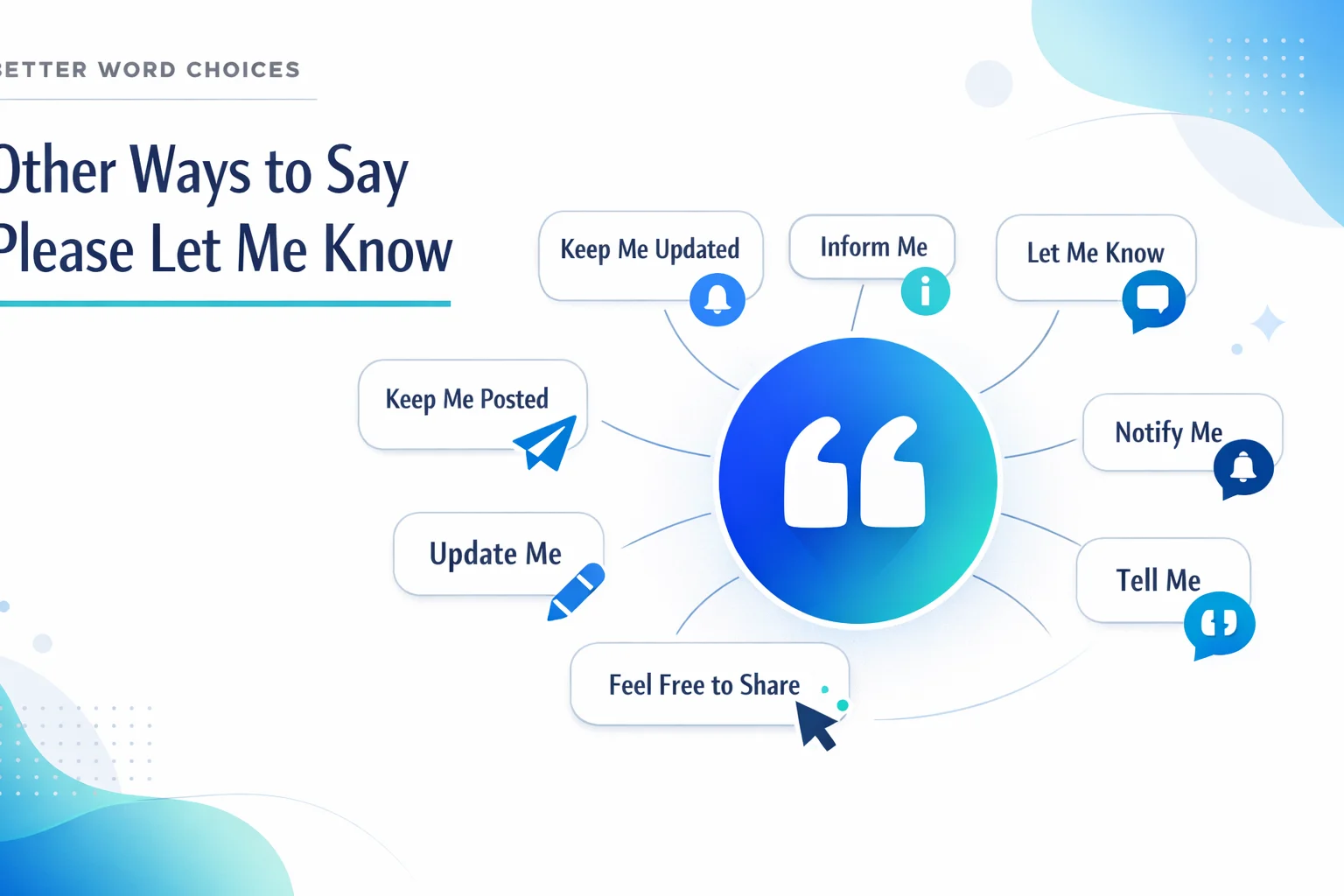
Other Ways to Say Please Let Me Know
These alternatives will help you sound more fluent, confident, and natural in different situations. Use them according to tone, context, and audience to express excitement, admiration, or approval.
1. Keep Me Posted
Meaning: Ask someone to continue providing updates over time.
Explanation: This phrase implies you want ongoing progress reports rather than a single response.
Example Sentence: Keep me posted on how the negotiations go this week.
Best Use: Ongoing projects
Worst Use: Formal contracts
Tone: Friendly, casual
Context Variability: Casual, professional
2. Keep Me in the Loop
Meaning: Ask to be included in future updates or decisions.
Explanation: It indicates that you want to stay informed throughout a group discussion or project.
Example Sentence: Please keep me in the loop on the client’s response.
Best Use: Team projects
Worst Use: One-time requests
Tone: Collaborative, casual
Context Variability: Professional, spoken
3. Let Me Know If You Have Any Questions
Meaning: Invite someone to ask for clarification if needed.
Explanation: A polite closing phrase commonly used in emails and professional communication.
Example Sentence: Let me know if you have any questions about the proposal.
Best Use: Email closings
Worst Use: Urgent requests
Tone: Polite, helpful
Context Variability: Professional, casual
4. Please Advise
Meaning: Request guidance or instructions.
Explanation: A concise and formal way to ask someone what action should be taken next.
Example Sentence: The shipment is delayed. Please advise on the next steps.
Best Use: Business emails
Worst Use: Casual conversations
Tone: Formal, direct
Context Variability: Professional
5. Kindly Inform Me
Meaning: Politely ask someone to provide information.
Explanation: More formal than “let me know,” making it suitable for official communication.
Example Sentence: Kindly inform me of any changes to the schedule.
Best Use: Official emails
Worst Use: Texting friends
Tone: Formal, respectful
Context Variability: Professional
6. Do Let Me Know
Meaning: Politely encourage someone to respond.
Explanation: Adding “do” creates gentle emphasis without sounding demanding.
Example Sentence: Do let me know if the new plan works for you.
Best Use: Polite follow-ups
Worst Use: Highly formal documents
Tone: Polite, warm
Context Variability: Spoken, casual
7. Please Confirm
Meaning: Request a clear confirmation.
Explanation: Best when you need a definite yes-or-no response.
Example Sentence: Please confirm your attendance by Friday.
Best Use: Event planning
Worst Use: Open-ended questions
Tone: Formal, direct
Context Variability: Professional
8. Let Me Know Your Thoughts
Meaning: Invite feedback or opinions.
Explanation: Encourages the other person to share their perspective.
Example Sentence: Let me know your thoughts on the new design.
Best Use: Feedback requests
Worst Use: Yes-or-no questions
Tone: Open, friendly
Context Variability: Professional, casual
9. Feel Free to Let Me Know
Meaning: Invite someone to reach out whenever they need.
Explanation: Creates a supportive, low-pressure tone.
Example Sentence: Feel free to let me know if anything is unclear.
Best Use: Supportive communication
Worst Use: Urgent deadlines
Tone: Warm, reassuring
Context Variability: Professional, spoken
10. Give Me a Heads-Up
Meaning: Ask for advance notice.
Explanation: Used when you want to be informed before something happens.
Example Sentence: Give me a heads-up if the meeting time changes.
Best Use: Scheduling changes
Worst Use: Formal reports
Tone: Casual, practical
Context Variability: Casual, spoken
11. Let Me Know How It Goes
Meaning: Ask for an update after an event or task.
Explanation: Shows interest in the outcome of something still in progress.
Example Sentence: Let me know how it goes at the interview tomorrow.
Best Use: Personal check-ins
Worst Use: Legal documents
Tone: Supportive, casual
Context Variability: Casual, spoken
12. Please Update Me
Meaning: Request the latest information.
Explanation: A professional way to ask for the current status.
Example Sentence: Please update me once the payment is processed.
Best Use: Status reports
Worst Use: Casual chats
Tone: Professional, neutral
Context Variability: Professional
13. I’d Appreciate an Update
Meaning: Politely request new information.
Explanation: Expresses gratitude in advance, making the request sound courteous.
Example Sentence: I’d appreciate an update on the shipment status.
Best Use: Formal follow-ups
Worst Use: Quick text messages
Tone: Polite, formal
Context Variability: Professional
14. Let Me Know If Anything Changes
Meaning: Ask to be informed of future changes.
Explanation: Focuses on updates if circumstances change later.
Example Sentence: Let me know if anything changes with the delivery date.
Best Use: Ongoing plans
Worst Use: One-time confirmations
Tone: Neutral, practical
Context Variability: Professional, casual
15. Please Keep Me Informed
Meaning: Request continuous updates.
Explanation: A more formal version of “keep me posted.”
Example Sentence: Please keep me informed about the project’s progress.
Best Use: Business reporting
Worst Use: Casual chats
Tone: Formal, professional
Context Variability: Professional
16. Shoot Me a Message
Meaning: Ask someone to send a quick message.
Explanation: Very casual and commonly used in texting.
Example Sentence: Shoot me a message once you land.
Best Use: Texting friends
Worst Use: Business emails
Tone: Informal, friendly
Context Variability: Casual, spoken
17. Drop Me a Line
Meaning: Ask someone to send a brief message.
Explanation: A friendly expression that’s slightly old-fashioned but still common.
Example Sentence: Drop me a line when you get a chance.
Best Use: Informal check-ins
Worst Use: Formal writing
Tone: Casual, friendly
Context Variability: Casual
18. Ping Me
Meaning: Ask someone to contact you quickly.
Explanation: Frequently used in workplace chats and messaging platforms.
Example Sentence: Ping me once the file is uploaded.
Best Use: Team chats
Worst Use: Formal letters
Tone: Casual, efficient
Context Variability: Casual, professional
19. Hit Me Up
Meaning: Ask someone to get in touch.
Explanation: A highly informal phrase commonly used among friends.
Example Sentence: Hit me up when you’re free this weekend.
Best Use: Friends, texting
Worst Use: Client emails
Tone: Informal, relaxed
Context Variability: Casual, spoken
20. Let Me Know What You Decide
Meaning: Ask someone to share their final decision.
Explanation: Specifically focuses on the outcome of a choice.
Example Sentence: Let me know what you decide about the venue.
Best Use: Decision-making
Worst Use: General updates
Tone: Neutral, direct
Context Variability: Professional, casual
21. Please Notify Me
Meaning: Formally request notification.
Explanation: Often used in official, technical, or administrative communication.
Example Sentence: Please notify me if the system goes offline.
Best Use: Technical alerts
Worst Use: Friendly conversations
Tone: Formal, precise
Context Variability: Professional
22. Inform Me at Your Earliest Convenience
Meaning: Politely request a prompt response.
Explanation: Conveys urgency while maintaining a courteous tone.
Example Sentence: Please inform me at your earliest convenience regarding the invoice.
Best Use: Formal deadlines
Worst Use: Casual conversation
Tone: Formal, urgent
Context Variability: Professional
23. Let Me Know Your Availability
Meaning: Ask when someone is free.
Explanation: Specifically used for scheduling meetings or appointments.
Example Sentence: Let me know your availability for next week’s call.
Best Use: Scheduling meetings
Worst Use: General feedback
Tone: Practical, professional
Context Variability: Professional
24. Get Back to Me
Meaning: Ask someone to respond after reviewing or considering something.
Explanation: Slightly more direct than “let me know.”
Example Sentence: Get back to me once you’ve reviewed the document.
Best Use: Follow-up requests
Worst Use: First-time formal emails
Tone: Direct, practical
Context Variability: Professional, casual
25. Reach Out If You Need Anything
Meaning: Offer support and invite future contact.
Explanation: Focuses on helping rather than requesting information.
Example Sentence: Reach out if you need anything during the transition.
Best Use: Supportive messages
Worst Use: Strict deadlines
Tone: Warm, supportive
Context Variability: Professional, spoken
26. Let Me Know If That Works
Meaning: Ask whether a suggestion is acceptable.
Explanation: Often follows a proposed plan, time, or idea.
Example Sentence: I suggested 3 PM. Let me know if that works for you.
Best Use: Scheduling suggestions
Worst Use: Open-ended questions
Tone: Friendly, practical
Context Variability: Casual, professional
27. Please Respond When You Can
Meaning: Politely request a reply without creating urgency.
Explanation: Lets the recipient know there’s no immediate rush.
Example Sentence: Please respond when you can—there’s no rush.
Best Use: Non-urgent requests
Worst Use: Time-sensitive tasks
Tone: Polite, relaxed
Context Variability: Professional, casual
28. Loop Me In
Meaning: Ask to be included in future conversations or updates.
Explanation: Frequently used in workplace communication and team collaboration.
Example Sentence: Loop me in on the email thread with the client.
Best Use: Team communication
Worst Use: One-on-one formal letters
Tone: Casual, collaborative
Context Variability: Professional, spoken
29. Let Me Know If I Can Help
Meaning: Offer assistance while inviting a response.
Explanation: Shows willingness to support the other person.
Example Sentence: Let me know if I can help with the presentation.
Best Use: Offering support
Worst Use: Strict formal requests
Tone: Kind, supportive
Context Variability: Professional, casual
30. Advise Me Accordingly
Meaning: Request guidance based on changing circumstances.
Explanation: A formal phrase commonly used in business, legal, and official communication.
Example Sentence: If the terms change, please advise me accordingly.
Best Use: Formal business writing
Worst Use: Everyday conversation
Tone: Formal, precise
Context Variability: Professional
Every alternative you learn is another tool for sounding natural in English.
Mini Quiz / Self-Check
Quick Quiz
1. Which phrase is the most appropriate for a formal business email requesting guidance?
A) Hit me up
B) Please advise
C) Shoot me a message
2. Which alternative works best in a casual text to a friend about weekend plans?
A) Ping me
B) Inform me at your earliest convenience
C) Please notify me
3. Which phrase specifically asks someone to share their final decision?
A) Let me know what you decide
B) Keep me posted
C) Drop me a line
4. Which phrase is the best choice in a team chat when you want to be included in future updates?
A) Loop me in
B) Advise me accordingly
C) Get back to me
Answers:
- B
- A
- A
- A
“Context decides the correct phrase, not just the meaning.
Comparison Table: Top Alternatives
| Phrase | Tone | Best Use |
|---|---|---|
| Keep me posted | Friendly, casual | Ongoing projects |
| Please advise | Formal, direct | Business emails |
| Kindly inform me | Formal, respectful | Official emails |
| Let me know your thoughts | Open, friendly | Feedback requests |
| Give me a heads-up | Casual, practical | Scheduling changes |
| Please keep me informed | Formal, professional | Business reporting |
| Ping me | Casual, quick | Team chats |
| Get back to me | Direct, practical | Follow-up requests |
| Loop me in | Casual, collaborative | Team communication |
| Advise me accordingly | Formal, precise | Formal business writing |
FAQs
1. What is a more formal way to say “please let me know”?
“Please advise” or “kindly inform me” are more formal alternatives commonly used in business emails.
2. What is a casual way to say “please let me know”?
“Keep me posted” or “give me a heads-up” work well in relaxed, everyday conversations.
3. Is it correct to say “please let me know” without “please”?
Yes, “let me know” alone is common and slightly more casual, often used in spoken English.
4. Which alternative works best for closing a business email?
“Please let me know if you have any questions” or “please advise” are both natural, professional email closings.
5. Can “let me know” be used in professional English?
Yes, it is widely accepted in professional English, though phrases like “please keep me informed” sound more formal.
Conclusion
Learning different other ways to say please let me know helps you avoid repetition and communicate more precisely, whether you are writing a formal email, chatting with a colleague, or texting a friend. Each alternative carries a slightly different tone, so choosing the right one shows stronger command of English.
Practice using these phrases daily in real conversations and emails to build lasting fluency. Paying attention to tone, formality, and context will help your English sound more natural, professional, and confident over time.
Read More Related Articles:
- Other Ways to Say “The Author Says” | Like a Skilled Academic Writer In 2026
- Other Ways to Say “In Summary” | Clearer and Stronger Conclusions In 2026
- Other Ways to Say “Similarly” | Smart Synonyms You’ll Use Every Day In 2026

Henry Walker is an American writer and blogger with a keen interest in communication, language and digital content. At TextsResponse.com, he creates informative and reader-focused resources designed to help people communicate with clarity, confidence and authenticity.