Quick Answer
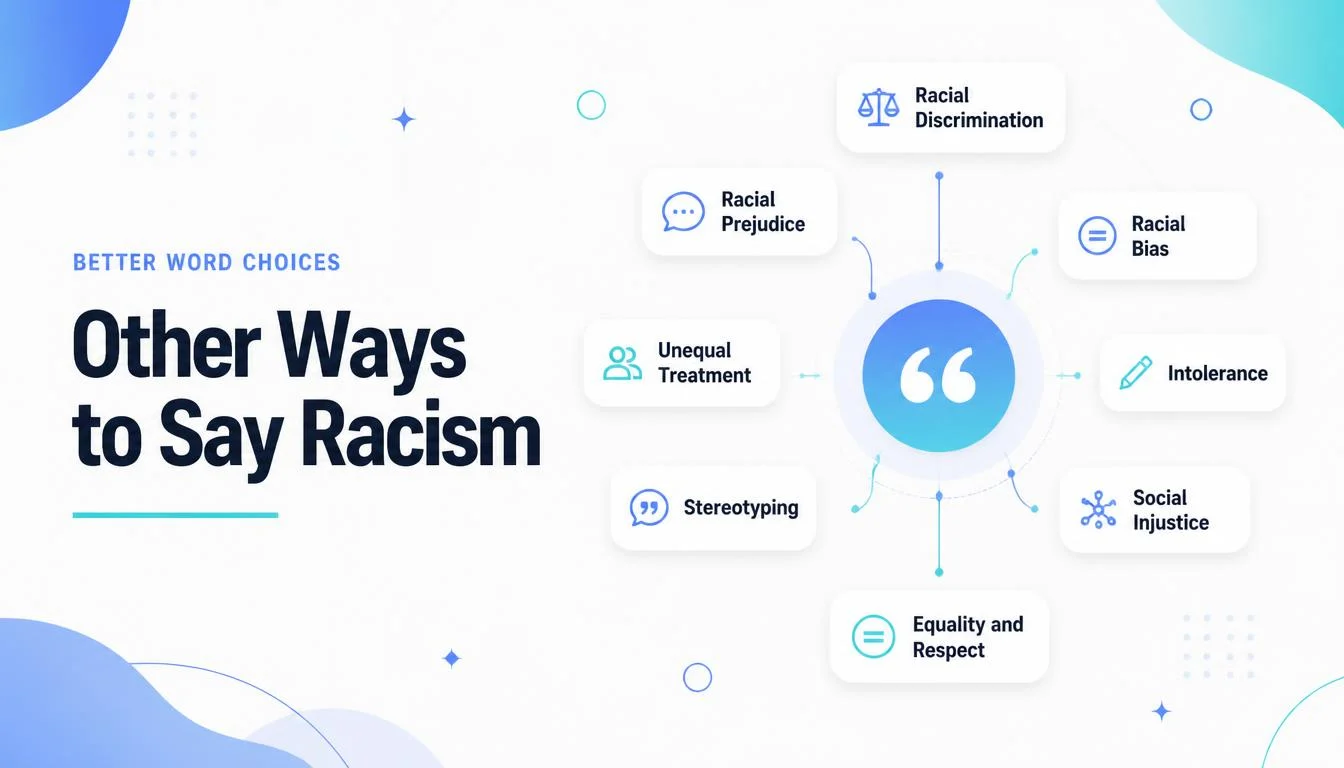
Other ways to say racism include racial discrimination, racial prejudice, racial bias, and racial intolerance. The best alternative depends on the context and the specific behavior you want to describe.
Learning other ways to say racism can help you discuss sensitive social issues with greater clarity, accuracy, and respect. Whether you are writing an essay, participating in a discussion, or preparing a professional report, choosing the right words helps you explain racial prejudice and unequal treatment effectively.
Several expressions are related to racism, but they do not all mean exactly the same thing. For example, “racial discrimination” refers to unfair treatment based on race, while “racial prejudice” describes preconceived attitudes or beliefs about people because of their race. Understanding these differences can strengthen your vocabulary and help you communicate thoughtfully in academic, professional, and everyday situations.
Quick Categories: Alternatives to Racism
Formal alternatives to racism
- Racial discrimination: Unfair treatment based on race.
- Racial prejudice: Negative attitudes toward people because of their race.
- Institutional racism: Practices within institutions that disadvantage racial groups.
- Racial inequality: Unequal opportunities or outcomes associated with race.
Pro Tip: Use these expressions in academic writing, research, reports, and discussions about civil rights. Choose the term that accurately describes the issue.
Casual alternatives
- Racial bias: A preference or assumption influenced by race.
- Racial intolerance: An unwillingness to accept people of different racial backgrounds.
- Racial stereotyping: Making generalized assumptions about people based on race.
- Racial unfairness: Unfair treatment connected to race.
Pro Tip: These phrases can make everyday explanations easier to understand, but they are not exact synonyms. Explain the specific behavior whenever possible.
Professional alternatives
- Workplace racial discrimination: Unfair treatment based on race at work.
- Systemic racism: Racism reinforced through interconnected systems and institutions.
- Racial inequity: An avoidable difference in access, treatment, or outcomes related to race.
- Discriminatory practices: Actions or procedures that unfairly disadvantage a group.
Pro Tip: In professional reaction phrases and workplace reports, describe the conduct, evidence, and impact rather than relying on broad labels alone.
Informal expressions
- Racially biased behavior: Behavior influenced by racial assumptions.
- Race-based unfair treatment: Unfair treatment because of someone’s race.
- Prejudiced attitudes: Opinions formed without fair consideration of individuals.
- Discrimination based on race: A straightforward way to describe the issue.
Pro Tip: These informal expressions in English can make difficult conversations more accessible. Maintain a respectful tone, particularly when discussing personal experiences.
What Does Racism Mean?
Racism refers to beliefs, attitudes, practices, or systems that treat people unfairly or disadvantage them because of their race or perceived racial background. It can appear in individual behavior, institutional policies, and wider social structures.
Racism is a noun. Related words include racist as a noun or adjective and racially as an adverb.
Examples:
- Noun: Racism has no place in the workplace.
- Adjective: The organization investigated racist comments.
- Adverb: Employees reported that they had been treated racially unfairly.
The term can describe personal prejudice, discriminatory conduct, or broader systems that produce racial disadvantages. Its precise meaning depends on the context and the evidence being discussed.
When to Use the Word Racism
The word is appropriate when discussing racial prejudice, discriminatory behavior, or systems that disadvantage racial groups.
Common contexts include:
- Education: Discussing discrimination in schools or universities.
- Workplaces: Reporting racial harassment or unequal treatment.
- Academic writing: Analyzing racial inequality, history, or social structures.
- Public discussions: Talking about civil rights and social justice.
- Personal conversations: Describing experiences of racial prejudice.
- News and research: Reporting documented discriminatory practices.
Spoken vs. Written English
In spoken English, a direct expression such as racial discrimination may help explain a specific incident without making the discussion unnecessarily abstract.
In written English, terms such as institutional racism, racial inequity, and discriminatory practices can provide greater precision when supported by evidence.
Formal vs. Informal English
Formal communication generally benefits from specific terminology. Informal conversations may use simpler phrases such as racial unfairness or race-based discrimination.
However, informal language should not minimize serious incidents or suggest that every alternative has the same meaning.
The clearest way to discuss racism is to name the behavior, explain its impact, and choose words that fit the evidence.
Is It Professional or Polite to Say Racism?
Yes. The word racism is appropriate in professional and respectful communication when it accurately describes the issue being discussed. It is not inherently impolite, although the way you use it can affect the tone of a conversation.
Business-style example:
“Our review identified concerns about potential racial discrimination in the recruitment process. We recommend investigating the evidence and reviewing the relevant hiring procedures.”
- Polite? Yes, when used accurately and respectfully.
- Professional? Yes, when supported by evidence and appropriate context.
You do not need to avoid the word simply because the topic is sensitive. Instead, distinguish between a documented finding, a reported concern, and an allegation that still needs investigation.
Pros and Cons of Using the Word Racism
Pros
- Simple and natural: It directly identifies the subject.
- Common usage: Most English speakers understand the word.
- Easy to understand: It communicates a serious social issue clearly.
- Useful in discussion: It applies to individual behavior and broader social systems.
Cons
- May be too broad: It does not always identify the exact conduct or mechanism.
- Can require clarification: People may interpret the term differently.
- Limited specificity: It may not distinguish prejudice from discriminatory actions.
- Needs careful context: Formal reports may require evidence, definitions, and precise descriptions.
These limitations do not make the word inappropriate. They simply explain why learning other ways to say racism can improve the accuracy of your communication.
Other Ways to Say Racism: 30 Alternatives With Examples
These alternatives will help you communicate more precisely in conversations, essays, reports, and professional settings.
Use each expression according to its meaning, tone, and audience. Some describe attitudes, others describe actions, and several refer to institutional or social patterns.
1. Racial Discrimination
Meaning: Unfair treatment of someone because of their race.
Explanation: This is one of the closest alternatives when the focus is on actions or decisions.
Example Sentence: The employee filed a complaint about racial discrimination during the promotion process.
Best Use: Formal reports
Worst Use: Unrelated conflicts
Tone: Formal, direct, serious
Context Variability: Casual: “That sounds like racial discrimination.” Professional: “The complaint concerns racial discrimination.” Spoken: “She believes she was treated unfairly because of her race.”
2. Racial Prejudice
Meaning: Negative attitudes or judgments based on race.
Explanation: This phrase emphasizes beliefs and assumptions rather than necessarily proving discriminatory action.
Example Sentence: The documentary examines how racial prejudice can influence personal relationships.
Best Use: Social discussions
Worst Use: Unrelated disagreements
Tone: Educational, formal, serious
Context Variability: Casual: “That comment reflects racial prejudice.” Professional: “The training addresses racial prejudice.” Spoken: “We need to challenge prejudiced assumptions.”
3. Racial Bias
Meaning: A preference or assumption influenced by race.
Explanation: Racial bias can be conscious or unconscious and may affect judgments or decisions.
Example Sentence: The company reviewed its interview process to identify possible racial bias.
Best Use: Workplace reviews
Worst Use: Unsupported accusations
Tone: Professional, analytical, neutral
Context Variability: Casual: “That judgment may show racial bias.” Professional: “We are assessing potential racial bias in recruitment.” Spoken: “Let’s check whether bias influenced that decision.”
4. Systemic Racism
Meaning: Racism reinforced through connected systems, institutions, or established practices.
Explanation: This term focuses on broader structures rather than only individual actions.
Example Sentence: The research explores how systemic racism can influence access to housing and education.
Best Use: Social research
Worst Use: Isolated errors without context
Tone: Academic, analytical, serious
Context Variability: Casual: “We should discuss systemic racism.” Professional: “The report examines systemic barriers.” Spoken: “The issue may go beyond one person’s actions.”
5. Institutional Racism
Meaning: Racism embedded in an institution’s policies, procedures, or practices.
Explanation: It is often used when examining how an organization or institution disadvantages racial groups.
Example Sentence: The investigation examined whether institutional racism affected access to public services.
Best Use: Policy analysis
Worst Use: Unverified conclusions
Tone: Formal, critical, analytical
Context Variability: Casual: “The discussion covers institutional racism.” Professional: “The review evaluates institutional practices.” Spoken: “We need to understand how the organization operates.”
6. Racial Inequality
Meaning: Unequal conditions, opportunities, or outcomes associated with race.
Explanation: This phrase describes disparities without automatically specifying their cause.
Example Sentence: The report highlights racial inequality in access to higher education.
Best Use: Research reports
Worst Use: Personal insults
Tone: Formal, descriptive, analytical
Context Variability: Casual: “Racial inequality remains a concern.” Professional: “The study measures racial inequality.” Spoken: “People do not always have equal opportunities.”
7. Racial Inequity
Meaning: An unfair difference in opportunities, treatment, resources, or outcomes related to race.
Explanation: The term emphasizes unfairness rather than simply describing a difference.
Example Sentence: The organization introduced new policies to address racial inequity in employee development.
Best Use: Equity initiatives
Worst Use: Neutral statistics alone
Tone: Professional, analytical, purposeful
Context Variability: Casual: “We should address racial inequity.” Professional: “The initiative targets racial inequities.” Spoken: “Some groups face unfair barriers.”
8. Racial Intolerance
Meaning: An unwillingness to accept people from different racial backgrounds.
Explanation: This phrase emphasizes rejection or hostility toward racial differences.
Example Sentence: The school has a clear policy against racial intolerance and harassment.
Best Use: Conduct policies
Worst Use: Neutral differences
Tone: Formal, disapproving, direct
Context Variability: Casual: “That behavior shows racial intolerance.” Professional: “The policy prohibits racial intolerance.” Spoken: “Everyone deserves to be treated with respect.”
9. Racial Stereotyping
Meaning: Making generalized assumptions about people because of their race.
Explanation: Stereotyping can reinforce prejudice and influence how individuals are treated.
Example Sentence: Racial stereotyping can lead managers to make unfair assumptions about job candidates.
Best Use: Bias education
Worst Use: Individual achievements
Tone: Educational, analytical, serious
Context Variability: Casual: “That sounds like racial stereotyping.” Professional: “The workshop addresses racial stereotypes.” Spoken: “We should judge people individually.”
10. Racial Harassment
Meaning: Unwanted conduct related to race that creates an intimidating, hostile, or offensive environment.
Explanation: This term is useful when discussing race-related insults, intimidation, or other inappropriate conduct. Its legal definition varies by jurisdiction.
Example Sentence: The employee reported repeated racial harassment by a colleague.
Best Use: Workplace complaints
Worst Use: Minor unrelated disputes
Tone: Formal, serious, specific
Context Variability: Casual: “He reported racial harassment.” Professional: “The complaint concerns alleged racial harassment.” Spoken: “The comments made the workplace uncomfortable.”
11. Race-Based Discrimination
Meaning: Unfair treatment specifically because of race.
Explanation: This phrase clearly identifies the basis of discriminatory treatment.
Example Sentence: The housing organization investigates complaints of race-based discrimination.
Best Use: Legal discussions
Worst Use: Unrelated unfairness
Tone: Formal, precise, direct
Context Variability: Casual: “That could be race-based discrimination.” Professional: “The policy prohibits race-based discrimination.” Spoken: “The decision should not depend on race.”
12. Racially Biased Behavior
Meaning: Behavior influenced by assumptions or preferences connected to race.
Explanation: This phrase is useful when describing conduct without automatically assigning a broader label.
Example Sentence: The training helps employees recognize racially biased behavior during meetings.
Best Use: Staff training
Worst Use: Unsupported judgments
Tone: Professional, descriptive, neutral
Context Variability: Casual: “That behavior seems racially biased.” Professional: “The review identified potentially biased behavior.” Spoken: “Let’s consider whether racial assumptions affected the interaction.”
13. Racial Hostility
Meaning: Open antagonism or hostility directed at people because of race.
Explanation: It emphasizes aggressive attitudes or conduct rather than unequal outcomes alone.
Example Sentence: The organization responded promptly to reports of racial hostility among staff.
Best Use: Incident reports
Worst Use: Ordinary disagreement
Tone: Serious, direct, formal
Context Variability: Casual: “The conversation turned hostile.” Professional: “The report documents alleged racial hostility.” Spoken: “The comments were openly hostile.”
14. Race-Based Unfair Treatment
Meaning: Treatment that disadvantages someone because of their race.
Explanation: This plain-language expression can help readers understand a complex issue quickly.
Example Sentence: The employee described race-based unfair treatment when requesting a transfer.
Best Use: Plain explanations
Worst Use: Technical legal analysis
Tone: Clear, accessible, serious
Context Variability: Casual: “That sounds like unfair treatment based on race.” Professional: “The complaint alleges race-based unfair treatment.” Spoken: “Everyone should receive fair treatment.”
15. Racial Disparity
Meaning: A measurable difference between racial groups in a particular outcome.
Explanation: A disparity does not automatically establish discrimination, so further evidence may be needed to explain its causes.
Example Sentence: The researchers investigated the racial disparity in graduation rates.
Best Use: Data analysis
Worst Use: Unsupported causal claims
Tone: Analytical, neutral, formal
Context Variability: Casual: “There is a racial disparity in the results.” Professional: “The report evaluates racial disparities.” Spoken: “The numbers differ across racial groups.”
16. Racial Exclusion
Meaning: Keeping people out of opportunities, spaces, or activities because of race.
Explanation: This term highlights barriers to participation or belonging.
Example Sentence: The museum revised its outreach strategy to address racial exclusion in its programs.
Best Use: Access reviews
Worst Use: Voluntary absence
Tone: Formal, critical, descriptive
Context Variability: Casual: “The policy may encourage racial exclusion.” Professional: “The review considers exclusionary practices.” Spoken: “Some people have been left out because of race.”
17. Racial Segregation
Meaning: The separation of people into different spaces or institutions based on race.
Explanation: The phrase is especially relevant to historical systems and ongoing forms of racial separation.
Example Sentence: The class studied the history of racial segregation in public schools.
Best Use: Historical analysis
Worst Use: Unrelated group differences
Tone: Academic, serious, historical
Context Variability: Casual: “We discussed racial segregation.” Professional: “The report examines patterns of segregation.” Spoken: “The policy separated people by race.”
18. Racial Marginalization
Meaning: The process of pushing racial groups to the edges of social, political, or economic life.
Explanation: It emphasizes reduced influence, participation, or access to resources.
Example Sentence: The initiative aims to reduce the racial marginalization of underserved communities.
Best Use: Community research
Worst Use: Ordinary preferences
Tone: Academic, analytical, serious
Context Variability: Casual: “The community feels marginalized.” Professional: “The study examines racial marginalization.” Spoken: “Some communities have less influence in decision-making.”
19. Racial Oppression
Meaning: The sustained restriction or mistreatment of people because of race.
Explanation: This phrase often describes severe or entrenched power imbalances.
Example Sentence: The historian documented the effects of racial oppression on generations of families.
Best Use: Historical studies
Worst Use: Minor disagreements
Tone: Strong, serious, critical
Context Variability: Casual: “The discussion covers racial oppression.” Professional: “The report analyzes structures of racial oppression.” Spoken: “The system placed unfair restrictions on a racial group.”
20. Racial Antagonism
Meaning: Active hostility or opposition between people or groups along racial lines.
Explanation: This term emphasizes conflict and hostility rather than discrimination in general.
Example Sentence: Community leaders worked to reduce racial antagonism after a series of public incidents.
Best Use: Conflict analysis
Worst Use: Cooperative interactions
Tone: Formal, analytical, serious
Context Variability: Casual: “The debate increased racial antagonism.” Professional: “The assessment considers racial tensions.” Spoken: “The groups became increasingly hostile toward each other.”
21. Racial Insensitivity
Meaning: A lack of awareness or consideration of how words or actions affect people because of race.
Explanation: It can describe inappropriate remarks or decisions, although it does not necessarily capture deliberate discrimination.
Example Sentence: The manager apologized for the racial insensitivity of the remark.
Best Use: Communication training
Worst Use: Severe abuse without context
Tone: Diplomatic, critical, measured
Context Variability: Casual: “That comment was racially insensitive.” Professional: “The incident raised concerns about racial sensitivity.” Spoken: “The remark could have been more considerate.”
22. Racial Hostility in the Workplace
Meaning: Hostile conduct toward employees because of race.
Explanation: This phrase narrows the discussion to workplace behavior and its effect on employees.
Example Sentence: The human resources team investigated reports of racial hostility in the workplace.
Best Use: HR investigations
Worst Use: Unrelated disputes
Tone: Professional, serious, specific
Context Variability: Casual: “There was hostility related to race at work.” Professional: “HR is reviewing the reported conduct.” Spoken: “Employees should feel safe and respected.”
23. Discriminatory Practices
Meaning: Policies or actions that unfairly disadvantage certain groups.
Explanation: The term is not limited to race, so specify the racial context when that is the focus.
Example Sentence: The audit identified practices that may disadvantage applicants from particular racial groups.
Best Use: Policy audits
Worst Use: General differences
Tone: Formal, analytical, precise
Context Variability: Casual: “Those practices seem unfair.” Professional: “The audit examines potentially discriminatory practices.” Spoken: “The process may disadvantage some applicants.”
24. Racially Unequal Treatment
Meaning: Treatment that differs unfairly between people because of race.
Explanation: This expression focuses on differences in how people are treated.
Example Sentence: The review considered whether customers received racially unequal treatment at the service desk.
Best Use: Service reviews
Worst Use: Differences with no racial link
Tone: Neutral, descriptive, formal
Context Variability: Casual: “Customers reported unequal treatment.” Professional: “The review assesses possible racial disparities in service.” Spoken: “Everyone should receive the same standard of service.”
25. Racial Prejudice and Discrimination
Meaning: A combination of race-based negative attitudes and unfair actions.
Explanation: This paired expression distinguishes the beliefs behind an issue from the behavior that may follow.
Example Sentence: The course explores how racial prejudice and discrimination can affect educational opportunities.
Best Use: Educational writing
Worst Use: Unrelated disputes
Tone: Academic, explanatory, serious
Context Variability: Casual: “We talked about prejudice and discrimination.” Professional: “The program addresses racial prejudice and discriminatory conduct.” Spoken: “Negative assumptions can lead to unfair treatment.”
26. Race-Based Exclusion
Meaning: Denying access or participation because of race.
Explanation: This expression is useful when the central issue is being deliberately or systematically excluded.
Example Sentence: The organization reviewed allegations of race-based exclusion from a professional networking event.
Best Use: Access complaints
Worst Use: Unrelated absence
Tone: Direct, formal, serious
Context Variability: Casual: “Some people were excluded because of race.” Professional: “The complaint concerns race-based exclusion.” Spoken: “Everyone who qualifies should have a fair opportunity to participate.”
27. Racial Stereotyping and Bias
Meaning: Generalized racial assumptions combined with biased judgments.
Explanation: This phrase is helpful when both assumptions and their influence on decisions are relevant.
Example Sentence: The workshop examines how racial stereotyping and bias affect hiring decisions.
Best Use: Bias workshops
Worst Use: Evidence-free claims
Tone: Educational, analytical, professional
Context Variability: Casual: “We need to challenge stereotypes.” Professional: “The training addresses stereotyping and bias.” Spoken: “Try to evaluate each person individually.”
28. Racial Inequity in Access
Meaning: Unfair differences in access to services, resources, or opportunities among racial groups.
Explanation: This phrase identifies the area in which racial inequity occurs.
Example Sentence: The study examines racial inequity in access to healthcare and education.
Best Use: Access research
Worst Use: Unrelated outcomes
Tone: Academic, specific, analytical
Context Variability: Casual: “Access is not equal for everyone.” Professional: “The report identifies inequities in access.” Spoken: “Some groups face additional barriers to essential services.”
29. Racially Discriminatory Conduct
Meaning: Behavior that unfairly treats people differently because of race.
Explanation: This is a formal phrase for describing conduct that may violate workplace rules or applicable law.
Example Sentence: The company stated that it would investigate any reports of racially discriminatory conduct.
Best Use: Formal complaints
Worst Use: Casual greetings
Tone: Formal, precise, serious
Context Variability: Casual: “The behavior may be discriminatory.” Professional: “The complaint alleges racially discriminatory conduct.” Spoken: “The incident needs to be reviewed fairly.”
30. Race-Related Injustice
Meaning: An unfair situation or outcome connected to race.
Explanation: This broader expression is useful when discussing injustice without claiming that every detail or cause has already been established.
Example Sentence: The campaign seeks to address race-related injustice in access to public services.
Best Use: Advocacy discussions
Worst Use: Technical diagnosis
Tone: Serious, broad, persuasive
Context Variability: Casual: “We should speak up about racial injustice.” Professional: “The initiative addresses race-related injustice.” Spoken: “People deserve fair treatment regardless of race.”
Common Mistakes When Using Alternatives to Racism
Choosing a related term without understanding its meaning can weaken your writing. Avoid these five common mistakes.
1. Treating racial bias and discrimination as identical
Mistake: “Every biased thought is automatically an act of discrimination.”
Better: “Racial bias can influence decisions, while racial discrimination involves unfair treatment.”
Bias refers to attitudes or assumptions. Discrimination focuses on treatment or actions.
2. Using systemic racism for every individual incident
Mistake: “One rude comment proves systemic racism.”
Better: “The comment may reflect racial prejudice; further evidence is needed to assess broader systemic patterns.”
Systemic racism refers to patterns connected to systems and institutions, not simply any single incident.
3. Assuming every racial disparity proves discrimination
Mistake: “The difference in outcomes proves racial discrimination.”
Better: “The disparity warrants further investigation into its causes.”
Differences in outcomes may require additional evidence before their causes can be established.
4. Using racial insensitivity to minimize serious harm
Mistake: “Repeated racial harassment was just racial insensitivity.”
Better: “The repeated conduct should be assessed as potential racial harassment.”
Choose terminology that reflects the nature and severity of the reported behavior.
5. Making unsupported accusations in professional writing
Mistake: “The manager is definitely racist.”
Better: “The complaint raises concerns about potentially discriminatory treatment, which requires investigation.”
In formal communication, distinguish established facts from allegations and interpretations.
Precise vocabulary does more than improve your English. It helps you describe difficult issues fairly and responsibly.
Mini Quiz: Test Your Understanding
1. Which term best describes unfair treatment based on race?Racial disparityRacial discriminationRacial sensitivity
2. Which term focuses on connected institutional or societal systems?Systemic racismRacial insensitivityRacial stereotyping
3. A report identifies different graduation rates between racial groups. Which term is the most neutral starting point?Racial oppressionRacial disparityRacial harassment
4. Which sentence is most suitable for a professional report?The manager is obviously racist.The complaint alleges potential racial discrimination and requires review.Everyone knows the process is racist.
0 of 4 answeredReset quiz
Comparison Table: Top 10 Alternatives to Racism
| Phrase | Tone | Best Use |
|---|---|---|
| Racial discrimination | Formal, direct | Complaints and reports |
| Racial prejudice | Educational, serious | Attitudes and beliefs |
| Racial bias | Analytical, neutral | Decision-making |
| Systemic racism | Academic, critical | Structural analysis |
| Institutional racism | Formal, analytical | Institutional practices |
| Racial inequality | Descriptive, formal | Social research |
| Racial inequity | Professional, analytical | Equity initiatives |
| Racial stereotyping | Educational, serious | Assumptions and stereotypes |
| Racial harassment | Formal, serious | Workplace incidents |
| Race-related injustice | Broad, persuasive | Advocacy and social issues |
FAQs
1. What is the most common alternative to racism?
Racial discrimination is one of the most useful alternatives when you mean unfair treatment based on race. For discussions of broader systems, systemic racism may be more appropriate.
2. What is a formal word for racism?
Racial discrimination, racial prejudice, and institutional racism are formal expressions. The best choice depends on whether you are describing actions, attitudes, or institutional patterns.
3. What is the difference between racism and racial discrimination?
Racism can include beliefs, behaviors, and broader systems. Racial discrimination specifically emphasizes unfair treatment because of race.
4. How can I describe racism professionally?
Use specific, evidence-based language such as reported racial discrimination, potential racial bias, or alleged discriminatory conduct. Avoid presenting unverified claims as established facts.
5. Can I use racial bias as another word for racism?
Sometimes, but the terms are not interchangeable. Racial bias describes race-related assumptions or preferences, while racism can include discriminatory actions and systemic structures.
Final Takeaway
Learning other ways to say racism helps you communicate with greater precision in academic writing, professional discussions, and everyday conversations. Expressions such as racial discrimination, racial prejudice, and systemic racism describe different aspects of the issue, so understanding their distinctions is essential.
Practice using one or two expressions each day. Write example sentences, compare formal and informal contexts, and consider the evidence before choosing a term. Strong English communication depends not only on vocabulary but also on accuracy, empathy, and awareness of tone.
Read More Related Articles:
- Other Ways to Say Circle Back | Improve Your Workplace Communication In 2026
- Other Ways to Say Welcome to the Team | Warm First Impression In 2026
- Other Ways to Say I Hope All Is Well | Make a Better First Impression In 2026

Victoria Hughes is a content writer dedicated to making communication clearer and more effective. Through TextsResponse.com, she shares practical insights and thoughtfully crafted response ideas that help readers express themselves with confidence.