Quick Answer
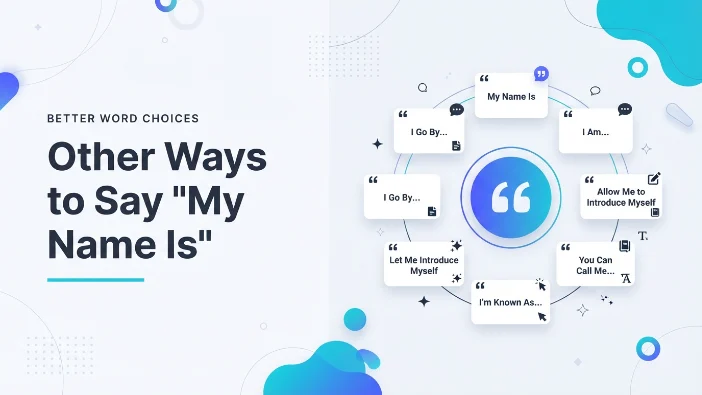
Looking for other ways to say “my name is”? The most natural alternatives are “I’m,” “I am,” “This is,” “Call me,” and “Let me introduce myself.” Each works differently depending on tone, setting, and how formal you want to sound.Top 5 alternatives: I’m, This is, Call me, Let me introduce myself, You can call me
My name is” is one of the first phrases English learners memorize, and for good reason it’s the simplest way to introduce yourself in almost any situation. It works in classrooms, interviews, emails, and casual chats alike. But because it’s so common, using it every single time can make your English sound repetitive and stiff.
Learning alternatives to “my name is” helps you sound more natural, confident, and fluent, whether you’re meeting a new colleague, greeting a stranger, or writing a formal email. It also helps you express excitement in English and adjust your tone to match the moment, from relaxed small talk to professional networking.
In this guide, you’ll find formal, casual, professional, and informal ways to introduce yourself, along with real examples, common mistakes, a quiz, and a comparison table to help you choose the right phrase every time.
The right tone makes your English sound professional and confident.”
Quick Categories
Formal alternatives to “My Name Is”
- Allow me to introduce myself
- Permit me to introduce myself
- I would like to introduce myself
- I have the pleasure of introducing myself as
Pro Tip: Save these phrases for interviews, official emails, or first meetings with senior professionals they signal respect and structure.
Casual alternatives
- I’m [name]
- Hi, I’m [name]
- The name’s [name]
- Hey, I’m [name]
Pro Tip: Use casual alternatives with peers, classmates, or at social events where the mood is relaxed.
Professional alternatives
- This is [name]
- I’m [name], and I work in [department/role]
- Let me introduce myself
- You can address me as
Pro Tip: Pair these with a short follow-up about your role it builds instant credibility in meetings and networking events.
Informal expressions
- People call me [name]
- I go by [name]
- I answer to [name]
- Just call me [name]
Pro Tip: Informal expressions work well when someone already knows you exist and you’re clarifying what to call you.
Common Mistakes
- Overusing “My name is” in every sentence Example: “My name is Sara. My name is Sara from marketing.” → Repeats the phrase unnecessarily.
- Mixing formal and informal phrases in one introduction Example: “Allow me to introduce myself, I’m Sara, what’s up?” → Tone doesn’t match.
- Using “The name’s ___” in formal settings Example: Saying this in a job interview sounds too casual or scripted.
- Forgetting to add context after the name Example: “I’m Sara.” (in a business meeting) → Missing role or purpose weakens the introduction.
- Using “I am” without contraction in casual speech Example: “I am Sara” in a friendly chat sounds overly formal and robotic.
“Small tone mistakes can make an introduction feel awkward even when the grammar is correct.”
What Does “My Name Is” Mean?
“My name is” is a fixed introductory phrase used to state your name to someone else. Grammatically, it follows the structure subject + verb “to be” + name, and it’s considered neutral neither too formal nor too casual.
Example Sentence: “My name is Ahmed, and I’ll be your instructor today.”
When to Use “My Name Is”
- Introducing yourself to someone for the first time
- Answering the phone in a formal or business context
- Writing a formal email introduction
- Speaking in interviews, presentations, or official settings
Spoken vs Written:
- Spoken: Common in interviews, phone calls, and public speaking
- Written: Common in emails, cover letters, and official documents
Formal vs Informal:
- Formal: Preferred in business and academic settings
- Informal: Less common; native speakers often prefer “I’m” in casual talk
Is It Professional or Polite to Say “My Name Is”?
My name is” is both polite and professional, but it can sound slightly stiff in casual conversation. In business writing or interviews, it’s a safe and respected choice.
Business-style example: “My name is Hina Malik, and I’ll be leading today’s presentation on quarterly sales.”
Polite? ✔️ Yes Professional? ✔️ Yes (appropriate in most formal contexts)
Polite doesn’t always mean formal but formal almost always sounds polite.
Pros and Cons of Using “My Name Is”
Pros
- Simple and natural
- Widely understood
- Works in almost any setting
- Easy for beginners to use correctly
Cons
- Can sound repetitive if overused
- Slightly formal for very casual settings
- Doesn’t show personality or tone
- Limited variation in fast-paced conversation
Other Ways to Say “My Name Is”
These alternatives will help you sound more fluent, confident, and natural in different situations. Use them according to tone, context, and audience to express excitement, admiration, or approval when meeting someone new.
1. Phrase: I’m [name]
Meaning: A short, natural way to state your name. Explanation: The most common casual and semi-formal alternative in spoken English. Example Sentence: “Hi, I’m Sara, nice to meet you.” Best Use: casual, everyday Worst Use: very formal writing Tone: warm, friendly Context Variability: casual, professional, spoken
2. Phrase: This is [name]
Meaning: Used to introduce yourself or someone else. Explanation: Common on phone calls and when introducing yourself in a group. Example Sentence: “Hi, this is Ahmed from customer support.” Best Use: phone calls, meetings Worst Use: face-to-face casual chat Tone: neutral, professional Context Variability: professional, spoken
3. Phrase: Call me [name]
Meaning: Tells someone what name to use for you. Explanation: Friendly way to skip formalities and invite familiarity. Example Sentence: “You can call me Alex.” Best Use: casual, friendly settings Worst Use: formal interviews Tone: relaxed, approachable Context Variability: casual, spoken
4. Phrase: My name’s [name]
Meaning: A contracted, natural version of “my name is.” Explanation: Slightly more casual than the full form but still widely accepted. Example Sentence: “My name’s Bilal, I just joined the team.” Best Use: everyday introductions Worst Use: formal documents Tone: friendly, natural Context Variability: casual, spoken
5. Phrase: Allow me to introduce myself
Meaning: A polite, formal way to begin an introduction. Explanation: Commonly used in business or official settings to sound respectful. Example Sentence: “Allow me to introduce myself, I’m the new project manager.” Best Use: interviews, formal events Worst Use: casual conversation Tone: polite, formal Context Variability: professional
6. Phrase: Let me introduce myself
Meaning: A slightly less formal version of the phrase above. Explanation: Works well when starting a presentation or meeting. Example Sentence: “Let me introduce myself before we begin the meeting.” Best Use: presentations, meetings Worst Use: casual texting Tone: professional, confident Context Variability: professional, spoken
7. Phrase: I go by [name]
Meaning: Indicates a preferred name, often a nickname. Explanation: Useful when your legal name differs from what you’re commonly called. Example Sentence: “My legal name is Muhammad, but I go by Mo.” Best Use: casual clarification Worst Use: legal documents Tone: relaxed, informative Context Variability: casual, professional
8. Phrase: People call me [name]
Meaning: Describes the name others commonly use for you. Explanation: Adds a personal, storytelling tone to introductions. Example Sentence: “People call me Sam, though my full name is Samuel.” Best Use: informal storytelling Worst Use: formal writing Tone: friendly, casual Context Variability: casual, spoken
9. Phrase: I’d like to introduce myself
Meaning: A polite way to begin a formal introduction. Explanation: Common in emails and professional written communication. Example Sentence: “I’d like to introduce myself as the new marketing lead.” Best Use: emails, formal writing Worst Use: casual chat Tone: polite, professional Context Variability: professional
10. Phrase: Permit me to introduce myself
Meaning: A very formal, slightly old-fashioned introduction. Explanation: Used in highly formal or ceremonial contexts. Example Sentence: “Permit me to introduce myself to the board.” Best Use: ceremonies, formal speeches Worst Use: everyday conversation Tone: formal, respectful Context Variability: professional
11. Phrase: I’m known as [name]
Meaning: States a name you’re recognized or referred to by. Explanation: Useful for stage names, nicknames, or professional titles. Example Sentence: “In the industry, I’m known as DJ Rays.” Best Use: professional branding Worst Use: legal forms Tone: confident, distinctive Context Variability: casual, professional
12. Phrase: You can call me [name]
Meaning: Invites someone to use a specific name for you. Explanation: Friendly and approachable, often used to shorten a formal name. Example Sentence: “You can call me Liz instead of Elizabeth.” Best Use: casual introductions Worst Use: formal documents Tone: warm, welcoming Context Variability: casual, spoken
13. Phrase: My friends call me [name]
Meaning: Shares a familiar or affectionate nickname. Explanation: Adds warmth and signals closeness or friendliness. Example Sentence: “My friends call me Coco.” Best Use: social settings Worst Use: business meetings Tone: playful, friendly Context Variability: casual
14. Phrase: Nice to meet you, I’m [name]
Meaning: Combines a greeting with a name introduction. Explanation: Common polite phrase used in first meetings. Example Sentence: “Nice to meet you, I’m Farah.” Best Use: first meetings Worst Use: repeat introductions Tone: polite, friendly Context Variability: casual, professional
15. Phrase: It’s a pleasure to meet you, I’m [name]
Meaning: A more formal greeting paired with a name. Explanation: Adds extra politeness, often used in business contexts. Example Sentence: “It’s a pleasure to meet you, I’m Daniyal Khan.” Best Use: interviews, formal events Worst Use: casual chats Tone: formal, respectful Context Variability: professional
16. Phrase: Hi, I’m [name]
Meaning: A quick, friendly self-introduction. Explanation: One of the most common phrases in everyday English. Example Sentence: “Hi, I’m Zara, welcome to the team.” Best Use: everyday introductions Worst Use: formal writing Tone: casual, friendly Context Variability: casual, spoken
17. Phrase: Hey, I’m [name]
Meaning: A very relaxed self-introduction. Explanation: Used mostly among peers or in informal social settings. Example Sentence: “Hey, I’m Omar, are you new here too?” Best Use: informal social settings Worst Use: business emails Tone: casual, easygoing Context Variability: casual, spoken
18. Phrase: The name’s [name]
Meaning: A stylish, confident way to state your name. Explanation: Often used for effect, sounds bold or cinematic. Example Sentence: “The name’s Khan, Imran Khan.” Best Use: informal, playful contexts Worst Use: formal interviews Tone: confident, stylish Context Variability: casual
19. Phrase: I answer to [name]
Meaning: Indicates the name you respond to, often used humorously. Explanation: Slightly informal and used to describe nicknames. Example Sentence: “My real name is Abdullah, but I answer to Abdul.” Best Use: casual conversation Worst Use: formal documents Tone: light, humorous Context Variability: casual
20. Phrase: I’m called [name]
Meaning: States the name people use to address you. Explanation: Slightly more formal than “I’m,” often used in written English. Example Sentence: “I’m called Naveed by my colleagues.” Best Use: written introductions Worst Use: very casual speech Tone: neutral, clear Context Variability: professional, casual
21. Phrase: You may address me as [name]
Meaning: A formal way to instruct someone on how to refer to you. Explanation: Used in professional or hierarchical settings. Example Sentence: “You may address me as Dr. Rehman.” Best Use: formal, professional titles Worst Use: friendly chats Tone: formal, authoritative Context Variability: professional
22. Phrase: Allow me to present myself
Meaning: A formal, slightly ceremonial way to introduce yourself. Explanation: Common in speeches or official introductions. Example Sentence: “Allow me to present myself to the committee.” Best Use: speeches, ceremonies Worst Use: texting, casual talk Tone: formal, ceremonial Context Variability: professional
23. Phrase: I have the honor of introducing myself as
Meaning: An elevated, respectful self-introduction. Explanation: Used in highly formal or diplomatic contexts. Example Sentence: “I have the honor of introducing myself as the event coordinator.” Best Use: formal ceremonies Worst Use: everyday conversation Tone: respectful, elevated Context Variability: professional
24. Phrase: For the record, I’m [name]
Meaning: States your name while emphasizing clarity or documentation. Explanation: Often used in meetings, interviews, or official statements. Example Sentence: “For the record, I’m the project supervisor, Sana Ali.” Best Use: meetings, official statements Worst Use: casual chat Tone: clear, formal Context Variability: professional
25. Phrase: Just so you know, I’m [name]
Meaning: A casual way to clarify your name mid-conversation. Explanation: Useful when correcting or clarifying identity informally. Example Sentence: “Just so you know, I’m Hassan, not Hamza.” Best Use: casual clarification Worst Use: formal writing Tone: relaxed, direct Context Variability: casual, spoken
26. Phrase: In case we haven’t met, I’m [name]
Meaning: A polite way to introduce yourself when unsure if you’ve met. Explanation: Common in professional networking situations. Example Sentence: “In case we haven’t met, I’m Areeba from HR.” Best Use: networking events Worst Use: repeated introductions Tone: polite, professional Context Variability: professional, spoken
27. Phrase: I don’t think we’ve met, I’m [name]
Meaning: A friendly way to introduce yourself to someone unfamiliar. Explanation: Common at social or professional gatherings. Example Sentence: “I don’t think we’ve met, I’m Talha.” Best Use: social, professional gatherings Worst Use: formal documents Tone: friendly, polite Context Variability: casual, professional
28. Phrase: I am [name]
Meaning: The full, uncontracted form of “I’m.” Explanation: Sounds slightly more formal or emphatic than “I’m.” Example Sentence: “I am Fatima, the lead designer for this project.” Best Use: formal speech, emphasis Worst Use: casual texting Tone: formal, deliberate Context Variability: professional
29. Phrase: Let me tell you my name
Meaning: A conversational lead-in before stating your name. Explanation: Adds a storytelling tone, often used in speeches. Example Sentence: “Let me tell you my name before we start the discussion.” Best Use: speeches, storytelling Worst Use: quick introductions Tone: conversational, engaging Context Variability: spoken, professional
30. Phrase: I’d love for you to know me as [name]
Meaning: A warm, expressive way to share your name. Explanation: Adds emotional warmth, often used in personal or creative contexts. Example Sentence: “I’d love for you to know me as Mira.” Best Use: personal, creative introductions Worst Use: formal business settings Tone: warm, expressive Context Variability: casual, spoken
“Every alternative carries its own tone choose the one that matches your moment, not just your meaning.
Mini Quiz / Self-Check
- Which phrase is most appropriate for a formal job interview?
A) Hey, I’m Sara
B) Allow me to introduce myself
C) The name’s Sara
D) I answer to Sara - Which phrase sounds most natural in a casual conversation with a new classmate?
A) I have the honor of introducing myself as
B) You may address me as
C) Hi, I’m Ahmed
D) For the record, I’m Ahmed - Which phrase is most appropriate when answering a business phone call?
A) The name’s Zoya
B) This is Zoya from support
C) I answer to Zoya
D) People call me Zoya - Which phrase would sound too informal in a formal email?
A) I’d like to introduce myself
B) I am writing to introduce myself
C) Hey, I’m Bilal
D) Allow me to introduce myself
Answers: 1) B, 2) C, 3) B, 4) C
Answers: 1-B, 2-C, 3-B, 4-C
Comparison Table: Top Alternatives
| Phrase | Tone | Best Use |
|---|---|---|
| I’m [name] | Friendly | Everyday introductions |
| This is [name] | Neutral | Phone calls, meetings |
| Call me [name] | Relaxed | Casual settings |
| Allow me to introduce myself | Formal | Interviews, official events |
| Let me introduce myself | Professional | Presentations |
| I go by [name] | Informal | Nicknames |
| You can call me [name] | Warm | Casual introductions |
| It’s a pleasure to meet you, I’m [name] | Formal | Business meetings |
| The name’s [name] | Confident | Informal, stylish contexts |
| You may address me as [name] | Formal | Professional titles |
FAQs
1. What is the most natural way to say “my name is”?
“I’m [name] is the most natural and widely used alternative in everyday spoken English.
2. Is “my name is” too formal for casual conversation?
It’s not wrong, but “I’m” or “call me” sound more natural in casual settings.
3. What’s a professional way to introduce yourself in a meeting?
Try “Let me introduce myself” or “This is [name], and I work in [department].”
4. Can I use “the name’s ___” in a job interview?
It’s best to avoid it in interviews since it sounds too casual or theatrical for formal settings.
5. How can I sound more confident when introducing myself?
Pair a clear phrase like “I’m [name]” with a brief, relevant detail about your role or purpose.
Conclusion
Learning different other ways to say “my name is” helps you adapt your tone to any situation, whether you’re networking at a formal event or chatting casually with new friends. Small changes in phrasing can make your English sound more natural, confident, and expressive.
Practice these alternatives daily, paying close attention to tone and context. Over time, choosing the right introduction phrase will become second nature, making every first impression feel polished and genuine.
Read More Related Articles:
- Other Ways to Say Thanks for Letting Me Know | Leave a Better Impression In 2026
- Other Ways to Say Thank You for Your Business | Customers Truly Appreciate In 2026
- Other Ways to Say “I Hope You’re Doing Well” | People Actually Enjoy Reading In 2026

Henry Walker is an American writer and blogger with a keen interest in communication, language and digital content. At TextsResponse.com, he creates informative and reader-focused resources designed to help people communicate with clarity, confidence and authenticity.