Quick Answer
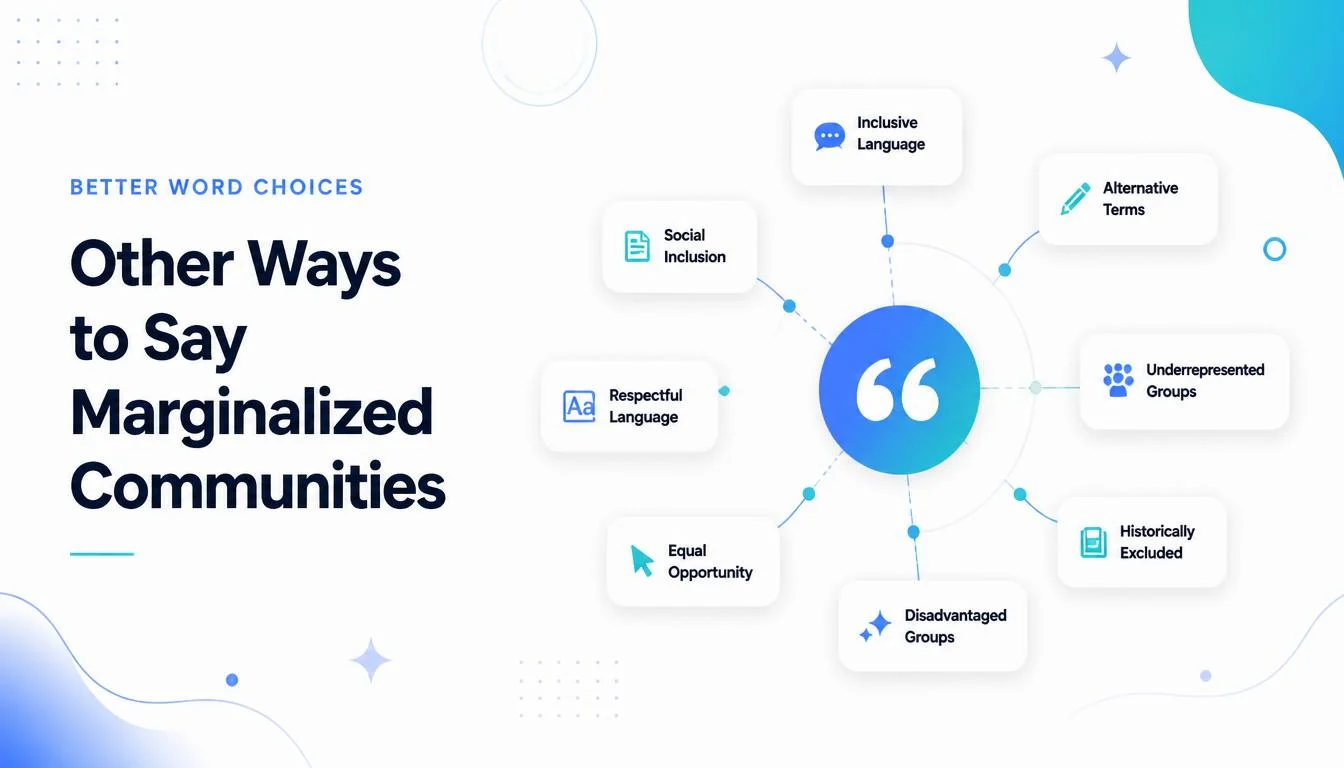
Other ways to say marginalized communities include underserved communities, underrepresented groups, historically excluded populations, and disadvantaged communities. Choose the term that best fits the context and the specific barriers people face.
Learning other ways to say marginalized communities can help you communicate more respectfully and precisely in academic writing, professional discussions, and social advocacy. The phrase generally refers to groups that face social exclusion, limited opportunities, unequal access to resources, or barriers to participating fully in society.
Depending on the context, alternatives such as “underserved communities,” “underrepresented groups,” and “historically excluded populations” can express different aspects of marginalization. However, these terms are not always interchangeable. Choosing accurate, inclusive language helps you describe people’s experiences thoughtfully while avoiding generalizations and emphasizing the specific challenges or inequalities being discussed.
Quick Categories: Alternatives by Context
Formal alternatives to “marginalized communities”
- Historically excluded groups: Emphasizes exclusion over time.
- Socially disadvantaged populations: Highlights structural and social barriers.
- Groups experiencing systemic inequality: Focuses on institutional disadvantages.
Pro tip: Use these expressions in academic papers, policy documents, and research reports when the meaning fits the evidence.
Casual alternatives
- Communities facing barriers: Clear and accessible.
- People with fewer opportunities: Emphasizes unequal access.
- Overlooked communities: Highlights a lack of attention or recognition.
Pro tip: In everyday conversation, prioritize clear, respectful wording instead of complicated terminology.
Professional alternatives
- Underserved communities: Best when access to services is limited.
- Underrepresented groups: Best when representation is insufficient.
- Communities facing socioeconomic barriers: Useful for reports and organizational planning.
Pro tip: Match the term to the specific issue. Limited healthcare access and limited workplace representation are different problems.
Informal expressions
- People who are often left out: Conversational and direct.
- Communities that do not get a fair chance: Emphasizes unequal opportunities.
- Groups whose voices are overlooked: Highlights participation and recognition.
Pro tip: These informal expressions can make conversations more accessible, but formal documents may require more precise terminology.
Common Mistakes When Using “Marginalized Communities”
Even advanced English learners can misuse this phrase when they overlook differences in meaning, context, and tone.
1. Treating every disadvantaged group as identical
Incorrect: All marginalized communities face the same problems.
Better: Different communities experience different barriers to education, healthcare, and employment.
2. Using “underserved” when you mean “underrepresented”
Incorrect: Women are underserved in the company’s leadership team.
Better: Women are underrepresented in the company’s leadership team.
Why: Underrepresentation concerns participation or visibility. Underservice concerns access to resources or services.
3. Defining people only by their disadvantages
Incorrect: The project is designed for the helpless and marginalized.
Better: The project supports community members who face barriers to essential services.
Why: Respectful language recognizes people as individuals, not merely as recipients of assistance.
4. Using the phrase without explaining the context
Incorrect: We need to help marginalized communities.
Better: We need to improve healthcare access for rural communities that lack nearby medical facilities.
Why: Specific language explains the problem and makes proposed solutions more meaningful.
5. Assuming a group prefers a particular label
Incorrect: Everyone in this neighborhood identifies as disadvantaged.
Better: The report describes the economic barriers affecting some residents of the neighborhood.
Why: People may describe their own identities and circumstances differently. Use community preferences and relevant evidence when available.
“Respectful communication describes the barriers people face, not their worth as individuals.”
What Does “Marginalized Communities” Mean?
Marginalized communities are groups of people who face exclusion from social, economic, political, cultural, or institutional opportunities. This exclusion may result from discrimination, unequal policies, historical disadvantages, or limited access to resources.
The word marginalized is the past participle of marginalize, meaning to push someone or a group toward the edges of society or limit their influence and participation.
Grammar explanation
The expression is a plural noun phrase:
- Marginalized: An adjective describing exclusion or reduced participation.
- Communities: A plural noun referring to groups of people connected by location, identity, experience, or shared circumstances.
Examples:
- Singular: A marginalized community needs better access to public transportation.
- Plural: Marginalized communities may encounter barriers to education and employment.
Example sentence
“Local organizations are developing programs to improve educational opportunities for marginalized communities.”
The phrase is common in academic writing, nonprofit communications, government reports, and discussions of social equity. However, the most accurate alternative depends on the issue being discussed.
When to Use “Marginalized Communities”
Use this phrase when discussing groups whose participation, influence, or access to opportunities has been restricted by social or institutional barriers.
Common contexts include:
- Education: Unequal access to quality schools, learning materials, or scholarships.
- Healthcare: Barriers to medical treatment, preventive care, or health information.
- Employment: Discrimination, unequal hiring opportunities, or workplace exclusion.
- Public policy: Laws and programs designed to address structural inequality.
- Community development: Housing, transportation, infrastructure, and essential services.
- Research and academia: Social exclusion, representation, inequality, and institutional power.
- Nonprofit work: Programs intended to improve access, participation, and community well-being.
Spoken vs. written English
| Context | Recommended wording |
|---|---|
| Everyday conversation | People who face barriers |
| Academic essay | Historically excluded groups |
| Workplace report | Underrepresented groups |
| Healthcare planning | Underserved communities |
| Public policy | Groups experiencing systemic inequality |
| Community outreach | Communities facing barriers |
Formal vs. informal usage
Formal language often requires precision and evidence. Informal language can be simpler, provided it remains respectful.
For instance, “people who are often left out” may work well in a conversation, while “historically excluded groups” may better suit an academic discussion of long-term institutional barriers.
Is It Professional or Polite to Say “Marginalized Communities”?
Yes. The phrase is generally appropriate in professional, academic, and public policy settings when it accurately describes the circumstances being discussed.
However, professionalism depends on more than choosing a formal expression. Writers should avoid broad generalizations, unsupported claims, and wording that presents people as powerless or all the same.
Business-style example
“Our outreach strategy prioritizes improving access to professional development for communities that have historically faced barriers to employment.”
This sentence identifies a practical objective without assuming that everyone in the affected communities has the same experience.
- Polite? Yes, when used respectfully and accurately.
- Professional? Yes, especially in reports, presentations, research, and inclusion initiatives.
- Best practice: Name the specific barriers, affected context, or intended outcome whenever possible.
Pros and Cons of Using “Marginalized Communities”
Pros
- Recognized terminology: Common in discussions of equity, inclusion, and public policy.
- Highlights structural barriers: Draws attention to exclusion rather than suggesting that unequal outcomes are always individual failures.
- Suitable for formal writing: Works in reports, research, and institutional communications.
- Concise and understandable: Communicates a broad social concept in two words.
Cons
- Can be too broad: It may group people with very different experiences under one label.
- May lack specificity: It does not explain whether the barrier concerns services, representation, rights, or economic opportunity.
- Can sound impersonal: Repeated use may make writing feel abstract or detached from real people.
- May not reflect community preferences: Some individuals or groups may prefer a more specific or different description.
The solution is not to avoid the phrase entirely. Instead, select a more precise expression when the context supports it.
30 Other Ways to Say “Marginalized Communities” With Examples
These alternatives will help you communicate more precisely in academic, professional, and everyday situations.
Choose each phrase according to its meaning, context, and audience. Unlike professional reaction phrases or informal expressions in English used to express feelings, these terms describe social conditions, representation, access, or exclusion.
1. Underserved Communities
Meaning: Communities that do not receive adequate services or resources.
Explanation: This phrase is especially useful when discussing gaps in healthcare, education, transportation, or public services.
Example Sentence: The organization provides free health screenings to underserved communities.
Best Use: Healthcare and services
Worst Use: Representation issues
Tone: Professional, clear, practical
Context Variability: Casual: “These areas need more support.” Professional: “We are expanding services for underserved communities.” Spoken: “Some neighborhoods lack adequate healthcare.”
2. Underrepresented Groups
Meaning: Groups whose presence or participation is lower than expected or appropriate in a particular setting.
Explanation: Use this expression when discussing representation in workplaces, universities, leadership, media, or public institutions.
Example Sentence: The company is working to increase opportunities for underrepresented groups in senior leadership.
Best Use: Workplace diversity
Worst Use: Service shortages
Tone: Formal, inclusive, specific
Context Variability: Casual: “Some groups are missing from the discussion.” Professional: “We aim to improve representation.” Spoken: “Not everyone has an equal voice.”
3. Historically Excluded Groups
Meaning: Groups that have experienced exclusion over an extended period.
Explanation: This phrase emphasizes historical patterns rather than suggesting that exclusion is only a current problem.
Example Sentence: The scholarship program supports students from historically excluded groups.
Best Use: Historical analysis
Worst Use: Temporary setbacks
Tone: Academic, respectful, analytical
Context Variability: Casual: “Groups that were left out in the past.” Professional: “The policy addresses historical exclusion.” Spoken: “These groups have faced barriers for generations.”
4. Disadvantaged Communities
Meaning: Communities experiencing social or economic disadvantages.
Explanation: This is a broad alternative that works when the particular barriers are explained in the surrounding text.
Example Sentence: The initiative provides educational resources to disadvantaged communities.
Best Use: Social programs
Worst Use: Identity alone
Tone: Neutral, formal, descriptive
Context Variability: Casual: “Communities with fewer opportunities.” Professional: “We are investing in disadvantaged communities.” Spoken: “These areas need better access to resources.”
5. Socially Excluded Groups
Meaning: Groups that face barriers to full participation in society.
Explanation: This expression highlights limited participation in social, economic, cultural, or civic life.
Example Sentence: The research examines how public transportation affects socially excluded groups.
Best Use: Social research
Worst Use: Simple demographics
Tone: Formal, analytical, precise
Context Variability: Casual: “People who are left out.” Professional: “The program addresses social exclusion.” Spoken: “Some people face barriers to participating in community life.”
6. Historically Disadvantaged Populations
Meaning: Populations that have faced long-standing disadvantages.
Explanation: This phrase suits discussions of persistent inequality in education, income, housing, or public resources.
Example Sentence: The new funding model prioritizes historically disadvantaged populations.
Best Use: Policy reports
Worst Use: Unsupported claims
Tone: Formal, research-oriented, measured
Context Variability: Casual: “Groups that have faced disadvantages for years.” Professional: “The initiative addresses long-standing inequities.” Spoken: “Past inequalities still affect opportunities today.”
7. Communities Facing Barriers
Meaning: Communities encountering obstacles that limit access or participation.
Explanation: This is a flexible and accessible phrase that lets you identify the specific barriers without relying on a broad label.
Example Sentence: Our training program supports communities facing barriers to employment.
Best Use: General communication
Worst Use: Unexplained specifics
Tone: Clear, neutral, empathetic
Context Variability: Casual: “People dealing with obstacles.” Professional: “We are reducing barriers to participation.” Spoken: “Some communities have difficulty accessing these services.”
8. Economically Disadvantaged Communities
Meaning: Communities experiencing financial hardship or limited economic opportunities.
Explanation: Use this expression when the main issue involves poverty, low incomes, employment, or financial resources.
Example Sentence: The initiative offers free digital skills training to economically disadvantaged communities.
Best Use: Economic inequality
Worst Use: Nonfinancial exclusion
Tone: Formal, descriptive, specific
Context Variability: Casual: “Communities with fewer financial resources.” Professional: “The project supports economic inclusion.” Spoken: “Some families cannot afford these opportunities.”
9. Underserved Populations
Meaning: Groups of people who receive insufficient services or support.
Explanation: This phrase focuses on people rather than geographic communities and is common in healthcare and public administration.
Example Sentence: The clinic is expanding its services to underserved populations.
Best Use: Public services
Worst Use: Historical exclusion
Tone: Professional, neutral, concise
Context Variability: Casual: “People who need better access to services.” Professional: “We are improving service delivery.” Spoken: “More people need access to reliable healthcare.”
10. Underprivileged Communities
Meaning: Communities with limited access to social, economic, or educational advantages.
Explanation: This familiar expression can work in general writing, although more specific alternatives may be preferable when describing particular barriers.
Example Sentence: The foundation provides learning materials to children in underprivileged communities.
Best Use: Educational outreach
Worst Use: Unrelated inequality
Tone: Traditional, descriptive, formal
Context Variability: Casual: “Communities with fewer advantages.” Professional: “The foundation expands educational access.” Spoken: “Some children lack essential learning resources.”
11. Communities with Limited Access to Resources
Meaning: Communities that cannot adequately access essential resources.
Explanation: This phrase is useful when discussing specific gaps in healthcare, education, technology, housing, or public infrastructure.
Example Sentence: The project delivers internet access to communities with limited access to resources.
Best Use: Resource allocation
Worst Use: Identity representation
Tone: Specific, neutral, practical
Context Variability: Casual: “Places that lack essential resources.” Professional: “We are addressing resource gaps.” Spoken: “Some areas do not have reliable internet access.”
12. Groups Experiencing Systemic Inequality
Meaning: Groups affected by inequality embedded in institutions, policies, or social systems.
Explanation: Use this phrase when discussing patterns that go beyond individual circumstances or isolated incidents.
Example Sentence: The report examines employment barriers affecting groups experiencing systemic inequality.
Best Use: Policy analysis
Worst Use: Minor inconvenience
Tone: Academic, analytical, formal
Context Variability: Casual: “Groups facing unfair systems.” Professional: “The review identifies structural inequalities.” Spoken: “Some barriers are built into how institutions operate.”
13. Communities Facing Social Inequality
Meaning: Communities experiencing unequal opportunities, treatment, or outcomes.
Explanation: This expression is suitable for broad discussions of unequal access to education, housing, employment, or public participation.
Example Sentence: Local leaders are developing initiatives for communities facing social inequality.
Best Use: Social development
Worst Use: Purely technical gaps
Tone: Neutral, serious, accessible
Context Variability: Casual: “Communities that do not get equal opportunities.” Professional: “The initiative promotes social equity.” Spoken: “People should have fair access to opportunities.”
14. Historically Underrepresented Communities
Meaning: Communities that have had limited representation over time.
Explanation: This phrase combines historical context with the specific issue of representation.
Example Sentence: The university is creating mentorship programs for historically underrepresented communities.
Best Use: Education and leadership
Worst Use: Service delivery
Tone: Formal, inclusive, precise
Context Variability: Casual: “Groups that have rarely been represented.” Professional: “The program strengthens representation.” Spoken: “More voices need to be included in decision making.”
15. Vulnerable Communities
Meaning: Communities that face increased exposure to particular risks or harm.
Explanation: This phrase is appropriate when vulnerability is relevant to the situation, such as during a natural disaster or public health emergency. It should not be used to imply that every member lacks agency.
Example Sentence: Emergency services are prioritizing communities vulnerable to flooding.
Best Use: Risk assessment
Worst Use: General identity labels
Tone: Serious, protective, context-dependent
Context Variability: Casual: “Communities at greater risk.” Professional: “The response prioritizes high-risk areas.” Spoken: “These neighborhoods need additional flood protection.”
16. Historically Disenfranchised Groups
Meaning: Groups that have been denied political rights, influence, or meaningful participation.
Explanation: This expression is particularly suitable for voting rights, civic participation, and political exclusion.
Example Sentence: The research explores voting access for historically disenfranchised groups.
Best Use: Civic participation
Worst Use: General service gaps
Tone: Formal, political, analytical
Context Variability: Casual: “People who were denied a political voice.” Professional: “The policy expands civic participation.” Spoken: “Some groups have historically faced barriers to voting.”
17. Communities Experiencing Poverty
Meaning: Communities in which residents experience poverty or insufficient financial resources.
Explanation: This expression directly identifies an economic condition without suggesting that poverty defines every resident.
Example Sentence: The housing program provides affordable accommodation for communities experiencing poverty.
Best Use: Poverty research
Worst Use: Representation gaps
Tone: Direct, respectful, descriptive
Context Variability: Casual: “Communities where many families struggle financially.” Professional: “The program addresses housing affordability.” Spoken: “Many households need more affordable housing.”
18. People Facing Structural Barriers
Meaning: People encountering obstacles created by institutional or social arrangements.
Explanation: This person-centered expression is useful when the barriers matter more than a particular community label.
Example Sentence: The career center offers additional support to people facing structural barriers to employment.
Best Use: Employment support
Worst Use: Unrelated challenges
Tone: Professional, person-centered, analytical
Context Variability: Casual: “People dealing with barriers in the system.” Professional: “We are reducing structural obstacles.” Spoken: “Some people face barriers beyond their individual control.”
19. Excluded Communities
Meaning: Communities that are left out of opportunities, services, or decision making.
Explanation: This concise phrase works when exclusion is the central issue and the surrounding text explains its nature.
Example Sentence: The consultation process aims to include previously excluded communities.
Best Use: Community engagement
Worst Use: Unrelated hardship
Tone: Direct, formal, inclusive
Context Variability: Casual: “Communities that have been left out.” Professional: “The consultation expands participation.” Spoken: “We need to hear from people who were previously excluded.”
20. Communities with Limited Opportunities
Meaning: Communities whose members have restricted access to opportunities.
Explanation: This accessible alternative suits education, career development, entrepreneurship, and community investment.
Example Sentence: The mentorship initiative supports young people from communities with limited opportunities.
Best Use: Youth development
Worst Use: Political rights
Tone: Accessible, supportive, neutral
Context Variability: Casual: “Places where people have fewer chances.” Professional: “The initiative broadens career pathways.” Spoken: “Young people deserve access to more opportunities.”
21. Disenfranchised Communities
Meaning: Communities whose members lack political power, rights, or meaningful participation in decision making.
Explanation: The term can also describe broader exclusion, but its political meaning is particularly important in civic contexts.
Example Sentence: The advocacy group works to strengthen participation among disenfranchised communities.
Best Use: Civic advocacy
Worst Use: Basic service shortages
Tone: Formal, political, assertive
Context Variability: Casual: “People who lack a meaningful voice.” Professional: “The campaign expands civic participation.” Spoken: “Residents need a stronger voice in local decisions.”
22. Communities Experiencing Discrimination
Meaning: Communities whose members encounter unfair treatment based on identity or perceived characteristics.
Explanation: This phrase is appropriate when discrimination is a documented or clearly relevant part of the issue.
Example Sentence: The organization provides legal information to communities experiencing discrimination.
Best Use: Anti-discrimination work
Worst Use: Unrelated disadvantage
Tone: Respectful, direct, serious
Context Variability: Casual: “Communities facing unfair treatment.” Professional: “The program addresses discriminatory practices.” Spoken: “Everyone should receive fair treatment.”
23. Groups Facing Institutional Barriers
Meaning: Groups encountering obstacles within organizations, public systems, or institutions.
Explanation: Use this expression when procedures, policies, or institutional practices restrict access or participation.
Example Sentence: The review identifies institutional barriers affecting groups seeking access to higher education.
Best Use: Institutional reform
Worst Use: Personal preferences
Tone: Formal, analytical, precise
Context Variability: Casual: “Groups facing obstacles in the system.” Professional: “We are reviewing institutional practices.” Spoken: “Some rules make it harder for people to participate.”
24. Communities with Limited Representation
Meaning: Communities whose members have insufficient visibility or participation in a particular setting.
Explanation: This phrase works well when discussing leadership, public consultations, research participation, or media coverage.
Example Sentence: The board is seeking input from communities with limited representation in local planning.
Best Use: Public consultation
Worst Use: Service access
Tone: Professional, inclusive, specific
Context Variability: Casual: “Communities that are rarely heard.” Professional: “The board is broadening stakeholder participation.” Spoken: “More residents should be included in the discussion.”
25. Socially Disadvantaged Populations
Meaning: Populations affected by social disadvantages that restrict opportunities or participation.
Explanation: This formal expression is suitable for research, social policy, and reports examining inequality.
Example Sentence: The study investigates access to education among socially disadvantaged populations.
Best Use: Academic research
Worst Use: Informal conversation
Tone: Academic, neutral, descriptive
Context Variability: Casual: “People who face social disadvantages.” Professional: “The study examines unequal access.” Spoken: “Some groups encounter more obstacles to education.”
26. Communities at Risk of Exclusion
Meaning: Communities that may be excluded from services, opportunities, or social participation.
Explanation: This phrase emphasizes the possibility of exclusion, rather than claiming that exclusion has already occurred in every case.
Example Sentence: The new strategy aims to prevent communities at risk of exclusion from losing access to public services.
Best Use: Preventive planning
Worst Use: Established facts
Tone: Cautious, professional, forward-looking
Context Variability: Casual: “Communities that might be left out.” Professional: “The strategy prevents exclusion.” Spoken: “We need to make sure no community is overlooked.”
27. People with Unequal Access to Opportunities
Meaning: People who do not have the same access to opportunities as others.
Explanation: This plain-language alternative works well when clarity matters more than technical terminology.
Example Sentence: The scholarship initiative supports people with unequal access to educational opportunities.
Best Use: General education
Worst Use: Technical labels
Tone: Clear, explanatory, accessible
Context Variability: Casual: “People who do not get the same chances.” Professional: “The initiative addresses unequal access.” Spoken: “Everyone should have a fair chance to succeed.”
28. Communities Historically Left Out of Decision Making
Meaning: Communities whose members have been excluded from decisions that affect them.
Explanation: This descriptive phrase highlights participation and influence, making it useful in local government and community development.
Example Sentence: The council is consulting communities historically left out of decision making.
Best Use: Local governance
Worst Use: Resource shortages alone
Tone: Direct, inclusive, explanatory
Context Variability: Casual: “People who were not asked for their opinions.” Professional: “The council is expanding community consultation.” Spoken: “Residents should have a say in decisions about their area.”
29. Communities Facing Socioeconomic Barriers
Meaning: Communities encountering obstacles linked to social and economic conditions.
Explanation: This phrase works when financial circumstances and social conditions jointly affect access to opportunities.
Example Sentence: The employment program supports communities facing socioeconomic barriers to career advancement.
Best Use: Economic development
Worst Use: Purely political exclusion
Tone: Formal, analytical, professional
Context Variability: Casual: “Communities facing social and financial obstacles.” Professional: “The program addresses socioeconomic barriers.” Spoken: “Income and access to resources can affect career opportunities.”
30. People and Communities Historically Pushed to the Margins
Meaning: People and communities that have repeatedly been excluded from mainstream opportunities or influence.
Explanation: This expressive alternative emphasizes long-term exclusion while retaining a human-centered focus.
Example Sentence: The museum’s new exhibition highlights the experiences of people and communities historically pushed to the margins.
Best Use: Cultural storytelling
Worst Use: Concise technical reports
Tone: Reflective, empathetic, expressive
Context Variability: Casual: “People who have often been left out.” Professional: “The exhibition recognizes historically excluded voices.” Spoken: “Their experiences deserve greater recognition.”
“The most accurate alternative is the one that explains the specific barrier, not simply the broad category.”
Comparison Table: Top 10 Alternatives
Use this table to quickly select the most appropriate expression for your writing or conversation.
| Phrase | Tone | Best Use |
|---|---|---|
| Underserved communities | Professional, neutral | Access to services |
| Underrepresented groups | Formal, inclusive | Representation |
| Historically excluded groups | Academic, analytical | Historical exclusion |
| Disadvantaged communities | Neutral, descriptive | Social and economic inequality |
| Socially excluded groups | Formal, analytical | Social participation |
| Communities facing barriers | Clear, accessible | General communication |
| Historically disadvantaged populations | Academic, formal | Policy and research |
| Vulnerable communities | Serious, context dependent | Risk and protection |
| Groups experiencing systemic inequality | Analytical, formal | Institutional inequality |
| Communities facing socioeconomic barriers | Professional, precise | Economic and social obstacles |
Quick selection tip: If the issue is inadequate healthcare, choose underserved communities. If it is limited workplace representation, choose underrepresented groups. If it is long-term exclusion, choose historically excluded groups.
Mini Quiz: Test Your Understanding
Choose the best alternative for each situation.
1. A hospital wants to improve medical services in areas with too few healthcare facilities. Which phrase fits best?Underrepresented groupsUnderserved communitiesHistorically disenfranchised groups
2. A company wants to improve the representation of women in senior leadership. Which phrase is most precise?Underrepresented groupsVulnerable communitiesCommunities experiencing poverty
3. A research paper examines long standing exclusion from public institutions. Which phrase fits best?Communities with limited access to resourcesHistorically excluded groupsPeople with unequal access to opportunities
4. You are speaking to a general audience and want a clear, respectful phrase without technical terminology. Which works best?People facing barriersSocially disadvantaged populationsGroups experiencing systemic inequality
0 of 4 answeredTry again
FAQs
1. What is another word for marginalized communities?
Common alternatives include underserved communities, underrepresented groups, historically excluded groups, and disadvantaged communities. The best choice depends on the type of exclusion or inequality being discussed.
2. What is a more professional way to say marginalized communities?
Groups experiencing systemic inequality and historically excluded groups can be appropriate in formal reports and academic writing. Use underserved communities when the main concern is inadequate access to services.
3. Is “underserved communities” the same as “marginalized communities”?
No. Underserved communities lack adequate services or resources, while marginalized communities face exclusion or reduced participation and influence. The two categories can overlap.
4. Is “disadvantaged communities” a respectful phrase?
Generally, yes, when it accurately describes the circumstances. However, a more specific phrase, such as communities facing barriers to education, may be clearer and less generalizing.
5. How can I avoid using “marginalized communities” too often in an essay?
Vary your wording according to the point you are making. You might use historically excluded groups, underserved populations, or groups facing structural barriers, but only when the meaning fits. Avoid changing terms merely to prevent repetition if they describe different circumstances.
Conclusion
Learning other ways to say marginalized communities helps you communicate social issues with greater precision, respect, and confidence. Expressions such as underserved communities, underrepresented groups, and historically excluded groups can strengthen your writing when they accurately describe the situation.
Practice these alternatives by writing example sentences, reading professional reports, and paying attention to the barriers each expression describes. With regular practice, you can build a stronger vocabulary, improve your formal communication, and choose language that is clear, inclusive, and appropriate for your audience.
Read More Related Articles:
- Other Ways to Say You’re Beautiful | Beyond the Ordinary Compliment In 2026
- Other Ways to Say I Love You in Spanish | Beyond the Usual Phrase In 2026
- Other Ways to Say I Love You in Other Languages | Beyond the Classic Three Words In 2026
Victoria Hughes is a content writer dedicated to making communication clearer and more effective. Through TextsResponse.com, she shares practical insights and thoughtfully crafted response ideas that help readers express themselves with confidence.