Quick Answer
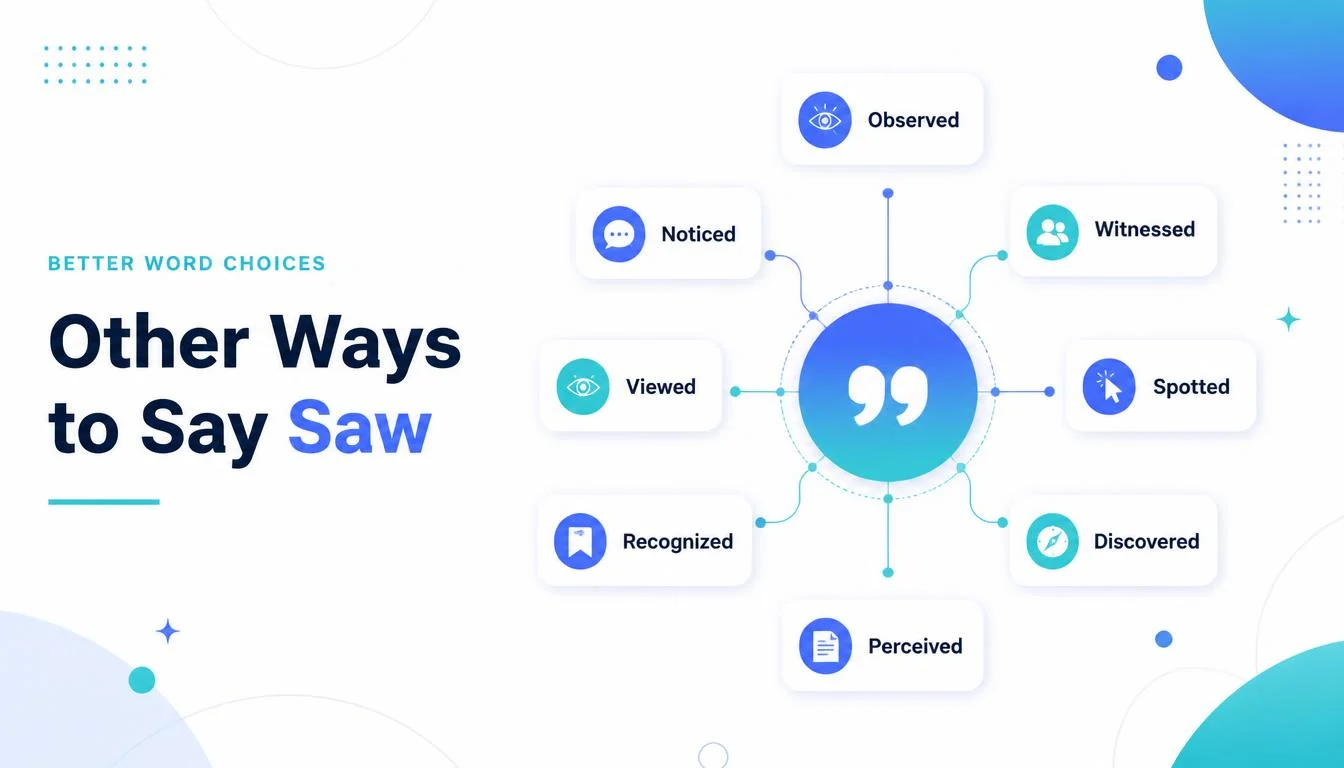
Other ways to say saw include noticed, observed, viewed, spotted, witnessed, encountered, and caught sight of.
Looking for other ways to say saw can make your English more precise, natural, and engaging. The best alternative depends on whether you mean noticing something, watching an event, or meeting someone.
Learning other ways to say saw also helps you avoid repetition in essays, stories, conversations, and professional writing. The right word can add clarity and show exactly how you experienced something.
What Is “Other Ways to Say Saw”? (Meaning, Grammar & Real Use)
Imagine telling a coworker about something you noticed during a meeting. You might say, “I saw an error in the report.” That sentence is completely correct, but repeating saw throughout a conversation or piece of writing can make your English sound basic or repetitive. Choosing more precise vocabulary helps you show exactly how you experienced something.
For example, noticed suggests that something caught your attention, while observed suggests more careful attention. Spotted often describes seeing something quickly, and witnessed is stronger because it usually refers to an event that you personally experienced.
Learning alternatives to saw can therefore make your English more precise in conversations, essays, reports, emails, and professional discussions. These choices are especially useful when you want to express excitement in English, describe an important event, or explain what happened clearly.
Definition
Saw is the past tense of see. It means that you perceived someone, something, or an event with your eyes.
Grammar Note
Saw is a verb and is the simple past form of see. It is common in both spoken and written English and works in formal, neutral, and informal contexts.
Example:
“I saw a familiar face in the audience.”
Where and Why People Use It
People use saw when describing something they visually experienced in the past. It is natural in everyday conversation, storytelling, personal writing, reports, and professional communication.
However, more specific verbs can communicate how the seeing happened. A writer may have noticed a detail, spotted an object, observed a pattern, or witnessed an event.
When Should You Use “Saw”?
The word saw is useful when you simply need to state that you visually experienced something. More specific alternatives are better when the manner or importance of seeing matters.
Common Contexts
- Describing something you noticed during the day
- Talking about a person you encountered
- Reporting something that happened
- Recalling an event
- Describing something in a story
- Explaining what you viewed online or in person
- Mentioning something you discovered visually
Spoken vs Written
Spoken English:
“Saw” is extremely natural in everyday conversations.
Written English:
“Saw” is correct, but alternatives such as observed, noticed, or witnessed can create greater precision.
Formal vs Informal
Formal: observed, witnessed, viewed, examined, identified
Neutral: noticed, saw, encountered, discovered, found
Informal: spotted, caught sight of, glimpsed, came across
Is It Professional or Just Polite?
Politeness vs Professionalism
“Saw” is neither especially formal nor informal. It is a neutral, standard English verb that is acceptable in professional communication.
The issue is not whether the word is professional. The issue is whether a more precise verb would communicate your meaning better.
Business Example
“I saw several inconsistencies in the quarterly report.”
For a more formal report, you could write:
“I observed several inconsistencies in the quarterly report.”
Verdict
Polite? ✔️ Yes
Professional? ✔️ Yes
Best for formal writing? ✔️ Yes, when simple wording is appropriate
Pros and Cons of Using “Saw”
Pros
- Simple: It communicates the basic idea immediately.
- Natural: Native speakers use it constantly in everyday English.
- Versatile: It works with people, objects, places, and events.
- Clear: Most English learners and readers understand it instantly.
Cons
- Can become repetitive: Frequent use may make writing feel basic.
- Limited precision: It does not explain how you saw something.
- Weak for detailed description: It may not show attention, duration, or importance.
- Sometimes too general: A more exact verb can communicate your meaning more effectively.
Common Mistakes People Make
Mistake 1: Using “saw” when “noticed” is more precise
❌ “I saw that the document had a spelling mistake.”
✔️ “I noticed that the document had a spelling mistake.”
Use noticed when something catches your attention.
Mistake 2: Confusing “saw” with “watched”
❌ “I saw television for two hours.”
✔️ “I watched television for two hours.”
Use watched when you intentionally pay attention to something over a period of time.
Mistake 3: Using “saw” for an important event
❌ “I saw the accident.”
✔️ “I witnessed the accident.”
Witnessed is often stronger when you personally experienced an event.
Mistake 4: Using “looked” when you mean “saw”
❌ “I looked a beautiful bird in the garden.”
✔️ “I saw a beautiful bird in the garden.”
Looked usually describes directing your eyes toward something. Saw describes actually perceiving it.
Mistake 5: Using “seen” as the simple past
❌ “Yesterday, I seen him at the station.”
✔️ “Yesterday, I saw him at the station.”
Saw is the simple past. Seen is normally used as a past participle, such as “I have seen him.”
“Small tone mistakes can make confident English sound careless.”
Alternatives by Category
Formal alternatives to “saw”
- Observed
- Witnessed
- Viewed
- Examined
Pro Tip: Choose observed for careful attention and witnessed for events you personally experienced.
Casual alternatives
- Noticed
- Spotted
- Caught sight of
- Glimpsed
Pro Tip: Use spotted for quick discoveries and glimpsed when the view was brief.
Professional alternatives
- Observed
- Identified
- Detected
- Reviewed
Pro Tip: In professional writing, select a verb that explains what you actually did rather than simply replacing saw.
Informal expressions
- Came across
- Came upon
- Ran into
- Found
Pro Tip: Check the context carefully because some informal expressions describe encountering something rather than literally seeing it.
“Formal and informal English aren’t about correctness. They’re about context.”
Other Ways to Say “Saw” (Full List with Examples)
These 30 alternatives help build fluency and let you describe observation, discovery, encounters, and visual experiences with greater precision.
1. Phrase: Noticed
Meaning: Became aware of something.
Explanation: Best when something attracts your attention.
Example Sentence: “I noticed a mistake in the report.”
Best Use: Details and changes
Worst Use: Long observation
Tone: Neutral and natural
Context Variability: casual / professional / spoken
2. Phrase: Observed
Meaning: Watched or noticed carefully.
Explanation: Suggests deliberate attention.
Example Sentence: “We observed a change in customer behavior.”
Best Use: Careful analysis
Worst Use: Quick glance
Tone: Formal and precise
Context Variability: professional / spoken / written
3. Phrase: Spotted
Meaning: Saw or recognized something quickly.
Explanation: Often suggests finding something noticeable.
Example Sentence: “I spotted your car outside.”
Best Use: Quick discovery
Worst Use: Formal reports
Tone: Casual and clear
Context Variability: casual / spoken / professional
4. Phrase: Witnessed
Meaning: Personally saw an event happen.
Explanation: Stronger than simply seeing something.
Example Sentence: “She witnessed the accident.”
Best Use: Significant events
Worst Use: Ordinary objects
Tone: Serious and formal
Context Variability: professional / spoken / written
5. Phrase: Viewed
Meaning: Looked at something.
Explanation: Common for images, documents, videos, and presentations.
Example Sentence: “I viewed the presentation yesterday.”
Best Use: Media and documents
Worst Use: Emotional events
Tone: Neutral and formal
Context Variability: professional / written / spoken
6. Phrase: Glimpsed
Meaning: Saw something briefly.
Explanation: Indicates a short or incomplete view.
Example Sentence: “I glimpsed him through the window.”
Best Use: Brief views
Worst Use: Detailed study
Tone: Literary and neutral
Context Variability: casual / spoken / written
7. Phrase: Caught Sight of
Meaning: Suddenly or briefly saw something.
Explanation: Useful when something enters your visual awareness.
Example Sentence: “I caught sight of her near the entrance.”
Best Use: Unexpected sightings
Worst Use: Formal reports
Tone: Natural and descriptive
Context Variability: casual / spoken / written
8. Phrase: Detected
Meaning: Discovered something through observation.
Explanation: Often suggests finding something subtle or hidden.
Example Sentence: “The technician detected a problem.”
Best Use: Problems and signals
Worst Use: Casual stories
Tone: Technical and precise
Context Variability: professional / written / spoken
9. Phrase: Identified
Meaning: Recognized or determined what something was.
Explanation: Focuses on recognition rather than simply seeing.
Example Sentence: “The officer identified the vehicle.”
Best Use: Recognition tasks
Worst Use: Casual sightings
Tone: Formal and professional
Context Variability: professional / written / spoken
10. Phrase: Examined
Meaning: Looked at something carefully.
Explanation: Suggests detailed visual inspection.
Example Sentence: “The doctor examined the image.”
Best Use: Detailed inspection
Worst Use: Passing encounters
Tone: Formal and precise
Context Variability: professional / written / spoken
11. Phrase: Inspected
Meaning: Looked at something closely to check its condition.
Explanation: Implies a deliberate evaluation.
Example Sentence: “The manager inspected the equipment.”
Best Use: Quality checks
Worst Use: Casual observation
Tone: Formal and professional
Context Variability: professional / written / spoken
12. Phrase: Witnessed Firsthand
Meaning: Personally saw an event occur.
Explanation: Emphasizes direct personal experience.
Example Sentence: “I witnessed the transformation firsthand.”
Best Use: Personal experience
Worst Use: Ordinary details
Tone: Strong and formal
Context Variability: professional / spoken / written
13. Phrase: Came Across
Meaning: Found or encountered something unexpectedly.
Explanation: Often describes discovering information, objects, or people.
Example Sentence: “I came across an interesting article.”
Best Use: Unexpected discovery
Worst Use: Formal evidence
Tone: Casual and natural
Context Variability: casual / spoken / written
14. Phrase: Came Upon
Meaning: Found something unexpectedly.
Explanation: Similar to “came across” but slightly more literary.
Example Sentence: “We came upon an old cabin.”
Best Use: Unexpected findings
Worst Use: Business emails
Tone: Literary and neutral
Context Variability: casual / spoken / written
15. Phrase: Found
Meaning: Discovered or encountered something.
Explanation: Simple and flexible when something becomes known or visible.
Example Sentence: “I found an interesting detail in the report.”
Best Use: Discoveries
Worst Use: Formal precision
Tone: Neutral and simple
Context Variability: casual / professional / spoken
16. Phrase: Discovered
Meaning: Found something previously unknown.
Explanation: Stronger than “saw” because it emphasizes discovery.
Example Sentence: “Researchers discovered a new pattern.”
Best Use: New information
Worst Use: Familiar objects
Tone: Formal and informative
Context Variability: professional / written / spoken
17. Phrase: Looked At
Meaning: Directed your eyes toward something.
Explanation: Describes the action of looking rather than the result.
Example Sentence: “I looked at the document before signing it.”
Best Use: Intentional viewing
Worst Use: Accidental sightings
Tone: Neutral and direct
Context Variability: casual / professional / spoken
18. Phrase: Watched
Meaning: Looked at something for a period of time.
Explanation: Best for ongoing visual attention.
Example Sentence: “We watched the match together.”
Best Use: Extended viewing
Worst Use: Quick sightings
Tone: Neutral and common
Context Variability: casual / spoken / written
19. Phrase: Witnessed an Event
Meaning: Personally saw an event happen.
Explanation: Gives importance to the event and personal involvement.
Example Sentence: “Thousands witnessed the historic event.”
Best Use: Major events
Worst Use: Small details
Tone: Formal and serious
Context Variability: professional / spoken / written
20. Phrase: Perceived
Meaning: Became aware of something through the senses.
Explanation: More abstract and academic than “saw.”
Example Sentence: “The change was perceived immediately.”
Best Use: Academic contexts
Worst Use: Casual conversation
Tone: Academic and formal
Context Variability: professional / written / spoken
21. Phrase: Recognized
Meaning: Identified someone or something from previous knowledge.
Explanation: Focuses on knowing what you were seeing.
Example Sentence: “I recognized her from the conference.”
Best Use: Familiar people
Worst Use: Unknown objects
Tone: Neutral and precise
Context Variability: casual / professional / spoken
22. Phrase: Noticed the Presence of
Meaning: Became aware that something or someone was there.
Explanation: Useful when emphasizing awareness.
Example Sentence: “We noticed the presence of several errors.”
Best Use: Formal observations
Worst Use: Casual stories
Tone: Formal and clear
Context Variability: professional / written / spoken
23. Phrase: Detected the Presence of
Meaning: Discovered that something existed or was present.
Explanation: Appropriate for technical or investigative situations.
Example Sentence: “The system detected the presence of malware.”
Best Use: Technical findings
Worst Use: Social conversations
Tone: Technical and formal
Context Variability: professional / written / spoken
24. Phrase: Took Notice of
Meaning: Paid attention to something.
Explanation: More deliberate than simply saying “saw.”
Example Sentence: “The manager took notice of the improvement.”
Best Use: Important changes
Worst Use: Quick sightings
Tone: Formal and neutral
Context Variability: professional / spoken / written
25. Phrase: Took In
Meaning: Looked at and mentally absorbed something.
Explanation: Can describe appreciating a scene or information.
Example Sentence: “We took in the beautiful view.”
Best Use: Scenes and experiences
Worst Use: Technical reports
Tone: Natural and descriptive
Context Variability: casual / spoken / written
26. Phrase: Laid Eyes On
Meaning: Saw someone or something.
Explanation: An idiomatic expression often used for emphasis.
Example Sentence: “I had never laid eyes on the building before.”
Best Use: First sightings
Worst Use: Formal reports
Tone: Idiomatic and informal
Context Variability: casual / spoken / written
27. Phrase: Got a Glimpse of
Meaning: Saw something briefly.
Explanation: Emphasizes a short or incomplete view.
Example Sentence: “I got a glimpse of the performer backstage.”
Best Use: Brief sightings
Worst Use: Formal analysis
Tone: Casual and descriptive
Context Variability: casual / spoken / written
28. Phrase: Encountered
Meaning: Came into contact with someone or something.
Explanation: Can describe physical, professional, or unexpected encounters.
Example Sentence: “We encountered several challenges.”
Best Use: Experiences and situations
Worst Use: Simple visual details
Tone: Neutral and professional
Context Variability: professional / spoken / written
29. Phrase: Reviewed
Meaning: Looked at something carefully to evaluate it.
Explanation: Common in professional and academic settings.
Example Sentence: “I reviewed the proposal this morning.”
Best Use: Documents and work
Worst Use: Casual sightings
Tone: Professional and formal
Context Variability: professional / written / spoken
30. Phrase: Surveyed
Meaning: Looked carefully over an area or situation.
Explanation: Suggests a broad and deliberate visual examination.
Example Sentence: “The team surveyed the area before beginning.”
Best Use: Areas and situations
Worst Use: Personal encounters
Tone: Formal and precise
Context Variability: professional / written / spoken
Comparison Table: Top 10 Alternatives at a Glance
| Phrase | Tone | Best Use |
|---|---|---|
| Noticed | Neutral | Details and changes |
| Observed | Formal | Careful analysis |
| Spotted | Casual | Quick discovery |
| Witnessed | Formal | Important events |
| Viewed | Neutral | Documents and media |
| Glimpsed | Descriptive | Brief sightings |
| Detected | Technical | Problems and signals |
| Identified | Professional | Recognition tasks |
| Examined | Formal | Detailed inspection |
| Discovered | Professional | New information |
Quick Self-Check (Mini Quiz)
Question 1
You saw a spelling mistake while reading an email. Which phrase is most natural?
A. Witnessed a spelling mistake
B. Noticed a spelling mistake
C. Surveyed a spelling mistake
D. Watched a spelling mistake
Answer: B. Noticed a spelling mistake
Question 2
You personally saw a serious accident happen. Which word best emphasizes your direct experience?
A. Witnessed
B. Viewed
C. Glimpsed
D. Reviewed
Answer: A. Witnessed
Question 3
A technician found a hidden problem in a machine. Which verb sounds most precise?
A. Spotted
B. Detected
C. Watched
D. Looked at
Answer: B. Detected
Question 4
You looked at a report carefully before approving it. Which professional verb fits best?
A. Glimpsed
B. Came upon
C. Reviewed
D. Laid eyes on
Answer: C. Reviewed
FAQs
What are the best alternatives to “saw”?
Some of the most useful alternatives are noticed, observed, spotted, witnessed, viewed, identified, detected, examined, and discovered. The best choice depends on the context.
What is a formal way to say “saw”?
Observed, witnessed, examined, inspected, and viewed can sound more formal than “saw.” Choose based on what actually happened rather than simply choosing the most formal word.
What is another way to say “saw” in professional writing?
In professional writing, observed, identified, detected, reviewed, examined, and noted are useful choices. Each communicates a slightly different type of observation.
What is a casual way to say “saw”?
Common casual choices include spotted, noticed, caught sight of, glimpsed, came across, and got a glimpse of. These are especially natural in everyday conversation.
Is “witnessed” the same as “saw”?
Not exactly. Witnessed usually emphasizes personally seeing an event happen, often an important or memorable event. Saw has a much broader meaning.
conclusion
Using different verbs instead of repeating saw can make your English clearer, more natural, and more precise. Words such as noticed, observed, spotted, witnessed, and discovered help you explain exactly what happened and how you experienced it.
The key is to match the verb with the context. Practice replacing saw with one precise alternative each day, especially in conversations, emails, essays, and professional writing.
Read More Related Articles:
- Other Ways to Say “From” in a Letter | For a More Professional Sign-Off In 2026
- Other Ways to Say Be Safe | Upgrade Your Farewells In 2026
- Other Ways to Say Feel Free | Formal Writing and Business Communication In 2026

Daniel Murphy is a professional writer and blogger specializing in digital communication and messaging trends. As a contributor to TextsResponse.com, he creates reader-focused content designed to help people find the right words at the right time.