Quick Answer
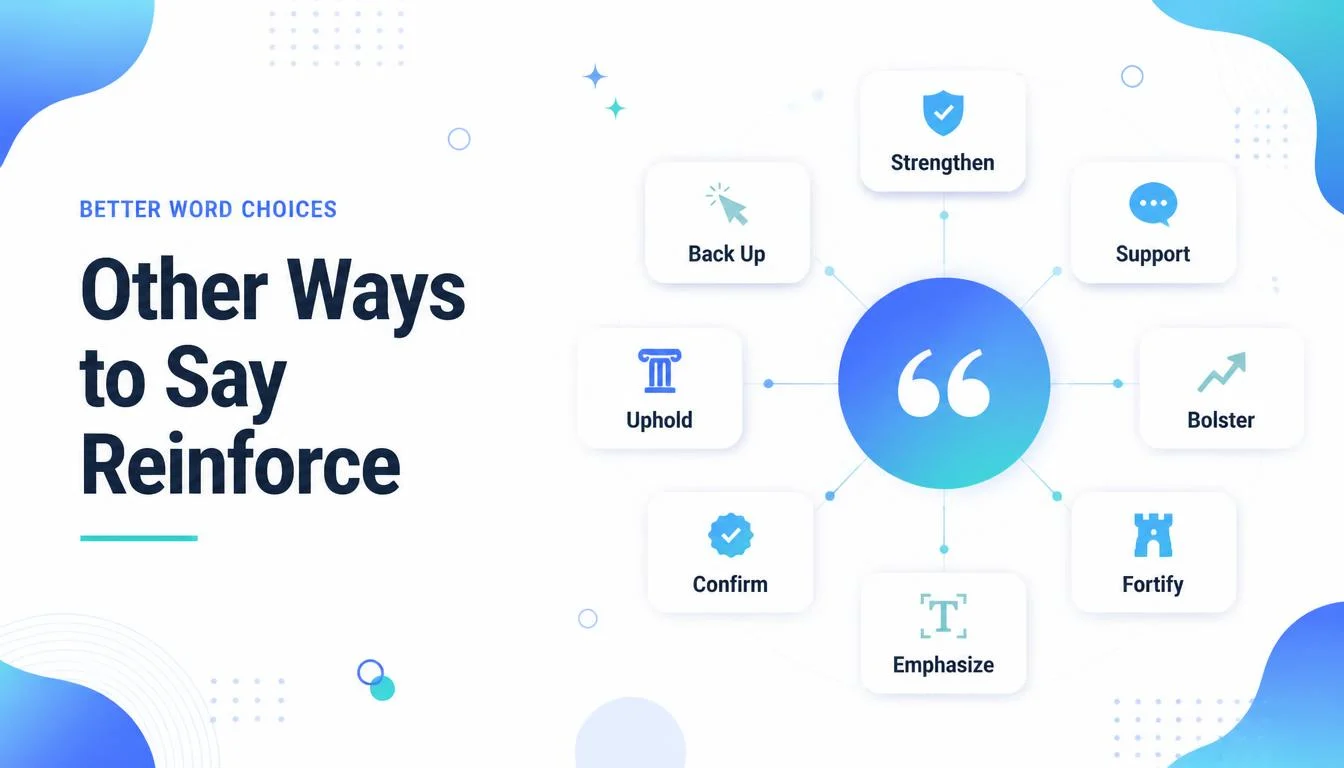
Other ways to say reinforce include strengthen, support, solidify, bolster, enhance, and fortify. Choose the best alternative based on whether you mean improving an idea, building confidence, or making something stronger.
Learning other ways to say reinforce can help you make your English writing more precise, professional, and engaging. The word “reinforce” means to strengthen, support, or make something more effective. It is commonly used in academic writing, workplace communication, education, and everyday conversations.
Depending on the context, you can replace “reinforce” with words such as “strengthen,” “bolster,” “support,” or “solidify.” For example, you might strengthen an argument, reinforce positive behavior, or bolster a team’s confidence. Understanding these alternatives helps you avoid repetition and choose words that express your intended meaning clearly.
What Is “Reinforce”? (Meaning, Grammar & Real Use)
Imagine you are presenting a new business strategy to your team. You explain the plan, provide supporting evidence, and repeat the most important goals to ensure everyone understands them. In this situation, you reinforce your message. The same word applies when a teacher strengthens a student’s understanding, a manager encourages positive behavior, or a company improves an existing security system.
Learning other ways to say reinforce helps you communicate these ideas with greater precision. Instead of repeating the same verb, you can select a phrase that describes exactly what you mean. For example, strengthen emphasizes improvement, while emphasize highlights importance. Support focuses on assistance, and confirm communicates that something is correct or established.
These distinctions are valuable when you write reports, participate in meetings, study academic texts, or express excitement in English about someone’s progress. The goal is not simply to memorize synonyms. It is to understand how meaning, tone, and context influence your word choice.
Definition: To reinforce means to make something stronger, more effective, more firmly established, or more likely to continue.
Grammar: Reinforce is a transitive verb, usually followed by a noun or pronoun. It is appropriate in formal, professional, academic, and everyday English.
Example: Regular practice reinforces good communication skills.
People use the word in spoken conversations and written communication whenever they want to describe strengthening an idea, structure, behavior, belief, or relationship.
When Should You Use “Reinforce”?
The word works in many situations, but selecting a more precise alternative can make your communication clearer.
Common contexts
- Education: Reinforce a lesson, concept, or student’s understanding.
- Business: Reinforce company values, expectations, or a strategic message.
- Communication: Reinforce an argument, opinion, or important point.
- Psychology: Reinforce positive behavior through encouragement or rewards.
- Construction and engineering: Reinforce a wall, bridge, or structural component.
- Relationships: Reinforce trust, mutual respect, or emotional support.
- Marketing: Reinforce brand recognition and customer confidence.
- Academic writing: Reinforce a claim with evidence or research.
Spoken vs. written English
In conversation, you might say, “Let’s strengthen our teamwork,” or “I want to emphasize this point.”
In formal writing, phrases such as “substantiate the argument,” “consolidate the findings,” or “bolster the evidence” may communicate your meaning more precisely.
Formal vs. informal English
Formal English favors specific verbs that describe the intended action. Informal English often uses straightforward alternatives such as “back up,” “build up,” or “make stronger.
Choose the expression that fits the situation rather than automatically assuming that a longer word sounds more professional.
Is It Professional or Just Polite?
Reinforce is both professional and appropriate in polite communication. It is a standard English verb frequently used in workplace discussions, reports, presentations, and formal correspondence.
Politeness concerns how respectfully you communicate. Professionalism concerns clarity, relevance, accuracy, and suitability for the workplace. A sentence can be professional without being especially warm, and polite without being particularly formal.
Business example: “We should reinforce our customer service standards through regular training and constructive feedback.
Verdict:
- Polite? ✔️ Yes, when used respectfully.
- Professional? ✔️ Yes, especially in workplace and academic contexts.
The key is to choose an appropriate object. You can reinforce a policy, message, standard, or relationship, but the surrounding sentence must make your intended meaning clear.
Pros and Cons of Using “Reinforce”
Pros
- Versatile: Works with ideas, structures, habits, beliefs, and relationships.
- Professional: Fits reports, meetings, presentations, and academic writing.
- Clear: Communicates the idea of making something stronger or more established.
- Concise: Expresses a complex idea with a single verb.
Cons
- Potentially vague: Readers may need more context to understand what is being strengthened.
- Can become repetitive: Reusing the same verb throughout a report can make the writing monotonous.
- Meaning varies by context: Reinforcing a structure differs from reinforcing an argument or behavior.
- Not always interchangeable: Words such as confirm, prove, and emphasize describe different actions.
For example, you can reinforce an argument with evidence, but evidence itself may substantiate the argument. Choosing the more precise verb helps readers understand the relationship between the ideas.
Common Mistakes People Make
Understanding the differences between similar verbs prevents confusing or unnatural sentences.
1. Using “reinforce” when you mean “repeat”
Incorrect: “Please reinforce the sentence exactly as I wrote it.”
Correct: “Please repeat the sentence exactly as I wrote it.”
Why: Repeat means to say or write something again. Reinforce means to make something stronger or more firmly established.
2. Confusing “reinforce” with “confirm”
Incorrect: “The latest test results reinforce that the meeting is scheduled for Monday.”
Correct: “The latest email confirms that the meeting is scheduled for Monday.”
Why: Confirm establishes that information is correct. Reinforce is more appropriate when additional evidence strengthens an existing conclusion or understanding.
3. Using “reinforce” without a clear object
Incorrect: “The manager will reinforce tomorrow.”
Correct: “The manager will reinforce the team’s understanding of the new policy tomorrow.”
Why: Reinforce generally takes an object. Specify what will become stronger or more firmly established.
4. Treating “support” and “reinforce” as identical
Incorrect: “The additional data reinforces the team with practical assistance.”
Correct: “The additional data reinforces the team’s argument.”
Why: Support can describe helping a person or group directly. Reinforce usually emphasizes strengthening something that already exists.
5. Assuming “reinforce” always means physical strengthening
Incorrect: “The teacher reinforced the classroom with a helpful example.”
Correct: “The teacher reinforced the lesson with a helpful example.”
Why: The verb has both physical and abstract meanings. Use an object that accurately reflects the intended action.
Small tone mistakes can make confident English sound careless.
Alternatives by Category
These categories provide a preview of the most useful options. The full list below includes all 30 alternatives with explanations and examples.
Formal alternatives to “reinforce”
- Strengthen: Improve the power, quality, or effectiveness of something.
- Substantiate: Support a claim with evidence.
- Consolidate: Bring separate elements together or make an existing position more secure.
Pro Tip: Use substantiate when discussing evidence, and consolidate when describing combined efforts, findings, or resources.
Casual alternatives
- Back up: Support a statement, opinion, or person.
- Build up: Gradually increase strength, confidence, or capacity.
- Make stronger: Express the meaning in straightforward everyday English.
Pro Tip: Prefer familiar expressions in casual conversations when they communicate your meaning more naturally than technical vocabulary.
Professional alternatives
- Bolster: Add support to strengthen an argument, position, or system.
- Emphasize: Draw attention to an important point.
- Solidify: Make a decision, understanding, or relationship more firmly established.
Pro Tip: Match the verb to your objective: emphasize the message, bolster the argument, or solidify the agreement.
Informal expressions
- Drive home: Make an important message especially clear.
- Hammer home: Repeat or present a point forcefully.
- Double down on: Commit more firmly to an existing position or approach.
Pro Tip: Use drive home in presentations and conversations. Reserve hammer home for situations where a forceful tone is appropriate.
“Formal and informal English aren’t about correctness. They’re about context.”
Other Ways to Say “Reinforce” (Full List with Examples)
The following 30 alternatives help you communicate more precisely in academic, professional, and everyday situations. Some strengthen an existing idea, while others express support, importance, or commitment.
1. Phrase: Strengthen
Meaning: Make something stronger or more effective.
Explanation: A versatile alternative for physical structures, skills, relationships, arguments, and systems.
Example Sentence: Regular feedback can strengthen team performance.
Best Use: General improvement
Worst Use: Simple repetition
Tone: Neutral professional
Context Variability: casual / professional / spoken
2. Phrase: Support
Meaning: Help maintain or strengthen something.
Explanation: Appropriate for people, claims, decisions, and projects. It can imply assistance rather than a direct increase in strength.
Example Sentence: The research supports our main conclusion.
Best Use: Claims and people
Worst Use: Physical repair
Tone: Neutral versatile
Context Variability: casual / professional / spoken
3. Phrase: Emphasize
Meaning: Highlight importance.
Explanation: Use this when you want an audience to pay attention to a key idea rather than make an object physically stronger.
Example Sentence: The manager emphasized the importance of accuracy.
Best Use: Important messages
Worst Use: Structural improvement
Tone: Professional direct
Context Variability: casual / professional / spoken
4. Phrase: Bolster
Meaning: Add strength or support.
Explanation: Often used for arguments, confidence, morale, and positions. It sounds polished in business and academic writing.
Example Sentence: The new findings bolster our proposal.
Best Use: Arguments and confidence
Worst Use: Simple instructions
Tone: Formal confident
Context Variability: professional / spoken / written
5. Phrase: Solidify
Meaning: Make something more secure or firmly established.
Explanation: Useful for relationships, agreements, understanding, and plans that need a stronger foundation.
Example Sentence: The discussion helped solidify our agreement.
Best Use: Agreements and plans
Worst Use: Repeating words
Tone: Professional neutral
Context Variability: casual / professional / spoken
6. Phrase: Confirm
Meaning: Establish that something is correct or definite.
Explanation: Choose this when evidence verifies information or a decision. It does not always mean making something stronger.
Example Sentence: The follow-up email confirmed the project deadline.
Best Use: Facts and decisions
Worst Use: Physical strengthening
Tone: Neutral formal
Context Variability: casual / professional / spoken
7. Phrase: Validate
Meaning: Establish the validity or legitimacy of something.
Explanation: Useful when evidence, feedback, or experience supports the soundness of an idea or a person’s concerns.
Example Sentence: The customer feedback validated our approach.
Best Use: Ideas and concerns
Worst Use: Structural repair
Tone: Professional analytical
Context Variability: professional / spoken / written
8. Phrase: Substantiate
Meaning: Support a claim with evidence.
Explanation: Particularly effective in research papers, reports, legal discussions, and analytical writing.
Example Sentence: The survey results substantiate the report’s findings.
Best Use: Evidence-based claims
Worst Use: Casual encouragement
Tone: Formal academic
Context Variability: professional / written / spoken
9. Phrase: Back up
Meaning: Provide support or evidence.
Explanation: A natural conversational phrase for defending an argument or supporting a statement with facts.
Example Sentence: Can you back up your recommendation with data?
Best Use: Opinions and claims
Worst Use: Formal academic prose
Tone: Casual direct
Context Variability: casual / professional / spoken
10. Phrase: Build up
Meaning: Increase or develop gradually.
Explanation: Appropriate for confidence, strength, trust, and skills that develop over time.
Example Sentence: Daily practice builds up your confidence.
Best Use: Gradual development
Worst Use: Immediate confirmation
Tone: Friendly neutral
Context Variability: casual / professional / spoken
11. Phrase: Deepen
Meaning: Make something more profound or developed.
Explanation: Useful for understanding, knowledge, relationships, and engagement when greater depth is the goal.
Example Sentence: Group discussions deepen students’ understanding.
Best Use: Learning and relationships
Worst Use: Physical reinforcement
Tone: Thoughtful professional
Context Variability: casual / professional / written
12. Phrase: Enhance
Meaning: Improve quality, value, or effectiveness.
Explanation: Select this when an action improves an existing feature rather than simply repeating or confirming it.
Example Sentence: The training program enhances employee communication skills.
Best Use: Quality improvement
Worst Use: Repeating a warning
Tone: Professional polished
Context Variability: professional / spoken / written
13. Phrase: Fortify
Meaning: Strengthen against pressure, attack, or difficulty.
Explanation: Often associated with defenses, systems, security, and resilience. It can also describe mental or emotional strength.
Example Sentence: The company fortified its cybersecurity measures.
Best Use: Security and resilience
Worst Use: Everyday repetition
Tone: Formal strong
Context Variability: professional / written / spoken
14. Phrase: Consolidate
Meaning: Combine or make something more secure.
Explanation: Works well for knowledge, resources, gains, and organizational processes that need to become more stable.
Example Sentence: The final review consolidated the team’s learning.
Best Use: Knowledge and resources
Worst Use: Highlighting a detail
Tone: Formal analytical
Context Variability: professional / written / spoken
15. Phrase: Reaffirm
Meaning: State support or commitment again.
Explanation: Appropriate for expressing renewed commitment to values, goals, agreements, or beliefs.
Example Sentence: The director reaffirmed the company’s commitment to fairness.
Best Use: Commitments and values
Worst Use: Physical repairs
Tone: Formal reassuring
Context Variability: professional / spoken / written
16. Phrase: Underscore
Meaning: Highlight the significance of something.
Explanation: Common in reports, articles, and presentations when evidence or an event makes a point especially clear.
Example Sentence: The results underscore the need for better planning.
Best Use: Key implications
Worst Use: Structural improvement
Tone: Formal analytical
Context Variability: professional / written / spoken
17. Phrase: Reinforce the message
Meaning: Make a message more memorable or convincing.
Explanation: This phrase is useful when repetition, examples, or supporting materials help an audience understand an important point.
Example Sentence: The closing slide reinforces the message about teamwork.
Best Use: Presentations and training
Worst Use: Unrelated details
Tone: Professional clear
Context Variability: professional / spoken / written
18. Phrase: Strengthen the argument
Meaning: Make reasoning more convincing.
Explanation: Use this when improved evidence, logic, or examples make a position more persuasive.
Example Sentence: Additional research strengthens the argument for flexible working hours.
Best Use: Academic arguments
Worst Use: Personal reassurance
Tone: Formal persuasive
Context Variability: professional / written / spoken
19. Phrase: Lend support to
Meaning: Provide assistance or evidence for something.
Explanation: A polished expression that introduces evidence supporting a claim or position.
Example Sentence: These findings lend support to the proposed solution.
Best Use: Research and reports
Worst Use: Casual requests
Tone: Formal measured
Context Variability: professional / written / spoken
20. Phrase: Give greater weight to
Meaning: Make an idea or consideration more influential.
Explanation: Appropriate when evidence, priorities, or arguments deserve increased consideration in a decision.
Example Sentence: The latest findings give greater weight to the safety concerns.
Best Use: Decision-making discussions
Worst Use: Physical strengthening
Tone: Formal analytical
Context Variability: professional / written / spoken
21. Phrase: Drive home
Meaning: Make a point unmistakably clear.
Explanation: A conversational expression for communicating an important message through examples, repetition, or strong evidence.
Example Sentence: The real-life example drove home the importance of preparation.
Best Use: Speeches and discussions
Worst Use: Neutral technical descriptions
Tone: Informal emphatic
Context Variability: casual / professional / spoken
22. Phrase: Hammer home
Meaning: Stress a point forcefully and repeatedly.
Explanation: This expression can sound forceful or confrontational, so use it when strong emphasis is intentional.
Example Sentence: The instructor hammered home the need to follow safety procedures.
Best Use: Urgent reminders
Worst Use: Sensitive negotiations
Tone: Forceful informal
Context Variability: casual / professional / spoken
23. Phrase: Highlight
Meaning: Draw attention to an important detail.
Explanation: Use this when you want to make a point noticeable without necessarily strengthening its underlying evidence.
Example Sentence: The report highlights the benefits of early planning.
Best Use: Reports and presentations
Worst Use: Structural reinforcement
Tone: Neutral professional
Context Variability: casual / professional / spoken
24. Phrase: Establish
Meaning: Set up or demonstrate something firmly.
Explanation: Appropriate when creating a foundation, defining expectations, or showing that a principle is well supported.
Example Sentence: The training establishes clear expectations for new employees.
Best Use: Rules and foundations
Worst Use: Repeating known facts
Tone: Formal neutral
Context Variability: professional / spoken / written
25. Phrase: Maintain
Meaning: Keep something at its current level or condition.
Explanation: Choose this when your goal is to preserve standards, performance, or a relationship rather than actively increase its strength.
Example Sentence: Regular reviews maintain consistent quality standards.
Best Use: Ongoing standards
Worst Use: New development
Tone: Professional neutral
Context Variability: casual / professional / spoken
26. Phrase: Amplify
Meaning: Increase the strength, impact, or reach of something.
Explanation: Useful for messages, voices, effects, and public awareness when you want an effect to become more noticeable.
Example Sentence: Customer testimonials amplified the campaign’s impact.
Best Use: Reach and impact
Worst Use: Quiet reassurance
Tone: Modern professional
Context Variability: professional / spoken / written
27. Phrase: Encourage
Meaning: Give someone confidence or motivation.
Explanation: Suitable for promoting positive behavior or helping a person continue an effort. It focuses on motivation rather than direct strengthening.
Example Sentence: The teacher encouraged students to practice independently.
Best Use: Motivation and growth
Worst Use: Physical structures
Tone: Warm supportive
Context Variability: casual / professional / spoken
28. Phrase: Improve
Meaning: Make something better.
Explanation: A broad, accessible alternative when an action raises quality, performance, or effectiveness without specifying exactly how.
Example Sentence: Weekly feedback improves the team’s performance.
Best Use: General progress
Worst Use: Mere repetition
Tone: Neutral accessible
Context Variability: casual / professional / spoken
29. Phrase: Double down on
Meaning: Commit more firmly to an existing position or approach.
Explanation: Common in business and conversation when someone increases their commitment. It can imply persistence even when others disagree.
Example Sentence: The company doubled down on its customer-first strategy.
Best Use: Strategic commitment
Worst Use: Neutral fact-checking
Tone: Informal assertive
Context Variability: casual / professional / spoken
30. Phrase: Make stronger
Meaning: Increase strength or effectiveness.
Explanation: A simple alternative that works when clarity matters more than sophistication, particularly for learners and everyday communication.
Example Sentence: More practice can make your writing stronger.
Best Use: Clear everyday English
Worst Use: Technical research prose
Tone: Simple neutral
Context Variability: casual / professional / spoken
Comparison Table: Top 10 Alternatives at a Glance
| Phrase | Tone | Best Use |
|---|---|---|
| Strengthen | Neutral | General improvement |
| Support | Versatile | Claims and people |
| Emphasize | Professional | Important messages |
| Bolster | Formal | Arguments and confidence |
| Solidify | Professional | Agreements and plans |
| Confirm | Neutral | Facts and decisions |
| Validate | Analytical | Ideas and concerns |
| Back up | Casual | Opinions and evidence |
| Enhance | Polished | Quality improvement |
| Highlight | Neutral | Reports and presentations |
Selection tip: These ten options cover many common contexts, but they are not interchangeable. For instance, support can mean helping someone, whereas emphasize means drawing attention to an idea.
Quick Self-Check (Mini Quiz)
Test your understanding of tone and context.
1. You have new research that makes your argument more convincing. Which phrase fits best?
A. Repeat the argument
B. Strengthen the argument
C. Maintain the argument
Correct answer: B. Strengthen the argument.
2. You want to make an important safety rule especially clear during training. Which expression is most suitable?
A. Drive home the rule
B. Consolidate the rule
C. Validate the rule
Correct answer: A. Drive home the rule. It emphasizes making a point unmistakably clear.
3. A report provides evidence that a claim is accurate. Which verb is most precise?
A. Encourage
B. Substantiate
C. Amplify
Correct answer: B. Substantiate.
4. You want to make an existing agreement more firmly established. Which option fits best?
A. Solidify the agreement
B. Repeat the agreement
C. Highlight the agreement
Correct answer: A. Solidify the agreement.
FAQs
1. What are the best alternatives to reinforce?
The most versatile options are strengthen, support, emphasize, bolster, and solidify. The best choice depends on whether you mean improvement, assistance, emphasis, or greater stability.
2. What is a formal word for reinforce?
Substantiate, consolidate, bolster, and fortify can work in formal contexts. Select the word that matches the specific meaning you want to communicate.
3. What is a professional way to say reinforce a point?
You can say emphasize a point, underscore its importance, or drive home the message. In formal reports, emphasize and underscore are generally suitable.
4. Can strengthen and reinforce be used interchangeably?
Often, yes. Both can describe making something more effective, but reinforce can also imply adding support to something that already exists.
5. How can I avoid repeating reinforce in an essay?
Use precise alternatives such as support, substantiate, emphasize, strengthen, and underscore. Check the context carefully because each verb expresses a slightly different relationship between ideas and evidence.
Conclusion
Learning different ways to express the idea of strengthening something can make your English more natural, precise, and professional. Use strengthen for general improvement, substantiate for evidence, emphasize for important points, and solidify for agreements or understanding. The best synonym is the one that communicates your intended meaning clearly.
Practice these expressions in emails, presentations, essays, and everyday conversations. Pay attention to tone, grammar, and context so you can choose language confidently rather than relying on the same familiar word.
Read More Related Articles:
- Other Ways to Say Keep in Mind | From Casual to Professional Phrases In 2026
- Other Ways to Say Tell Me More | Fresh Phrases for Any Situation In 2026
- Other Ways to Say “Works for Me” | Say Yes Without Repeating Yourself In 2026

Victoria Hughes is a content writer dedicated to making communication clearer and more effective. Through TextsResponse.com, she shares practical insights and thoughtfully crafted response ideas that help readers express themselves with confidence.