Quick Answer
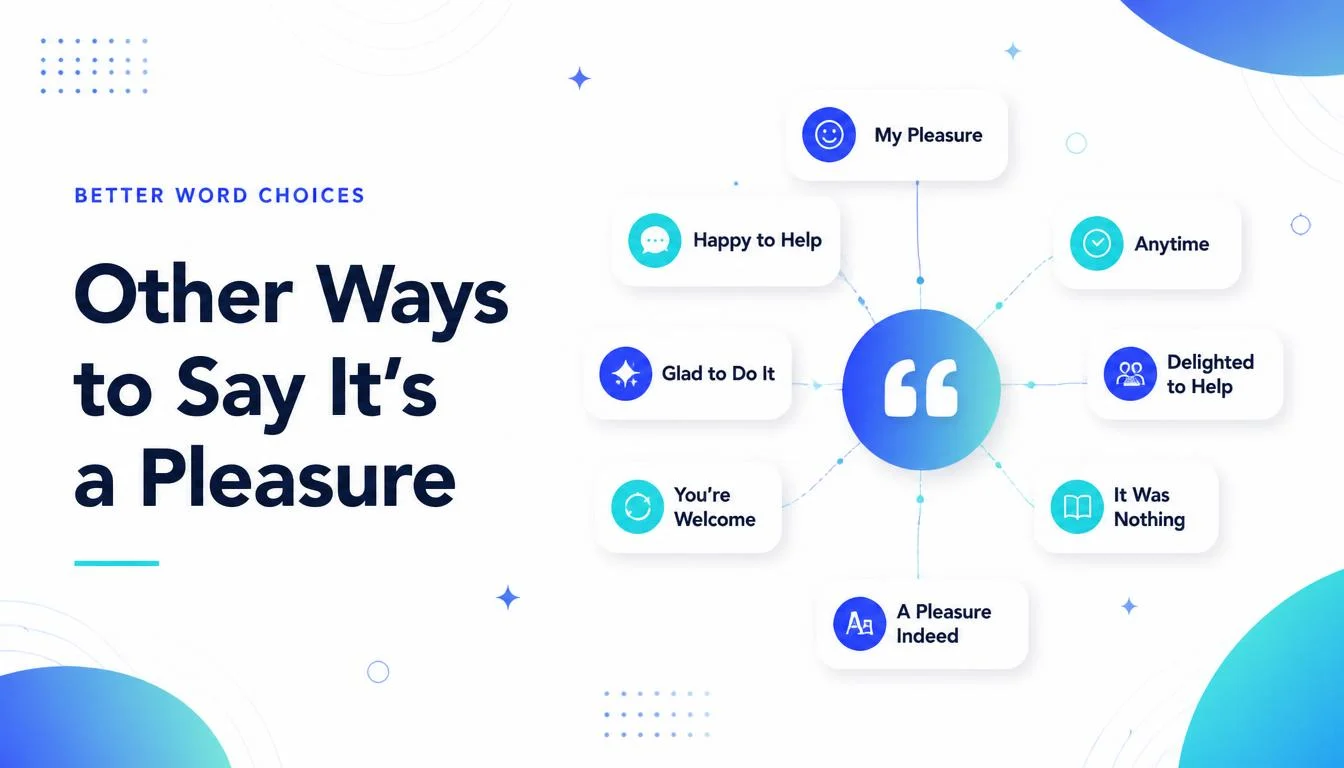
Other ways to say it’s a pleasure include “my pleasure,” “happy to help,” “glad to be of assistance,” and “it was a delight.” Choose an expression that matches the situation and level of formality.
Learning other ways to say it’s a pleasure can help you sound more natural, polite, and confident in English. Whether you are responding to thanks, meeting someone new, or communicating with colleagues, the right expression can make your conversations warmer and more professional.
The phrase “it’s a pleasure” is commonly used to show friendliness, appreciation, or willingness to help. However, repeating it in every situation can make your communication sound less varied. Alternatives such as “my pleasure,” “I’m glad I could help,” and “it’s been a delight” allow you to express the same sentiment in different ways, from casual conversations to formal business settings.
What Is “It’s a Pleasure”? (Meaning, Grammar & Real Use)
Imagine a colleague thanks you for helping with an important presentation. You could simply say, “It’s a pleasure,” but choosing a more specific response, such as “I’m happy to help,” can make your communication sound warmer and more natural. Similarly, when meeting a new client, saying “It’s a pleasure to meet you” creates a courteous first impression.
The expression “It’s a pleasure” communicates that an experience, interaction, or act of assistance is enjoyable or welcome. People commonly use it to respond to gratitude, introduce themselves politely, or show appreciation during professional and personal conversations.
Learning alternatives to this expression helps English learners communicate with greater confidence. Instead of repeating the same words, you can choose language that reflects your relationship with the listener and the situation. These expressions also help you express excitement in English when meeting someone important or participating in a meaningful event.
Grammatically, “It’s a pleasure” is a declarative sentence using a contraction of “it is.” It is polite, grammatically correct, and suitable for many formal and informal situations.
Example: “It’s a pleasure working with your team.”
You can use the expression in spoken conversations, business emails, introductions, and thank-you exchanges. The key is to choose an alternative that matches your intended meaning.
When Should You Use “It’s a Pleasure”?
This expression works in several situations, but the best alternative depends on your purpose.
Common contexts
- Responding to thanks: Say “My pleasure” or “Happy to help” after assisting someone.
- Meeting someone: Use “It’s a pleasure to meet you” when introducing yourself.
- Professional networking: Say “The pleasure is mine” to respond graciously to an introduction.
- Recognizing an opportunity: Use “It’s an honor” when the occasion feels especially meaningful.
- Working with others: Say “I’ve enjoyed working with you” when expressing appreciation after a project.
- Welcoming a guest: Use “We’re delighted to have you here” in hospitality or event settings.
Spoken vs. written English
Spoken English: “My pleasure,” “Glad to help,” and “Happy to help” sound natural in everyday conversation.
Written English: “It was a pleasure working with you” and “I appreciate the opportunity” work well in emails and professional messages.
Formal vs. informal English
Formal: “It is an honor to meet you” or “The pleasure is entirely mine.”
Informal: “No problem,” “Anytime,” or “Glad I could help.”
Choose a phrase that reflects the situation rather than automatically using the most formal expression.
Is “It’s a Pleasure” Professional or Just Polite?
“It’s a pleasure” is both polite and professional. It communicates goodwill without sounding overly casual, making it suitable for meetings, networking, customer service, and business correspondence.
Politeness focuses on showing respect and consideration. Professionalism also considers clarity, appropriateness, and the relationship between the speakers.
Business example: “It’s a pleasure to collaborate with your team on this project.”
- Polite? ✔️ Yes
- Professional? ✔️ Yes
The phrase is particularly effective when meeting clients or acknowledging someone’s assistance. However, a more specific expression may sound more sincere when you want to emphasize gratitude or appreciation.
Pros and Cons of Using “It’s a Pleasure”
Pros
- Polite and respectful: Suitable for professional introductions and courteous exchanges.
- Easy to understand: Most fluent English speakers recognize the expression.
- Versatile: It can describe enjoyable work, introductions, and helpful interactions.
- Positive tone: It creates a friendly impression without sounding overly familiar.
Cons
- Can sound rehearsed: Repeating it in every interaction may make your language feel less natural.
- May be too formal for friends: Casual alternatives can feel warmer in relaxed conversations.
- Limited emotional detail: It does not always communicate deep gratitude, excitement, or admiration.
- May need clarification: The phrase alone may not explain what you appreciated or enjoyed.
Use the expression when it fits, but vary your wording to make conversations more natural and meaningful.
Common Mistakes People Make
English learners sometimes use polite expressions incorrectly because similar phrases serve different purposes.
1. Using “My pleasure” before understanding the context
Incorrect: “My pleasure to meet you” as a standalone introduction.
Correct: “It’s a pleasure to meet you.”
“My pleasure” most commonly responds to thanks, while “It’s a pleasure to meet you” is a natural introduction.
2. Confusing “It’s a pleasure” with “It’s my pleasure”
Incorrect: “It’s pleasure to help you.”
Correct: “It’s a pleasure to help you.”
The noun “pleasure” needs the article “a” in this construction.
3. Using overly casual language in formal emails
Incorrect: “No worries!” in every formal client response.
Correct: “You’re very welcome. I’m happy to assist.”
“No worries” can be appropriate in friendly workplaces, but a more measured expression may suit formal client communication better.
4. Saying “The pleasure is mine” without a reason
Incorrect: “The pleasure is mine” when someone simply asks you to send a file.
Correct: “You’re welcome. I’m glad I could help.”
“The pleasure is mine” is especially natural when responding to a compliment or a polite introduction.
5. Choosing “It’s an honor” for routine tasks
Incorrect: “It’s an honor to forward this routine document.”
Correct: “I’m happy to forward the document.”
“An honor” suggests special significance or privilege. Reserve it for occasions that genuinely merit that emphasis.
Small tone mistakes can make confident English sound careless.
Alternatives by Category
The following phrases offer a preview of the full list. Each category highlights a different communication style.
Formal alternatives to “It’s a Pleasure”
- It is a privilege.
- The pleasure is entirely mine.
- I am honored.
- I am delighted to make your acquaintance.
Pro Tip: Use formal expressions when meeting senior professionals, welcoming distinguished guests, or attending official events.
Casual alternatives
- My pleasure.
- Glad to help.
- Happy to help.
- Anytime.
Pro Tip: Match the other person’s conversational style, especially when responding to a quick thank-you.
Professional alternatives
- I’m pleased to assist.
- It’s a pleasure working with you.
- I appreciate the opportunity.
- I’m glad I could be of assistance.
Pro Tip: In business emails, mention the task or collaboration to make your response feel specific rather than generic.
Informal expressions
- No problem.
- Don’t mention it.
- Of course.
- It was nothing.
Pro Tip: Use informal expressions with people you know or in relaxed workplaces, but avoid minimizing significant favors.
Other Ways to Say “It’s a Pleasure” (Full List with Examples)
These 30 alternatives help you communicate gratitude, enjoyment, admiration, or approval with greater precision. Choose a phrase according to your audience, purpose, and desired tone.
1. Phrase: My Pleasure
Meaning: I was happy to help.
Explanation: A natural, courteous response to thanks.
Example Sentence: “Thank you for your assistance.” “My pleasure.”
Best Use: Everyday gratitude
Worst Use: Formal introductions
Tone: Warm and polite
Context Variability: casual / professional / spoken
2. Phrase: The Pleasure Is Mine
Meaning: I feel equally pleased.
Explanation: Often used when responding to a compliment or introduction.
Example Sentence: “It’s wonderful to meet you.” “The pleasure is mine.”
Best Use: Polite introductions
Worst Use: Routine requests
Tone: Courteous and refined
Context Variability: professional / formal / spoken
3. Phrase: I’m Happy to Help
Meaning: Helping you was enjoyable.
Explanation: A friendly, natural response that emphasizes willingness.
Example Sentence: “Thanks for explaining the process.” “I’m happy to help.”
Best Use: Helpful interactions
Worst Use: Insincere apologies
Tone: Warm and approachable
Context Variability: casual / professional / spoken
4. Phrase: Glad to Help
Meaning: I was pleased to assist.
Explanation: A concise alternative for conversations and short messages.
Example Sentence: “Thanks for fixing the issue.” “Glad to help.”
Best Use: Quick responses
Worst Use: Ceremonial occasions
Tone: Friendly and concise
Context Variability: casual / professional / spoken
5. Phrase: It’s an Honor
Meaning: The opportunity is meaningful or prestigious.
Explanation: Expresses respect when participating in a significant event.
Example Sentence: “It’s an honor to speak at this conference.”
Best Use: Special occasions
Worst Use: Routine favors
Tone: Respectful and formal
Context Variability: professional / formal / spoken
6. Phrase: It Is a Privilege
Meaning: The opportunity is valued.
Explanation: Emphasizes appreciation for being included or trusted.
Example Sentence: “It is a privilege to work alongside this team.”
Best Use: Meaningful opportunities
Worst Use: Minor errands
Tone: Formal and appreciative
Context Variability: professional / formal / written
7. Phrase: I’m Delighted
Meaning: I feel very pleased.
Explanation: Communicates enthusiasm about an invitation, meeting, or opportunity.
Example Sentence: “I’m delighted to join your project.”
Best Use: Positive announcements
Worst Use: Serious complaints
Tone: Enthusiastic and polished
Context Variability: professional / formal / spoken
8. Phrase: I’m Pleased to Assist
Meaning: I am glad to provide help.
Explanation: A professional alternative for customer service and business communication.
Example Sentence: “I’m pleased to assist with your request.”
Best Use: Client communication
Worst Use: Close friendships
Tone: Professional and courteous
Context Variability: professional / formal / written
9. Phrase: Happy to Be of Service
Meaning: I am willing and pleased to help.
Explanation: Suitable for service-oriented interactions, though it can sound traditional.
Example Sentence: “We’re happy to be of service.”
Best Use: Customer support
Worst Use: Casual banter
Tone: Courteous and service-focused
Context Variability: professional / formal / spoken
10. Phrase: It Was a Pleasure Meeting You
Meaning: I enjoyed meeting you.
Explanation: A natural phrase for ending a first meeting or follow-up message.
Example Sentence: “It was a pleasure meeting you at the seminar.
Best Use: Networking follow-ups
Worst Use: Before introductions
Tone: Warm and professional
Context Variability: professional / formal / written
11. Phrase: It’s a Pleasure Working With You
Meaning: I enjoy our professional collaboration.
Explanation: Expresses appreciation for an ongoing working relationship.
Example Sentence: “It’s a pleasure working with you on this campaign.”
Best Use: Team collaboration
Worst Use: Hostile relationships
Tone: Positive and professional
Context Variability: professional / spoken / written
12. Phrase: I’m Grateful for the Opportunity
Meaning: I appreciate being given the chance.
Explanation: Emphasizes gratitude rather than simply enjoyment.
Example Sentence: “I’m grateful for the opportunity to present my research.”
Best Use: Career opportunities
Worst Use: Simple thanks
Tone: Sincere and respectful
Context Variability: professional / formal / written
13. Phrase: I Appreciate the Opportunity
Meaning: I value the chance provided.
Explanation: Works well in interviews, business emails, and professional introductions.
Example Sentence: “I appreciate the opportunity to discuss this proposal.”
Best Use: Business correspondence
Worst Use: Casual favors
Tone: Professional and measured
Context Variability: professional / formal / written
14. Phrase: I’m Honored
Meaning: I feel respected and privileged.
Explanation: Appropriate when receiving recognition, an invitation, or a meaningful responsibility.
Example Sentence: “I’m honored to accept this award.”
Best Use: Recognition events
Worst Use: Routine assistance
Tone: Grateful and formal
Context Variability: professional / formal / spoken
15. Phrase: It’s Wonderful to Meet You
Meaning: I’m very pleased to meet you.
Explanation: Adds warmth to a first introduction.
Example Sentence: “It’s wonderful to meet you in person.”
Best Use: Friendly introductions
Worst Use: Impersonal notices
Tone: Warm and enthusiastic
Context Variability: casual / professional / spoken
16. Phrase: A Pleasure to Meet You
Meaning: I’m pleased to make your acquaintance.
Explanation: A concise, polite greeting that works in many professional settings.
Example Sentence: “A pleasure to meet you, Ms. Carter.”
Best Use: First meetings
Worst Use: Thank-you replies
Tone: Polite and polished
Context Variability: professional / formal / spoken
17. Phrase: I’m Glad I Could Help
Meaning: I’m pleased my assistance was useful.
Explanation: A reassuring response after solving a problem.
Example Sentence: “I’m glad I could help you prepare for the interview.”
Best Use: Problem solving
Worst Use: Formal ceremonies
Tone: Supportive and friendly
Context Variability: casual / professional / spoken
18. Phrase: Don’t Mention It
Meaning: There’s no need to thank me.
Explanation: An informal response that downplays a small favor.
Example Sentence: “Thanks for holding the door.” “Don’t mention it.”
Best Use: Small favors
Worst Use: Formal letters
Tone: Casual and relaxed
Context Variability: casual / informal / spoken
19. Phrase: No Problem
Meaning: Helping was not an inconvenience.
Explanation: A common, relaxed response to thanks.
Example Sentence: “Thanks for sending the notes.” “No problem.”
Best Use: Everyday requests
Worst Use: Formal ceremonies
Tone: Casual and friendly
Context Variability: casual / informal / spoken
20. Phrase: Anytime
Meaning: I’d be willing to help again.
Explanation: Suggests that future requests would be welcome.
Example Sentence: “Thanks for helping me move.” “Anytime!”
Best Use: Ongoing friendships
Worst Use: Strict boundaries
Tone: Friendly and generous
Context Variability: casual / informal / spoken
21. Phrase: Of Course
Meaning: Helping or agreeing was natural.
Explanation: A simple response that can convey willingness when said warmly.
Example Sentence: “Could you explain this again?” “Of course.”
Best Use: Everyday assistance
Worst Use: Sensitive refusals
Tone: Reassuring and neutral
Context Variability: casual / professional / spoken
22. Phrase: It Was Nothing
Meaning: The effort was minor.
Explanation: Downplays a small favor, but may minimize a significant contribution.
Example Sentence: “Thanks for carrying the box.” “It was nothing.”
Best Use: Minor favors
Worst Use: Major achievements
Tone: Modest and casual
Context Variability: casual / informal / spoken
23. Phrase: It Was My Pleasure
Meaning: I genuinely enjoyed helping.
Explanation: A complete, courteous response to gratitude.
Example Sentence: “It was my pleasure to assist you yesterday.”
Best Use: Polite exchanges
Worst Use: Urgent disputes
Tone: Warm and refined
Context Variability: professional / formal / spoken
24. Phrase: I’m More Than Happy to Help
Meaning: I’m very willing to help.
Explanation: Adds emphasis and reassurance to an offer of assistance.
Example Sentence: “I’m more than happy to review your draft.”
Best Use: Offering support
Worst Use: Reluctant refusals
Tone: Enthusiastic and helpful
Context Variability: casual / professional / spoken
25. Phrase: It’s Been a Delight
Meaning: The experience has been enjoyable.
Explanation: Useful when reflecting on a completed event or collaboration.
Example Sentence: “It’s been a delight working with your organization.”
Best Use: Closing remarks
Worst Use: Routine instructions
Tone: Warm and polished
Context Variability: professional / formal / written
26. Phrase: I’ve Enjoyed Every Moment
Meaning: The experience has been consistently enjoyable.
Explanation: Expresses stronger personal appreciation for a memorable experience.
Example Sentence: “I’ve enjoyed every moment of this project.
Best Use: Meaningful experiences
Worst Use: Brief encounters
Tone: Sincere and expressive
Context Variability: casual / professional / spoken
27. Phrase: I’m Thrilled to Be Here
Meaning: I’m extremely excited to participate.
Explanation: Communicates enthusiasm at an event or important gathering.
Example Sentence: “I’m thrilled to be here and meet the team.”
Best Use: Special events
Worst Use: Routine emails
Tone: Enthusiastic and upbeat
Context Variability: professional / casual / spoken
28. Phrase: It’s a Joy to Help
Meaning: Helping brings genuine happiness.
Explanation: A heartfelt option for meaningful assistance or personal support.
Example Sentence: “It’s a joy to help students build confidence.”
Best Use: Personal support
Worst Use: Legal correspondence
Tone: Warm and heartfelt
Context Variability: casual / professional / spoken
29. Phrase: I Welcome the Opportunity
Meaning: I am willing and pleased to take part.
Explanation: Emphasizes readiness to participate in a task or collaboration.
Example Sentence: “I welcome the opportunity to contribute to this initiative.”
Best Use: Professional proposals
Worst Use: Casual thanks
Tone: Formal and confident
Context Variability: professional / formal / written
30. Phrase: I’m Glad to Be Part of It
Meaning: I’m pleased to belong to the group or experience.
Explanation: Expresses appreciation for inclusion in a team, project, or event.
Example Sentence: “I’m glad to be part of this important project.”
Best Use: Team involvement
Worst Use: Individual favors
Tone: Positive and inclusive
Context Variability: professional / casual / spoken
Comparison Table: Top 10 Alternatives at a Glance
Use this table to select an expression that matches your audience and communication goal.
| Phrase | Tone | Best Use |
|---|---|---|
| My pleasure | Warm and polite | Responding to thanks |
| The pleasure is mine | Refined and courteous | Introductions |
| I’m happy to help | Friendly and supportive | Everyday assistance |
| Glad to help | Casual and approachable | Quick replies |
| It’s an honor | Respectful and formal | Special occasions |
| I’m pleased to assist | Professional and courteous | Customer service |
| It was a pleasure meeting you | Warm and professional | Follow-up emails |
| I appreciate the opportunity | Professional and sincere | Interviews and proposals |
| No problem | Relaxed and friendly | Informal conversations |
| I’m glad I could help | Supportive and natural | Solving problems |
Quick Self-Check (Mini Quiz)
Test your understanding of tone and context with these four questions.
Question 1
You have just helped a colleague fix a spreadsheet, and they thank you. Which response sounds most natural?
A. It is a privilege.
B. Glad to help.
C. I’m honored.
D. I welcome the opportunity.
Correct answer: B. “Glad to help” is natural and friendly in an everyday workplace exchange.
Question 2
You are emailing a potential business partner after your first meeting. Which phrase is most appropriate?
A. It was a pleasure meeting you.
B. It was nothing.
C. Anytime!
D. No worries, buddy.
Correct answer: A. It sounds courteous and professional in a follow-up email.
Question 3
You have been invited to receive a prestigious professional award. Which response best communicates respect and appreciation?
A. No problem.
B. Don’t mention it.
C. I’m honored.
D. Of course.
Correct answer: C. “I’m honored” conveys the significance of the recognition.
Question 4
A friend thanks you for giving them a ride. Which response is most natural in a casual conversation?
A. I appreciate the opportunity.
B. Anytime!
C. It is a privilege.
D. I am pleased to assist.
Correct answer: B. “Anytime!” is friendly and suggests you would be happy to help again.
FAQs
1. What are the best alternatives to “It’s a Pleasure”?
Popular alternatives include “My pleasure,” “The pleasure is mine,” “I’m happy to help,” “Glad to help,” and “It was a pleasure meeting you.” The best choice depends on the context.
2. How do you say “It’s a Pleasure” professionally?
Use phrases such as “I’m pleased to assist,” “I appreciate the opportunity,” or “It’s a pleasure working with you.” These expressions are appropriate for business emails, meetings, and professional conversations.
3. Is “My Pleasure” more polite than “You’re Welcome”?
Both are polite. My pleasure” emphasizes that you were happy to help, while “You’re welcome” is a neutral, widely accepted response to thanks.
4. How do you respond to “It’s a Pleasure to Meet You”?
You can say “The pleasure is mine,” “It’s a pleasure to meet you, too,” or “Likewise.” These responses are natural, courteous, and suitable for professional introductions.
5. What is a casual way to say “It’s a Pleasure”?
Try “Glad to help,” “No problem,” “Anytime,” or “Of course.” Use these informal expressions in relaxed conversations and familiar workplace settings.
Conclusion
Learning different ways to express pleasure helps you communicate naturally in professional and personal situations. Whether you are responding to gratitude, meeting a client, or celebrating an opportunity, the right expression makes your message more specific and appropriate. Understanding tone also helps you avoid repeating the same phrase in every conversation.
Practice one or two new expressions each day. Use formal alternatives in business communication, friendly phrases with colleagues, and informal expressions with friends when appropriate. For more vocabulary ideas, explore and continue building your professional English skills.
Read More Related Articles:
- Other Ways to Say Contact Us on Website | Natural Phrases to Use In 2026
- Other Ways to Say Bless You After a Sneeze | Clever Ways to Respond In 2026
- Other Ways to Say I Hope You Feel Better Soon | Comforting Messages for Anyone In 2026

Henry Walker is an American writer and blogger with a keen interest in communication, language and digital content. At TextsResponse.com, he creates informative and reader-focused resources designed to help people communicate with clarity, confidence and authenticity.