Quick Answer
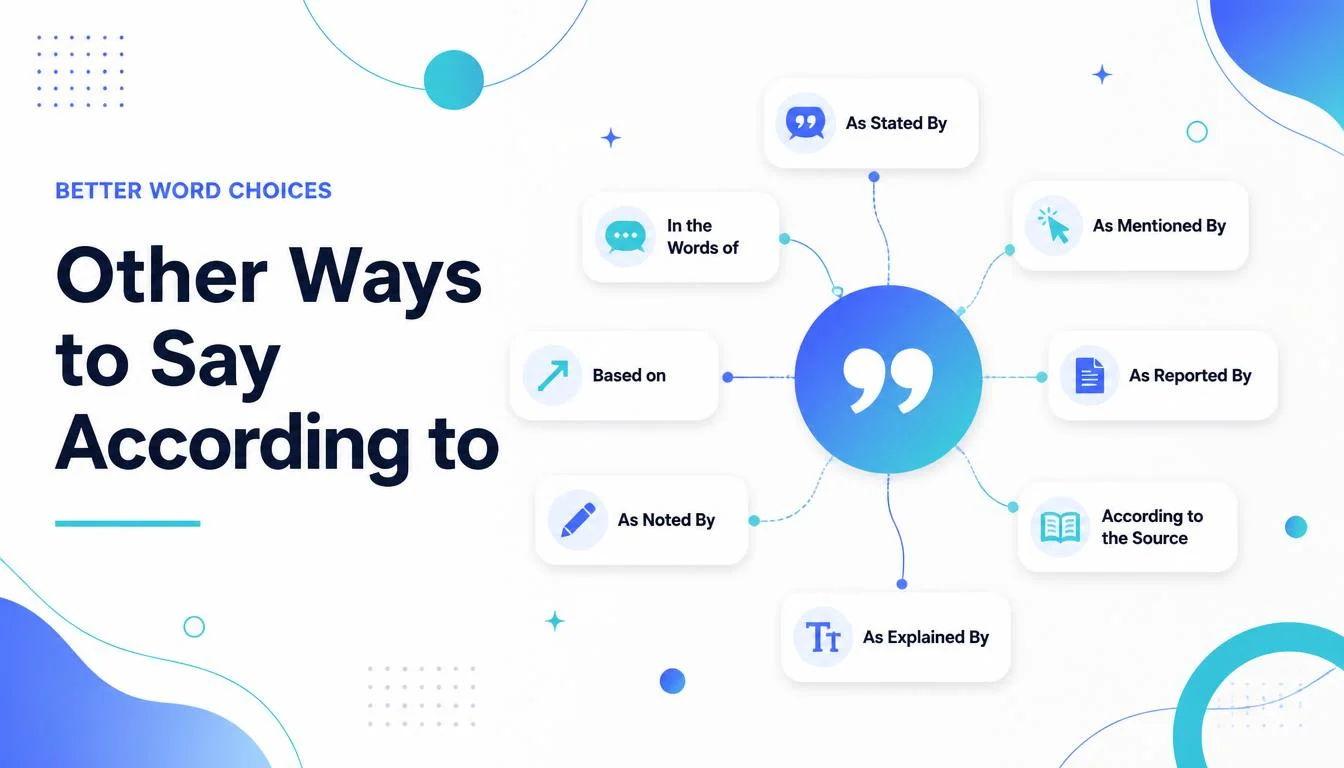
Other ways to say according to include as stated by, as reported by, based on, as per, in the words of, and as noted by.
Finding the right other ways to say according to can make your writing more varied, precise, and professional. While “according to” is widely used, different alternatives may sound more natural depending on the context.
Whether you are writing an academic paper, professional email, report, or everyday message, learning other ways to say according to helps you express information and sources with greater clarity and flexibility.
Quick Categories
Formal alternatives to “according to”
- As stated by
- As reported by
- As noted by
- As indicated by
Pro Tip: Use these expressions when referring to reports, research, official statements, or published information.
Casual alternatives
- As someone says
- From what someone says
- In someone’s words
- From someone’s point of view
Pro Tip: These options work best in conversations and informal discussions where a relaxed tone is appropriate.
Professional alternatives
- Based on
- As documented by
- As outlined by
- As indicated in
Pro Tip: Use these when discussing data, reports, business documents, research, or evidence.
Informal expressions
- Going by
- From what I hear
- By someone’s account
- As someone puts it
Pro Tip: Check the context carefully because some informal expressions can sound too conversational in academic or business writing.
“Attribution phrases tell your reader where the information comes from. Precision makes your message more credible.”
Common Mistakes With “According To”
1. Using “according to” without a source
Incorrect:
According to, the project will finish next month.
There must be a source or reference after according to.
Correct:
According to the project manager, the project will finish next month.
2. Using “according to” when stating your own opinion
Incorrect:
According to me, this is the best solution.
Better:
In my opinion, this is the best solution.
Why: “According to” generally introduces information attributed to another source.
3. Confusing “according to” with “based on”
These phrases can overlap, but they are not always interchangeable.
According to the report, customer satisfaction increased.
The decision was based on customer feedback.
The first attributes information to a source. The second identifies the basis for a decision.
4. Using an overly casual alternative in formal writing
Too casual:
From what I hear, the company is changing its policy.
More professional:
According to the company announcement, the policy is changing.
5. Repeating “according to” in every paragraph
Repetition can make writing monotonous.
Instead, vary your wording:
According to the survey, employees value flexibility. The report also indicates that remote work remains popular.
What Does “According To” Mean?
“According to” means that information comes from a particular person, source, report, document, belief, or perspective.
It is commonly followed by a noun, pronoun, or noun phrase.
Structure:
According to + source + information
Example:
According to the latest report, online sales increased by 15%.
The phrase does not necessarily mean that the speaker personally agrees with the information. It simply identifies where the information or viewpoint comes from.
When to Use “According To”
You can use “according to” in many situations, including:
- Referring to research findings
- Reporting someone’s opinion
- Citing a news source
- Discussing statistics
- Referring to official documents
- Presenting information from a report
- Describing someone’s perspective
- Summarizing expert comments
- Introducing information in presentations
- Supporting a statement with a source
Spoken English
According to John, the meeting has been moved to Friday.
Written English
According to the annual report, revenue increased significantly.
Formal English
According to the findings of the study, the treatment was effective.
Informal English
According to Tom, we’re meeting at six.
Key point: “According to” is flexible enough for both spoken and written communication.
Is It Professional or Polite to Say “According To”?
Yes. “According to” is both polite and professional. It is widely used in business, academic, journalistic, and everyday communication.
The expression itself is neutral. Its professionalism depends largely on the source and the surrounding sentence.
Polite? ✔️ Yes
Professional? ✔️ Yes
Business-style example
According to the latest sales report, customer demand has increased during the second quarter.
This sounds clear, neutral, and professional.
“You do not need to replace ‘according to’ every time. Use alternatives when they make your meaning more precise or your writing less repetitive.”
Pros and Cons of Using “According To”
Pros
- Simple and natural: Easy for most English speakers to understand.
- Friendly and neutral: It does not usually sound confrontational.
- Common usage: Frequently used in spoken and written English.
- Easy to understand: Clearly identifies the source of information.
Cons
- Can become repetitive: Frequent use may make writing monotonous.
- Sometimes too general: It may not explain exactly how evidence supports a claim.
- Limited stylistic range: Other phrases may provide more precise meaning.
- May sound formulaic: Repeated use can make academic or professional writing less varied.
Other Ways to Say “According To” With Examples
These alternatives will help you sound more fluent, confident, and natural in different situations.
Use them according to tone, context, and audience to communicate information, viewpoints, evidence, or attribution accurately.
1. Phrase: As Stated By
Meaning: This means that information was directly stated by a particular person or source.
Explanation: It is useful when referring to an explicit statement.
Example Sentence: As stated by the director, the company will expand its training program.
Best Use: Formal attribution
Worst Use: Casual conversation
Tone: Formal, precise, professional
Context Variability: Casual: low | Professional: high | Spoken: moderate
2. Phrase: As Reported By
Meaning: This indicates that information was reported by a person, organization, or publication.
Explanation: It is especially useful for news, research, and documented information.
Example Sentence: As reported by the local newspaper, the bridge will reopen next week.
Best Use: News reporting
Worst Use: Casual chat
Tone: Formal, factual, objective
Context Variability: Casual: low | Professional: high | Spoken: moderate
3. Phrase: Based On
Meaning: This identifies the information, evidence, or material used as the basis for something.
Explanation: It often focuses more on evidence than direct attribution.
Example Sentence: Based on the latest data, customer demand is expected to increase.
Best Use: Data analysis
Worst Use: Direct quotation
Tone: Professional, analytical, neutral
Context Variability: Casual: moderate | Professional: high | Spoken: high
4. Phrase: As Noted By
Meaning: This means that someone previously observed or mentioned something.
Explanation: It is common in reports, essays, and professional documents.
Example Sentence: As noted by the researcher, the results require further investigation.
Best Use: Formal writing
Worst Use: Casual chat
Tone: Academic, formal, objective
Context Variability: Casual: low | Professional: high | Spoken: moderate
5. Phrase: As Indicated By
Meaning: This means that evidence or information points toward a particular conclusion.
Explanation: It is particularly useful when discussing data or evidence.
Example Sentence: As indicated by the survey results, customers prefer shorter delivery times.
Best Use: Evidence analysis
Worst Use: Friendly conversation
Tone: Formal, analytical, precise
Context Variability: Casual: low | Professional: high | Spoken: moderate
6. Phrase: As Documented By
Meaning: This means that information has been recorded in a document or official source.
Explanation: It emphasizes documented evidence rather than personal opinion.
Example Sentence: As documented by the audit, several transactions require additional review.
Best Use: Official records
Worst Use: Casual discussion
Tone: Formal, factual, authoritative
Context Variability: Casual: low | Professional: high | Spoken: moderate
7. Phrase: As Outlined By
Meaning: This refers to information or plans presented by someone.
Explanation: It works especially well when discussing strategies, procedures, or proposals.
Example Sentence: As outlined by the manager, the new procedure will begin next month.
Best Use: Business documents
Worst Use: Casual chat
Tone: Professional, structured, formal
Context Variability: Casual: low | Professional: high | Spoken: high
8. Phrase: As Mentioned By
Meaning: This indicates that someone has already mentioned specific information.
Explanation: It is useful when referring back to something said earlier.
Example Sentence: As mentioned by Sarah, the deadline has been extended.
Best Use: Follow-up discussion
Worst Use: Academic citation
Tone: Neutral, professional, conversational
Context Variability: Casual: high | Professional: high | Spoken: high
9. Phrase: As Explained By
Meaning: This introduces information that someone has explained.
Explanation: It is useful when the source has provided clarification or reasoning.
Example Sentence: As explained by the instructor, the process involves three main stages.
Best Use: Explanations
Worst Use: Statistical reporting
Tone: Clear, neutral, professional
Context Variability: Casual: high | Professional: high | Spoken: high
10. Phrase: In The Words Of
Meaning: This introduces an idea using someone’s own wording or perspective.
Explanation: It is particularly useful when emphasizing how a person expressed an idea.
Example Sentence: In the words of the CEO, “Our customers remain our priority.”
Best Use: Direct perspective
Worst Use: Technical data
Tone: Expressive, professional, reflective
Context Variability: Casual: high | Professional: high | Spoken: high
11. Phrase: From The Perspective Of
Meaning: This identifies a particular viewpoint.
Explanation: It is useful when different people or groups have different perspectives.
Example Sentence: From the perspective of employees, flexible schedules can improve work-life balance.
Best Use: Viewpoint analysis
Worst Use: Simple facts
Tone: Academic, analytical, neutral
Context Variability: Casual: moderate | Professional: high | Spoken: high
12. Phrase: In The View Of
Meaning: This means according to someone’s opinion or perspective.
Explanation: It is common in formal and analytical writing.
Example Sentence: In the view of several analysts, the market requires further monitoring.
Best Use: Formal opinions
Worst Use: Casual chat
Tone: Formal, analytical, restrained
Context Variability: Casual: low | Professional: high | Spoken: moderate
13. Phrase: From The Point Of View Of
Meaning: This identifies someone’s particular perspective.
Explanation: It is longer than “from the perspective of” but remains clear and natural.
Example Sentence: From the point of view of customers, transparent pricing is important.
Best Use: Perspective analysis
Worst Use: Brief reports
Tone: Neutral, explanatory, clear
Context Variability: Casual: high | Professional: high | Spoken: high
14. Phrase: By The Account Of
Meaning: This introduces someone’s version or description of events.
Explanation: It can emphasize that the information represents one person’s account.
Example Sentence: By his account, the meeting ended earlier than expected.
Best Use: Personal accounts
Worst Use: Scientific evidence
Tone: Formal, narrative, neutral
Context Variability: Casual: moderate | Professional: moderate | Spoken: moderate
15. Phrase: As Per
Meaning: This means in accordance with a particular source, instruction, or requirement.
Explanation: It is common in some business contexts but can sound bureaucratic.
Example Sentence: As per the updated schedule, the presentation will begin at 10 a.m.
Best Use: Business instructions
Worst Use: Natural conversation
Tone: Formal, administrative, businesslike
Context Variability: Casual: low | Professional: high | Spoken: moderate
16. Phrase: In Accordance With
Meaning: This means following a rule, requirement, instruction, or standard.
Explanation: It is more formal than “according to” and often relates to compliance.
Example Sentence: The procedure was completed in accordance with company policy.
Best Use: Rules and policies
Worst Use: Casual opinions
Tone: Formal, official, precise
Context Variability: Casual: low | Professional: high | Spoken: moderate
17. Phrase: In Line With
Meaning: This means consistent with an idea, policy, trend, or standard.
Explanation: It describes alignment rather than simply attributing information.
Example Sentence: The new policy is in line with current industry standards.
Best Use: Business alignment
Worst Use: Source attribution
Tone: Professional, neutral, practical
Context Variability: Casual: moderate | Professional: high | Spoken: high
18. Phrase: Consistent With
Meaning: This means that something agrees with or matches other information.
Explanation: It is useful when comparing findings, evidence, or statements.
Example Sentence: The findings are consistent with previous research.
Best Use: Research comparison
Worst Use: Direct quotations
Tone: Academic, analytical, objective
Context Variability: Casual: moderate | Professional: high | Spoken: moderate
19. Phrase: As Shown By
Meaning: This indicates that evidence demonstrates or reveals something.
Explanation: It works well when discussing visible results, figures, or data.
Example Sentence: As shown by the results, customer satisfaction has improved.
Best Use: Data explanation
Worst Use: Personal opinions
Tone: Clear, analytical, professional
Context Variability: Casual: moderate | Professional: high | Spoken: high
20. Phrase: As Demonstrated By
Meaning: This means that evidence clearly illustrates a particular point.
Explanation: It is stronger and more formal than simply saying “according to.”
Example Sentence: As demonstrated by the study, regular practice can improve language retention.
Best Use: Academic evidence
Worst Use: Casual conversation
Tone: Formal, academic, authoritative
Context Variability: Casual: low | Professional: high | Spoken: moderate
21. Phrase: As Suggested By
Meaning: This introduces an idea or conclusion that someone or something suggests.
Explanation: It is useful when the evidence does not necessarily establish a fact conclusively.
Example Sentence: As suggested by the survey, employees prefer flexible working arrangements.
Best Use: Tentative findings
Worst Use: Certain facts
Tone: Cautious, analytical, professional
Context Variability: Casual: moderate | Professional: high | Spoken: high
22. Phrase: As Recommended By
Meaning: This means following someone’s recommendation.
Explanation: It should be used when the source has specifically recommended an action.
Example Sentence: As recommended by the consultant, the company will revise its onboarding process.
Best Use: Professional advice
Worst Use: Neutral facts
Tone: Professional, formal, practical
Context Variability: Casual: moderate | Professional: high | Spoken: high
23. Phrase: According To The View Of
Meaning: This identifies a specific person’s or group’s viewpoint.
Explanation: It is useful when emphasizing a perspective rather than a factual source.
Example Sentence: According to the view of several experts, further research is necessary.
Best Use: Expert opinions
Worst Use: Simple statements
Tone: Formal, analytical, academic
Context Variability: Casual: low | Professional: high | Spoken: moderate
24. Phrase: From What I Hear
Meaning: This introduces information the speaker has heard from other people.
Explanation: It is conversational and signals that the information may not be independently verified.
Example Sentence: From what I hear, the company is planning to open another office.
Best Use: Casual conversation
Worst Use: Formal reports
Tone: Informal, conversational, tentative
Context Variability: Casual: high | Professional: low | Spoken: high
25. Phrase: Going By
Meaning: This means using particular information as a basis for an assumption or conclusion.
Explanation: It is common in conversational English.
Example Sentence: Going by the current schedule, we should arrive before noon.
Best Use: Everyday reasoning
Worst Use: Academic writing
Tone: Casual, natural, conversational
Context Variability: Casual: high | Professional: moderate | Spoken: high
26. Phrase: As Someone Puts It
Meaning: This introduces an idea using someone’s particular way of expressing it.
Explanation: It is useful when paraphrasing or highlighting someone’s wording.
Example Sentence: As the author puts it, effective communication requires active listening.
Best Use: Explanatory writing
Worst Use: Formal statistics
Tone: Conversational, expressive, clear
Context Variability: Casual: high | Professional: high | Spoken: high
27. Phrase: As Mentioned In
Meaning: This refers to information previously presented in a document or source.
Explanation: It is especially useful for referring back to reports, articles, or previous sections.
Example Sentence: As mentioned in the report, customer retention remains a key priority.
Best Use: Document references
Worst Use: Casual conversation
Tone: Formal, neutral, professional
Context Variability: Casual: low | Professional: high | Spoken: moderate
28. Phrase: As Cited In
Meaning: This identifies a source in which particular information has been cited or referenced.
Explanation: It is mainly useful in academic or research-oriented contexts.
Example Sentence: As cited in the study, employee engagement increased after the training program.
Best Use: Academic references
Worst Use: Casual speech
Tone: Academic, formal, precise
Context Variability: Casual: low | Professional: high | Spoken: low
29. Phrase: According To The Data
Meaning: This introduces information derived from a particular set of data.
Explanation: It is useful when discussing measurable results or statistics.
Example Sentence: According to the data, online purchases increased during the holiday period.
Best Use: Data reporting
Worst Use: Personal opinions
Tone: Analytical, professional, objective
Context Variability: Casual: moderate | Professional: high | Spoken: high
30. Phrase: According To The Evidence
Meaning: This introduces a conclusion or statement supported by available evidence.
Explanation: It emphasizes evidence rather than a person as the source.
Example Sentence: According to the evidence, the issue appears to have started earlier than expected.
Best Use: Evidence analysis
Worst Use: Casual chat
Tone: Formal, analytical, objective
Context Variability: Casual: low | Professional: high | Spoken: moderate
“Choose an attribution phrase based on what you are actually communicating: a source, an opinion, evidence, a rule, or a perspective.”
How to Choose the Right Alternative
Not all alternatives to “according to” mean exactly the same thing.
For a person’s statement
Use:
- As stated by
- As mentioned by
- As explained by
- In the words of
For research or data
Use:
- Based on
- As indicated by
- As demonstrated by
- As shown by
For policies or rules
Use:
- In accordance with
- As per
- In line with
For someone’s viewpoint
Use:
- From the perspective of
- In the view of
- From the point of view of
For casual conversation
Use:
- From what I hear
- Going by
- As someone puts it
Mini Quiz: Test Yourself
1. Which phrase is most appropriate for a formal research sentence?
A. From what I hear
B. According to
C. Going by
D. As someone puts it
Answer: B. According to
2. Which alternative focuses on evidence rather than a person’s statement?
A. In the words of
B. Based on
C. As mentioned by
D. As stated by
Answer: B. Based on
3. Which expression sounds most conversational?
A. In accordance with
B. As documented by
C. From what I hear
D. As demonstrated by
Answer: C. From what I hear
4. Which phrase is best for describing compliance with a company policy?
A. In accordance with
B. From what I hear
C. In the words of
D. As someone puts it
Answer: A. In accordance with
Comparison Table: Top Alternatives
| Phrase | Tone | Best Use |
|---|---|---|
| As stated by | Formal | Direct statements |
| As reported by | Formal | News and reports |
| Based on | Professional | Data and evidence |
| As noted by | Academic | Research and observations |
| As indicated by | Analytical | Evidence and results |
| As documented by | Formal | Official records |
| As outlined by | Professional | Plans and procedures |
| In the view of | Formal | Opinions |
| From the perspective of | Academic | Viewpoints |
| From what I hear | Informal | Casual conversation |
FAQs
What are the best alternatives to “according to”?
Some useful alternatives include as stated by, as reported by, based on, as noted by, as indicated by, and in the view of. The best choice depends on whether you are referring to a source, opinion, evidence, or perspective.
Is “according to” professional English?
Yes. “According to” is professional and appropriate in business, academic, journalistic, and everyday communication. It is a neutral attribution phrase.
What is a formal way to say “according to”?
Formal alternatives include as stated by, as reported by, as documented by, as indicated by, and in accordance with, although the exact meaning varies by context.
Can I use “according to” in academic writing?
Yes. It is commonly used in academic writing when attributing information to a source. However, academic citations should follow the required citation style rather than relying only on the phrase “according to.”
What is an informal way to say “according to”?
Depending on the context, conversational alternatives include from what I hear, going by, and as someone puts it. These should generally be avoided in highly formal writing.
Conclusion
Learning different ways to express “according to” helps you avoid unnecessary repetition and communicate more precisely. Expressions such as as stated by, based on, as reported by, and from the perspective of each serve slightly different purposes.
The key is to match your phrase with your context. Practice replacing “according to” with an appropriate alternative in emails, presentations, essays, conversations, and reports. With regular practice, your English will become more varied, natural .
Read More Related Articles:
- Other Ways to Say You’re Beautiful | Beyond the Ordinary Compliment In 2026
- Other Ways to Say I Love You in Spanish | Beyond the Usual Phrase In 2026
- Other Ways to Say I Love You in Other Languages | Beyond the Classic Three Words In 2026

Daniel Murphy is a professional writer and blogger specializing in digital communication and messaging trends. As a contributor to TextsResponse.com, he creates reader-focused content designed to help people find the right words at the right time.