Quick Answer
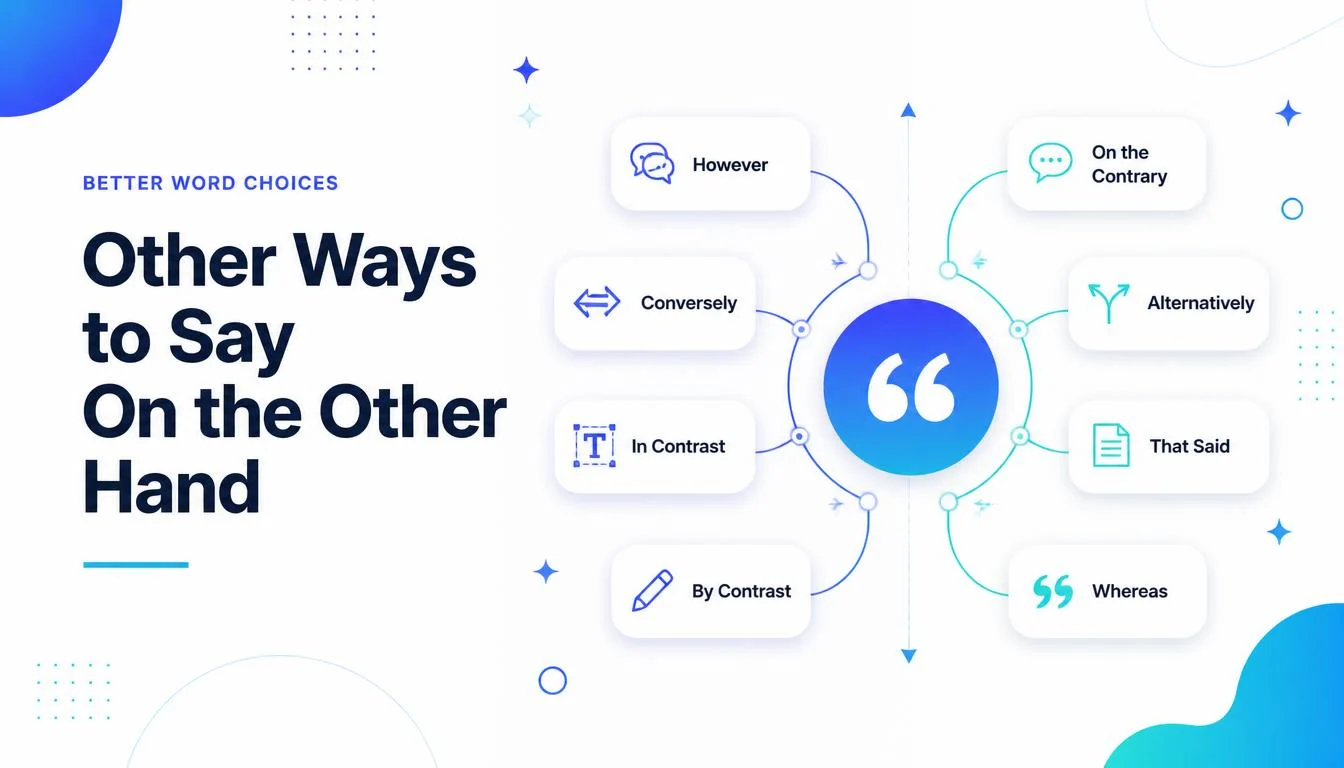
Other ways to say “on the other hand” include “conversely,” “in contrast,” “by comparison,” “however,” and “alternatively.” These expressions help you show contrasting ideas clearly and naturally.
Looking for other ways to say on the other hand? Whether you’re writing an essay, preparing a professional email, or having a conversation, using different expressions can make your English sound more fluent and engaging.
The phrase “on the other hand” is commonly used to introduce a contrasting idea or a different perspective. Learning alternative expressions such as “conversely,” “in contrast,” and “that said” can help you communicate more effectively in both formal and informal situations.
What Is “On the Other Hand”? Meaning, Grammar & Real Use
Imagine you are discussing whether to accept a new job. The salary is attractive, but the commute is long. You might say, “The salary is excellent. On the other hand, the commute could be exhausting.” This expression helps you present two contrasting aspects of the same situation without dismissing either one.
The phrase is especially useful when comparing advantages and disadvantages, discussing different perspectives, or explaining why a situation is more complicated than it first appears. It helps readers and listeners follow your reasoning and understand how two ideas relate to each other.
Learning alternatives to “on the other hand” can improve your fluency by giving you more ways to introduce contrasts. Expressions such as “however,” “by contrast,” and “that said” allow you to adjust your tone depending on the situation. Unlike expressions used to express excitement in English, contrast phrases focus on differences, qualifications, and opposing viewpoints.
Whether you are writing an academic essay, preparing a business presentation, or having a casual conversation, choosing the right transition makes your ideas easier to follow. Understanding these expressions also helps you avoid repetitive sentence structures and communicate more confidently.
Meaning
“On the other hand” is a transitional expression used to introduce a contrasting idea, alternative perspective, or different aspect of a situation.
Grammar Explanation
“On the other hand” is an idiomatic transitional phrase. It commonly appears at the beginning of a sentence and is usually followed by a comma.
Structure: First idea. On the other hand, + contrasting idea.
Example: The apartment is spacious. On the other hand, it is quite expensive.
The expression is neutral and works in both formal and informal English. It is particularly useful when presenting two sides of an issue.
When Should You Use “On the Other Hand”?
This expression works in many situations where you need to compare ideas or introduce a contrasting point.
Common Contexts
- Comparing advantages and disadvantages: “The job pays well. On the other hand, it requires frequent travel.”
- Discussing different viewpoints: “Some people prefer working remotely. On the other hand, others enjoy the office environment.”
- Academic writing: “The study found positive results. On the other hand, the sample size was limited.”
- Professional communication: “The proposal could reduce costs. On the other hand, it may require additional training.”
- Everyday conversations: “I like the design. On the other hand, the color is too bright.”
Spoken vs. Written English
Spoken English: “I could take the bus. On the other hand, walking might be quicker.”
Written English: “The proposed strategy offers several benefits. However, its implementation may require additional resources.”
In conversation, expressions such as “that said” and “then again” can sound natural. In formal writing, “however,” “by contrast,” and “nevertheless” are often useful.
Formal vs. Informal Usage
Formal: “The first approach is cost-effective. Conversely, the second approach offers greater flexibility.”
Informal: “The restaurant looks great. On the flip side, it is pretty expensive.”
Choose the expression that matches the relationship between your ideas. Not every alternative communicates the same kind of contrast.
Is It Professional or Just Polite?
“On the other hand” is both polite and professional. It is a neutral expression that helps you present a different perspective without sounding confrontational.
Politeness: It allows you to acknowledge another point while introducing a contrasting idea.
Professionalism: It works well in reports, presentations, business emails, and discussions where balanced reasoning is important.
Business-Style Example
“The proposed software could improve productivity. On the other hand, the implementation costs may be higher than expected.”
Polite? ✔️ Yes
Professional? ✔️ Yes
The phrase is suitable for professional settings, although alternatives such as “however” and “that said” may create a more concise sentence.
Pros and Cons of Using “On the Other Hand”
Pros
- Simple and natural: Easy to understand and use in everyday communication.
- Balanced tone: Helps present different sides of an issue fairly.
- Common usage: Widely recognized in spoken and written English.
- Easy to understand: Clearly signals that a contrasting idea is coming.
Cons
- Repetitive: Frequent use can make writing sound monotonous.
- Sometimes wordy: Shorter transitions such as “yet” or “however” may be more concise.
- Limited emotional range: Primarily expresses contrast rather than emotion.
- Not suitable for every contrast: Some situations require expressions that show direct opposition, comparison, or concession more precisely.
Common Mistakes People Make
Here are five common errors to avoid when using this expression and its alternatives.
1. Using It Without a Meaningful Contrast
Incorrect: The sky is blue. On the other hand, the grass is green.
Correct: The sky is clear. On the other hand, the forecast predicts heavy rain.
The second sentence presents a meaningful contrast between current conditions and the forecast.
2. Confusing It With “On the Contrary”
Incorrect: I enjoy reading. On the contrary, I also enjoy writing.
Correct: I enjoy reading. In addition, I enjoy writing.
“On the contrary” is used to contradict or correct a previous statement, not simply to add another idea.
3. Using “Whereas” as a Standalone Sentence
Incorrect: The first plan is affordable. Whereas, the second is expensive.
Correct: The first plan is affordable, whereas the second is expensive.
“Whereas” usually connects two contrasting clauses within a sentence.
4. Using Too Many Contrast Words Together
Incorrect: However, on the other hand, the project may fail.
Correct: However, the project may fail.
Using several transitions with the same function can make a sentence unnecessarily repetitive.
5. Choosing an Informal Expression in Formal Writing
Incorrect: The proposal offers savings. On the flip side, it requires more staff.
Correct: The proposal offers savings. However, it requires more staff.
“On the flip side” is conversational, while “however” is more suitable for formal reports.
“Small tone mistakes can make confident English sound careless.”
Alternatives by Category
The following categories offer a curated preview of useful alternatives. Each phrase also appears in the full list below, where you will find its meaning, usage, and examples.
Formal alternatives to “On the Other Hand”
- Conversely
- Nevertheless
- In contrast
- Notwithstanding
Pro Tip: Use “conversely” for a reversed relationship and “nevertheless” when acknowledging a difficulty before presenting a contrasting conclusion.
Casual alternatives
- That said
- Then again
- Still
- On the flip side
Pro Tip: Use “that said” to qualify a previous statement and “then again” when reconsidering an idea.
Professional alternatives
- However
- By contrast
- At the same time
- Even so
Pro Tip: Choose “however” for a general contrast and “by contrast” when directly comparing two subjects.
Informal expressions
- On the flip side
- Looking at it another way
- From another perspective
- In a different light
Pro Tip: Use conversational expressions when exploring different viewpoints, but keep formal documents concise and precise.
“Formal and informal English aren’t about correctness. They’re about context.”
Other Ways to Say “On the Other Hand” (30 Alternatives With Examples)
These 30 alternatives help you build fluency and express contrasting ideas more naturally in different situations.
Use each phrase according to its tone, context, and the relationship between your ideas. Some emphasize direct opposition, while others introduce a qualification or a different perspective.
1. Phrase: However
Meaning: Introduces a contrasting or qualifying idea.
Explanation: A versatile transition for formal and informal writing.
Example Sentence: The product is affordable. However, it lacks advanced features.
Best Use: General contrast
Worst Use: Simple addition
Tone: Neutral, professional
Context Variability: Casual: I like it. However, it is costly. Professional: However, costs remain high. Spoken: However, we can reconsider.
2. Phrase: Nevertheless
Meaning: Introduces a contrasting point despite a previous statement.
Explanation: Emphasizes that something remains true despite a difficulty.
Example Sentence: The task was difficult. Nevertheless, the team completed it.
Best Use: Concessive contrast
Worst Use: Casual chatter
Tone: Formal, determined
Context Variability: Casual: It was hard. Nevertheless, I tried. Professional: Nevertheless, the project continued. Spoken: Nevertheless, we succeeded.
3. Phrase: Conversely
Meaning: Introduces an opposite or reversed relationship.
Explanation: Useful when the second point reverses the first.
Example Sentence: Higher demand increases prices. Conversely, lower demand may reduce them.
Best Use: Reversed relationships
Worst Use: Loose comparisons
Tone: Analytical, formal
Context Variability: Casual: He prefers tea. Conversely, I prefer coffee. Professional: Conversely, expenses declined. Spoken: Conversely, the other option is cheaper.
4. Phrase: By Contrast
Meaning: Highlights a difference between two things.
Explanation: Often used when directly comparing characteristics or results.
Example Sentence: The first proposal is expensive. By contrast, the second is affordable.
Best Use: Direct comparison
Worst Use: Simple concession
Tone: Analytical, professional
Context Variability: Casual: My room is small. By contrast, hers is large. Professional: By contrast, the second model is more efficient. Spoken: By contrast, this option is easier.
5. Phrase: That Said
Meaning: Introduces a qualification or contrasting consideration.
Explanation: Acknowledges a previous point before adding a different perspective.
Example Sentence: The plan is ambitious. That said, it is achievable.
Best Use: Balanced opinions
Worst Use: Legal instructions
Tone: Conversational, thoughtful
Context Variability: Casual: It is expensive. That said, it is useful. Professional: That said, we should proceed carefully. Spoken: That said, I agree.
6. Phrase: Still
Meaning: Introduces a contrasting point that remains valid.
Explanation: Often expresses a simple concession.
Example Sentence: The journey was long. Still, we enjoyed it.
Best Use: Brief contrast
Worst Use: Technical analysis
Tone: Casual, neutral
Context Variability: Casual: It is late. Still, let’s go. Professional: Still, the risks remain. Spoken: Still, I think it will work.
7. Phrase: Yet
Meaning: Introduces a contrasting or unexpected idea.
Explanation: Connects ideas that seem inconsistent or surprising.
Example Sentence: The task was difficult, yet the team completed it.
Best Use: Concise contrast
Worst Use: Formal transitions
Tone: Concise, neutral
Context Variability: Casual: It is small, yet useful. Professional: The results are limited, yet promising. Spoken: He is young, yet experienced.
8. Phrase: On the Contrary
Meaning: Directly contradicts a previous statement or assumption.
Explanation: Used when correcting or rejecting an earlier idea.
Example Sentence: The process is not complicated. On the contrary, it is quite simple.
Best Use: Direct contradiction
Worst Use: Balanced comparisons
Tone: Assertive, formal
Context Variability: Casual: I am not upset. On the contrary, I am happy. Professional: On the contrary, the evidence supports the claim. Spoken: On the contrary, I agree.
9. Phrase: In Contrast
Meaning: Introduces a difference between two things.
Explanation: Highlights a distinction between characteristics, results, or situations.
Example Sentence: The northern region is dry. In contrast, the southern region receives heavy rainfall.
Best Use: Clear comparisons
Worst Use: Simple additions
Tone: Neutral, analytical
Context Variability: Casual: My bag is light. In contrast, his is heavy. Professional: In contrast, costs increased. Spoken: In contrast, this route is shorter.
10. Phrase: Alternatively
Meaning: Introduces another possible choice or approach.
Explanation: Presents an option rather than a direct contradiction.
Example Sentence: We could travel by train. Alternatively, we could rent a car.
Best Use: Other options
Worst Use: Direct opposition
Tone: Neutral, professional
Context Variability: Casual: We can walk. Alternatively, we can drive. Professional: Alternatively, the team could revise the proposal. Spoken: Alternatively, let’s meet tomorrow.
11. Phrase: Whereas
Meaning: Connects two contrasting facts or situations.
Explanation: Commonly joins clauses within one sentence.
Example Sentence: My sister prefers tea, whereas I prefer coffee.
Best Use: Clause comparison
Worst Use: Standalone transitions
Tone: Formal, analytical
Context Variability: Casual: I like summer, whereas he likes winter. Professional: Sales increased, whereas costs declined. Spoken: She works remotely, whereas I work onsite.
12. Phrase: While
Meaning: Introduces a contrasting idea within a sentence.
Explanation: Can express contrast or time, depending on context.
Example Sentence: While the plan is affordable, it may take longer.
Best Use: Balanced clauses
Worst Use: Ambiguous timing
Tone: Neutral, flexible
Context Variability: Casual: While I like it, I prefer the other one. Professional: While costs are low, risks remain. Spoken: While I agree, I have concerns.
13. Phrase: Even So
Meaning: Introduces a contrasting point despite a previous fact.
Explanation: Emphasizes that a conclusion remains valid despite an obstacle.
Example Sentence: The weather was unpleasant. Even so, we enjoyed the trip.
Best Use: Concessive contrast
Worst Use: Simple alternatives
Tone: Neutral, reassuring
Context Variability: Casual: It was cold. Even so, we went out. Professional: Even so, the proposal remains viable. Spoken: Even so, I would try.
14. Phrase: Nonetheless
Meaning: Introduces a point that remains true despite a previous consideration.
Explanation: Similar to “nevertheless,” with a formal tone.
Example Sentence: The results were limited. Nonetheless, the study provided useful insights.
Best Use: Formal concession
Worst Use: Casual banter
Tone: Formal, measured
Context Variability: Casual: It was tough. Nonetheless, we continued. Professional: Nonetheless, the recommendation stands. Spoken: Nonetheless, we made progress.
15. Phrase: Instead
Meaning: Introduces a different choice or action in place of another.
Explanation: Emphasizes replacement rather than simple contrast.
Example Sentence: We did not take a taxi. Instead, we walked to the station.
Best Use: Replacement choices
Worst Use: Neutral comparisons
Tone: Direct, practical
Context Variability: Casual: Let’s stay home instead. Professional: Instead, we will use the revised plan. Spoken: We can meet tomorrow instead.
16. Phrase: Rather
Meaning: Introduces a preferred or corrected alternative.
Explanation: Often signals a choice or clarification.
Example Sentence: We should focus on quality rather than speed.
Best Use: Preference and correction
Worst Use: Unrelated contrasts
Tone: Precise, thoughtful
Context Variability: Casual: Let’s walk rather than drive. Professional: Rather, we should revise the schedule. Spoken: I prefer tea rather than coffee.
17. Phrase: In Comparison
Meaning: Introduces a point by comparing it with another.
Explanation: Highlights relative differences or similarities.
Example Sentence: The new model is lightweight. In comparison, the older model is much heavier.
Best Use: Comparative analysis
Worst Use: Direct contradiction
Tone: Analytical, neutral
Context Variability: Casual: This room is bright. In comparison, that one is dark. Professional: In comparison, costs were lower. Spoken: In comparison, this option is easier.
18. Phrase: At the Same Time
Meaning: Introduces another consideration that exists alongside the first.
Explanation: Often balances two ideas without directly contradicting either.
Example Sentence: The policy is flexible. At the same time, it requires careful monitoring.
Best Use: Balanced considerations
Worst Use: Strict opposition
Tone: Neutral, measured
Context Variability: Casual: I am excited. At the same time, I am nervous. Professional: At the same time, risks must be assessed. Spoken: At the same time, we need to be realistic.
19. Phrase: Then Again
Meaning: Introduces a reconsideration or alternative thought.
Explanation: Often signals that the speaker is thinking through another possibility.
Example Sentence: I might buy the car. Then again, I could save the money.
Best Use: Reconsidering choices
Worst Use: Formal reports
Tone: Casual, reflective
Context Variability: Casual: I could go. Then again, I might stay. Professional: Then again, the alternative may be more practical. Spoken: Then again, we could wait.
20. Phrase: On the Flip Side
Meaning: Introduces another aspect of a situation, often a disadvantage or benefit.
Explanation: A conversational way to present the other side of an issue.
Example Sentence: The job pays well. On the flip side, it requires long hours.
Best Use: Casual comparisons
Worst Use: Formal documents
Tone: Informal, conversational
Context Variability: Casual: It is cheap. On the flip side, it is slow. Professional: The feature is useful. On the flip side, it adds costs. Spoken: On the flip side, we have more time.
21. Phrase: From Another Perspective
Meaning: Introduces a different way of viewing an issue.
Explanation: Encourages consideration of another viewpoint.
Example Sentence: From another perspective, the delay gave us time to improve the design.
Best Use: Viewpoint changes
Worst Use: Simple facts
Tone: Thoughtful, analytical
Context Variability: Casual: From another perspective, it was a good decision. Professional: From another perspective, the investment may be worthwhile. Spoken: From another perspective, we could wait.
22. Phrase: Looking at It Another Way
Meaning: Introduces an alternative interpretation of a situation.
Explanation: Helps reframe an idea or problem.
Example Sentence: Looking at it another way, the extra time could improve the final result.
Best Use: Reframing ideas
Worst Use: Formal legal writing
Tone: Conversational, reflective
Context Variability: Casual: Looking at it another way, we saved money. Professional: Looking at it another way, the delay may be beneficial. Spoken: Looking at it another way, we have options.
23. Phrase: In a Different Light
Meaning: Presents a situation from a different perspective or interpretation.
Explanation: Often changes how an event or idea is understood.
Example Sentence: The new evidence puts the decision in a different light.
Best Use: New interpretations
Worst Use: Simple contrasts
Tone: Reflective, descriptive
Context Variability: Casual: That story shows him in a different light. Professional: The findings place the proposal in a different light. Spoken: It makes sense in a different light.
24. Phrase: By the Same Token
Meaning: Introduces a related point that follows a similar line of reasoning.
Explanation: Often adds a balancing consideration rather than a direct opposite.
Example Sentence: Employees need clear goals. By the same token, managers need regular feedback.
Best Use: Parallel reasoning
Worst Use: Direct contradiction
Tone: Formal, analytical
Context Variability: Casual: We need rest. By the same token, we need exercise. Professional: By the same token, the team needs adequate resources. Spoken: By the same token, we should listen.
25. Phrase: Despite That
Meaning: Introduces a point that remains true despite a previous difficulty.
Explanation: Emphasizes persistence or an unexpected outcome.
Example Sentence: The road was crowded. Despite that, we arrived on time.
Best Use: Concessive contrast
Worst Use: Simple choices
Tone: Neutral, direct
Context Variability: Casual: It was expensive. Despite that, I bought it. Professional: Despite that, the project remains feasible. Spoken: Despite that, we continued.
26. Phrase: Even Though
Meaning: Introduces a contrast between an expected and an actual outcome.
Explanation: Connects two clauses and highlights a surprising result.
Example Sentence: Even though the task was difficult, she completed it.
Best Use: Unexpected outcomes
Worst Use: Standalone transitions
Tone: Neutral, explanatory
Context Variability: Casual: Even though it rained, we went out. Professional: Even though costs increased, demand remained stable. Spoken: Even though I was tired, I finished.
27. Phrase: In Spite Of That
Meaning: Introduces a result that occurs despite a previous circumstance.
Explanation: Similar to “despite that,” with a slightly more conversational structure.
Example Sentence: The instructions were unclear. In spite of that, the team completed the task.
Best Use: Concessive statements
Worst Use: Simple comparisons
Tone: Neutral, conversational
Context Variability: Casual: It was cold. In spite of that, we stayed outside. Professional: In spite of that, the project moved forward. Spoken: In spite of that, I agree.
28. Phrase: In Opposition
Meaning: Indicates that one idea or position directly opposes another.
Explanation: Usually appears with “to” when identifying the opposing position.
Example Sentence: The proposal was introduced in opposition to the existing policy.
Best Use: Direct opposition
Worst Use: Mild differences
Tone: Formal, assertive
Context Variability: Casual: His idea was in opposition to mine. Professional: The recommendation stands in opposition to current policy. Spoken: Their views are in opposition.
29. Phrase: In Contrast to This
Meaning: Introduces a comparison that highlights a difference from the preceding point.
Explanation: Explicitly connects the new statement to an earlier idea.
Example Sentence: The first method is time-consuming. In contrast to this, the second method is quick.
Best Use: Explicit comparisons
Worst Use: Casual conversation
Tone: Formal, analytical
Context Variability: Casual: This bag is heavy. In contrast to this, that one is light. Professional: In contrast to this, the revised plan is more efficient. Spoken: In contrast to this, the other option is simpler.
30. Phrase: On the Other Side
Meaning: Refers to a different side or aspect of an issue, often in a comparison.
Explanation: Can be used in discussions of opposing positions, although “on the other hand” is more idiomatic for general contrast.
Example Sentence: On the other side of the debate, some experts support a gradual transition.
Best Use: Opposing viewpoints
Worst Use: Formal transitions
Tone: Neutral, conversational
Context Variability: Casual: On the other side, some people disagree. Professional: On the other side of the discussion, the team raised concerns. Spoken: On the other side, we have another option.
Comparison Table: Top 10 Alternatives at a Glance
| Phrase | Tone | Best Use |
|---|---|---|
| However | Neutral, professional | General contrast |
| By contrast | Analytical | Direct comparison |
| Conversely | Formal, analytical | Reversed relationships |
| That said | Conversational | Qualifying a point |
| Nevertheless | Formal | Concession |
| Still | Casual, neutral | Brief contrast |
| Yet | Concise, neutral | Unexpected contrast |
| In contrast | Analytical | Comparing differences |
| Alternatively | Neutral, professional | Presenting another option |
| At the same time | Measured, neutral | Balancing considerations |
Quick Self-Check: Mini Quiz
Test your understanding of contrast expressions with these four questions.
Question 1
You want to introduce a contrasting point in a professional report. Which phrase is most suitable?HoweverOn the flip sideThen again
Question 2
You want to present an opposite relationship between two results. Which phrase fits best?ConverselyIn additionFor example
Question 3
Which phrase is best for reconsidering a decision in casual conversation?Pursuant toThen againIn accordance with
Question 4
Which expression is best for presenting another possible choice?NeverthelessAlternativelyOn the contrary
FAQs
1. What are the most common alternatives to “on the other hand”?
Common alternatives include “however,” “by contrast,” “conversely,” “that said,” and “nevertheless.” Each expresses a slightly different kind of contrast.
2. What is a formal alternative to “on the other hand”?
“Conversely,” “nevertheless,” “in contrast,” and “by contrast” are useful formal alternatives, depending on whether you are showing opposition, concession, or comparison.
3. How can I replace “on the other hand” in professional writing?
Use “however” for a general contrast, “by contrast” for a direct comparison, and “that said” to introduce a qualification in a less formal professional context.
4. Is “on the other hand” formal or informal?
It is neutral and suitable for both formal and informal English. It is widely used in essays, business communication, presentations, and everyday conversations.
5. What is the difference between “on the other hand” and “on the contrary”?
“On the other hand” introduces a different aspect or viewpoint, while “on the contrary” directly contradicts or corrects a previous statement.
conclusion
Learning alternatives to “on the other hand” helps you communicate contrasts more clearly and avoid repetitive sentence structures. Expressions such as “however,” “by contrast,” and “that said” allow you to present different perspectives while maintaining a natural flow.
Read More Related Articles:
- Other Ways to Say You’re Beautiful | Beyond the Ordinary Compliment In 2026
- Other Ways to Say I Love You in Spanish | Beyond the Usual Phrase In 2026
- Other Ways to Say I Love You in Other Languages | Beyond the Classic Three Words In 2026

Henry Walker is an American writer and blogger with a keen interest in communication, language and digital content. At TextsResponse.com, he creates informative and reader-focused resources designed to help people communicate with clarity, confidence and authenticity.