Quick Answer
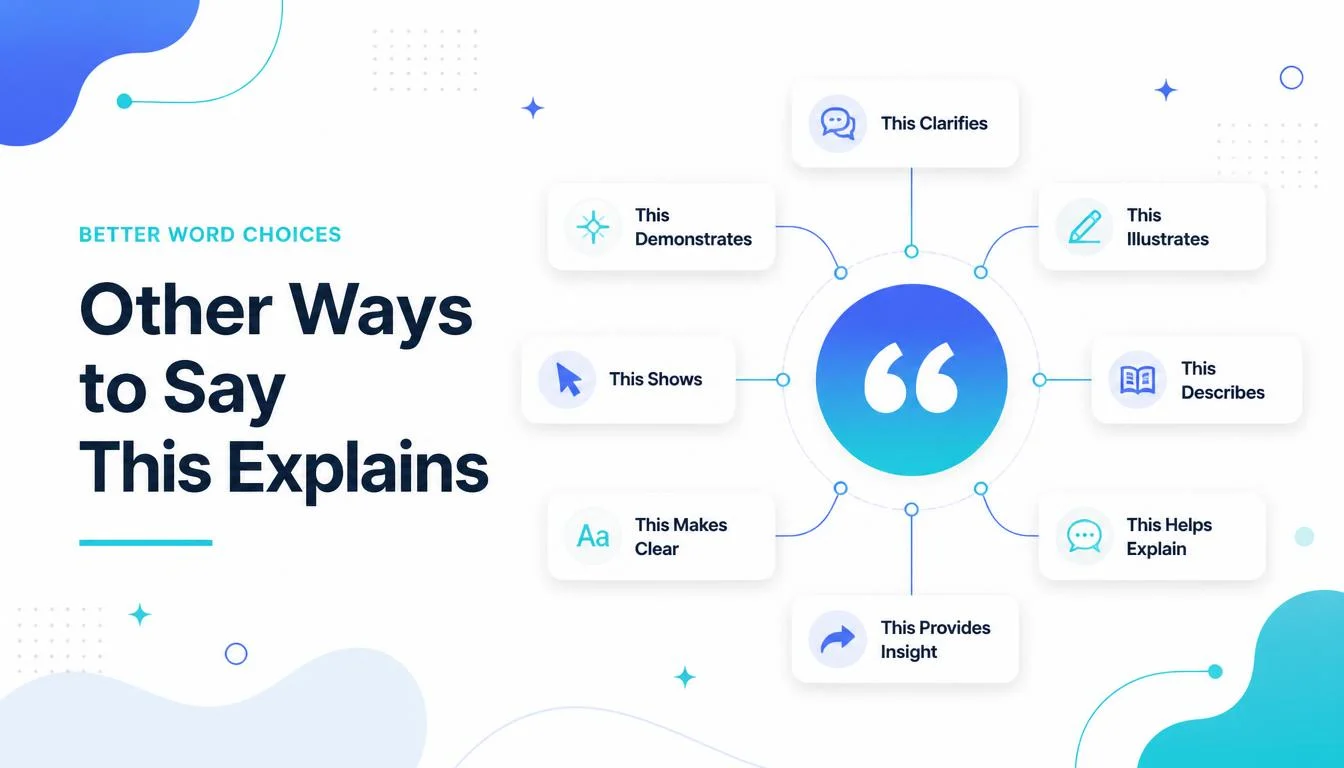
Other ways to say “this explains” include this demonstrates, this clarifies, this illustrates, this shows, and this reveals. These alternatives help make your writing clearer and more engaging.
Learning other ways to say this explains can help you improve your writing and express ideas more effectively. Whether you are writing an academic essay, analyzing evidence, or explaining a point, choosing the right phrase makes your sentences sound clearer and more polished.
The phrase “this explains” is often used to show why something happens or how a particular idea makes sense. However, repeating it throughout an essay can make your writing sound monotonous. Alternatives such as “this demonstrates,” “this highlights,” and “this provides an explanation” help you connect ideas smoothly and communicate your meaning with greater precision.
What Is “This Explains”? Meaning, Grammar and Real Use
Imagine you are writing an essay, presenting research findings, or explaining a business decision. You have already introduced an idea, and now you want to show how something makes that idea easier to understand. You might write, “This explains why customer satisfaction declined.” The phrase communicates your point, but repeating it throughout an article or presentation can make your language sound predictable.
Learning other ways to say this explains helps you communicate with greater precision. Depending on your purpose, you might clarify a complicated concept, demonstrate a relationship, identify a cause, or support an argument with evidence.
These alternatives are particularly useful for students, professionals, teachers, and English learners who want to develop more natural written and spoken communication. They can also help you express excitement in English when explaining an interesting discovery, although the phrase itself is generally neutral rather than enthusiastic.
Meaning: “This explains” introduces information that makes a situation, result, idea, or process easier to understand.
Grammar: “This” is a demonstrative pronoun, while “explains” is a present-tense verb. The expression is neutral and suitable for academic, professional, and everyday communication.
Example: “This clarifies why the project took longer than expected.”
People use the phrase in essays, reports, meetings, presentations, conversations, and educational materials. The best replacement depends on whether the sentence emphasizes clarity, evidence, illustration, or causation.
When Should You Use “This Explains”?
Choose an alternative when you want to avoid repetition, communicate a more specific meaning, or match the tone of your audience.
Common contexts
- Academic essays: Explain how evidence supports a claim or why an event occurred.
- Business reports: Connect performance results with decisions, processes, or market conditions.
- Presentations: Make complicated information easier for an audience to follow.
- Everyday conversations: Describe why something happened or how a situation makes sense.
- Scientific writing: Interpret observations, findings, and relationships between variables.
- Teaching: Introduce a clearer interpretation of a concept or example.
Spoken vs. written English
In conversation, expressions such as “that makes sense now,” “this shows,” and “that explains it” sound natural and accessible.
In formal writing, phrases such as “this demonstrates,” “this indicates,” and “this provides an explanation for” may offer greater precision.
Formal vs. informal English
Formal language is useful when presenting research, documenting decisions, or writing professional correspondence. Informal expressions work well when speaking with friends, classmates, or familiar colleagues.
Always consider what the sentence actually establishes. A result may suggest a possibility without proving it, so choose verbs that reflect the strength of your evidence.
Is “This Explains” Professional or Just Polite?
“This explains” is both professional and neutral. It is not merely a polite expression. It communicates a relationship between information and an explanation, making it appropriate for workplace discussions, reports, and presentations.
Politeness concerns how respectfully you communicate with others. Professionalism concerns clarity, accuracy, appropriate tone, and suitability for the situation.
Business example: “This analysis explains the decline in quarterly sales and identifies opportunities for improvement.”
- Polite? ✔️ Yes
- Professional? ✔️ Yes
However, professional communication benefits from specificity. “This analysis identifies the primary factors behind the decline” may communicate more clearly when you want to emphasize causes rather than general explanation.
For additional workplace vocabulary, see Professional English Communication Guide.
Pros and Cons of Using “This Explains”
Pros
- Simple: Communicates the connection between information and understanding without complicated wording.
- Versatile: Works in conversations, academic writing, reports, and presentations.
- Easy to understand: Most English speakers immediately recognize its meaning.
- Grammatically flexible: Can introduce a reason, result, process, or interpretation.
Cons
- Repetitive: Frequent use can make essays and reports sound monotonous.
- Sometimes vague: It does not specify whether information proves, suggests, illustrates, or clarifies something.
- Limited emphasis: It may not communicate the importance or strength of a finding.
- Dependent on context: Readers may need additional information to understand exactly what “this” refers to.
The solution is not to replace the phrase every time. Instead, choose a more precise verb whenever it improves the sentence.
Common Mistakes People Make
1. Using “This explains” when the evidence only suggests something
Incorrect: “This explains that the treatment always works.”
Correct: “This suggests that the treatment may work.”
Use “suggests” when evidence supports a possibility without establishing certainty.
2. Confusing explanation with proof
Incorrect: “This explains the theory is definitely correct.”
Correct: “This supports the theory.”
An explanation makes something understandable, while support provides reasons or evidence for a claim.
3. Repeating the phrase throughout an essay
Incorrect: “This explains the problem. This explains the result. This explains the difference.”
Correct: “This clarifies the problem, demonstrates the result, and highlights the difference.”
Choose verbs that describe the specific function of each sentence.
4. Using an incomplete grammatical structure
Incorrect: “This explains why the reason.”
Correct: “This explains why the error occurred.”
After “why,” include a suitable clause that completes the idea.
5. Using a vague reference
Incorrect: “This explains why it happened.”
Correct: “The customer feedback explains why satisfaction declined.”
Name the relevant factor when the reader might not understand what “this” or “it” refers to.
Small tone mistakes can make confident English sound careless.
Alternatives by Category
The following phrases provide a preview of the most useful alternatives. Each one also appears in the complete list below.
Formal alternatives to “This Explains”
- This elucidates
- This provides an explanation for
- This accounts for
Pro Tip: Use these expressions in academic papers and formal reports, but avoid unnecessarily complicated vocabulary when a simpler verb is more accurate.
Casual alternatives
- This shows
- That makes sense now
- That explains it
Pro Tip: In conversation, choose expressions that sound natural when spoken aloud rather than phrases that feel written for an essay.
Professional alternatives
- This clarifies
- This demonstrates
- This indicates
Pro Tip: Match the verb to the evidence. Use “demonstrates” for strong support and “indicates” for a sign or suggestion.
Informal expressions
- Now I get it
- That clears things up
- This makes it clear
Pro Tip: Save highly conversational expressions for informal discussions, and switch to neutral wording when writing for clients or senior colleagues.
Formal and informal English aren’t about correctness. They’re about context.
Other Ways to Say “This Explains”: 30 Alternatives with Examples
These 30 alternatives help you communicate ideas more precisely, explain evidence, and make arguments easier to follow. Although the phrase is not usually used to express strong emotion, selecting the right wording can make your explanation more engaging and convincing.
1. Phrase: This Clarifies
Meaning: Makes something easier to understand.
Explanation: Best when confusion or uncertainty needs to be resolved.
Example Sentence: “This clarifies the difference between the two methods.”
Best Use: Academic writing
Worst Use: Casual banter
Tone: Clear, professional
Context Variability: Casual / professional / spoken
2. Phrase: This Demonstrates
Meaning: Shows something through evidence or an example.
Explanation: Useful when information strongly supports a conclusion.
Example Sentence: “This demonstrates the effectiveness of the new strategy.”
Best Use: Research reports
Worst Use: Unsupported claims
Tone: Formal, confident
Context Variability: Professional / academic / spoken
3. Phrase: This Illustrates
Meaning: Makes an idea clearer through an example.
Explanation: Highlights a concept by showing how it works in practice.
Example Sentence: “This illustrates the importance of effective communication.”
Best Use: Teaching examples
Worst Use: Simple greetings
Tone: Educational, neutral
Context Variability: Academic / professional / spoken
4. Phrase: This Shows
Meaning: Presents information that makes something apparent.
Explanation: A simple, flexible alternative for everyday and professional communication.
Example Sentence: “This shows how customer preferences have changed.”
Best Use: General explanations
Worst Use: Technical precision
Tone: Neutral, direct
Context Variability: Casual / professional / spoken
5. Phrase: This Indicates
Meaning: Suggests or points toward a conclusion.
Explanation: Appropriate when information provides a sign but does not necessarily prove a claim.
Example Sentence: “This indicates a possible improvement in performance.”
Best Use: Data analysis
Worst Use: Certain proof
Tone: Analytical, formal
Context Variability: Professional / academic / spoken
6. Phrase: This Suggests
Meaning: Points toward a possible interpretation.
Explanation: Use when the available evidence supports a reasonable possibility rather than certainty.
Example Sentence: “This suggests that the revised schedule is more effective.”
Best Use: Tentative conclusions
Worst Use: Established facts
Tone: Cautious, analytical
Context Variability: Academic / professional / spoken
7. Phrase: This Accounts For
Meaning: Explains why something happened or exists.
Explanation: Particularly useful for identifying factors behind a result or difference.
Example Sentence: “This accounts for the increase in operating costs.”
Best Use: Cause analysis
Worst Use: Simple definitions
Tone: Formal, explanatory
Context Variability: Professional / academic / spoken
8. Phrase: This Helps Explain
Meaning: Contributes to understanding a situation.
Explanation: Emphasizes that the information is one part of a broader explanation.
Example Sentence: “This helps explain the variation in test results.”
Best Use: Complex topics
Worst Use: Complete certainty
Tone: Neutral, informative
Context Variability: Casual / professional / spoken
9. Phrase: This Makes Clear
Meaning: Makes a point understandable or obvious.
Explanation: Useful when emphasizing a conclusion that follows from the available information.
Example Sentence: “This makes clear why early planning matters.”
Best Use: Key conclusions
Worst Use: Unclear evidence
Tone: Direct, confident
Context Variability: Professional / academic / spoken
10. Phrase: This Provides Clarity
Meaning: Reduces confusion about a topic.
Explanation: Suitable for discussions, reports, and communications that resolve uncertainty.
Example Sentence: “This provides clarity on the revised approval process.”
Best Use: Workplace updates
Worst Use: Casual chats
Tone: Professional, reassuring
Context Variability: Professional / casual / spoken
11. Phrase: This Elucidates
Meaning: Explains something in greater detail.
Explanation: A formal alternative often used in academic or technical writing.
Example Sentence: “This elucidates the relationship between language and learning.”
Best Use: Academic analysis
Worst Use: Everyday conversation
Tone: Formal, scholarly
Context Variability: Academic / professional / spoken
12. Phrase: This Reveals
Meaning: Makes previously hidden information apparent.
Explanation: Choose it when findings uncover a detail, pattern, or underlying issue.
Example Sentence: “This reveals a gap in the current training program.”
Best Use: New findings
Worst Use: Basic instructions
Tone: Insightful, direct
Context Variability: Professional / academic / spoken
13. Phrase: This Highlights
Meaning: Draws attention to an important point.
Explanation: Emphasizes significance rather than explaining every detail.
Example Sentence: “This highlights the need for better planning.”
Best Use: Main findings
Worst Use: Detailed causation
Tone: Professional, emphatic
Context Variability: Casual / professional / spoken
14. Phrase: This Establishes
Meaning: Sets out or supports a conclusion firmly.
Explanation: Use when information provides a sound basis for a point, relationship, or principle.
Example Sentence: “This establishes a clear connection between the two variables.”
Best Use: Logical arguments
Worst Use: Weak evidence
Tone: Formal, authoritative
Context Variability: Academic / professional / spoken
15. Phrase: This Confirms
Meaning: Supports that something previously believed or suspected is true.
Explanation: Appropriate when reliable evidence verifies an existing understanding.
Example Sentence: “This confirms that the payment was received.”
Best Use: Verified findings
Worst Use: Speculation
Tone: Certain, professional
Context Variability: Professional / casual / spoken
16. Phrase: This Sheds Light On
Meaning: Helps people understand a difficult or unclear issue.
Explanation: A natural expression for introducing new insight into a complex subject.
Example Sentence: “This sheds light on the causes of employee turnover.”
Best Use: Complex issues
Worst Use: Basic facts
Tone: Informative, approachable
Context Variability: Casual / professional / spoken
17. Phrase: This Makes Sense Of
Meaning: Organizes information into an understandable explanation.
Explanation: Useful when separate facts become meaningful once considered together.
Example Sentence: “This makes sense of the conflicting results.”
Best Use: Confusing information
Worst Use: Simple statements
Tone: Neutral, analytical
Context Variability: Casual / professional / spoken
18. Phrase: This Accounts For Why
Meaning: Identifies the reason behind an event or result.
Explanation: Useful for emphasizing causation, although “this explains why” is often more concise.
Example Sentence: “This accounts for why demand increased during the summer.”
Best Use: Cause analysis
Worst Use: Concise summaries
Tone: Analytical, formal
Context Variability: Professional / academic / spoken
19. Phrase: This Points To
Meaning: Suggests a likely cause, conclusion, or direction.
Explanation: Use when the evidence indicates a possibility without establishing it conclusively.
Example Sentence: “This points to a need for additional research.”
Best Use: Early findings
Worst Use: Proven conclusions
Tone: Analytical, cautious
Context Variability: Casual / professional / spoken
20. Phrase: This Demonstrates Why
Meaning: Shows the reason something matters or happens.
Explanation: Connects supporting evidence directly to a reason or conclusion.
Example Sentence: “This demonstrates why consistent practice improves fluency.”
Best Use: Persuasive writing
Worst Use: Unrelated details
Tone: Confident, educational
Context Variability: Academic / professional / spoken
21. Phrase: This Helps Clarify
Meaning: Makes an idea or situation somewhat easier to understand.
Explanation: Useful when information improves understanding without resolving every question.
Example Sentence: “This helps clarify the requirements for the position.”
Best Use: Instructional guidance
Worst Use: Definitive conclusions
Tone: Helpful, professional
Context Variability: Casual / professional / spoken
22. Phrase: This Provides an Explanation For
Meaning: Offers a reason or account for something.
Explanation: A formal phrase for reports, academic discussion, and detailed analysis.
Example Sentence: “This provides an explanation for the observed differences.”
Best Use: Formal reports
Worst Use: Quick replies
Tone: Formal, objective
Context Variability: Academic / professional / written
23. Phrase: This Is Why
Meaning: Introduces the reason behind a situation.
Explanation: A concise expression that connects a previous statement to its cause.
Example Sentence: “The deadline changed. This is why we revised the schedule.”
Best Use: Direct explanations
Worst Use: Complex analysis
Tone: Clear, conversational
Context Variability: Casual / professional / spoken
24. Phrase: This Makes It Clear
Meaning: Emphasizes that an idea has become understandable.
Explanation: Works well when summarizing evidence or explaining an important distinction.
Example Sentence: “This makes it clear that both teams need additional support.”
Best Use: Summary statements
Worst Use: Ambiguous evidence
Tone: Direct, neutral
Context Variability: Casual / professional / spoken
25. Phrase: That Explains It
Meaning: Indicates that new information resolves confusion.
Explanation: A common conversational response when you finally understand a situation.
Example Sentence: “You were working remotely? That explains it!”
Best Use: Everyday conversations
Worst Use: Formal reports
Tone: Casual, friendly
Context Variability: Casual / spoken
26. Phrase: Now I Get It
Meaning: Shows that you have finally understood something.
Explanation: A natural response during lessons, demonstrations, and informal discussions.
Example Sentence: “Now I get it. The second figure includes shipping costs.”
Best Use: Informal learning
Worst Use: Formal reports
Tone: Relaxed, conversational
Context Variability: Casual / spoken
27. Phrase: That Clears Things Up
Meaning: Resolves confusion or uncertainty.
Explanation: Useful after someone provides helpful details or corrects a misunderstanding.
Example Sentence: “Thanks for explaining the timeline. That clears things up.”
Best Use: Friendly discussions
Worst Use: Academic analysis
Tone: Warm, informal
Context Variability: Casual / professional / spoken
28. Phrase: This Gives Us Insight Into
Meaning: Helps develop a deeper understanding of something.
Explanation: Appropriate for interpreting patterns, behavior, or research findings.
Example Sentence: “This gives us insight into customer decision-making.”
Best Use: Business analysis
Worst Use: Simple definitions
Tone: Analytical, professional
Context Variability: Professional / academic / spoken
29. Phrase: This Accounts For the Difference
Meaning: Identifies the reason two things are not the same.
Explanation: Especially useful when comparing results, measurements, or outcomes.
Example Sentence: “The revised methodology accounts for the difference in results.”
Best Use: Comparative analysis
Worst Use: Unrelated topics
Tone: Technical, objective
Context Variability: Professional / academic / written
30. Phrase: This Makes the Reason Clear
Meaning: Directly identifies why something happened.
Explanation: A straightforward alternative when the purpose is to emphasize a cause.
Example Sentence: “The additional data makes the reason clear.”
Best Use: Clear summaries
Worst Use: Complex theories
Tone: Neutral, explanatory
Context Variability: Casual / professional / spoken
Comparison Table: Top 10 Alternatives at a Glance
| Phrase | Tone | Best Use |
|---|---|---|
| This clarifies | Professional | Resolving confusion |
| This demonstrates | Formal | Supporting conclusions |
| This illustrates | Educational | Giving examples |
| This shows | Neutral | General explanations |
| This indicates | Analytical | Interpreting data |
| This suggests | Cautious | Tentative conclusions |
| This accounts for | Formal | Explaining causes |
| This helps explain | Neutral | Complex subjects |
| This highlights | Emphatic | Emphasizing importance |
| This sheds light on | Approachable | Exploring difficult issues |
For more vocabulary-building ideas, read See also: Other Ways to Say “Amazing”.
Quick Self-Check: Mini Quiz
Test your understanding by choosing the phrase that best matches each situation.
Question 1
You are writing a research report. Your data points toward a possible relationship, but it does not prove one. Which phrase is most appropriate?
- A. This confirms
- B. This suggests
- C. Now I get it
- D. This establishes
Correct answer: B. This suggests.
It communicates a possible interpretation without overstating the evidence.
Question 2
A colleague explains a confusing change to the project schedule. What is the most natural informal response?
- A. This elucidates
- B. This establishes
- C. That clears things up
- D. This demonstrates
Correct answer: C. That clears things up.
It sounds friendly and natural in everyday workplace conversation.
Question 3
You want to draw attention to an important finding in a business presentation. Which phrase fits best?
- A. This highlights
- B. Now I get it
- C. That explains it
- D. This makes sense of
Correct answer: A. This highlights.
It emphasizes the importance of a finding without necessarily claiming that the finding proves something.
Question 4
You are explaining why operating costs increased in a quarterly report. Which alternative is most precise?
- A. This accounts for the increase
- B. That clears things up
- C. Now I get it
- D. This illustrates a greeting
Correct answer: A. This accounts for the increase.
It directly connects the identified factor to the financial result.
FAQs
1. What are the best alternatives to “this explains”?
The best choices include “this clarifies,” “this demonstrates,” “this illustrates,” “this shows,” and “this helps explain.” Choose according to whether you are clarifying an idea, presenting evidence, or identifying a cause.
2. How can I say “this explains” in formal English?
Use “this elucidates,” “this provides an explanation for,” or “this accounts for.” In many formal situations, “this demonstrates” or “this indicates” is clearer and more natural.
3. What is another way to say “this explains why”?
Try “this accounts for why,” “this is why,” or “this helps explain why.” For concise professional writing, you can also identify the cause directly.
4. Can I use “this explains” in academic writing?
Yes. The phrase is appropriate for essays, research papers, and reports. However, alternatives such as “this demonstrates,” “this suggests,” and “this indicates” can express the strength of your evidence more precisely.
5. How do I avoid repeating “this explains” in an essay?
Identify the function of each sentence before choosing a replacement. Use “clarifies” for understanding, “illustrates” for examples, “indicates” for signs, and “accounts for” for causes.
Conclusion
Learning other ways to say this explains can make your English more precise, natural, and engaging. Instead of relying on one phrase, select vocabulary that reflects your purpose, whether you are presenting evidence, clarifying an idea, or explaining a result.
Practice using two or three alternatives each day in your essays, emails, conversations, and presentations. Pay attention to tone, context, and the strength of your evidence so that your language remains accurate as well as fluent.
Read More Related Articles:
- Other Ways to Say You’re Beautiful | Beyond the Ordinary Compliment In 2026
- Other Ways to Say I Like You | Words They’ll Never Forget In 2026
- Other Ways to Say I Love You | Melt Hearts and Strengthen Your Bond In 2026

Henry Walker is an American writer and blogger with a keen interest in communication, language and digital content. At TextsResponse.com, he creates informative and reader-focused resources designed to help people communicate with clarity, confidence and authenticity.