Quick Answer
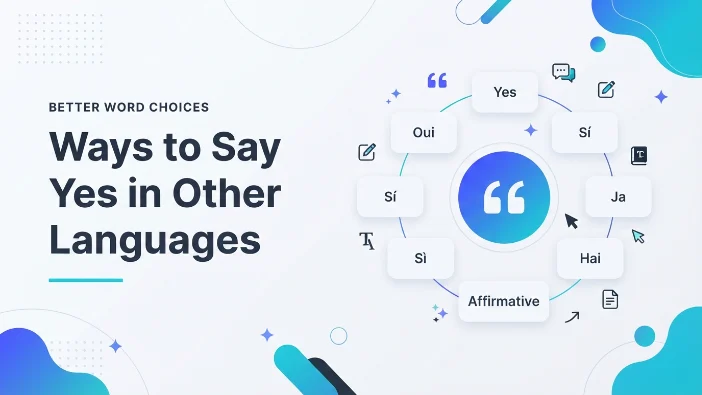
If you want to sound global and confident, you do not have to stick to one word for agreement. Common ways to say yes around the world include Sí, Oui, Ja, Hai, and Da. Learning these alternatives to yes helps you connect with people from different cultures and express excitement in English conversations about travel and language.
Yes” is one of the most basic words in any language, but it carries different tones, levels of formality, and cultural meaning depending on where it is used. Every language has its own way of expressing agreement, and knowing a few of these words instantly makes you sound more worldly and respectful when traveling or speaking with international colleagues.
People use alternatives to yes for many reasons. Some want to greet international friends properly, some are studying a new language, and others simply enjoy expanding their vocabulary. Learning how different cultures express excitement in English and in their native tongues builds real confidence in communication.
This guide breaks down formal, casual, professional, and informal expressions of yes from languages spoken across Europe, Asia, the Middle East, and Africa. By the end, you will have thirty new ways to affirm, agree, and connect with people everywhere.
Quick Categories
Formal Alternatives to Yes
- Oui (French)
- Ja (German)
- Sim (Portuguese)
- Igen (Hungarian)
Pro Tip: In formal settings, pair the word with a polite gesture like a nod or a respectful tone. Formality often depends on delivery, not just vocabulary.
Casual Alternatives to Yes
- Sí (Spanish)
- Ya (Indonesian)
- Da (Russian)
- Tak (Polish)
Pro Tip: Casual versions of yes are perfect for friends and everyday conversation, but avoid them in business emails or formal meetings.
Professional Alternatives to Yes
- Hai (Japanese)
- Ne (Korean)
- Na’am (Arabic)
- Ano (Czech)
Pro Tip: In professional environments, tone matters as much as the word itself. A calm, clear delivery makes any yes sound credible.
Informal Expressions for Yes
- Chai (Thai, casual speech)
- Iya (Indonesian, relaxed tone)
- Haan (Hindi, everyday use)
- Oo (Tagalog, friendly tone)
Pro Tip: Informal expressions are common in spoken language among friends and family but can sound too relaxed in written communication.
Common Mistakes
- Using casual words in formal writing. Example: Writing “ya” instead of “yes” in a business email.
- Mispronouncing tonal languages. Example: Saying “shì” in Mandarin with the wrong tone changes the meaning.
- Assuming one word works everywhere. Example: Using “sí” in Portuguese instead of “sim.”
- Ignoring cultural gestures. Example: Nodding while saying “yes” in cultures where nodding can mean something different.
- Overusing slang versions with strangers. Example: Greeting a new business contact with an overly casual “yeah” equivalent.
What Does Yes Mean
“Yes” is an affirmative word used to confirm, agree, or accept something. Grammatically, it functions as an interjection or a response particle rather than a full sentence, though it can stand alone as a complete reply.
Example sentence: “Yes, I will attend the meeting tomorrow.”
When to Use Yes
- Confirming an invitation or request
- Agreeing with someone’s opinion
- Accepting an offer or proposal
- Responding to a direct question
Spoken vs Written: In spoken English, “yes” can be shortened or softened depending on tone. In written English, it usually stays formal and direct.
Formal vs Informal: Formal writing keeps “yes” as is, while informal speech often replaces it with relaxed alternatives like “sure” or “yeah.”
The right tone makes your English sound professional and confident.”
Is It Professional or Polite to Say Yes
Saying “yes” is almost always polite and professional in English, as long as the tone and context match the situation.
Business example: “Yes, I can complete the report by Friday.”
Polite: Yes Professional: Yes
Pros and Cons of Using Yes
Pros:
- Simple and natural
- Friendly tone
- Common usage
- Easy to understand
Cons:
- Too informal for work when replaced with slang versions
- Overused without variation
- Limited emotional range on its own
- Not always suitable for formal writing without context
“A single word can carry a whole culture behind it.”
Ways to Say Yes in Other Languages
These alternatives will help you sound more fluent, confident, and natural in different cultural situations. Use them according to tone, context, and audience to express excitement, admiration, or approval in a global setting.
1. Phrase: Sí (Spanish)
Meaning: Yes.
Explanation: The standard Spanish word for agreement or affirmation, used across Spanish-speaking countries.
Example Sentence: “Sí, quiero ir contigo.” (Yes, I want to go with you.)
Best Use: Everyday conversations
Worst Use: Formal contexts where a longer response is expected
Tone: Friendly, direct
Context Variability: Casual, professional, spoken, written
2. Phrase: Oui (French)
Meaning: Yes.
Explanation: The standard French affirmative used in both casual and formal situations.
Example Sentence: “Oui, je suis d’accord.” (Yes, I agree.)
Best Use: Casual and professional conversations
Worst Use: When speaking languages other than French
Tone: Polite, neutral
Context Variability: Casual, professional, spoken, written
3. Phrase: Ja (German)
Meaning: Yes.
Explanation: The basic German affirmative, commonly used in both everyday speech and writing.
Example Sentence: “Ja, das ist richtig.” (Yes, that is correct.)
Best Use: Everyday and professional conversations
Worst Use: Informal situations where a more expressive response is preferred
Tone: Clear, direct
Context Variability: Casual, professional, spoken, written
4. Phrase: Sì (Italian)
Meaning: Yes.
Explanation: The standard Italian word for agreeing or confirming something.
Example Sentence: “Sì, mi piace molto.” (Yes, I like it a lot.)
Best Use: Everyday conversations
Worst Use: Highly formal situations requiring a detailed response
Tone: Warm, expressive
Context Variability: Casual, professional, spoken, written
5. Phrase: Sim (Portuguese)
Meaning: Yes.
Explanation: A common Portuguese affirmative used in both Brazil and Portugal.
Example Sentence: “Sim, eu concordo.” (Yes, I agree.)
Best Use: Formal and casual conversations
Worst Use: When pronunciation could cause confusion with another language
Tone: Polite, steady
Context Variability: Casual, professional, spoken, written
6. Phrase: Da (Russian)
Meaning: Yes.
Explanation: The primary Russian affirmative used to agree, confirm, or answer positively.
Example Sentence: “Да, я согласен.” (Yes, I agree.)
Best Use: Everyday conversation
Worst Use: Situations requiring a more elaborate response
Tone: Direct, straightforward
Context Variability: Casual, professional, spoken, written
7. Phrase: Shì (Mandarin Chinese)
Meaning: Yes / correct.
Explanation: Shì can mean “yes,” “is,” or “correct,” depending on the sentence and context.
Example Sentence: “是的,我同意。” (Shì de, wǒ tóngyì. Yes, I agree.)
Best Use: Confirmations and formal responses
Worst Use: Treating it as a universal equivalent of “yes” in every situation
Tone: Clear, precise
Context Variability: Professional, spoken, written
8. Phrase: Hai (Japanese)
Meaning: Yes / understood.
Explanation: Hai is commonly used to show agreement, acknowledgment, or that you are listening and understand.
Example Sentence: “はい、わかりました。” (Hai, wakarimashita. Yes, I understand.)
Best Use: Respectful and professional situations
Worst Use: Casual situations where a more relaxed response is appropriate
Tone: Respectful, attentive
Context Variability: Professional, spoken
9. Phrase: Ne (Korean)
Meaning: Yes.
Explanation: Ne is a polite Korean affirmative often used to agree, acknowledge, or show understanding.
Example Sentence: “네, 알겠습니다.” (Ne, algesseumnida. Yes, I understand.)
Best Use: Workplace and respectful conversations
Worst Use: Very informal conversations with close friends
Tone: Polite, gentle
Context Variability: Professional, spoken
10. Phrase: Na’am (Arabic)
Meaning: Yes.
Explanation: Na’am is a standard Arabic affirmative used to express agreement or confirmation.
Example Sentence: “نعم، أنا موافق.” (Na’am, ana muwafiq. Yes, I agree.)
Best Use: Formal and respectful conversations
Worst Use: Very casual exchanges where regional alternatives may sound more natural
Tone: Respectful, formal
Context Variability: Professional, spoken, written
11. Phrase: Haan (Hindi)
Meaning: Yes.
Explanation: A common Hindi affirmative used frequently in everyday conversations.
Example Sentence: “हाँ, मैं आऊँगा।” (Haan, main aaunga. Yes, I will come.)
Best Use: Everyday conversations
Worst Use: Highly formal writing
Tone: Friendly, casual
Context Variability: Casual, spoken
12. Phrase: Haan Ji (Urdu)
Meaning: Yes, respectfully.
Explanation: Adding ji makes the response more polite and respectful, especially when speaking to elders or showing courtesy.
Example Sentence: “ہاں جی، ٹھیک ہے۔” (Haan ji, theek hai. Yes, that is fine.)
Best Use: Respectful conversations
Worst Use: Very casual conversations between close friends
Tone: Polite, warm
Context Variability: Casual, professional, spoken
13. Phrase: Evet (Turkish)
Meaning: Yes.
Explanation: The standard Turkish affirmative used to agree, confirm, or answer positively.
Example Sentence: “Evet, katılıyorum.” (Yes, I agree.)
Best Use: General conversation
Worst Use: None in particular
Tone: Neutral, clear
Context Variability: Casual, professional, spoken, written
14. Phrase: Nai (Greek)
Meaning: Yes.
Explanation: Nai is the standard Greek word for “yes,” even though it may sound similar to the English word “nay.”
Example Sentence: “Ναι, συμφωνώ.” (Nai, symfonó. Yes, I agree.)
Best Use: Conversations with Greek speakers
Worst Use: Situations where listeners may mistake it for “no”
Tone: Friendly, expressive
Context Variability: Casual, professional, spoken
15. Phrase: Tak (Polish)
Meaning: Yes.
Explanation: The standard Polish affirmative used to express agreement or confirmation.
Example Sentence: “Tak, zgadzam się.” (Yes, I agree.)
Best Use: Everyday and professional conversations
Worst Use: Situations where the listener does not understand Polish
Tone: Firm, clear
Context Variability: Casual, professional, spoken, written
16. Phrase: Ja (Dutch)
Meaning: Yes.
Explanation: A simple Dutch affirmative used in everyday and business conversations.
Example Sentence: “Ja, dat klopt.” (Yes, that is correct.)
Best Use: Casual and professional conversations
Worst Use: When speaking to someone who does not understand Dutch
Tone: Direct, natural
Context Variability: Casual, professional, spoken
17. Phrase: Ja (Swedish)
Meaning: Yes.
Explanation: The standard Swedish word for agreement or confirmation.
Example Sentence: “Ja, det stämmer.” (Yes, that is correct.)
Best Use: Everyday Swedish conversations
Worst Use: None in particular
Tone: Soft, polite
Context Variability: Casual, professional, spoken
18. Phrase: Kyllä (Finnish)
Meaning: Yes.
Explanation: A standard Finnish affirmative, often associated with more complete or formal responses, while joo is common in casual speech.
Example Sentence: “Kyllä, olen samaa mieltä.” (Yes, I agree.)
Best Use: Formal or careful conversations
Worst Use: Very casual exchanges where joo may sound more natural
Tone: Clear, precise
Context Variability: Professional, spoken, written
19. Phrase: Vâng (Vietnamese)
Meaning: Yes / yes, respectfully.
Explanation: Vâng is commonly used to show agreement and respect, particularly toward someone older or in a higher social position.
Example Sentence: “Vâng, tôi hiểu rồi.” (Yes, I understand.)
Best Use: Respectful conversations
Worst Use: Very casual conversations with close friends
Tone: Respectful, gentle
Context Variability: Professional, spoken
20. Phrase: Chai (Thai)
Meaning: Yes.
Explanation: Chai is commonly used to express agreement or confirmation in Thai.
Example Sentence: “ใช่ครับ” (Chai khráp. Yes.)
Best Use: Everyday conversations
Worst Use: Assuming it works by itself in every formal situation
Tone: Friendly, conversational
Context Variability: Casual, spoken
21. Phrase: Ya (Indonesian)
Meaning: Yes.
Explanation: A simple Indonesian affirmative commonly used to agree or confirm something.
Example Sentence: “Ya, saya setuju.” (Yes, I agree.)
Best Use: General conversation
Worst Use: None in particular
Tone: Neutral, clear
Context Variability: Casual, professional, spoken
22. Phrase: Ndiyo (Swahili)
Meaning: Yes.
Explanation: The standard Swahili affirmative used to express agreement or give a positive answer.
Example Sentence: “Ndiyo, nakubaliana nawe.” (Yes, I agree with you.)
Best Use: Everyday and formal conversations
Worst Use: Situations where Swahili is not understood
Tone: Warm, direct
Context Variability: Casual, professional, spoken
23. Phrase: Ken (Hebrew)
Meaning: Yes.
Explanation: Ken is the standard Hebrew affirmative used in both casual and formal situations.
Example Sentence: “כן, אני מסכים.” (Ken, ani maskim. Yes, I agree.)
Best Use: Everyday conversations
Worst Use: None in particular
Tone: Clear, direct
Context Variability: Casual, professional, spoken, written
24. Phrase: Bale (Persian)
Meaning: Yes.
Explanation: Bale is a polite Persian affirmative commonly used to express agreement or confirmation.
Example Sentence: “بله، موافقم.” (Bale, movafegham. Yes, I agree.)
Best Use: Respectful and formal conversations
Worst Use: Very casual slang exchanges
Tone: Polite, formal
Context Variability: Professional, spoken
25. Phrase: Hyan (Bengali)
Meaning: Yes.
Explanation: A common Bengali affirmative used in everyday spoken communication.
Example Sentence: “হ্যাঁ, আমি রাজি।” (Hyan, ami raji. Yes, I agree.)
Best Use: Everyday conversations
Worst Use: Highly formal written contexts without appropriate wording
Tone: Friendly, casual
Context Variability: Casual, spoken
26. Phrase: Haan Ji (Punjabi)
Meaning: Yes, respectfully.
Explanation: Haan ji is a polite Punjabi response used to show agreement while also expressing respect.
Example Sentence: “ਹਾਂ ਜੀ, ਮੈਂ ਤਿਆਰ ਹਾਂ।” (Haan ji, main tiyar haan. Yes, I am ready.)
Best Use: Respectful conversations with elders or family
Worst Use: Extremely casual texting with close friends
Tone: Warm, respectful
Context Variability: Casual, professional, spoken
27. Phrase: Oo (Tagalog)
Meaning: Yes.
Explanation: Oo is a casual Filipino affirmative commonly heard in relaxed everyday conversations.
Example Sentence: “Oo, sang-ayon ako.” (Yes, I agree.)
Best Use: Casual conversations
Worst Use: Formal business writing
Tone: Friendly, light
Context Variability: Casual, spoken
28. Phrase: Ano (Czech)
Meaning: Yes.
Explanation: Ano is the standard Czech affirmative and can be used in both everyday and professional conversations.
Example Sentence: “Ano, souhlasím.” (Yes, I agree.)
Best Use: Professional and everyday conversations
Worst Use: When the listener does not know Czech
Tone: Clear, steady
Context Variability: Casual, professional, spoken, written
29. Phrase: Igen (Hungarian)
Meaning: Yes.
Explanation: The standard Hungarian affirmative used to agree, confirm, or answer positively.
Example Sentence: “Igen, egyetértek.” (Yes, I agree.)
Best Use: General and professional conversations
Worst Use: None in particular
Tone: Firm, neutral
Context Variability: Casual, professional, spoken, written
30. Phrase: Da (Romanian)
Meaning: Yes.
Explanation: Da is the standard Romanian affirmative used in everyday and formal communication.
Example Sentence: “Da, sunt de acord.” (Yes, I agree.)
Best Use: Everyday conversations
Worst Use: None in particular
Tone: Direct, friendly
Context Variability: Casual, professional, spoken, written
“Every language greets agreement differently, but the warmth behind it stays the same.
Learning how to say yes around the world opens doors to real cultural connection.
Mini Quiz Self Check
1. Which word means yes in French? A. Ja B. Oui C. Sí D. Da
2. In which language does “yes” require careful attention to tone to avoid confusion? A. Spanish B. Mandarin Chinese C. Dutch D. Polish
3. Which phrase is the respectful, polite version of yes in Urdu? A. Haan B. Haan Ji C. Chai D. Oo
4. True or False: “Nai” sounds like “no” in English but actually means yes in Greek. A. True B. False
Answers: 1-B, 2-B, 3-B, 4-A
Comparison Table Top Alternatives
| Phrase | Tone | Best Use |
|---|---|---|
| Sí (Spanish) | friendly, direct | casual conversation |
| Oui (French) | polite, neutral | formal or casual French |
| Ja (German) | firm, clear | professional settings |
| Hai (Japanese) | respectful, calm | professional settings |
| Ne (Korean) | polite, gentle | workplace conversation |
| Na’am (Arabic) | respectful, formal | formal conversation |
| Haan (Hindi) | friendly, casual | everyday conversation |
| Da (Russian) | blunt, honest | everyday speech |
| Shì (Mandarin) | formal, precise | professional confirmation |
| Vâng (Vietnamese) | respectful, gentle | formal conversation |
FAQs
What is the most common way to say yes in another language? Sí in Spanish and Oui in French are among the most recognized affirmatives worldwide due to how widely these languages are spoken.
Is it rude to use the wrong tone when saying yes in Mandarin? Yes, tone changes meaning in Mandarin, so an incorrect tone can confuse listeners or sound unintentional.
Which language uses a word for yes that sounds like no in English? Greek uses “nai,” which sounds similar to “no” but actually means yes.
Can I use casual versions of yes in professional emails? No, casual alternatives like slang versions should be avoided in professional written communication.
Why should I learn multiple ways to say yes in different languages? Learning these alternatives to yes builds cultural awareness, improves communication, and helps you express excitement in English and other languages naturally.
Conclusion
Learning different ways to say yes in other languages is a simple but powerful way to build cultural connection and confidence in communication. From formal expressions like Oui and Ja to casual ones like Chai and Oo, each word carries its own tone and cultural meaning.
Practice these alternatives daily, pay attention to tone and context, and you will naturally sound more fluent and globally aware in your conversations. Small words like yes carry big cultural weight, so use them thoughtfully.
Read More Related Articles:
- Other Ways to Say Circle Back | Improve Your Workplace Communication In 2026
- Other Ways to Say Welcome to the Team | Warm First Impression In 2026
- Other Ways to Say I Hope All Is Well | Make a Better First Impression In 2026

Henry Walker is an American writer and blogger with a keen interest in communication, language and digital content. At TextsResponse.com, he creates informative and reader-focused resources designed to help people communicate with clarity, confidence and authenticity.