Quick Answer
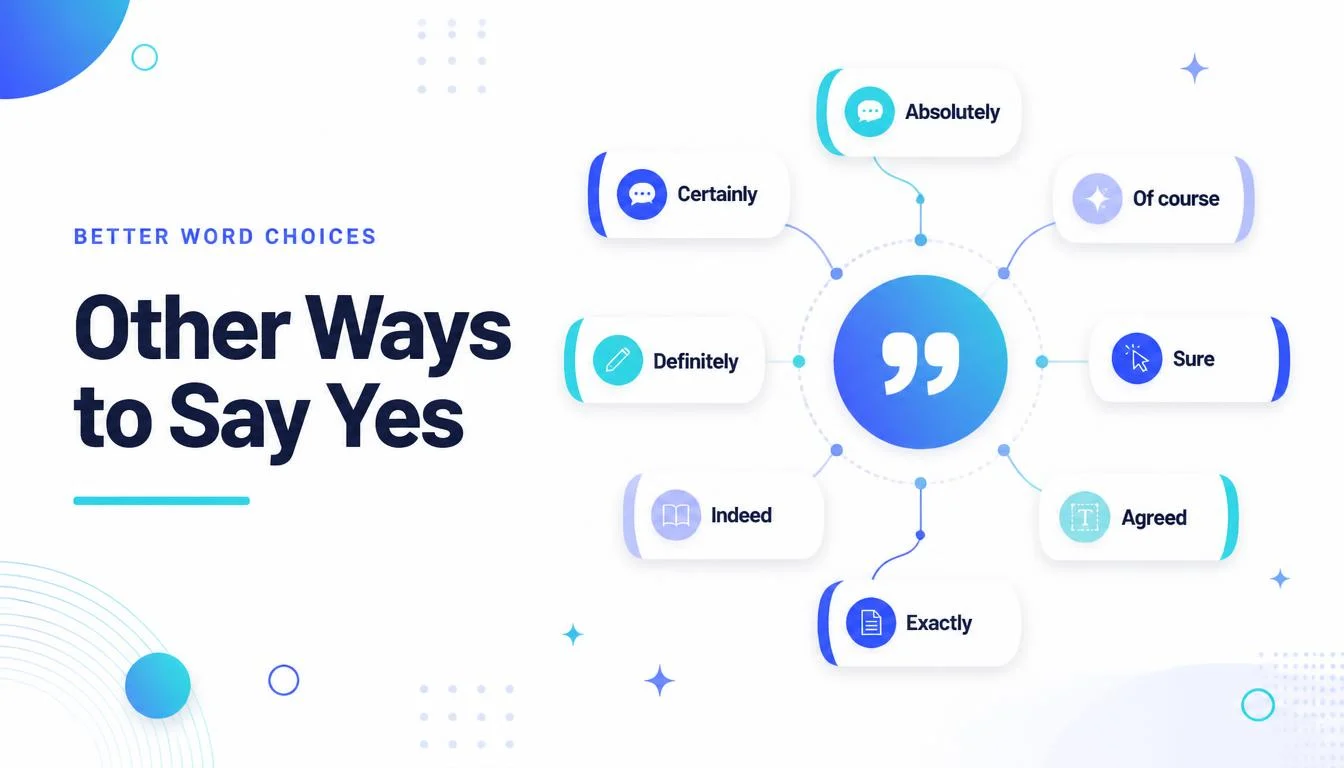
Other ways to say yes include absolutely, certainly, definitely, of course, indeed, agreed, and certainly.
Finding other ways to say yes can help you sound more natural, confident, and expressive in English. Instead of repeating “yes” in every conversation, you can choose alternatives that match the situation and tone.
Whether you are agreeing with someone, confirming information, accepting an offer, or responding professionally, learning other ways to say yes gives you more flexibility in both spoken and written English.
Quick Categories
Formal Alternatives to “Yes”
- Certainly
- Indeed
- Affirmative
- Without a doubt
Pro Tip: Use formal alternatives to yes in emails, interviews, and business meetings where a polished, professional reaction is expected.
Casual Alternatives
- Yeah
- Yep
- Sure thing
- Totally
Pro Tip: Save casual alternatives for friends, family, and relaxed spoken conversations, not formal written communication.
Professional Alternatives
- Absolutely
- I’d be happy to
- Consider it done
- Agreed
Pro Tip: Professional reaction phrases like these show initiative and reliability, which is why they work well in workplace conversations.
Informal Expressions
- You bet
- No problem
- Yup
- Okay
Pro Tip: Informal expressions in English are great for texting and casual chats, but they can sound too relaxed in formal writing.
Small word choices create a big difference in how confident and fluent you sound.
Common Mistakes
- Overusing “yes” in every response. Example: “Yes, yes, and yes, that works for me.
- Using casual alternatives in formal emails. Example: “Yep, I’ll send the report by Friday.” (too informal for a client email)
- Mixing tone within the same message. Example: “Certainly, no problem, I’m on it!” (formal and informal mixed awkwardly)
- Saying “yes” without context, causing confusion. Example: “Yes.” (unclear which question is being answered)
- Using slang alternatives with people you do not know well. Example: “Totally, dude!” to a new manager on the first day.
What Does “Yes” Mean?
Yes is an affirmative word used to agree, confirm, or accept something. Grammatically, it functions as an interjection and can stand alone as a complete response to a yes-or-no question.
Example Sentence: “Yes, I will attend the meeting on Monday.”
When to Use “Yes”
- Confirming an appointment or plan
- Accepting an invitation
- Answering a direct question
- Agreeing with a statement or opinion
Spoken vs Written: In speech, yes is often shortened or replaced with casual alternatives like yeah or yep. In writing, especially professional communication, yes or its formal alternatives are preferred.
Formal vs Informal: Formal settings call for certainly or of course, while informal settings allow for sure or okay.
Is It Professional or Polite to Say “Yes”?
Saying yes is almost always polite, but it is not always the most professional choice depending on context. A single-word yes can feel abrupt in business writing.
Business Example: “Yes, I can complete the report by Thursday.” works, but “Certainly, I will have the report ready by Thursday.” sounds more polished.
Polite? ✔️ Yes Professional? ❌ No (in most cases without added detail)
Pros and Cons of Using “Yes”
Pros:
- Simple and natural
- Friendly tone
- Common usage
- Easy to understand
Cons:
- Too informal for work
- Overused
- Limited emotional range
- Not suitable for formal writing
Fluency isn’t about knowing more words, it’s about knowing when to use them.
Other Ways to Say “Yes” (With Examples)
These alternatives will help you sound more fluent, confident, and natural in different situations.
1. Absolutely
Meaning: A strong, enthusiastic way to say yes.
Explanation: Shows confidence and full agreement.
Example Sentence: “Absolutely, I would love to join the project.”
Best Use: Professional agreement
Worst Use: Uncertain situations
Tone: Confident, enthusiastic
Context Variability: Professional, spoken
2. Certainly
Meaning: A polite, formal way to confirm agreement.
Explanation: Common in business and customer service.
Example Sentence: “Certainly, I will forward the documents today.”
Best Use: Business emails
Worst Use: Casual chats
Tone: Formal, polite
Context Variability: Professional
3. Of Course
Meaning: Expresses willingness without hesitation.
Explanation: Suggests the answer was already obvious.
Example Sentence: “Of course, I can help you with that.”
Best Use: Friendly requests
Worst Use: Serious negotiations
Tone: Warm, reassuring
Context Variability: Casual, professional
4. Definitely
Meaning: Confirms something with certainty.
Explanation: Adds strong emphasis to an agreement.
Example Sentence: “Definitely, count me in for the trip.”
Best Use: Enthusiastic agreement
Worst Use: Formal contracts
Tone: Energetic, sure
Context Variability: Casual, spoken
5. Indeed
Meaning: A formal confirmation of truth or agreement.
Explanation: Common in professional or academic tone.
Example Sentence: “Indeed, the results support our proposal.”
Best Use: Formal writing
Worst Use: Texting friends
Tone: Formal, precise
Context Variability: Professional
6. Affirmative
Meaning: A formal or technical way to say yes.
Explanation: Often used in official or military contexts.
Example Sentence: “Affirmative, proceeding as planned.”
Best Use: Technical communication
Worst Use: Casual conversation
Tone: Formal, direct
Context Variability: Professional
7. You Bet
Meaning: An enthusiastic informal yes.
Explanation: Shows eagerness and friendliness.
Example Sentence: “You bet, I’ll be there early.”
Best Use: Friendly conversation
Worst Use: Formal meetings
Tone: Cheerful, casual
Context Variability: Casual, spoken
8. For Sure
Meaning: A casual but confident agreement.
Explanation: Popular in everyday spoken English.
Example Sentence: “For sure, that plan works for me.”
Best Use: Everyday conversation
Worst Use: Business proposals
Tone: Relaxed, confident
Context Variability: Casual, spoken
9. Totally
Meaning: A strong casual agreement.
Explanation: Adds emphasis and enthusiasm.
Example Sentence: “Totally, that’s a great idea.”
Best Use: Social conversations
Worst Use: Professional emails
Tone: Enthusiastic, informal
Context Variability: Casual, spoken
10. Yeah
Meaning: A relaxed, spoken version of yes.
Explanation: Very common in daily speech.
Best Use: Informal talk
Worst Use: Written reports
Tone: Casual, natural
Context Variability: Spoken
11. Yep
Meaning: A short, casual confirmation.
Example Sentence: “Yep, that’s exactly right.”
Best Use: Quick replies
Worst Use: Formal writing
Tone: Casual, light
Context Variability: Spoken
12. Sure Thing
Meaning: A friendly, willing agreement.
Explanation: Suggests ease and helpfulness.
Example Sentence: “Sure thing, I’ll take care of it.”
Best Use: Helpful responses
Worst Use: Formal negotiations
Tone: Friendly, easygoing
Context Variability: Casual, professional
13. No Problem
Meaning: Agreement paired with reassurance.
Explanation: Shows the request is easy to fulfill.
Example Sentence: “No problem, I can send that now.”
Best Use: Customer service
Worst Use: Serious formal replies
Tone: Reassuring, relaxed
Context Variability: Casual, professional
14. Absolutely Yes
Meaning: A very strong and confident way to express agreement.
Explanation: Removes any sense of hesitation or uncertainty.
Best Use: Strong agreement
Worst Use: Uncertain answers
Tone: Assertive, confident
Context Variability: Professional, spoken
15. Correct
Meaning: Confirms that something is true or accurate.
Example Sentence: “Correct, the meeting starts at 3 PM.”
Best Use: Fact confirmation
Worst Use: Emotional responses
Tone: Neutral, precise
Context Variability: Professional
16. That’s Right
Meaning: Confirms agreement with a statement.
Explanation: Often used to validate someone’s point.
Example Sentence: “That’s right, we finished the project early.”
Best Use: Conversational confirmation
Worst Use: One-word answers
Tone: Affirming, clear
Context Variability: Casual, spoken
17. Agreed
Meaning: A short, professional way to confirm consensus.
Explanation: Common in meetings and negotiations.
Example Sentence: “Agreed, let’s move forward with the plan.”
Best Use: Team decisions
Worst Use: Emotional topics
Tone: Formal, decisive
Context Variability: Professional
18. I’m on Board
Meaning: Shows enthusiastic agreement to participate.
Explanation: Suggests commitment to an idea or plan.
Example Sentence: “I’m on board with the new strategy.”
Best Use: Team projects
Worst Use: Simple factual answers
Tone: Supportive, engaged
Context Variability: Professional, spoken
19. Count Me In
Meaning: An eager way to accept an invitation.
Explanation: Expresses excitement to join.
Example Sentence: “Count me in for the weekend hike.”
Best Use: Social invitations
Worst Use: Formal contracts
Tone: Excited, willing
Context Variability: Casual, spoken
20. Naturally
Meaning: Suggests the answer is expected or obvious.
Explanation: Adds a slightly formal, confident tone.
Example Sentence: “Naturally, we will support the decision.”
Best Use: Confident agreement
Worst Use: Uncertain topics
Tone: Assured, formal
Context Variability: Professional
21. Right On
Meaning: An informal expression of enthusiastic agreement.
Explanation: Common in relaxed, upbeat conversation.
Example Sentence: “Right on, let’s grab lunch at noon.”
Best Use: Friendly banter
Worst Use: Written business communication
Tone: Playful, casual
Context Variability: Casual, spoken
22. By All Means
Meaning: A polite, formal way to give permission or agree.
Explanation: Suggests generosity in agreeing.
Example Sentence: “By all means, feel free to use my office.”
Best Use: Polite permission
Worst Use: Casual texting
Tone: Gracious, formal
Context Variability: Professional
23. Yup
Meaning: A very casual, quick confirmation.
Explanation: Common in text messages and short replies.
Example Sentence: “Yup, on my way now.”
Best Use: Texting
Worst Use: Professional reports
Tone: Relaxed, brief
Context Variability: Spoken
24. Okay
Meaning: A neutral way to accept or agree.
Explanation: Works in both casual and semi-formal settings.
Example Sentence: “Okay, I will schedule the call for tomorrow.”
Best Use: General agreement
Worst Use: Highly formal writing
Tone: Neutral, simple
Context Variability: Casual, professional
25. Roger That
Meaning: An informal way to confirm understanding.
Explanation: Originates from radio communication and is now sometimes used playfully.
Example Sentence: “Roger that, I’ll update the file now.”
Best Use: Team banter
Worst Use: Client communication
Tone: Playful, informal
Context Variability: Casual
26. Consider It Done
Meaning: A confident promise to complete a task.
Explanation: Shows reliability and initiative.
Example Sentence: “Consider it done, I’ll finish it by tonight.”
Best Use: Workplace tasks
Worst Use: Simple factual replies
Tone: Confident, dependable
Context Variability: Professional
27. I’d Be Happy To
Meaning: A polite, professional way to accept a request.
Explanation: Adds warmth to a formal agreement.
Example Sentence: “I’d be happy to review the proposal.”
Best Use: Client requests
Worst Use: Casual quick replies
Tone: Polite, professional
Context Variability: Professional
28. Precisely
Meaning: Confirms something is exactly correct.
Explanation: Adds precision and formality to agreement.
Example Sentence: “Precisely, that’s the outcome we expected.”
Best Use: Detailed discussions
Worst Use: Casual small talk
Tone: Formal, exact
Context Variability: Professional
29. It Would Be My Pleasure
Meaning: A gracious, formal way to agree to help.
Explanation: Common in customer service and hospitality.
Example Sentence: “It would be my pleasure to assist you.”
Best Use: Customer service
Worst Use: Casual conversation
Tone: Gracious, formal
Context Variability: Professional
30. Sure
Meaning: A simple, versatile agreement.
Explanation: Works across many casual and semi-formal situations.
Example Sentence: “Sure, I can meet you at five.”
Best Use: General everyday use
Mini Quiz / Self-Check
1. Which phrase is best for a formal business email? a) Yep b) Certainly c) You bet d) Right on Answer: b) Certainly
2. Which alternative is too casual for a job interview? a) Absolutely b) I’d be happy to c) Yup d) Agreed Answer: c) Yup
3. A client asks if you can send a report today. Which response sounds most professional? a) Sure thing, no worries b) I’d be happy to send it today c) Yep, on it d) Totally Answer: b) I’d be happy to send it today
4. Which phrase shows the strongest enthusiasm among friends? a) Indeed b) Affirmative c) Count me in d) Correct Answer: c) Count me in
“Great communicators don’t just answer, they respond with the right tone.”
Comparison Table: Top Alternatives
| Phrase | Tone | Best Use |
|---|---|---|
| Absolutely | Confident, enthusiastic | Professional agreement |
| Certainly | Formal, polite | Business emails |
| Of course | Warm, reassuring | Friendly requests |
| Definitely | Energetic, sure | Enthusiastic agreement |
| Indeed | Formal, precise | Formal writing |
| Sure thing | Friendly, easygoing | Helpful responses |
| No problem | Reassuring, relaxed | Customer service |
| Agreed | Formal, decisive | Team decisions |
| I’d be happy to | Polite, professional | Client requests |
| Consider it done | Confident, dependable | Workplace tasks |
FAQs
1. What is a professional way to say yes? Professional alternatives include certainly, absolutely, and I’d be happy to, since they sound polished in workplace communication.
2. What is a casual way to say yes? Casual alternatives include yeah, yep, and totally, which are common in relaxed, spoken conversations.
3. Is it rude to only say yes in a conversation? It is not rude, but repeating yes without variation can sound flat, so alternatives to yes help you sound more engaged.
4. How can I express excitement in English besides saying yes? Try phrases like absolutely, count me in, or definitely, which add enthusiasm and energy to your response.
5. Which alternative should I avoid in formal writing? Avoid casual expressions like yep, yup, or totally in formal writing, since they lower the professional tone of your message.
Conclusion
Learning other ways to say yes helps you sound more fluent, confident, and adaptable in both spoken and written English. From formal alternatives like certainly and indeed to informal expressions like yep and no problem, each phrase carries its own tone and best-use context.
Read More Related Articles:
- Other Ways to Say “Let’s Go Team” | Games, Work and More In 2026
- Other Ways to Say Problem Solving Skills | Make Your Resume Stronger In 2026
- Other Ways to Say No in Spanish | Simple Ways to Sound Fluent In 2026

Henry Walker is an American writer and blogger with a keen interest in communication, language and digital content. At TextsResponse.com, he creates informative and reader-focused resources designed to help people communicate with clarity, confidence and authenticity.