Quick Answer
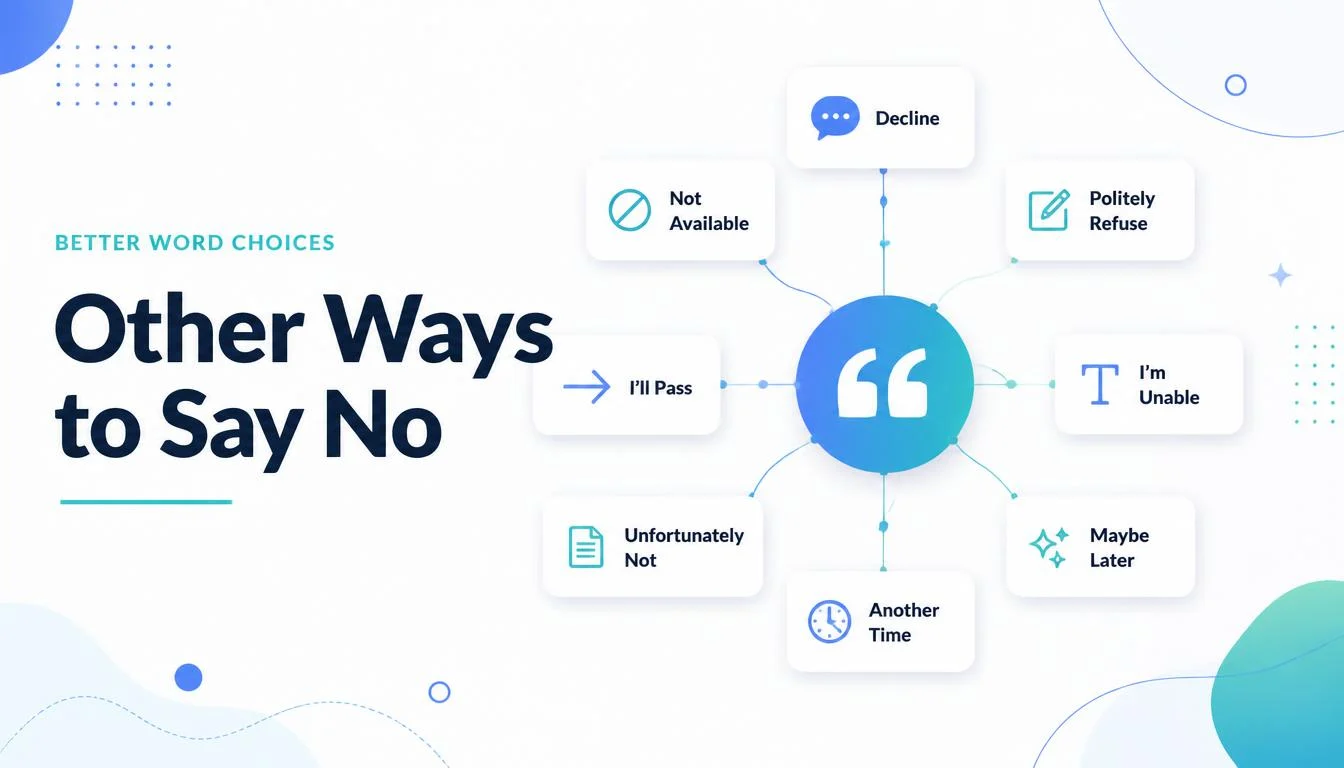
Other ways to say no include I’m afraid not, I respectfully decline, I can’t, not this time, I’ll have to pass, and I appreciate the offer, but no. These alternatives help you express refusal politely, professionally, or casually.
Knowing other ways to say no can help you communicate more effectively in everyday conversations, professional settings, and personal relationships. Instead of using the same word repeatedly, you can choose expressions that sound polite, respectful, or direct, depending on the situation.
In this guide, you’ll discover 30 other ways to say no, with examples of how to use each expression naturally. Whether you want to decline an invitation, refuse a request, or set a boundary, these alternatives will help you express yourself with confidence.
Quick Categories: Different Ways to Say No
1. Formal alternatives to “No”
These expressions are suitable for formal conversations, official correspondence, and respectful refusals.
- I must respectfully decline.
- Unfortunately, I am unable to.
- I regret that I cannot.
- I appreciate the offer, but I must decline.
Pro Tip
Use a brief explanation when appropriate, but avoid overexplaining a refusal in formal communication.
2. Casual alternatives
These phrases work well with friends, family, and people you know comfortably.
- Not this time.
- Maybe another time.
- I don’t think so.
- I’m going to pass.
Pro Tip
A warm tone and a friendly alternative can make a casual refusal feel more considerate.
3. Professional alternatives
Use these expressions in meetings, emails, and workplace discussions.
- I’m afraid I can’t commit to that.
- That won’t be possible for me.
- I have to decline at this time.
- I won’t be able to accommodate that request.
Pro Tip
In professional settings, state your decision clearly and offer an alternative when you genuinely can.
4. Informal expressions
These expressions are natural in relaxed conversations.
- No thanks.
- I’ll sit this one out.
- Not really.
- I’m good, thanks.
Pro Tip
Informal expressions work best with people who understand your conversational style. Use more explicit wording when clarity matters.
What Does “No” Mean?
No is a negative response used to refuse, reject, deny, or disagree with something.
It can function as an adverb, a determiner, or a noun, depending on the sentence.
Example: “Would you like another cup of coffee?” “No, thank you.”
The word can communicate anything from a simple preference to a firm boundary, depending on the context and tone.
When to Use “No”
You can use different expressions of refusal in a variety of situations:
- Declining invitations: When you cannot attend an event or social gathering.
- Rejecting requests: When someone asks you to do something you cannot or do not want to do.
- Workplace communication: When declining additional tasks or proposals.
- Setting boundaries: When protecting your time, privacy, or personal preferences.
- Disagreeing politely: When expressing a different opinion.
Spoken vs. Written Usage
| Context | Recommended Expression |
|---|---|
| Spoken conversation | Not this time. |
| Professional email | Unfortunately, I am unable to. |
| Formal letter | I must respectfully decline. |
| Casual text | No thanks, I’m good. |
Is It Professional or Polite to Say “No”?
Polite? Yes, when delivered respectfully.
Professional? Yes, when the wording suits the situation.
The word “no” is not inherently rude or unprofessional. However, a short explanation or courteous phrase can make a refusal sound more considerate.
Business-style example:
“Thank you for considering me for this project. Unfortunately, I won’t be able to take it on due to my current commitments.”
“A clear and respectful refusal can protect your boundaries without damaging professional relationships.”
Pros and Cons of Using “No”
Pros
- Simple and natural: Easy to understand and use.
- Friendly tone: Can sound warm when paired with polite wording.
- Common usage: Widely understood in everyday English.
- Easy to understand: Communicates a clear response.
Cons
- Too informal for work: A bare “no” may sound abrupt in certain professional situations.
- Overused: Repeating the same expression can make communication less varied.
- Limited emotional range: Does not always communicate appreciation or regret.
- Not suitable for every formal context: Some situations benefit from a more complete response.
“The goal is not to avoid saying no. It is to say it in a way that matches the situation.”
Other Ways to Say No (With Examples)
These alternatives will help you sound more fluent, confident, and natural in different situations.
Choose each expression according to tone, context, and audience to communicate a refusal clearly and respectfully.
30 Alternatives to “No”
1. Phrase: I’m afraid I can’t
- Meaning: Politely communicates an inability to agree or participate.
- Explanation: It softens a refusal by expressing regret.
- Example Sentence: I’m afraid I can’t attend the meeting tomorrow.
- Best Use: Polite refusals
- Worst Use: Casual banter
- Tone: Respectful, gentle, professional
- Context Variability: Casual: I’m afraid I can’t. Professional: I’m afraid I can’t take on another project. Spoken: I’m afraid I can’t make it.
2. Phrase: I’d rather not
- Meaning: Expresses a personal preference not to do something.
- Explanation: It communicates reluctance without sounding overly direct.
- Example Sentence: I’d rather not discuss that topic right now.
- Best Use: Personal boundaries
- Worst Use: Formal rejection
- Tone: Gentle, reserved, direct
- Context Variability: Casual: I’d rather not. Professional: I’d rather not comment on that matter. Spoken: I’d rather not go out tonight.
3. Phrase: Unfortunately, that won’t work for me
- Meaning: Politely declines a suggestion or arrangement.
- Explanation: It communicates that a proposed option is unsuitable.
- Example Sentence: Unfortunately, that meeting time won’t work for me.
- Best Use: Scheduling conflicts
- Worst Use: Friendly invitations
- Tone: Professional, courteous, neutral
- Context Variability: Casual: That won’t work for me. Professional: Unfortunately, that deadline won’t work for me. Spoken: That time won’t work for me.
4. Phrase: I appreciate the offer, but no thank you
- Meaning: Declines an offer while expressing gratitude.
- Explanation: It acknowledges the other person’s kindness before refusing.
- Example Sentence: I appreciate the offer, but no thank you. I’ve already made other arrangements.
- Best Use: Declining offers
- Worst Use: Urgent refusals
- Tone: Grateful, polite, warm
- Context Variability: Casual: Thanks, but no thanks. Professional: I appreciate the offer, but I must decline. Spoken: I appreciate it, but no thank you.
5. Phrase: I’m not available
- Meaning: States that you cannot participate or attend.
- Explanation: It provides a straightforward reason for declining.
- Example Sentence: I’m not available for a meeting this afternoon.
- Best Use: Scheduling conflicts
- Worst Use: Personal disagreements
- Tone: Neutral, direct, professional
- Context Variability: Casual: I’m not free. Professional: I’m not available at that time. Spoken: Sorry, I’m not available.
6. Phrase: I must respectfully decline
- Meaning: Formally refuses an invitation or proposal.
- Explanation: It communicates a firm decision in courteous language.
- Example Sentence: I must respectfully decline the invitation to participate.
- Best Use: Formal correspondence
- Worst Use: Casual chats
- Tone: Formal, courteous, firm
- Context Variability: Casual: I’ll have to pass. Professional: I must respectfully decline. Spoken: I must respectfully decline the invitation.
7. Phrase: I’m going to pass
- Meaning: Indicates that you do not wish to participate.
- Explanation: It is a relaxed way to decline an invitation or offer.
- Example Sentence: I’m going to pass on the movie tonight.
- Best Use: Casual invitations
- Worst Use: Official letters
- Tone: Casual, friendly, relaxed
- Context Variability: Casual: I’ll pass. Professional: I’ll pass on this opportunity for now. Spoken: I’m going to pass.
8. Phrase: Not this time
- Meaning: Declines something on the current occasion.
- Explanation: It leaves open the possibility of agreeing in the future.
- Example Sentence: Thanks for inviting me, but not this time.
- Best Use: Friendly invitations
- Worst Use: Permanent refusals
- Tone: Friendly, gentle, casual
- Context Variability: Casual: Not this time. Professional: I won’t be able to join this time. Spoken: Not this time, maybe next week.
9. Phrase: I’m unable to
- Meaning: States that you cannot fulfill a request.
- Explanation: It provides a concise and professional refusal.
- Example Sentence: I’m unable to attend the training session tomorrow.
- Best Use: Formal communication
- Worst Use: Relaxed conversation
- Tone: Formal, neutral, professional
- Context Variability: Casual: I can’t. Professional: I’m unable to approve the request. Spoken: I’m unable to attend.
10. Phrase: Maybe another time
- Meaning: Declines an invitation while suggesting a future opportunity.
- Explanation: It softens the refusal and maintains a friendly tone.
- Example Sentence: I can’t join you today, but maybe another time.
- Best Use: Social invitations
- Worst Use: Firm boundaries
- Tone: Warm, friendly, tentative
- Context Variability: Casual: Maybe next time. Professional: Perhaps we can arrange another time. Spoken: Maybe another time.
11. Phrase: I don’t think so
- Meaning: Expresses disagreement or a negative response.
- Explanation: It communicates a refusal less directly than a blunt no.
- Example Sentence: Do you think we can finish today? I don’t think so.
- Best Use: Informal discussions
- Worst Use: Formal decisions
- Tone: Casual, tentative, conversational
- Context Variability: Casual: I don’t think so. Professional: I don’t believe that will be possible. Spoken: I don’t think so, sorry.
12. Phrase: I have to decline
- Meaning: Politely refuses an invitation or request.
- Explanation: It communicates a decision with a professional tone.
- Example Sentence: I have to decline the invitation because of a scheduling conflict.
- Best Use: Professional refusals
- Worst Use: Casual banter
- Tone: Formal, respectful, firm
- Context Variability: Casual: I’ll have to pass. Professional: I have to decline the offer. Spoken: I’m sorry, but I have to decline.
13. Phrase: That’s not possible for me
- Meaning: Explains that a proposed action cannot be accommodated.
- Explanation: It clearly communicates a limitation.
- Example Sentence: That’s not possible for me this week because of existing commitments.
- Best Use: Practical limitations
- Worst Use: Friendly offers
- Tone: Direct, neutral, firm
- Context Variability: Casual: I can’t do that. Professional: That’s not possible for me at the moment. Spoken: Sorry, that’s not possible for me.
14. Phrase: I’ll sit this one out
- Meaning: Declines participation in a particular activity.
- Explanation: It is a relaxed expression that usually applies to group activities.
- Example Sentence: I’ll sit this one out and join you next time.
- Best Use: Group activities
- Worst Use: Formal requests
- Tone: Casual, friendly, relaxed
- Context Variability: Casual: I’ll sit this one out. Professional: I’ll sit out this optional activity. Spoken: I’ll sit this one out, thanks.
15. Phrase: No thanks
- Meaning: Politely declines an offer.
- Explanation: It combines a negative response with appreciation.
- Example Sentence: No thanks, I’ve already had lunch.
- Best Use: Everyday offers
- Worst Use: Formal proposals
- Tone: Friendly, simple, polite
- Context Variability: Casual: No thanks. Professional: No, thank you for the offer. Spoken: No thanks, I’m fine.
16. Phrase: I’m good, thanks
- Meaning: Indicates that you do not need or want something.
- Explanation: It is a friendly way to decline an offer.
- Example Sentence: I’m good, thanks. I don’t need another cup of tea.
- Best Use: Casual offers
- Worst Use: Official correspondence
- Tone: Relaxed, friendly, informal
- Context Variability: Casual: I’m good, thanks. Professional: No, thank you. Spoken: I’m good, thanks.
17. Phrase: I’d prefer not to
- Meaning: Expresses a preference against doing something.
- Explanation: It communicates a personal choice in a considerate way.
- Example Sentence: I’d prefer not to share those details publicly.
- Best Use: Personal boundaries
- Worst Use: Urgent instructions
- Tone: Polite, reserved, clear
- Context Variability: Casual: I’d rather not. Professional: I’d prefer not to comment. Spoken: I’d prefer not to, if that’s okay.
18. Phrase: I can’t commit to that
- Meaning: Indicates that you cannot promise to do something.
- Explanation: It sets a boundary without rejecting the person making the request.
- Example Sentence: I can’t commit to that deadline with my current workload.
- Best Use: Work commitments
- Worst Use: Simple offers
- Tone: Professional, firm, measured
- Context Variability: Casual: I can’t promise that. Professional: I can’t commit to that timeline. Spoken: I can’t commit to that right now.
19. Phrase: I’m afraid that’s not an option
- Meaning: Firmly communicates that a particular choice is unavailable.
- Explanation: It combines a softening phrase with a clear boundary.
- Example Sentence: I’m afraid that extending the deadline is not an option.
- Best Use: Firm decisions
- Worst Use: Friendly invitations
- Tone: Formal, firm, restrained
- Context Variability: Casual: That’s not going to work. Professional: I’m afraid that’s not an option. Spoken: I’m afraid that’s not possible.
20. Phrase: I’m not interested
- Meaning: States that you do not want to pursue an offer or activity.
- Explanation: It communicates a clear lack of interest.
- Example Sentence: Thank you, but I’m not interested in changing providers.
- Best Use: Unwanted offers
- Worst Use: Sensitive invitations
- Tone: Direct, neutral, firm
- Context Variability: Casual: I’m not interested. Professional: I’m not interested in pursuing this opportunity. Spoken: Thanks, but I’m not interested.
21. Phrase: I’ll have to say no
- Meaning: Expresses a refusal while acknowledging that the decision may be difficult.
- Explanation: It softens the negative response without making the decision unclear.
- Example Sentence: I’d love to help, but I’ll have to say no this time.
- Best Use: Personal requests
- Worst Use: Formal notices
- Tone: Gentle, honest, conversational
- Context Variability: Casual: I’ll have to say no. Professional: I’ll have to decline. Spoken: Sorry, I’ll have to say no.
22. Phrase: I can’t make it
- Meaning: States that you cannot attend an event or appointment.
- Explanation: It is a common expression for declining plans.
- Example Sentence: I can’t make it to dinner tonight.
- Best Use: Event invitations
- Worst Use: Business proposals
- Tone: Casual, direct, friendly
- Context Variability: Casual: I can’t make it. Professional: I’m unable to attend. Spoken: Sorry, I can’t make it.
23. Phrase: I’m not comfortable with that
- Meaning: Expresses discomfort or disagreement with a proposed action.
- Explanation: It sets a boundary by focusing on your personal comfort.
- Example Sentence: I’m not comfortable with sharing confidential information.
- Best Use: Personal boundaries
- Worst Use: Routine scheduling
- Tone: Honest, firm, respectful
- Context Variability: Casual: I’m not comfortable with that. Professional: I’m not comfortable proceeding without approval. Spoken: I’m not comfortable doing that.
24. Phrase: I’ll pass for now
- Meaning: Declines something at the present time.
- Explanation: It leaves room for reconsideration later.
- Example Sentence: I’ll pass for now, but thank you for thinking of me.
- Best Use: Temporary refusals
- Worst Use: Final decisions
- Tone: Casual, polite, tentative
- Context Variability: Casual: I’ll pass for now. Professional: I’ll decline for now. Spoken: I’ll pass for now, thanks.
25. Phrase: I’m afraid I have to decline
- Meaning: Politely and firmly refuses an offer or request.
- Explanation: It combines regret with a clear decision.
- Example Sentence: I’m afraid I have to decline the invitation due to a prior commitment.
- Best Use: Formal invitations
- Worst Use: Casual chats
- Tone: Formal, courteous, firm
- Context Variability: Casual: Sorry, I can’t. Professional: I’m afraid I have to decline. Spoken: I’m afraid I’ll have to decline.
26. Phrase: I’d like to, but I can’t
- Meaning: Expresses willingness while explaining an inability to participate.
- Explanation: It shows appreciation or interest before declining.
- Example Sentence: I’d like to join the workshop, but I can’t attend that day.
- Best Use: Friendly invitations
- Worst Use: Unwanted requests
- Tone: Warm, considerate, sincere
- Context Variability: Casual: I’d like to, but I can’t. Professional: I’d be happy to, but I’m unavailable. Spoken: I’d love to, but I can’t.
27. Phrase: I’m going to have to decline
- Meaning: Politely communicates that you cannot accept an offer.
- Explanation: It frames the refusal as a necessary decision.
- Example Sentence: I’m going to have to decline the additional assignment this week.
- Best Use: Work requests
- Worst Use: Casual offers
- Tone: Professional, courteous, firm
- Context Variability: Casual: I’ll have to pass. Professional: I’m going to have to decline. Spoken: I’m sorry, but I’ll have to decline.
28. Phrase: I don’t believe that will work
- Meaning: Expresses disagreement with a proposed plan or solution.
- Explanation: It focuses on the feasibility of the suggestion rather than the person.
- Example Sentence: I don’t believe that approach will work within our current budget.
- Best Use: Business discussions
- Worst Use: Simple invitations
- Tone: Measured, professional, direct
- Context Variability: Casual: I don’t think that’ll work. Professional: I don’t believe that proposal will work. Spoken: I don’t think that will work.
29. Phrase: I’m unable to accommodate that request
- Meaning: Formally states that a request cannot be fulfilled.
- Explanation: It is a professional expression for communicating limitations.
- Example Sentence: I’m unable to accommodate that request within the current schedule.
- Best Use: Official correspondence
- Worst Use: Casual conversations
- Tone: Formal, professional, firm
- Context Variability: Casual: I can’t do that. Professional: I’m unable to accommodate that request. Spoken: I’m afraid I can’t accommodate that.
30. Phrase: Thank you, but I’ll have to pass
- Meaning: Declines an offer while expressing appreciation.
- Explanation: It combines gratitude with a clear refusal.
- Example Sentence: Thank you for inviting me to the event, but I’ll have to pass.
- Best Use: Polite refusals
- Worst Use: Urgent situations
- Tone: Courteous, friendly, composed
- Context Variability: Casual: Thanks, but I’ll pass. Professional: Thank you, but I must decline. Spoken: Thanks for asking, but I’ll have to pass.
Common Mistakes When Saying “No”
Avoid these five common errors to make your refusals sound more natural and appropriate.
1. Giving a blunt refusal in a sensitive situation
Incorrect: “No. I won’t help you.”
Better: “I’m sorry, but I won’t be able to help this time.”
2. Using overly casual language in formal communication
Incorrect: “Nah, I’m good.”
Better: “Thank you for the offer, but I must decline.”
3. Giving an unclear response
Incorrect: “Maybe, we’ll see.”
Better: “I’m afraid I won’t be able to attend.”
4. Overexplaining your refusal
Incorrect: “I can’t come because I have several things to do, and then I need to visit someone, and I’m not sure how long everything will take.”
Better: “I’m sorry, but I won’t be able to attend due to a prior commitment.”
5. Saying yes when you mean no
Incorrect: “Sure, I’ll do it,” when you know you cannot.
Better: “I appreciate you asking, but I can’t commit to that right now.”
“A respectful refusal is clearer and more useful than a promise you cannot keep.”
Comparison Table: Top 10 Alternatives
| Phrase | Tone | Best Use |
|---|---|---|
| I’m afraid I can’t | Polite | Professional refusals |
| I’d rather not | Gentle | Personal boundaries |
| Unfortunately, that won’t work for me | Professional | Scheduling |
| I appreciate the offer, but no thank you | Courteous | Declining offers |
| I’m not available | Neutral | Appointments |
| I must respectfully decline | Formal | Official communication |
| I’m going to pass | Casual | Social invitations |
| Maybe another time | Friendly | Future plans |
| I’m unable to | Formal | Business emails |
| Thank you, but I’ll have to pass | Warm | Polite refusals |
Mini Quiz: Test Your Understanding
1. Which expression is most suitable for a formal business email?Nah, I’m good.I must respectfully decline.I’ll sit this one out.
2. Which phrase politely declines a casual invitation while leaving room for another time?Maybe another time.I’m unable to accommodate that request.I’m afraid that’s not an option.
3. Which expression is best for setting a personal boundary?I’d rather not.No way, ever.That is impossible.
4. Which phrase is suitable for declining an extra work assignment?I’m good, thanks.I can’t commit to that deadline.Not really.Check answers
FAQs
1. What are the most polite ways to say no?
“I’m afraid I can’t,” “I appreciate the offer, but I must decline,” and “Thank you, but I’ll have to pass” are polite options.
2. How can I say no professionally in an email?
Use a courteous expression such as “Unfortunately, I’m unable to accommodate that request at this time.”
3. How do I say no without sounding rude?
Acknowledge the request, communicate your decision clearly, and add a brief explanation when appropriate.
4. What are some casual alternatives to no?
Not this time,” “I’m going to pass,” “No thanks,” and “Maybe another time” are common informal expressions in English.
5. How can I say no firmly but politely?
Use direct wording such as “I’m not comfortable with that” or “I’m afraid that’s not an option” while maintaining a respectful tone.
Conclusion
Learning different ways to say no helps you communicate with greater confidence, clarity, and flexibility. From casual invitations to professional requests, the right expression allows you to decline while maintaining a respectful tone.
Practice these phrases in everyday conversations and workplace scenarios. Pay attention to your audience, the level of formality, and the message you want to convey. With regular practice, you’ll become more comfortable setting boundaries and expressing your decisions .
Read More Related Articles:
- Other Ways to Say Circle Back | Improve Your Workplace Communication In 2026
- Other Ways to Say Welcome to the Team | Warm First Impression In 2026
- Other Ways to Say I Hope All Is Well | Make a Better First Impression In 2026
Victoria Hughes is a content writer dedicated to making communication clearer and more effective. Through TextsResponse.com, she shares practical insights and thoughtfully crafted response ideas that help readers express themselves with confidence.