Quick Answer 🔥
“And much more” is a catch-all phrase that signals an incomplete list. It is useful in speech and marketing copy, but it becomes vague and repetitive when overused. Stronger options depend on whether you want to sound formal, casual, or professional.Top 5 alternatives: and so on, and more besides, to name a few, among other things, and everything in between.
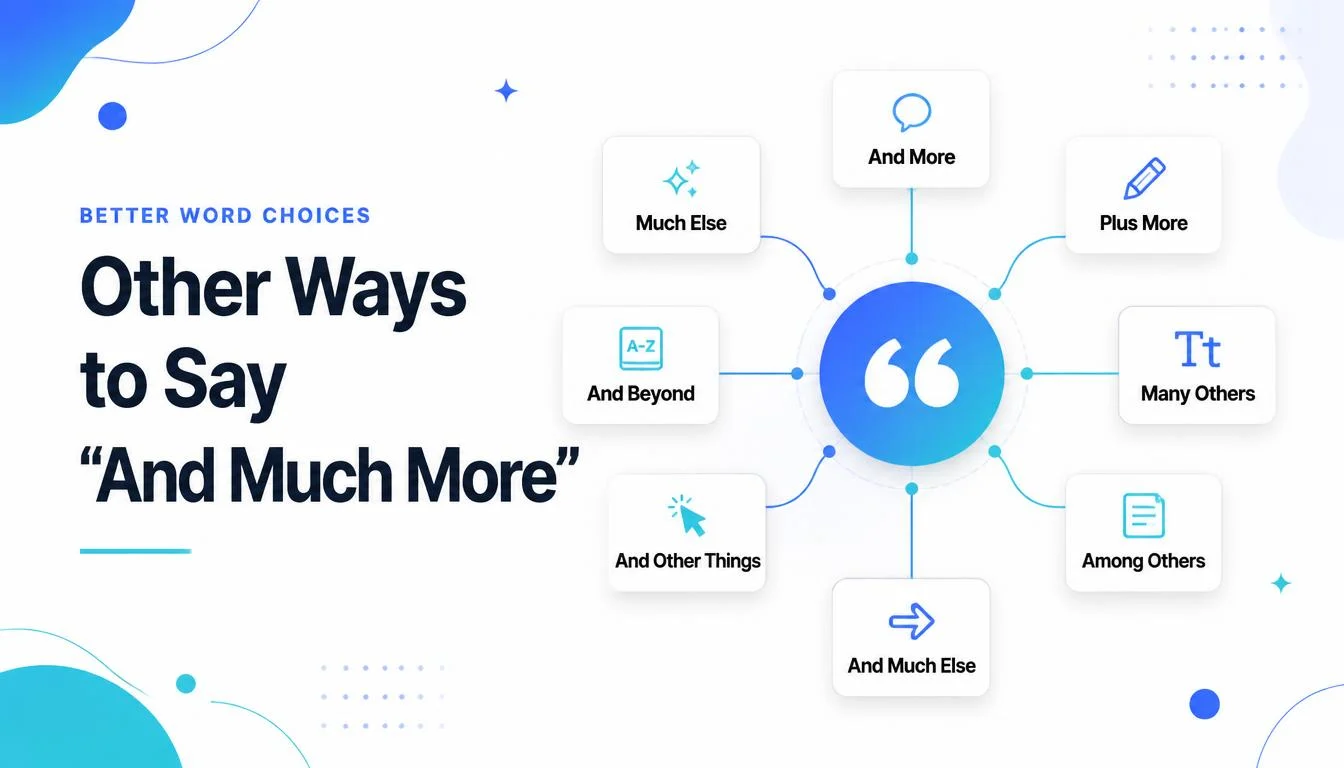
Finding other ways to say “and much more” can make your writing sound more polished, engaging, and natural. Whether you are writing a blog post, describing products, listing services, or preparing a professional presentation, choosing the right phrase helps you avoid repetition while keeping your message clear.
In this guide, you’ll discover other ways to say “and much more” for different situations and audiences. From formal alternatives to casual expressions, these phrases will help you make your sentences more interesting and communicate your ideas with confidence.
What Is “And Much More”?
Picture this. You are finishing a presentation to a client. You have listed ten features of your new software, and you want to signal that the list does not end there. Most speakers reach for the same three words: and much more. It works. It is safe. But after the fifth time in one meeting, it starts to sound like a placeholder rather than a promise.
That is exactly why learners search for other ways to say and much more. The phrase itself is not wrong. It is simply limited. Once you know the alternatives to and much more, you can choose the version that fits your audience, whether you want to express excitement in English or close a formal report with precision.
Definition
“And much more” is a noun phrase used at the end of a list to indicate that additional items, benefits, or details exist but are not being named.
Grammar Note
- It functions as a coordinating phrase.
- It follows a comma or the word “and”, and it normally appears at the end of a sentence.
- It belongs to the neutral register, meaning it sits between casual and formal English.
Example in Real Use
“The course covers grammar, pronunciation, writing skills, and much more.”
Where and Why People Use It
Spoken vs Written
- Spoken: Extremely common. It fills a gap when a speaker cannot recall every item.
- Written: Acceptable in blogs, brochures, and newsletters. Weak in academic and legal writing.
Formal vs Informal
- Formal: Rare and discouraged because it lacks specificity.
- Informal: Very common in conversation, advertising, and everyday chat.
When Should You Use “And Much More”?
- Product descriptions where the goal is to hint at extra value.
- Casual conversation when listing items would slow you down.
- Marketing copy that wants to create curiosity.
- Presentations where time is short and the full list is unnecessary.
- Spoken English when you are thinking aloud and need a closing phrase.
- Avoid in academic papers, contracts, medical reports, and technical manuals, where every item must be named.
Spoken vs Written: Natural in speech and semi-formal writing. Risky in strict formal writing.
Formal vs Informal: Neutral leaning informal. It is never fully formal because it hides information.
Is It Professional or Just Polite?
Politeness and professionalism are not the same thing. “And much more” is polite enough because it sounds positive and generous. Professionalism, however, depends on precision. In business writing, vague closing phrases can make a proposal feel unfinished.
Business-style example: “Our package includes onboarding, training, priority support, and much more.” This works in a brochure but weakens a signed contract.
Polite? ✔️ Yes
Professional? ✔️ Yes, with limits. Use it in marketing and speech, not in documents that require exact detail.
Pros and Cons of Using “And Much More”
Pros
- Simple and natural in conversation.
- Friendly, generous tone.
- Extremely common and widely understood.
- Flexible enough for speech, blogs, and advertising.
Cons
- Vague and uninformative in formal writing.
- Overused in sales copy.
- Limited emotional range.
- Not suitable for legal, academic, or technical documents.
Formal and informal English aren’t about correctness. They’re about context.
Common Mistakes People Make
1. Using It in Academic Writing
Incorrect: “The survey measured satisfaction, loyalty, and much more.”
Correct: “The survey measured satisfaction, loyalty, and repeat purchase intent.”
2. Pairing It with “Etc.”
Incorrect: “We sell shoes, bags, and much more, etc.”
Correct: “We sell shoes, bags, and much more.”
3. Repeating It in the Same Paragraph
Incorrect: “We offer design, support, and much more. Our team provides strategy, training, and much more.”
Correct: “We offer design, support, and much more. Our team also provides strategy and training.”
4. Using It After a List of Only Two Items
Incorrect: “The package includes lunch and much more.”
Correct: “The package includes lunch, transport, and much more.”
5. Using It in a Contract or Specification
Incorrect: “The supplier shall deliver hardware, software, and much more.”
Correct: “The supplier shall deliver hardware, software, installation, and a 12-month warranty.”
Small tone mistakes can make confident English sound careless.
Alternatives by Category
These are a preview of the full list. Every phrase below also appears in the complete 30-item section further down.
Formal Alternatives to “And Much More”
- among other things
- including but not limited to
- and similar items
Pro Tip: Use these in reports and proposals when you need an audit trail without listing every single item.
Casual Alternatives
- and all that
- and stuff like that
- and then some
Pro Tip: Keep these for friends and relaxed chats, never for a client email.
Professional Alternatives
- and additional services
- along with further options
- plus a full range of extras
Pro Tip: Name at least two real items before the closing phrase so the claim sounds credible.
Informal Expressions
- and everything in between
- and that’s just the beginning
- plus a whole lot more
Pro Tip: These work well in informal expressions in English because they add energy rather than precision.
Other Ways to Say “And Much More” (Full List with Examples)
These 30 alternatives build fluency and help you express excitement, admiration, or approval depending on tone and context. Some are formal, some are playful, and all of them are more specific than the phrase you already know.
1. Phrase: And so on
Meaning: Continues a list without naming every item.
Explanation: The most neutral and common substitute.
Example: “We packed shirts, socks, chargers, and so on.”
Best Use: Everyday lists
Worst Use: Legal writing
Tone: Neutral, brief
Context Variability: casual / professional / spoken
2. Phrase: And more besides
Meaning: Indicates extra items of the same kind.
Explanation: Slightly more formal than “and so on”.
Example: “The role includes travel, training, and more besides.”
Best Use: Job descriptions
Worst Use: Quick texts
Tone: Formal, measured
Context Variability: professional / written
3. Phrase: To name a few
Meaning: Introduces a short sample from a longer list.
Explanation: Signals that the speaker is selecting highlights.
Example: “We visited Rome, Paris, and Madrid, to name a few.”
Best Use: Presentations
Worst Use: Casual chat
Tone: Polished, informative
Context Variability: professional / spoken
4. Phrase: Among other things
Meaning: One item sits inside a larger set.
Explanation: Common in formal and academic English.
Example: “She handles hiring, payroll, and, among other things, compliance.”
Best Use: Formal reports
Worst Use: Friendly texts
Tone: Formal, neutral
Context Variability: professional / written
5. Phrase: And everything in between
Meaning: Covers the full range from start to finish.
Explanation: Emphasises completeness rather than extra items.
Example: “We build small sites, large platforms, and everything in between.”
Best Use: Marketing copy
Worst Use: Contracts
Tone: Expansive, friendly
Context Variability: casual / professional / spoken
6. Phrase: And then some
Meaning: More than expected, often impressively so.
Explanation: Adds a note of surprise or emphasis.
Example: “She met the target and then some.”
Best Use: Praise
Worst Use: Formal reports
Tone: Upbeat, informal
Context Variability: casual / spoken
7. Phrase: Plus a whole lot more
Meaning: A large amount of additional content.
Explanation: Warmer and more energetic than “and much more”.
Example: “The bundle includes templates, checklists, plus a whole lot more.”
Best Use: Sales pages
Worst Use: Academic essays
Tone: Enthusiastic, casual
Context Variability: casual / professional
8. Phrase: And the like
Meaning: Similar items of the same category.
Explanation: Slightly old-fashioned but still useful.
Example: “Bring pens, notebooks, and the like.”
Best Use: Instructions
Worst Use: Emails to clients
Tone: Neutral, plain
Context Variability: casual / written
9. Phrase: Not to mention
Meaning: Adds a stronger point after a list.
Explanation: Introduces the most impressive item last.
Example: “It saves time, reduces errors, not to mention cutting costs.”
Best Use: Persuasive speech
Worst Use: Simple lists
Tone: Persuasive, sharp
Context Variability: professional / spoken
10. Phrase: And that’s just the beginning
Meaning: The current list is only the start.
Explanation: Builds curiosity and forward momentum.
Example: “We have covered the basics, and that’s just the beginning.”
Best Use: Openings
Worst Use: Closing arguments
Tone: Motivating, dynamic
Context Variability: casual / professional / spoken
11. Phrase: And countless others
Meaning: Too many items to count individually.
Explanation: Emphasises scale and volume.
Example: “The library serves students, teachers, researchers, and countless others.”
Best Use: Impact statements
Worst Use: Product specs
Tone: Expansive, formal
Context Variability: professional / written
12. Phrase: Including but not limited to
Meaning: The list is not exhaustive and nothing is excluded.
Explanation: Standard legal and business phrasing.
Example: “Fees cover tuition, materials, and, including but not limited to, exam entry.”
Best Use: Contracts
Worst Use: Conversation
Tone: Legal, precise
Context Variability: professional / written
13. Phrase: Along with many others
Meaning: Adds further unnamed participants or items.
Explanation: Slightly softer than “and countless others”.
Example: “The initiative supports farmers, small shops, along with many others.”
Best Use: Speeches
Worst Use: Short notes
Tone: Formal, inclusive
Context Variability: professional / written
14. Phrase: And such
Meaning: Things of a similar type.
Explanation: Very short and very casual.
Example: “He collects coins, stamps, and such.”
Best Use: Casual talk
Worst Use: Formal emails
Tone: Relaxed, vague
Context Variability: casual / spoken
15. Phrase: And all that
Meaning: Everything related to the topic.
Explanation: Common in British informal speech.
Example: “We talked about work, deadlines, and all that.”
Best Use: Friendly chat
Worst Use: Business writing
Tone: Casual, dismissive
Context Variability: casual / spoken
16. Phrase: And stuff like that
Meaning: Similar unspecified things.
Explanation: Highly informal and conversational.
Example: “She enjoys yoga, hiking, and stuff like that.”
Best Use: Friends
Worst Use: Interviews
Tone: Informal, relaxed
Context Variability: casual / spoken
17. Phrase: And more importantly
Meaning: Shifts attention to a stronger point.
Explanation: Adds priority rather than quantity.
Example: “It saves money and, more importantly, it saves time.”
Best Use: Arguments
Worst Use: Product lists
Tone: Serious, focused
Context Variability: professional / spoken
18. Phrase: And beyond
Meaning: Extends past the current limit or category.
Explanation: Short, modern, and slightly aspirational.
Example: “We support local businesses and beyond.”
Best Use: Branding
Worst Use: Technical writing
Tone: Ambitious, clean
Context Variability: professional / written
19. Phrase: And many others
Meaning: A large number of additional people or things.
Explanation: Standard and safe in most contexts.
Example: “Doctors, nurses, and many others joined the campaign.”
Best Use: General writing
Worst Use: Legal text
Tone: Neutral, plain
Context Variability: casual / professional / written
20. Phrase: To say nothing of
Meaning: Introduces an even stronger example.
Explanation: Formal and slightly rhetorical.
Example: “The delay cost money, to say nothing of our reputation.”
Best Use: Formal argument
Worst Use: Casual chat
Tone: Formal, pointed
Context Variability: professional / written
21. Phrase: Let alone
Meaning: Rules out an even less likely option.
Explanation: Used after a negative statement.
Example: “He cannot finish the report, let alone the whole project.”
Best Use: Emphasis
Worst Use: Simple lists
Tone: Sharp, emphatic
Context Variability: professional / spoken
22. Phrase: Plus a full range of extras
Meaning: A wide set of additional features.
Explanation: Commercial and benefit-focused.
Example: “The hotel offers breakfast, spa access, plus a full range of extras.”
Best Use: Hospitality copy
Worst Use: Academic work
Tone: Commercial, warm
Context Variability: professional / written
23. Phrase: And additional services
Meaning: Extra professional offerings.
Explanation: Clean and businesslike.
Example: “We provide consulting, audits, and additional services.”
Best Use: Proposals
Worst Use: Personal chat
Tone: Professional, clear
Context Variability: professional / written
24. Phrase: Along with further options
Meaning: More choices are available.
Explanation: Softer and more polite than “and more”.
Example: “The plan includes storage, support, along with further options.”
Best Use: Client emails
Worst Use: Casual speech
Tone: Polite, formal
Context Variability: professional / written
25. Phrase: And that is not all
Meaning: More information is coming.
Explanation: Creates anticipation in speech.
Example: “The price includes delivery, and that is not all.”
Best Use: Presentations
Worst Use: Reports
Tone: Dramatic, lively
Context Variability: casual / spoken
26. Phrase: And a great deal more
Meaning: A significant amount of additional content.
Explanation: Formal version of “and much more”.
Example: “The archive holds letters, maps, and a great deal more.”
Best Use: Formal writing
Worst Use: Quick messages
Tone: Formal, weighty
Context Variability: professional / written
27. Phrase: Plus other benefits
Meaning: Additional advantages.
Explanation: Focuses on value rather than items.
Example: “Staff receive insurance, holidays, plus other benefits.”
Best Use: HR documents
Worst Use: Creative writing
Tone: Practical, neutral
Context Variability: professional / written
28. Phrase: And similar offerings
Meaning: Comparable products or services.
Explanation: Common in market and business writing.
Example: “The shop sells cables, adapters, and similar offerings.”
Best Use: Business reports
Worst Use: Friendly chat
Tone: Formal, factual
Context Variability: professional / written
29. Phrase: Plus so much more
Meaning: Emphasises emotional value, not just quantity.
Explanation: Popular in advertising and lifestyle copy.
Example: “Join us for workshops, networking, plus so much more.”
Best Use: Event promos
Worst Use: Legal writing
Tone: Warm, inviting
Context Variability: casual / professional
30. Phrase: And the list goes on
Meaning: The examples continue endlessly.
Explanation: A natural spoken closer for long lists.
Example: “We have grammar, vocabulary, pronunciation, and the list goes on.”
Best Use: Spoken English
Worst Use: Formal reports
Tone: Conversational, easy
Context Variability: casual / spoken
Comparison Table: Top 10 Alternatives at a Glance
| Phrase | Tone | Best Use |
|---|---|---|
| And so on | Neutral, brief | Everyday lists |
| And more besides | Formal, measured | Job descriptions |
| To name a few | Polished, informative | Presentations |
| Among other things | Formal, neutral | Reports |
| And everything in between | Expansive, friendly | Marketing copy |
| And then some | Upbeat, informal | Praise |
| Not to mention | Persuasive, sharp | Speeches |
| And that’s just the beginning | Motivating, dynamic | Openings |
| Including but not limited to | Legal, precise | Contracts |
| And many others | Neutral, plain | General writing |
Quick Self-Check (Mini Quiz)
1. You are writing a legal contract. Which phrase fits best?
A) And all that
B) Including but not limited to
C) And stuff like that
Answer: B.
2. You want to praise a colleague who exceeded a target. Which works best?
A) She met the goal and then some.
B) She met the goal and so on.
C) She met the goal and the like.
Answer: A.
3. Which phrase is too informal for a client email?
A) Along with further options
B) And stuff like that
C) Plus other benefits
Answer: B.
4. You are opening a keynote speech and want to build curiosity. Which is strongest?
A) And that’s just the beginning
B) And such
C) And many others
Answer: A.
FAQs
1. What is a formal alternative to “and much more”?
Use “among other things”, “including but not limited to”, or “and a great deal more” in reports, proposals, and legal documents.
2. Can I use “and much more” in academic writing?
It is best avoided. Academic writing values precision, so name the specific items or use “among other things” instead.
3. What is the most casual way to say “and much more”?
“And stuff like that”, “and all that”, and “and such” are the most casual options, suitable only for relaxed conversation.
4. Is “and much more” professional English?
It is acceptable in marketing and spoken business English, but it weakens formal documents that require exact detail.
5. Which phrase works best in a presentation?
“To name a few” and “and that’s just the beginning” keep an audience engaged while signalling that more follows.
Conclusion
Knowing other ways to say and much more gives you control over tone. A contract needs precision, a sales page needs energy, and a chat with a friend needs ease. When you match the phrase to the situation, your English sounds intentional rather than repetitive.
Practice one new phrase each day. Swap it into a real email, a meeting, or a conversation, and notice how the reaction changes. Tone awareness is what separates competent English from confident English.
Read More Related Articles:
- Other Ways to Say Thanks for Letting Me Know | Leave a Better Impression In 2026
- Other Ways to Say Thank You for Your Business | Customers Truly Appreciate In 2026
- Other Ways to Say “I Hope You’re Doing Well” | People Actually Enjoy Reading In 2026

Daniel Murphy is a professional writer and blogger specializing in digital communication and messaging trends. As a contributor to TextsResponse.com, he creates reader-focused content designed to help people find the right words at the right time.