Quick Answer
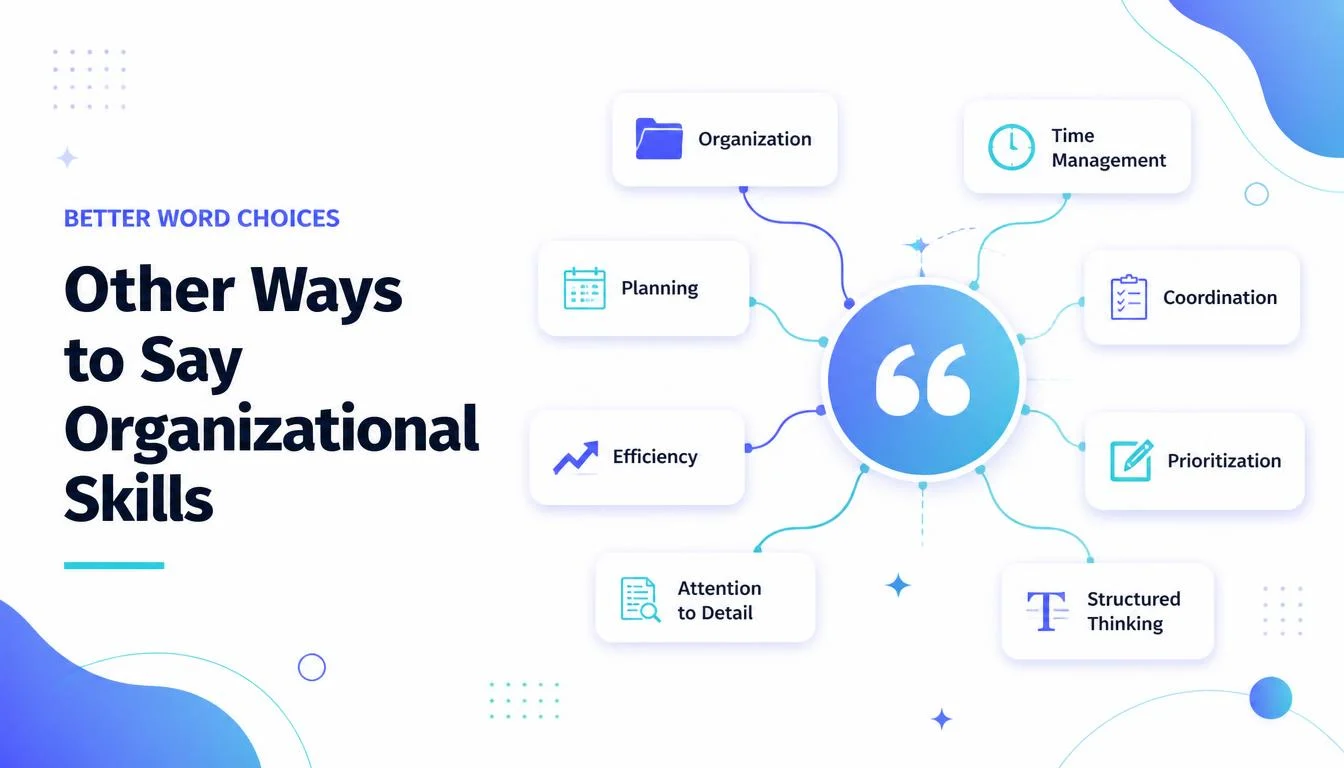
If you want fresh, natural ways to describe organizational skills in a resume, interview, or workplace conversation, try these five right away: planning ability, time management skills, ability to prioritize, structured approach, and coordination skills. Each one carries a slightly different shade of meaning, so the right choice depends on your tone and context.
Organizational skills describe a person’s ability to plan, structure, and manage tasks, time, and resources efficiently. People use this phrase constantly in resumes, job interviews, performance reviews, and everyday workplace conversations to describe someone who works in an orderly, methodical way.
Learning alternatives to organizational skills helps you avoid repeating the same phrase in a resume or cover letter, and it lets you match your language to the situation. A recruiter, a manager, and a close colleague all expect slightly different registers of English, and knowing multiple options helps you sound polished in every setting.
Beyond professional writing, synonym variety also helps you express excitement in English when you genuinely admire how well someone manages their workload. Instead of repeating “great organizational skills” every time, you can highlight structure, efficiency, or planning ability with more precision and energy.
Quick Categories
Formal alternatives to “organizational skills”
- Planning and coordination abilities
- Administrative competence
- Systematic approach to work
- Structured methodology
Pro Tip: Use formal alternatives in resumes, cover letters, and performance reviews where precision and professionalism matter most.
Casual alternatives
- Being on top of things
- Having it all together
- Keeping things in order
- A knack for staying organized
Pro Tip: Save casual phrases for team chats or informal feedback, not official documents.
Professional alternatives
- Project management skills
- Time management ability
- Resource allocation skills
- Process optimization skills
Pro Tip: Pair professional alternatives with a specific example, such as a project you streamlined, to make the phrase credible.
Informal expressions
- A well-oiled machine
- Got their ducks in a row
- Runs a tight ship
- Never misses a beat
Pro Tip: Informal expressions work well in spoken English but can sound unprofessional in written business communication.
“Precision in wording shows precision in thinking.”
Common Mistakes
- Overusing the exact phrase repeatedly in a resume. Example: “I have organizational skills. My organizational skills help me plan events. My organizational skills are strong.” (Repetitive and weak.)
- Using vague synonyms without proof or examples. Example: “I am very organized.” (Says nothing about how or why.)
- Confusing organizational skills with punctuality alone. Example: “I have organizational skills because I am always on time.” (Too narrow a definition.)
- Mixing formal and casual tone in the same document. Example: “I have excellent administrative competence and I basically have my ducks in a row.” (Inconsistent register.)
- Using the phrase without contextual evidence in interviews. Example: “I have great organizational skills, trust me.” (Unsupported claim.)
What Does “Organizational Skills” Mean?
Organizational skills refer to the ability to plan, prioritize, and manage tasks, time, and resources in a structured, efficient way. Grammatically, it functions as a noun phrase, typically used after verbs like “have,” “demonstrate,” or “possess.”
Example Sentence: She demonstrated strong organizational skills by managing three projects at once without missing a deadline.
When to Use “Organizational Skills”
- On a resume or CV, especially in the skills or summary section
- During job interviews when describing your work style
- In performance reviews and self-evaluations
- When writing recommendation letters for colleagues
Spoken vs Written
- Spoken: Often shortened or paraphrased, such as “I keep things running smoothly.”
- Written: Usually stated directly and formally, such as “Demonstrated excellent organizational skills.”
Formal vs Informal
- Formal: “Possesses strong organizational and planning abilities.”
- Informal: “Really good at keeping everything in order.”
Is It Professional or Polite to Say “Organizational Skills”?
The phrase itself is polite and widely accepted in professional English. It is a safe, neutral term suitable for resumes, interviews, and workplace communication.
Business Example: “Her organizational skills allowed the team to complete the audit two weeks ahead of schedule.”
Polite? ✔️ Yes Professional? ✔️ Yes (this phrase is professional in almost all contexts, unlike many casual expressions)
Pros and Cons of Using “Organizational Skills”
Pros
- Simple and natural
- Widely understood in business English
- Common usage across industries
- Easy to understand for non-native speakers
Cons
- Overused in resumes and cover letters
- Can sound generic without specific examples
- Limited emotional range or personality
- Not descriptive enough for niche technical roles
Other Ways to Say Organizational Skills
These alternatives will help you sound more fluent, confident, and natural in different situations. Use them according to tone, context, and audience to express excitement, admiration, or approval when describing someone’s efficiency and structure.
1. Phrase: Planning ability
Meaning: The skill of preparing steps in advance to reach a goal.
Explanation: Focuses on foresight rather than daily task management.
Example Sentence: Her planning ability made the product launch run smoothly.
Best Use: resumes, interviews
Worst Use: casual chats
Tone: formal, precise
Context Variability: professional, written
2. Phrase: Time management skills
Meaning: The ability to use time efficiently to complete tasks.
Explanation: Highlights scheduling and prioritization over general order.
Example Sentence: His time management skills let him juggle five clients at once.
Best Use: job descriptions
Worst Use: informal speech
Tone: professional, direct
Context Variability: professional, spoken
3. Phrase: Ability to prioritize
Meaning: Skill in deciding which tasks matter most.
Explanation: Emphasizes decision-making under competing demands.
Example Sentence: Her ability to prioritize helped the team meet a tight deadline.
Best Use: interviews
Worst Use: casual writing
Tone: analytical, confident
Context Variability: professional, spoken
4. Phrase: Structured approach
Meaning: A methodical way of handling tasks or projects.
Explanation: Suggests consistency and a clear system.
Example Sentence: His structured approach reduced errors across the department.
Best Use: performance reviews
Worst Use: casual texts
Tone: formal, methodical
Context Variability: professional, written
5. Phrase: Coordination skills
Meaning: The ability to bring people or tasks together smoothly.
Explanation: Focuses on teamwork and logistics rather than solo planning.
Example Sentence: Her coordination skills kept every department aligned during the merger.
Best Use: leadership roles
Worst Use: solo tasks
Tone: collaborative, capable
Context Variability: professional, spoken
6. Phrase: Administrative competence
Meaning: Proficiency in managing office tasks and processes.
Explanation: Often used for support or operations roles.
Example Sentence: Her administrative competence kept the office running without delays.
Best Use: office roles
Worst Use: creative fields
Tone: formal, technical
Context Variability: professional, written
7. Phrase: Systematic approach to work
Meaning: Working according to a fixed, logical method.
Explanation: Suggests reliability and repeatable processes.
Example Sentence: His systematic approach to work made onboarding new hires easier.
Best Use: technical roles
Worst Use: creative brainstorming
Tone: logical, formal
Context Variability: professional, written
8. Phrase: Process optimization skills
Meaning: The ability to improve how tasks or systems function.
Explanation: Common in operations, manufacturing, or tech roles.
Example Sentence: Her process optimization skills cut production time by twenty percent.
Best Use: operations roles
Worst Use: entry-level tasks
Tone: technical, results-driven
Context Variability: professional, written
9. Phrase: Project management skills
Meaning: The ability to plan, execute, and oversee projects.
Explanation: Broader than organization; includes leadership and budgeting.
Example Sentence: His project management skills brought the campaign in under budget.
Best Use: leadership resumes
Worst Use: entry-level jobs
Tone: authoritative, capable
Context Variability: professional, spoken
10. Phrase: Resource allocation skills
Meaning: Skill in distributing time, money, or staff effectively.
Explanation: Common in management and finance contexts.
Example Sentence: Her resource allocation skills prevented budget overruns all year.
Best Use: management roles
Worst Use: casual conversation
Tone: strategic, formal
Context Variability: professional, written
11. Phrase: Being on top of things
Meaning: Staying aware and in control of tasks.
Explanation: A casual way to describe general organization.
Example Sentence: She’s really on top of things this quarter.
Best Use: team chats
Worst Use: formal reports
Tone: casual, approving
Context Variability: casual, spoken
12. Phrase: Having it all together
Meaning: Being composed and well-organized in general.
Explanation: Informal, often used about personal or professional life.
Example Sentence: I don’t know how she has it all together with three kids and a full-time job.
Best Use: friendly conversation
Worst Use: resumes
Tone: warm, informal
Context Variability: casual, spoken
13. Phrase: Keeping things in order
Meaning: Maintaining structure and tidiness in tasks or spaces.
Explanation: Slightly casual but still workplace-appropriate.
Example Sentence: He’s great at keeping things in order, even during busy weeks.
Best Use: team feedback
Worst Use: formal writing
Tone: friendly, practical
Context Variability: casual, professional
14. Phrase: A knack for staying organized
Meaning: A natural talent for maintaining order.
Explanation: Suggests the skill comes easily, almost instinctively.
Example Sentence: She has a real knack for staying organized under pressure.
Best Use: informal praise
Worst Use: technical reports
Tone: admiring, casual
Context Variability: casual, spoken
15. Phrase: A well-oiled machine
Meaning: An operation that runs smoothly with no wasted effort.
Explanation: An idiom describing a team or system, not just a person.
Example Sentence: Under her leadership, the department became a well-oiled machine.
Best Use: team praise
Worst Use: individual resumes
Tone: idiomatic, impressed
Context Variability: casual, spoken
16. Phrase: Got their ducks in a row
Meaning: Fully prepared and organized before starting something.
Explanation: A common idiom for readiness and order.
Example Sentence: She had her ducks in a row before the client call even started.
Best Use: casual praise
Worst Use: formal documents
Tone: playful, informal
Context Variability: casual, spoken
17. Phrase: Runs a tight ship
Meaning: Manages a team or process with strict order and discipline.
Explanation: Often used for managers or leaders.
Example Sentence: The new supervisor runs a tight ship, and productivity has improved.
Best Use: leadership feedback
Worst Use: personal resumes
Tone: idiomatic, respectful
Context Variability: casual, spoken
18. Phrase: Never misses a beat
Meaning: Stays consistently organized without errors or delays.
Explanation: Implies flawless execution and attentiveness.
Example Sentence: Even during the busiest season, she never misses a beat.
Best Use: informal compliments
Worst Use: technical writing
Tone: admiring, casual
Context Variability: casual, spoken
19. Phrase: Methodical mindset
Meaning: A way of thinking that favors order and logical steps.
Explanation: Highlights cognitive style rather than daily tasks.
Example Sentence: His methodical mindset helped the team avoid costly mistakes.
Best Use: interviews
Worst Use: casual chat
Tone: formal, thoughtful
Context Variability: professional, spoken
20. Phrase: Detail-oriented planning
Meaning: Careful attention to small elements while organizing tasks.
Explanation: Combines organization with precision.
Example Sentence: Her detail-oriented planning caught issues before they became problems.
Best Use: quality-focused roles
Worst Use: big-picture strategy talks
Tone: precise, formal
Context Variability: professional, written
21. Phrase: Efficient work habits
Meaning: Practices that help someone complete tasks with minimal waste.
Explanation: Broader than organization, includes productivity overall.
Example Sentence: His efficient work habits let him finish reports ahead of schedule.
Best Use: performance reviews
Worst Use: casual introductions
Tone: professional, positive
Context Variability: professional, written
22. Phrase: Strong sense of structure
Meaning: A clear, natural preference for order and system.
Explanation: Often used to describe personality traits at work.
Example Sentence: Her strong sense of structure made the chaotic project manageable.
Best Use: interviews
Worst Use: informal texts
Tone: formal, descriptive
Context Variability: professional, spoken
23. Phrase: Logistical skills
Meaning: The ability to coordinate complex moving parts, like people or supplies.
Explanation: Common in event planning, operations, and supply chain roles.
Example Sentence: Her logistical skills made the conference run without a single delay.
Best Use: operations, events
Worst Use: creative writing roles
Tone: technical, capable
Context Variability: professional, spoken
24. Phrase: Task management ability
Meaning: Skill in tracking and completing multiple responsibilities.
Explanation: Emphasizes juggling workload rather than long-term planning.
Example Sentence: His task management ability kept the sprint on track.
Best Use: tech and agile teams
Worst Use: formal essays
Tone: modern, practical
Context Variability: professional, spoken
25. Phrase: Orderly work style
Meaning: A consistent, tidy approach to completing tasks.
Explanation: A neutral, slightly formal description of habits.
Example Sentence: Her orderly work style made handovers between shifts easy.
Best Use: performance notes
Worst Use: casual conversation
Tone: neutral, formal
Context Variability: professional, written
26. Phrase: Skilled at multitasking
Meaning: Able to handle several tasks at once effectively.
Explanation: Related to organization but focuses on parallel work.
Example Sentence: She’s skilled at multitasking, managing calls and reports simultaneously.
Best Use: fast-paced roles
Worst Use: single-focus jobs
Tone: energetic, capable
Context Variability: professional, spoken
27. Phrase: Efficient scheduler
Meaning: Someone who plans time and appointments effectively.
Explanation: Focuses specifically on calendar and time-based organization.
Example Sentence: As an efficient scheduler, he never double-books meetings.
Best Use: administrative roles
Worst Use: creative projects
Tone: precise, practical
Context Variability: professional, spoken
28. Phrase: Strategic planner
Meaning: Someone skilled at organizing long-term goals and steps.
Explanation: Suggests big-picture thinking, not just daily tasks.
Example Sentence: As a strategic planner, she mapped out the year’s goals in one meeting.
Best Use: leadership roles
Worst Use: entry-level tasks
Tone: authoritative, formal
Context Variability: professional, written
29. Phrase: Keeps everything streamlined
Meaning: Removes unnecessary steps to make processes smoother.
Explanation: Implies both organization and efficiency together.
Example Sentence: He keeps everything streamlined, so nothing ever falls behind.
Best Use: operations feedback
Worst Use: formal cover letters
Tone: modern, approving
Context Variability: casual, professional
30. Phrase: Highly systematic
Meaning: Following clear, consistent methods in all tasks.
Explanation: A concise, formal descriptor often used in evaluations.
Example Sentence: Her highly systematic approach made the audit process painless.
Best Use: formal evaluations
Worst Use: casual introductions
Tone: formal, precise
Context Variability: professional, written
“Words carry tone. Choose the one that matches the moment.”
“Fluency isn’t about big words. It’s about the right words.”
Mini Quiz / Self-Check
1. Which phrase is most appropriate for a formal resume?
a) Got their ducks in a row
b) Planning ability
c) A well-oiled machine
2. Which phrase would sound too casual in a business email?
a) Time management skills
b) Runs a tight ship
c) Administrative competence
3. Which phrase best describes managing a team’s coordination during a big event?
a) Logistical skills
b) Never misses a beat
c) Having it all together
4. True or False: “Organizational skills” is considered impolite in professional settings.
a) True
b) False
Answers: 1-b, 2-b, 3-a, 4-b
Comparison Table: Top Alternatives
| Phrase | Tone | Best Use |
|---|---|---|
| Planning ability | Formal, precise | Resumes |
| Time management skills | Professional, direct | Job descriptions |
| Ability to prioritize | Analytical, confident | Interviews |
| Structured approach | Formal, methodical | Performance reviews |
| Coordination skills | Collaborative, capable | Leadership roles |
| Administrative competence | Formal, technical | Office roles |
| Project management skills | Authoritative, capable | Leadership resumes |
| Being on top of things | Casual, approving | Team chats |
| Runs a tight ship | Idiomatic, respectful | Leadership feedback |
| Methodical mindset | Formal, thoughtful | Interviews |
FAQs
1. What is the most professional way to say organizational skills?
“Planning ability” or “structured approach” are strong, formal choices suitable for resumes and performance reviews.
2. Is “organizational skills” the same as “time management”?
They overlap but differ: organizational skills cover structure and order overall, while time management focuses specifically on scheduling.
3. Can I use idioms like “runs a tight ship” in a job interview?
Yes, in spoken conversation, but avoid idioms in written applications like resumes or cover letters.
4. How do I show organizational skills without repeating the phrase in my resume?
Rotate alternatives like “coordination skills,” “process optimization skills,” or “structured approach” throughout different bullet points.
5. What’s a casual way to compliment someone’s organizational skills?
Try “you really have your ducks in a row” or “you’re always on top of things” in informal conversation.
Conclusion
Learning multiple alternatives to organizational skills makes your English sound more natural, varied, and confident, whether you are writing a resume or chatting with colleagues. Each phrase carries its own tone, so matching the right word to the right context instantly improves how professional and articulate you sound.
Practice using a few of these phrases every day, in speech and writing, until they feel natural. Paying attention to tone, from formal terms like “administrative competence” to casual idioms like “runs a tight ship,” will help you communicate clearly in any situation.
Read More Related Articles:
- Other Ways to Say Circle Back | Improve Your Workplace Communication In 2026
- Other Ways to Say Welcome to the Team | Warm First Impression In 2026
- Other Ways to Say I Hope All Is Well | Make a Better First Impression In 2026

Henry Walker is an American writer and blogger with a keen interest in communication, language and digital content. At TextsResponse.com, he creates informative and reader-focused resources designed to help people communicate with clarity, confidence and authenticity.