Quick Answer
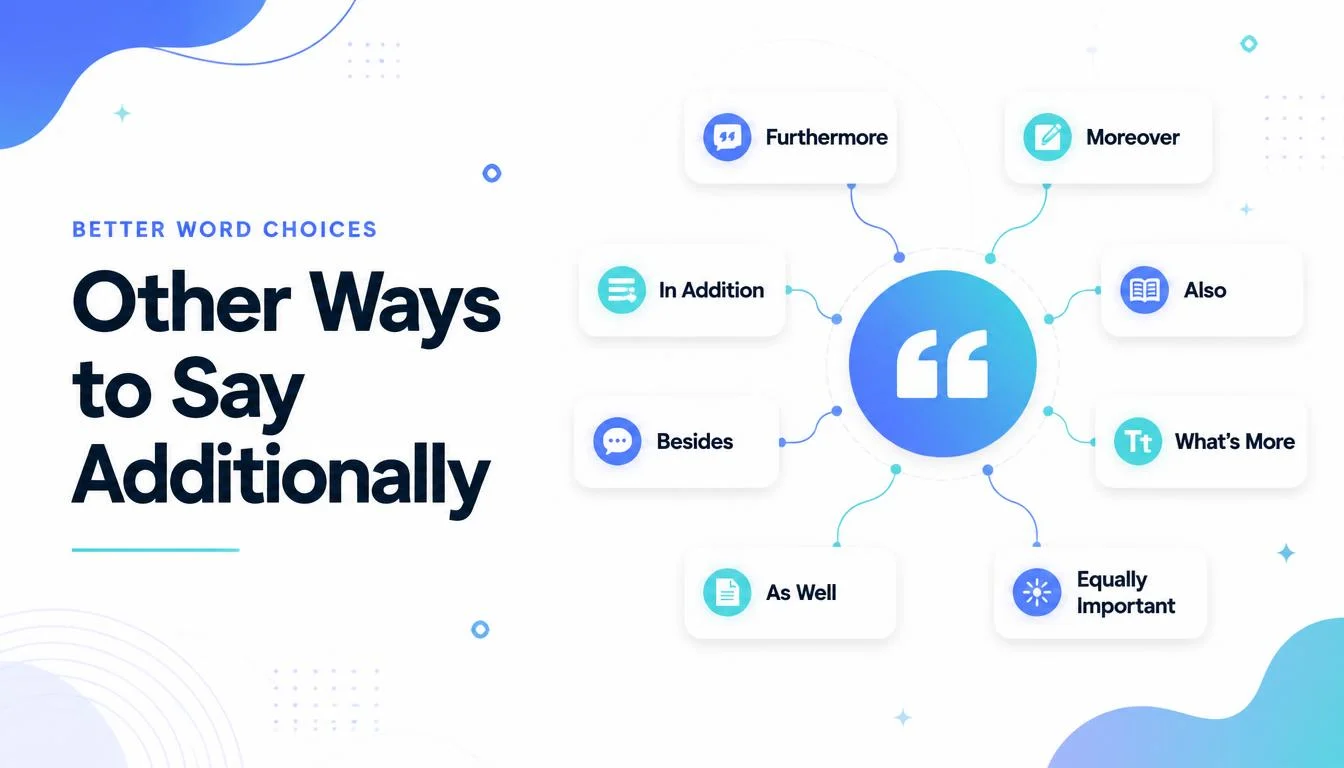
Other ways to say additionally include Furthermore, Moreover, In addition, Also, Besides, and On top of that. These alternatives help you express extra information clearly and naturally.
Finding the right words can make your writing more engaging and professional. Other ways to say additionally can help you avoid repetition and make your sentences flow smoothly in both formal and informal communication.
Whether you’re writing an essay, preparing a business email, or having a conversation, learning other ways to say additionally will help you connect ideas more effectively. From formal transitions to casual expressions, these alternatives make it easier to add information with clarity and confidon.
What Is “Additionally”? (Meaning, Grammar & Real Use)
Imagine writing a business email where you have already explained a project’s progress and now need to mention another important detail. Repeating “additionally” in every paragraph can make your message sound repetitive. Choosing a suitable alternative, such as “furthermore,” “in addition,” or “what’s more,” helps your writing flow naturally while keeping your ideas connected.
The word “additionally” is widely used in academic essays, business reports, presentations, professional emails, and everyday conversations. It helps readers understand that another point is being introduced to support or expand on the previous statement. Learning alternatives to “additionally” gives English learners more flexibility when connecting ideas and expressing information clearly.
These expressions are also useful for developing professional communication skills. Although phrases used to express excitement in English serve a different purpose, choosing the right transition word can make your message more engaging and easier to follow. Whether you are writing an essay or speaking in a meeting, understanding how to add information smoothly strengthens your overall fluency.
Definition
“Additionally” is an adverb that means “in addition” or “also.” It introduces extra information that supports, expands on, or complements a previous statement.
Example: The course improves writing skills. Additionally, it develops critical thinking.
Grammar Note
“Additionally” is a conjunctive adverb used to connect related ideas. It commonly appears at the beginning of a sentence, followed by a comma, or within a sentence to add information.
Example: The proposal is affordable. Furthermore, it is easy to implement.
It is considered neutral to formal and is especially common in professional and academic writing.
When Should You Use “Additionally”?
Use this transition when you want to introduce another point that relates to the information already presented.
Common Contexts
- Academic writing: Adding supporting arguments, research findings, or evidence.
- Professional emails: Mentioning extra details, requirements, or updates.
- Business reports: Expanding on results, recommendations, or observations.
- Presentations: Introducing another key point or supporting detail.
- Everyday conversations: Adding information to an ongoing discussion.
- Persuasive writing: Strengthening an argument with another supporting reason.
Spoken vs. Written English
Written: The company reduced operating costs. Additionally, it improved customer satisfaction.
Spoken: The location is convenient. Also, the parking is free.
“Additionally” is more common in formal writing, while “also” and “plus” often sound more natural in everyday speech.
Formal vs. Informal English
Formal: Furthermore, the findings support the proposed recommendations.
Informal: Plus, we can finish everything before Friday.
Choose the expression that matches the audience, purpose, and tone of your message.
Is It Professional or Just Polite?
“Additionally” is both professional and polite. It is a neutral transition word that helps introduce extra information without sounding overly emotional or demanding.
Politeness: It maintains a respectful, neutral tone.
Professionalism: It is appropriate for business emails, reports, proposals, and presentations.
Business-Style Example
“The revised schedule reduces delays. Additionally, it improves coordination between departments.”
Polite? ✔️ Yes
Professional? ✔️ Yes
Pros and Cons of Using “Additionally”
Pros
- Clear and simple: Introduces extra information in a straightforward way.
- Professional tone: Fits formal and business communication.
- Widely understood: Familiar to English speakers across different contexts.
- Improves organization: Helps readers follow related ideas.
Cons
- Can become repetitive: Frequent use makes writing sound monotonous.
- May sound overly formal: Can feel stiff in casual conversations.
- Limited emotional range: Adds information without expressing strong feelings.
- May weaken flow: Overusing transitions can make sentences feel mechanical.
Common Mistakes People Make
Avoid these five common errors when using additive transition words.
1. Repeating “Additionally” Too Often
Incorrect: The plan is affordable. Additionally, it is practical. Additionally, it is effective.
Correct: The plan is affordable. Furthermore, it is practical. It is also effective.
2. Using “Additionally” to Introduce a Contradiction
Incorrect: The product is expensive. Additionally, it is not durable.
Correct: The product is expensive. Moreover, it is not durable.
Note: “Moreover” adds emphasis, but if you want to highlight a contrast, use “however.”
3. Confusing “Additionally” With “Consequently”
Incorrect: The team worked hard. Additionally, the project was completed early.
Correct: The team worked hard. Consequently, the project was completed early.
“Consequently” expresses a result, while “additionally” introduces another point.
4. Forgetting the Comma After a Sentence-Initial Transition
Incorrect: Additionally the company expanded its services.
Correct: Additionally, the company expanded its services.
5. Using an Informal Expression in a Formal Report
Incorrect: Plus, the findings support the proposed strategy.
Correct: Furthermore, the findings support the proposed strategy.
“Small tone mistakes can make confident English sound careless.”
Alternatives by Category
The following curated preview introduces useful alternatives. All of these phrases also appear in the full list below.
Formal alternatives to “Additionally”
- Furthermore
- Moreover
- In addition
- Additionally to this
Pro Tip: Use “furthermore” and “moreover” to introduce supporting points in formal essays and reports. Avoid “additionally to this,” which is generally less natural than “in addition to this.”
Casual alternatives
- Also
- Plus
- What’s more
- On top of that
Pro Tip: Choose “also” for everyday conversations and “plus” when adding a quick supporting point.
Professional alternatives
- In addition
- Furthermore
- Along with that
- As well as that
Pro Tip: Use “in addition” in business emails and “furthermore” in reports when introducing a closely related point.
Informal expressions
- Besides that
- Another thing is
- Not only that
- And another thing
Pro Tip: Use conversational expressions in discussions and informal messages, but choose a more neutral transition for formal documents.
“Formal and informal English aren’t about correctness. They’re about context.”
Other Ways to Say “Additionally” (Full List With Examples)
These 30 alternatives help you connect ideas more naturally, improve fluency, and communicate with greater confidence. Choose each expression according to tone, context, and audience.
1. Phrase: Furthermore
Meaning: Introduces an additional supporting point.
Explanation: Common in formal and academic writing.
Example Sentence: The strategy is affordable. Furthermore, it improves efficiency.
Best Use: Academic writing
Worst Use: Casual chat
Tone: Formal, logical, professional
Context Variability: Casual: The plan works. Also, it’s affordable. Professional: Furthermore, the strategy reduces costs. Spoken: Furthermore, we need more time.
2. Phrase: Moreover
Meaning: Adds another point that strengthens an argument.
Explanation: Often emphasizes the importance of supporting information.
Example Sentence: The service is reliable. Moreover, it is affordable.
Best Use: Persuasive writing
Worst Use: Casual chat
Tone: Formal, emphatic, polished
Context Variability: Casual: It’s useful, plus it’s cheap. Professional: Moreover, the proposal supports growth. Spoken: Moreover, we should consider the risks.
3. Phrase: In Addition
Meaning: Introduces another related point.
Explanation: A versatile expression suitable for formal and professional contexts.
Example Sentence: In addition, the company offers flexible working hours.
Best Use: General writing
Worst Use: Repetitive prose
Tone: Neutral, professional, clear
Context Variability: Casual: Also, we have snacks. Professional: In addition, the team provides training. Spoken: In addition, we need approval.
4. Phrase: Also
Meaning: Adds another piece of information.
Explanation: One of the most natural and versatile alternatives.
Example Sentence: The course is affordable and also includes practical exercises.
Best Use: Everyday communication
Worst Use: Formal repetition
Tone: Neutral, natural, simple
Context Variability: Casual: I also like the design. Professional: We also provide technical support. Spoken: She also joined the meeting.
5. Phrase: What’s More
Meaning: Introduces another point, often with added emphasis.
Explanation: Highlights an extra benefit or supporting detail.
Example Sentence: The apartment is spacious. What’s more, it is close to work.
Best Use: Engaging writing
Worst Use: Legal documents
Tone: Friendly, emphatic, conversational
Context Variability: Casual: It’s cheap. What’s more, it’s nearby. Professional: What’s more, the plan improves productivity. Spoken: What’s more, we have extra time.
6. Phrase: Plus
Meaning: Adds another reason, benefit, or detail.
Explanation: Common in casual speech and informal writing.
Example Sentence: The restaurant is nearby. Plus, it offers affordable meals.
Best Use: Casual conversation
Worst Use: Formal reports
Tone: Casual, upbeat, direct
Context Variability: Casual: Plus, it’s free. Professional: The service is affordable, and it also saves time. Spoken: Plus, we can leave early.
7. Phrase: On Top of That
Meaning: Introduces an additional point, often emphasizing an extra benefit or burden.
Explanation: Common in everyday speech and informal writing.
Example Sentence: The deadline is approaching. On top of that, two team members are absent.
Best Use: Everyday speech
Worst Use: Academic writing
Tone: Conversational, emphatic, informal
Context Variability: Casual: On top of that, we got a discount. Professional: Additionally, the team must complete training. Spoken: On top of that, the traffic is terrible.
8. Phrase: Besides That
Meaning: Adds another point to an ongoing discussion.
Explanation: Often introduces an extra consideration or supporting detail.
Example Sentence: Besides that, the proposal includes a detailed budget.
Best Use: Casual discussions
Worst Use: Formal research
Tone: Conversational, neutral, relaxed
Context Variability: Casual: Besides that, everything looks good. Professional: In addition, the report includes a budget. Spoken: Besides that, we need approval.
9. Phrase: As Well
Meaning: Indicates that something is included in addition to another thing.
Explanation: Commonly appears at the end of a clause or sentence.
Example Sentence: The package includes installation as well.
Best Use: Everyday communication
Worst Use: Sentence openings
Tone: Neutral, natural, friendly
Context Variability: Casual: I’ll come as well. Professional: The service includes maintenance as well. Spoken: She wants to join as well.
10. Phrase: As Well As That
Meaning: Introduces another related point or feature.
Explanation: Connects an additional detail to the previous statement.
Example Sentence: The course improves grammar. As well as that, it develops speaking skills.
Best Use: Conversational writing
Worst Use: Concise reports
Tone: Neutral, conversational, explanatory
Context Variability: Casual: It’s affordable. As well as that, it’s convenient. Professional: In addition, the course improves communication. Spoken: As well as that, we have more time.
11. Phrase: Along With That
Meaning: Introduces another item or related detail.
Explanation: Often connects an additional feature, task, or responsibility.
Example Sentence: Along with that, the company provides health insurance.
Best Use: Workplace communication
Worst Use: Formal citations
Tone: Neutral, professional, conversational
Context Variability: Casual: Along with that, we need snacks. Professional: Along with that, employees receive training. Spoken: Along with that, we should review the budget.
12. Phrase: In Addition To This
Meaning: Introduces something extra beyond what has already been mentioned.
Explanation: Usually followed by a noun or noun phrase.
Example Sentence: In addition to this, the company offers remote work options.
Best Use: Formal writing
Worst Use: Repeated transitions
Tone: Formal, clear, explanatory
Context Variability: Casual: Besides that, we have more time. Professional: In addition to this, the team receives support. Spoken: In addition to this, we need approval.
13. Phrase: Another Point Is
Meaning: Introduces a new supporting idea.
Explanation: Helps organize arguments and discussions.
Example Sentence: Another point is that the project requires additional funding.
Best Use: Presentations
Worst Use: Formal citations
Tone: Neutral, organized, direct
Context Variability: Casual: Another point is that we need snacks. Professional: Another point is that costs may increase. Spoken: Another point is that we need more staff.
14. Phrase: Another Thing Is
Meaning: Introduces another detail or consideration.
Explanation: Common in informal conversations and discussions.
Example Sentence: Another thing is that we need to confirm the venue.
Best Use: Casual discussions
Worst Use: Formal reports
Tone: Conversational, relaxed, natural
Context Variability: Casual: Another thing is, I’m busy tomorrow. Professional: Additionally, the schedule requires approval. Spoken: Another thing is, we need a backup plan.
15. Phrase: Not Only That
Meaning: Adds another point that reinforces the previous statement.
Explanation: Often emphasizes an additional benefit or problem.
Example Sentence: The software is easy to use. Not only that, it is affordable.
Best Use: Emphatic speech
Worst Use: Technical reports
Tone: Emphatic, conversational, engaging
Context Variability: Casual: It’s fun. Not only that, it’s free. Professional: Furthermore, the system reduces errors. Spoken: Not only that, it saves time.
16. Phrase: And Another Thing
Meaning: Introduces an additional point in a conversation.
Explanation: Can sound emphatic, especially when raising a concern.
Example Sentence: And another thing, we need to discuss the revised deadline.
Best Use: Informal discussions
Worst Use: Academic writing
Tone: Conversational, emphatic, direct
Context Variability: Casual: And another thing, bring your notebook. Professional: Additionally, we must review the deadline. Spoken: And another thing, please call me later.
17. Phrase: Beyond That
Meaning: Introduces an additional point beyond what has already been discussed.
Explanation: Can suggest a further consideration or a broader perspective.
Example Sentence: The product is affordable. Beyond that, it is easy to maintain.
Best Use: Analytical discussions
Worst Use: Simple lists
Tone: Neutral, thoughtful, polished
Context Variability: Casual: Beyond that, it’s a good deal. Professional: Beyond that, the proposal supports long-term growth. Spoken: Beyond that, we need more details.
18. Phrase: Further
Meaning: Introduces additional information or indicates something more.
Explanation: Often appears in formal expressions such as “furthermore” or “further details.”
Example Sentence: Further, the report identifies several areas for improvement.
Best Use: Formal writing
Worst Use: Casual speech
Tone: Formal, concise, professional
Context Variability: Casual: Also, we need more time. Professional: Further, the report outlines risks. Spoken: Further, we should review the results.
19. Phrase: Additionally To This
Meaning: Intended to introduce another related point.
Explanation: This construction is generally unnatural. Prefer “in addition to this.”
Example Sentence: In addition to this, the team will provide technical support.
Best Use: Corrected writing
Worst Use: Standard usage
Tone: Formal, explanatory, corrective
Context Variability: Casual: Besides that, we need help. Professional: In addition to this, the team offers support. Spoken: Also, we need assistance.
20. Phrase: Equally Important
Meaning: Introduces another point of comparable importance.
Explanation: Emphasizes that the next detail deserves equal attention.
Example Sentence: Equally important, the team must maintain data security.
Best Use: Persuasive writing
Worst Use: Minor details
Tone: Formal, emphatic, analytical
Context Variability: Casual: Just as important, we need a plan. Professional: Equally important, we must protect customer data. Spoken: Equally important, everyone should participate.
21. Phrase: More Importantly
Meaning: Introduces a point considered more significant than the previous one.
Explanation: Adds emphasis rather than simply listing another detail.
Example Sentence: More importantly, the new policy protects employee privacy.
Best Use: Emphasizing priorities
Worst Use: Equal points
Tone: Emphatic, professional, analytical
Context Variability: Casual: More importantly, we had fun. Professional: More importantly, the change improves safety. Spoken: More importantly, everyone is safe.
22. Phrase: To Add To That
Meaning: Introduces another related detail or supporting point.
Explanation: Common in conversations and informal discussions.
Example Sentence: To add to that, the new system reduces paperwork.
Best Use: Group discussions
Worst Use: Formal reports
Tone: Conversational, cooperative, neutral
Context Variability: Casual: To add to that, the food was great. Professional: Furthermore, the system reduces costs. Spoken: To add to that, we need more time.
23. Phrase: In the Same Way
Meaning: Introduces a point that follows a similar pattern or idea.
Explanation: Indicates similarity rather than simply adding unrelated information.
Example Sentence: The first team improved its results. In the same way, the second team made progress.
Best Use: Comparisons
Worst Use: Unrelated points
Tone: Neutral, explanatory, analytical
Context Variability: Casual: In the same way, I prefer the second option. Professional: Similarly, the second department improved. Spoken: In the same way, we can solve this problem.
24. Phrase: Likewise
Meaning: Introduces a similar point or corresponding situation.
Explanation: Often connects parallel ideas rather than simply adding information.
Example Sentence: The first proposal reduces costs. Likewise, the second improves efficiency.
Best Use: Parallel comparisons
Worst Use: Unrelated details
Tone: Formal, concise, neutral
Context Variability: Casual: Likewise, I enjoyed the event. Professional: Likewise, the second team met its target. Spoken: Likewise, we should review the results.
25. Phrase: Similarly
Meaning: Introduces another point that resembles the previous one.
Explanation: Best when the added information has a clear similarity.
Example Sentence: The first department improved productivity. Similarly, the second reduced delays.
Best Use: Comparative writing
Worst Use: Unrelated information
Tone: Analytical, formal, neutral
Context Variability: Casual: Similarly, I liked the other one. Professional: Similarly, the second team improved efficiency. Spoken: Similarly, we can adjust the schedule.
26. Phrase: What’s Also Worth Noting
Meaning: Introduces another detail considered relevant or noteworthy.
Explanation: Directs attention to an additional observation.
Example Sentence: What’s also worth noting is that the service is available 24 hours a day.
Best Use: Detailed explanations
Worst Use: Brief messages
Tone: Thoughtful, informative, professional
Context Variability: Casual: It’s also worth noting that parking is free. Professional: It is also worth noting that costs have declined. Spoken: What’s also worth noting is the shorter delivery time.
27. Phrase: On a Related Note
Meaning: Introduces another point connected to the current topic.
Explanation: Often shifts the discussion to a closely related issue.
Example Sentence: On a related note, we should review the updated schedule.
Best Use: Topic transitions
Worst Use: Unrelated points
Tone: Neutral, conversational, professional
Context Variability: Casual: On a related note, did you call Sam? Professional: On a related note, the budget needs review. Spoken: On a related note, we need to discuss staffing.
28. Phrase: Alongside This
Meaning: Introduces an additional feature, action, or consideration.
Explanation: Emphasizes that two things occur or exist together.
Example Sentence: Alongside this, the company introduced a new training program.
Best Use: Business updates
Worst Use: Direct quotations
Tone: Professional, neutral, polished
Context Variability: Casual: Alongside this, we bought new supplies. Professional: Alongside this, the company expanded its services. Spoken: Alongside this, we need a new schedule.
29. Phrase: Added To That
Meaning: Introduces another point that contributes to the existing information.
Explanation: Common in conversational English, though “to add to that” is often more natural.
Example Sentence: To add to that, the team completed the project ahead of schedule.
Best Use: Informal discussion
Worst Use: Formal essays
Tone: Conversational, explanatory, relaxed
Context Variability: Casual: To add to that, the place is nearby. Professional: Furthermore, the team met its target. Spoken: To add to that, we have extra resources.
30. Phrase: Additionally
Meaning: Introduces extra information related to a previous point.
Explanation: The original expression remains a clear and professional choice.
Example Sentence: The company improved its services. Additionally, it expanded its customer support team.
Best Use: Professional writing
Worst Use: Repetitive prose
Tone: Neutral, formal, clear
Context Variability: Casual: Also, we have more time. Professional: Additionally, the team will review the proposal. Spoken: Additionally, we need to confirm the details.
Comparison Table: Top 10 Alternatives at a Glance
| Phrase | Tone | Best Use |
|---|---|---|
| Furthermore | Formal | Academic writing |
| Moreover | Formal | Supporting arguments |
| In addition | Neutral | General communication |
| Also | Casual, neutral | Everyday conversation |
| What’s more | Conversational | Emphasizing benefits |
| Plus | Informal | Casual discussions |
| On top of that | Informal | Extra details |
| As well | Neutral | Adding information |
| Along with that | Professional | Workplace communication |
| Beyond that | Neutral | Further considerations |
Quick Self-Check (Mini Quiz)
Test your understanding of additive transitions with these four questions.
Question 1
You are writing a formal report and want to introduce another supporting point. Which phrase is most appropriate?PlusFurthermoreAnd another thing
Question 2
You are chatting with a friend and want to add a quick benefit. Which expression sounds natural?Pursuant toPlusIn accordance with
Question 3
You want to introduce a point that is similar to the previous one. Which phrase should you choose?SimilarlyConsequentlyHowever
Question 4
Which expression is most appropriate for adding another point in a professional email?In additionAnd another thingOn top of that
FAQs
1. What are the best alternatives to “additionally”?
The most versatile alternatives are “furthermore,” “moreover,” “in addition,” “also,” and “what’s more.” Choose based on tone and context.
2. What is a formal alternative to “additionally”?
“Furthermore,” “moreover,” and “in addition” are common formal alternatives for academic writing, reports, and professional communication.
3. How can I replace “additionally” in a professional email?
Use “in addition,” “also,” or “furthermore” to introduce extra details, supporting information, or another point.
4. Is “additionally” too formal for everyday conversation?
It can sound formal in casual conversation. “Also,” “plus,” and “what’s more” often sound more natural in everyday speech.
5. What is the difference between “additionally” and “furthermore”?
Both introduce extra information. “Furthermore” often adds emphasis to a supporting argument, while “additionally” generally introduces another related point.
conclusion
Learning different ways to introduce additional information helps you communicate more clearly and avoid repetitive writing. Expressions such as “furthermore,” “in addition,” and “also” allow you to connect ideas naturally across professional, academic, and casual settings.
Practice these transitions in emails, essays, and everyday conversations. Pay attention to tone and context so your English sounds fluent, confident, and appropriate for your audience.
Read More Related Articles:
- Other Ways to Say “Let’s Go Team” | Games, Work and More In 2026
- Other Ways to Say Problem Solving Skills | Make Your Resume Stronger In 2026
- Other Ways to Say No in Spanish | Simple Ways to Sound Fluent In 2026

Henry Walker is an American writer and blogger with a keen interest in communication, language and digital content. At TextsResponse.com, he creates informative and reader-focused resources designed to help people communicate with clarity, confidence and authenticity.