Quick Answer
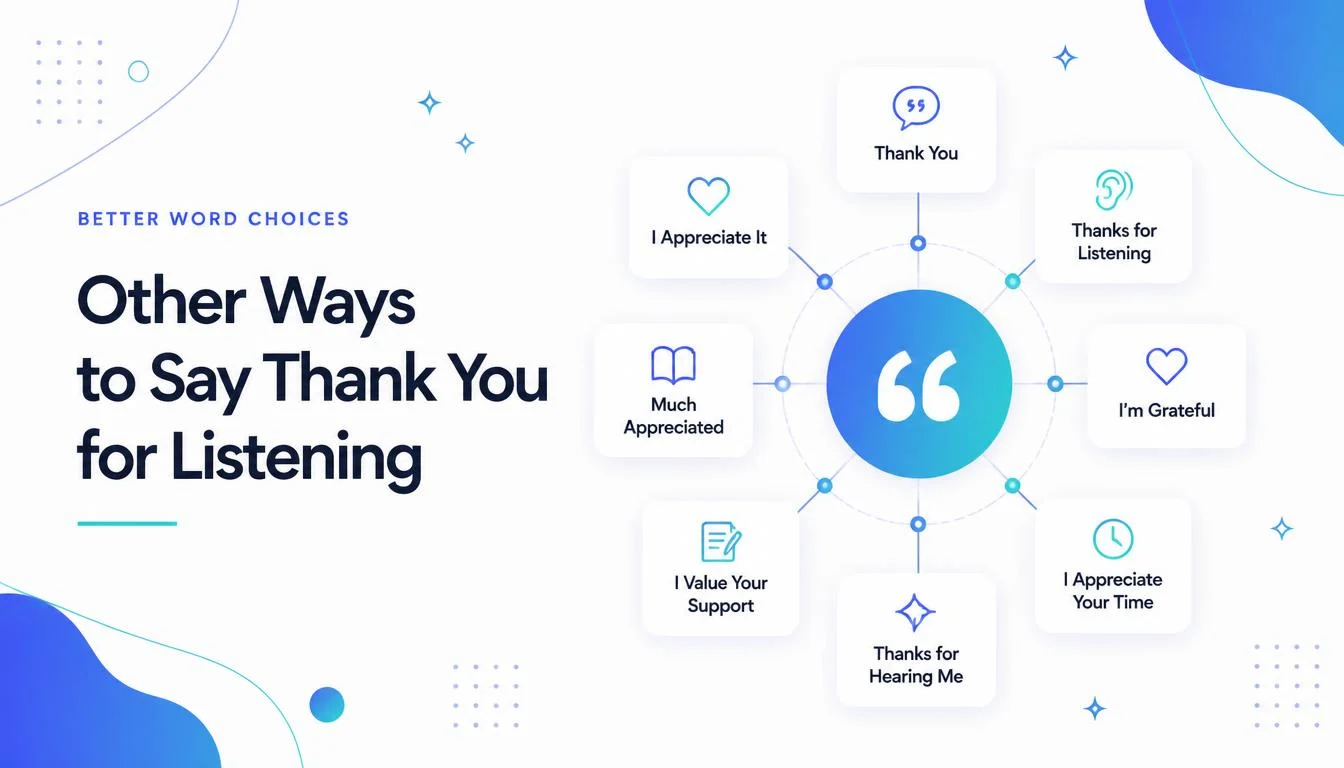
Other ways to say “Thank you for listening” include I appreciate your attention, Thank you for hearing me out, I’m grateful you listened, and Thank you for your time.
Finding the right other ways to say thank you for listening can help you express appreciation more naturally and thoughtfully. Whether you are speaking in a presentation, conversation, meeting, or personal discussion, the right phrase can make your message feel more sincere.
In this guide, we’ll explore useful other ways to say thank you for listening, from formal and professional expressions to warm and conversational alternatives. These phrases can help you communicate gratitude while matching the tone and context of the situation.
What Is “Other Ways to Say Thank You for Listening”? Meaning, Grammar & Real Use
Imagine finishing a presentation, sharing a difficult experience with a colleague, or speaking to a group about an important idea. You want to acknowledge that people gave you their attention, but repeating the same closing phrase every time can make your communication feel predictable. Choosing a more specific expression can make your appreciation sound warmer, more professional, or more personal.
The phrase “thank you for listening” is a polite way to recognize someone’s attention after you have spoken. It is especially common at the end of presentations, speeches, conversations, meetings, and personal discussions. Learning alternatives to this expression gives you more flexibility when communicating with different audiences.
These expressions are also useful when you want to express excitement in English, appreciation, empathy, or respect without sounding repetitive. The best choice depends on whether you are speaking to a friend, customer, manager, audience, or colleague.
Definition
“Thank you for listening” is an expression of gratitude used to acknowledge someone’s attention after you have spoken or shared information.
Grammar Note
“Thank you” is a polite expression of gratitude, followed by the preposition “for” and the gerund “listening.” The phrase is grammatically correct and works in both spoken and written English.
Example: “Thank you for listening to my presentation.”
Where and Why People Use It
You can use the expression in:
- Presentations and speeches
- Meetings and discussions
- Personal conversations
- Interviews and talks
- Online presentations
- Academic presentations
- Professional communication
- Emotional or supportive conversations
It is suitable for both spoken and written communication, although more specific alternatives may sound more polished in formal professional settings.
When Should You Use “Thank You for Listening”?
Use the expression when you want to recognize that someone has given you their attention or allowed you to finish speaking.
Common Contexts
- After a presentation: “Thank you for listening to my presentation.”
- After sharing an opinion: “Thank you for listening to my thoughts.”
- After an emotional conversation: “Thank you for listening to me.”
- After a speech: “Thank you all for listening.”
- During professional communication: “Thank you for listening to my proposal.”
- After asking for advice: “Thank you for listening and understanding.”
Spoken vs Written
Spoken: “Thanks for listening. I really appreciate it.”
Written: “Thank you for taking the time to review my comments.”
The spoken version can be warmer and more conversational, while the written version may focus more specifically on the recipient’s time and attention.
Formal vs Informal
Formal: “Thank you for your time and attention.”
Neutral: “Thank you for listening.”
Casual: “Thanks for hearing me out.”
Is It Professional or Just Polite?
“Thank you for listening” is both polite and acceptable in professional situations. However, the most appropriate wording depends on what the audience has actually done.
For a presentation, “Thank you for your time and attention” can sound more formal. For a personal conversation, “I appreciate you listening” can sound warmer and more natural.
Business example: “Thank you for your time and attention. I would be happy to answer any questions.”
Polite? ✔️ Yes
Professional? ✔️ Yes
Pros and Cons of Using “Thank You for Listening”
Pros
- Simple: The meaning is immediately clear.
- Polite: It acknowledges the listener’s attention respectfully.
- Versatile: It works in personal, academic, and professional settings.
- Natural: Native speakers commonly use it after conversations and presentations.
Cons
- Can sound repetitive: Using it after every presentation may feel formulaic.
- May lack specificity: It does not explain what you appreciate about the listener’s contribution.
- Can feel distant: In an emotional conversation, a warmer phrase may be more appropriate.
- May be less polished: Formal presentations sometimes benefit from more specific professional reaction phrases.
Common Mistakes People Make
1. Using “Thanks for Listening” in Every Situation
The phrase is correct, but repeating it mechanically can sound rehearsed.
Less natural: “Thanks for listening” after every business presentation.
Better: “Thank you for your time and attention.”
2. Confusing “Listening” With “Hearing”
“Hearing” and “listening” are not identical. Listening usually implies paying attention.
Incorrect: “Thank you for hearing my presentation.”
Correct: “Thank you for listening to my presentation.”
3. Using “Hear Me Out” With a Formal Audience
“Hear me out” is conversational and often suggests that you want someone to consider an opinion or proposal.
Less suitable: “Thank you for hearing me out, distinguished guests.”
Better: “Thank you for your time and consideration.”
4. Forgetting the Preposition “For”
When “listening” follows “thank you,” use “for.”
Incorrect: “Thank you listening to me.”
Correct: “Thank you for listening to me.”
5. Using an Overly Formal Phrase in a Personal Conversation
A formal expression can create unnecessary distance.
Awkward: “I appreciate your attention and consideration” to a close friend.
Natural: “I really appreciate you listening.”
“Small tone mistakes can make confident English sound careless.”
Alternatives by Category
Formal alternatives to “Thank You for Listening”
- Thank you for your time and attention.
- Thank you for your consideration.
- I appreciate your attention.
- Thank you for taking the time to listen.
Pro Tip: For speeches and formal presentations, mention the audience’s time, attention, or consideration rather than simply repeating “thank you.”
Casual alternatives
- I appreciate you listening.
- Thanks for hearing me out.
- Thanks for listening.
- I really appreciate it.
Pro Tip: Use warmer, simpler expressions when speaking with friends, familiar colleagues, or people in relaxed conversations.
Professional alternatives
- Thank you for your time.
- I appreciate your attention.
- Thank you for taking the time to hear me out.
- I value your time and attention.
Pro Tip: In professional communication, connect your appreciation to a specific action such as listening, reviewing, considering, or discussing.
Informal expressions
- Thanks for hearing me out.
- I appreciate you being here.
- Thanks for sticking with me.
- I really appreciate you listening.
Pro Tip: Informal expressions in English work best when the relationship and setting already allow a relaxed conversational tone.
“Formal and informal English aren’t about correctness. They’re about context.”
Other Ways to Say “Thank You for Listening”
These 30 alternatives build fluency and help you express appreciation, admiration, or approval depending on your audience, relationship, and context.
1. Phrase: I Appreciate You Listening
Meaning: Shows gratitude for someone’s attention.
Explanation: A warm and natural choice for personal conversations.
Example Sentence: “I appreciate you listening to me.”
Best Use: Personal conversations
Worst Use: Formal speeches
Tone: Warm, sincere
Context Variability: Casual / professional / spoken
2. Phrase: Thank You for Hearing Me Out
Meaning: Thanks someone for patiently considering what you said.
Explanation: Often used after sharing an opinion or concern.
Example Sentence: “Thank you for hearing me out before making a decision.”
Best Use: Difficult discussions
Worst Use: Formal reports
Tone: Appreciative, conversational
Context Variability: Casual / professional / spoken
3. Phrase: Thank You for Your Time and Attention
Meaning: Appreciates both time and focused attention.
Explanation: A polished option for presentations and formal settings.
Example Sentence: “Thank you for your time and attention.”
Best Use: Formal presentations
Worst Use: Casual chats
Tone: Formal, respectful
Context Variability: Casual / professional / spoken
4. Phrase: Thank You for Your Attention
Meaning: Thanks an audience for paying attention.
Explanation: Particularly common at the end of presentations and speeches.
Example Sentence: “Thank you for your attention.”
Best Use: Public presentations
Worst Use: Personal talks
Tone: Formal, concise
Context Variability: Casual / professional / spoken
5. Phrase: I Appreciate Your Attention
Meaning: Expresses gratitude for someone’s focused attention.
Explanation: Suitable for professional and academic communication.
Example Sentence: “I appreciate your attention during today’s presentation.”
Best Use: Business presentations
Worst Use: Casual texting
Tone: Professional, courteous
Context Variability: Casual / professional / spoken
6. Phrase: Thank You for Taking the Time to Listen
Meaning: Appreciates the time someone deliberately gave you.
Explanation: More specific and personal than a simple thank-you.
Example Sentence: “Thank you for taking the time to listen to my concerns.”
Best Use: Personal discussions
Worst Use: Quick exchanges
Tone: Sincere, respectful
Context Variability: Casual / professional / spoken
7. Phrase: I Value Your Time and Attention
Meaning: Shows respect for someone’s time and focus.
Explanation: Strong choice for professional communication.
Example Sentence: “I value your time and attention during this discussion.”
Best Use: Business meetings
Worst Use: Casual chats
Tone: Professional, respectful
Context Variability: Casual / professional / spoken
8. Phrase: Thank You for Considering My Thoughts
Meaning: Thanks someone for thinking about your ideas or opinions.
Explanation: Useful when presenting an argument or viewpoint.
Example Sentence: “Thank you for considering my thoughts on the proposal.”
Best Use: Professional discussions
Worst Use: Informal chats
Tone: Respectful, thoughtful
Context Variability: Casual / professional / written
9. Phrase: Thank You for Considering My Perspective
Meaning: Appreciates someone’s willingness to understand your viewpoint.
Explanation: Especially useful during discussions involving different opinions.
Example Sentence: “Thank you for considering my perspective on this issue.”
Best Use: Difficult discussions
Worst Use: Casual greetings
Tone: Respectful, diplomatic
Context Variability: Casual / professional / spoken
10. Phrase: I Appreciate Your Willingness to Listen
Meaning: Thanks someone for being receptive.
Explanation: Highlights openness rather than simply attention.
Example Sentence: “I appreciate your willingness to listen to my concerns.”
Best Use: Sensitive discussions
Worst Use: Routine meetings
Tone: Sincere, diplomatic
Context Variability: Casual / professional / spoken
11. Phrase: Thank You for Being Attentive
Meaning: Thanks someone for paying close attention.
Explanation: Directly recognizes attentive behavior.
Example Sentence: “Thank you for being attentive throughout the presentation.”
Best Use: Formal events
Worst Use: Close friends
Tone: Formal, appreciative
Context Variability: Casual / professional / spoken
12. Phrase: Thank You for Giving Me Your Attention
Meaning: Thanks someone for focusing on what you said.
Explanation: Appropriate when addressing an audience.
Example Sentence: “Thank you for giving me your attention today.”
Best Use: Public speaking
Worst Use: Private texting
Tone: Formal, courteous
Context Variability: Casual / professional / spoken
13. Phrase: I’m Grateful You Took the Time to Listen
Meaning: Expresses sincere gratitude for someone’s time.
Explanation: More personal and emotionally warm than a basic thank-you.
Example Sentence: “I’m grateful you took the time to listen to me.”
Best Use: Personal support
Worst Use: Quick meetings
Tone: Warm, sincere
Context Variability: Casual / professional / spoken
14. Phrase: Thank You for Listening So Carefully
Meaning: Thanks someone for paying close attention.
Explanation: Specifically recognizes the quality of their attention.
Example Sentence: “Thank you for listening so carefully to my explanation.”
Best Use: Detailed discussions
Worst Use: Formal speeches
Tone: Warm, appreciative
Context Variability: Casual / professional / spoken
15. Phrase: I’m Thankful You Listened
Meaning: Expresses gratitude that someone listened.
Explanation: Works particularly well in personal or emotional conversations.
Example Sentence: “I’m thankful you listened when I needed someone to talk to.”
Best Use: Personal conversations
Worst Use: Formal reports
Tone: Warm, sincere
Context Variability: Casual / professional / spoken
16. Phrase: Thank You for Hearing Me
Meaning: Thanks someone for listening to your concerns.
Explanation: Can sound especially sincere when discussing emotions or difficulties.
Example Sentence: “Thank you for hearing me when I was struggling.”
Best Use: Emotional conversations
Worst Use: Business reports
Tone: Personal, sincere
Context Variability: Casual / professional / spoken
17. Phrase: I Appreciate Being Heard
Meaning: Expresses gratitude for having your perspective acknowledged.
Explanation: Useful when someone has listened respectfully to your concerns.
Example Sentence: “I appreciate being heard during our discussion.”
Best Use: Sensitive conversations
Worst Use: Casual greetings
Tone: Sincere, reflective
Context Variability: Casual / professional / spoken
18. Phrase: Thank You for Your Consideration
Meaning: Thanks someone for thoughtfully considering what you presented.
Explanation: A professional expression often used after requests or proposals.
Example Sentence: “Thank you for your consideration of my proposal.”
Best Use: Formal correspondence
Worst Use: Casual conversations
Tone: Formal, courteous
Context Variability: Casual / professional / written
19. Phrase: Thank You for Engaging With My Ideas
Meaning: Appreciates someone’s active attention to your ideas.
Explanation: Works well when discussing proposals or creative concepts.
Example Sentence: “Thank you for engaging with my ideas during the meeting.”
Best Use: Creative discussions
Worst Use: Casual greetings
Tone: Professional, appreciative
Context Variability: Casual / professional / spoken
20. Phrase: I Appreciate Your Time
Meaning: Thanks someone for spending time with you.
Explanation: A concise expression suitable for many professional situations.
Example Sentence: “I appreciate your time and the thoughtful discussion.”
Best Use: Business meetings
Worst Use: Casual chats
Tone: Professional, courteous
Context Variability: Casual / professional / spoken
21. Phrase: Thank You for Joining Me
Meaning: Thanks someone for participating in a conversation or event.
Explanation: Best when people actively joined a meeting, talk, or discussion.
Example Sentence: “Thank you for joining me for today’s discussion.”
Best Use: Meetings and talks
Worst Use: Private conversations
Tone: Friendly, professional
Context Variability: Casual / professional / spoken
22. Phrase: Thank You for Staying Engaged
Meaning: Thanks someone for remaining attentive and involved.
Explanation: Useful during longer presentations or discussions.
Example Sentence: “Thank you for staying engaged throughout the workshop.”
Best Use: Workshops and training
Worst Use: Short conversations
Tone: Professional, encouraging
Context Variability: Casual / professional / spoken
23. Phrase: Thank You for Giving Me a Chance to Speak
Meaning: Thanks someone for allowing you to express your views.
Explanation: Appropriate when you have been given an opportunity to address a group.
Example Sentence: “Thank you for giving me a chance to speak about the project.”
Best Use: Formal discussions
Worst Use: Casual chats
Tone: Respectful, formal
Context Variability: Casual / professional / spoken
24. Phrase: I Appreciate Your Patience and Attention
Meaning: Thanks someone for remaining attentive and patient.
Explanation: Particularly useful after a lengthy explanation or presentation.
Example Sentence: “I appreciate your patience and attention during this presentation.”
Best Use: Long presentations
Worst Use: Brief chats
Tone: Formal, appreciative
Context Variability: Casual / professional / spoken
25. Phrase: Thank You for Taking the Time to Hear Me Out
Meaning: Thanks someone for carefully considering what you said.
Explanation: Combines appreciation for time with the conversational idea of hearing someone out.
Example Sentence: “Thank you for taking the time to hear me out.”
Best Use: Difficult conversations
Worst Use: Formal reports
Tone: Sincere, conversational
Context Variability: Casual / professional / spoken
26. Phrase: I’m Grateful for Your Attention
Meaning: Expresses sincere appreciation for someone’s focus.
Explanation: A warmer alternative to a standard formal closing.
Example Sentence: “I’m grateful for your attention and thoughtful questions.”
Best Use: Formal presentations
Worst Use: Casual greetings
Tone: Warm, formal
Context Variability: Casual / professional / spoken
27. Phrase: Thank You for Listening With an Open Mind
Meaning: Thanks someone for considering your ideas without immediate judgment.
Explanation: Particularly suitable for sensitive or differing viewpoints.
Example Sentence: “Thank you for listening with an open mind.”
Best Use: Sensitive discussions
Worst Use: Routine announcements
Tone: Respectful, thoughtful
Context Variability: Casual / professional / spoken
28. Phrase: Thank You for Your Thoughtful Attention
Meaning: Thanks someone for giving careful attention.
Explanation: Adds emphasis to the quality and care of their listening.
Example Sentence: “Thank you for your thoughtful attention throughout the presentation.”
Best Use: Formal presentations
Worst Use: Casual chats
Tone: Formal, appreciative
Context Variability: Casual / professional / spoken
29. Phrase: I Appreciate You Being Here and Listening
Meaning: Thanks someone for both attending and listening.
Explanation: A warm choice for talks, personal discussions, and small groups.
Example Sentence: “I appreciate you being here and listening to my story.”
Best Use: Personal talks
Worst Use: Formal letters
Tone: Warm, personal
Context Variability: Casual / professional / spoken
30. Phrase: Thank You for Your Support and Attention
Meaning: Thanks someone for both emotional or practical support and attention.
Explanation: Best when the listener has provided meaningful encouragement.
Example Sentence: “Thank you for your support and attention throughout this process.”
Best Use: Supportive situations
Worst Use: Quick exchanges
Tone: Warm, appreciative
Context Variability: Casual / professional / spoken
Comparison Table: Top 10 Alternatives at a Glance
| Phrase | Tone | Best Use |
|---|---|---|
| I Appreciate You Listening | Warm | Personal conversations |
| Thank You for Hearing Me Out | Conversational | Difficult discussions |
| Thank You for Your Time and Attention | Formal | Presentations |
| Thank You for Your Attention | Formal | Public speaking |
| I Appreciate Your Attention | Professional | Business presentations |
| Thank You for Taking the Time to Listen | Sincere | Personal discussions |
| I Value Your Time and Attention | Professional | Business meetings |
| Thank You for Your Consideration | Formal | Written communication |
| I Appreciate Your Time | Professional | Meetings |
| Thank You for Listening With an Open Mind | Thoughtful | Sensitive discussions |
Quick Self-Check
Question 1
You have just completed a formal business presentation. Which expression is most suitable?
A. Thanks for hearing me out, guys.
B. Thank you for your time and attention.
C. Thanks for sticking with me.
D. I appreciate you being here, buddy.
Answer: B
Question 2
A close friend listens while you explain a personal problem. Which sounds most natural?
A. Thank you for your consideration.
B. I appreciate you listening.
C. Thank you for your thoughtful attention.
D. Thank you for giving me your attention.
Answer: B
Question 3
You want to thank a manager for considering your proposal. Which phrase fits best?
A. Thanks for hearing me out.
B. Thanks for listening, everyone.
C. Thank you for your consideration.
D. Thanks for sticking with me.
Answer: C
Question 4
You are speaking about a sensitive disagreement and want to recognize someone’s openness. Which option is most appropriate?
A. Thank you for listening with an open mind.
B. Thanks for listening, buddy.
C. Thanks for sticking around.
D. Thanks for hearing this stuff.
Answer: A
FAQs
1. What are the best alternatives to “thank you for listening”?
Useful alternatives include “I appreciate you listening,” “thank you for your time and attention,” “thank you for hearing me out,” and “I appreciate your attention.”
2. What is a professional way to say “thank you for listening”?
For professional settings, try “Thank you for your time and attention,” “I appreciate your attention,” or “I value your time and attention.”
3. How do you say “thank you for listening” in a formal presentation?
“Thank you for your time and attention” is a polished closing for a formal presentation. “Thank you for your attention” is another concise option.
4. What can I say instead of “thank you for listening” to a friend?
Natural alternatives include “I appreciate you listening,” “Thanks for hearing me out,” and “I’m really grateful you listened.”
5. Is “thank you for hearing me out” professional?
It can be professional in a relaxed workplace conversation, particularly when discussing an idea or concern. For highly formal situations, “Thank you for your consideration” may be more appropriate.
conclusion
Learning different ways to express gratitude for someone’s attention gives you greater control over tone and meaning. Instead of relying on one expression, you can choose wording that matches a presentation, business meeting, personal conversation, or sensitive discussion.
Daily practice will help these phrases become natural parts of your vocabulary. Pay attention to the relationship, setting, and purpose before choosing an expression, because effective English is not simply about finding a synonym. It is about choosing language that fits the moment.
Read More Related Articles:
- Other Ways to Say Mental Health | More Respectful Ways to Express It In 2026
- Other Ways to Say Oh My God | Say It With More Surprise and Emotion In 2026
- Other Ways to Say Make Love | Beautiful Phrases for Couples In 2026

Daniel Murphy is a professional writer and blogger specializing in digital communication and messaging trends. As a contributor to TextsResponse.com, he creates reader-focused content designed to help people find the right words at the right time.