Quick Answer
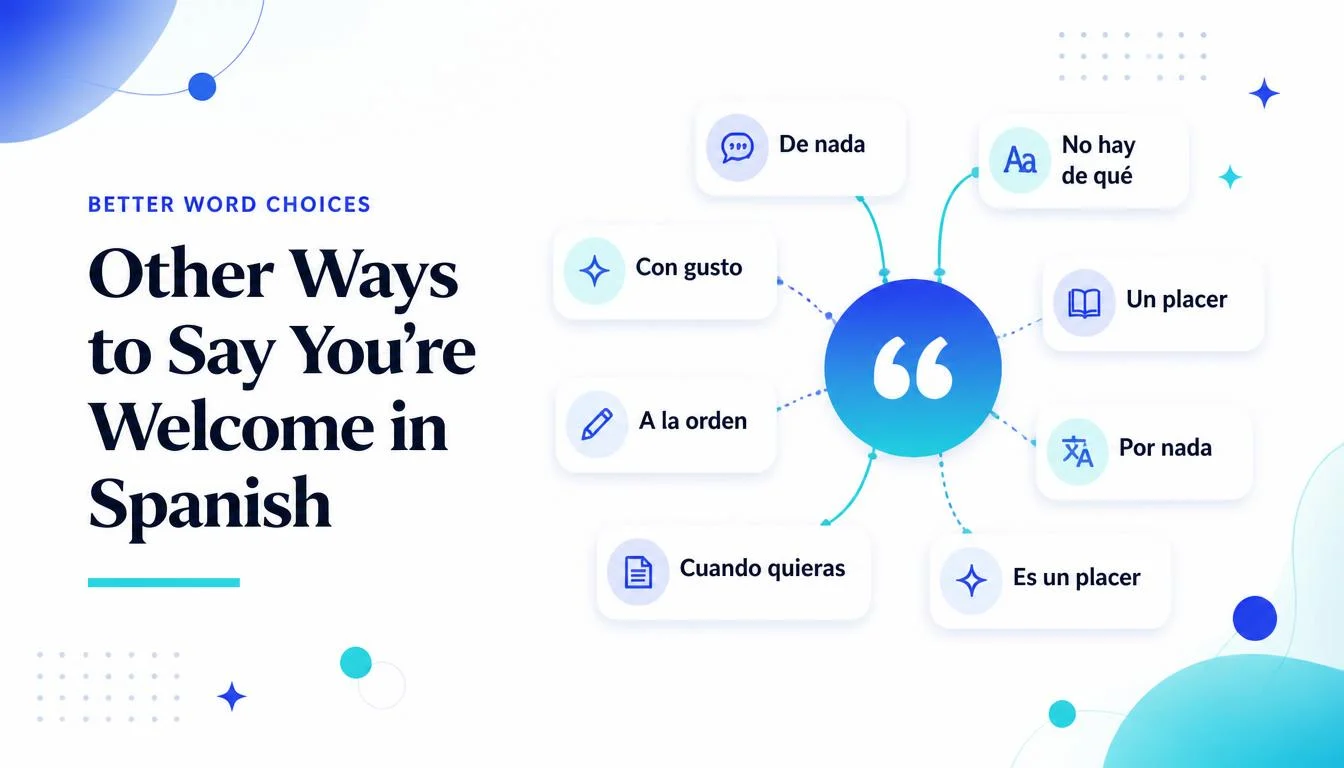
Other ways to say “You’re welcome” in Spanish include De nada, No hay de qué, Con gusto, Un placer, and No te preocupes.
Learning other ways to say you’re welcome in Spanish can help you sound more natural, polite, and confident in different conversations. While de nada is the most common response, Spanish offers many alternatives depending on the situation and level of formality.
Whether you’re speaking with friends, coworkers, customers, or someone you’ve just met, knowing other ways to say you’re welcome in Spanish allows you to choose an expression that fits the context. From warm and casual responses to professional phrases, these alternatives can make your Spanish more flexible and authentic.
What Is “You’re Welcome in Spanish”? Meaning, Grammar & Real Use
Imagine that a Spanish-speaking colleague thanks you for helping with a presentation. You know the basic response, de nada, but you want to sound more natural and choose an expression that fits a professional setting. This is where learning different responses becomes useful. Spanish speakers do not rely on one fixed expression every time someone says “gracias.” The appropriate response can be warm, formal, casual, polite, or regionally familiar.
The phrase “you’re welcome” is an English response to thank you. In Spanish, de nada is the most widely recognized equivalent, but it is only one option. Expressions such as con gusto, no hay de qué, and un placer can communicate slightly different levels of warmth or formality.
Learning alternatives to “you’re welcome in Spanish” can make your conversations sound more natural and flexible. These phrases are also useful when learning professional reaction phrases or trying to express excitement in English while communicating with Spanish-speaking colleagues.
Definition: “You’re welcome” in Spanish refers to expressions used to respond politely after someone thanks you.
Grammar: Most alternatives are fixed expressions rather than complete sentences. Their register ranges from neutral and polite to formal or conversational.
Example: “Gracias por tu ayuda.” “De nada.”
These expressions appear frequently in spoken Spanish, but several are also appropriate in written messages, customer service, workplace communication, and formal interactions.
When Should You Use “You’re Welcome in Spanish”?
Different Spanish responses work in different situations. Consider the relationship, setting, and degree of formality before choosing one.
Common contexts
- Responding when someone says gracias
- Helping a friend or family member
- Answering a customer or client
- Communicating with Spanish-speaking colleagues
- Responding to thanks in emails or messages
- Showing warmth after providing a favor
- Maintaining polite conversation while traveling
- Responding formally to a professional or unfamiliar person
Spoken vs Written
Spoken Spanish:
Expressions such as de nada, con gusto, and por nada are natural in everyday conversation.
Written Spanish:
De nada, no hay de qué, and un placer can work in messages and professional correspondence when the context is appropriate.
Formal vs Informal
More formal:
Es un placer, ha sido un placer, a su servicio
Neutral or broadly appropriate:
De nada, con gusto, no hay de qué
More casual:
Por nada, a ti, cuando quieras
Regional preferences can vary, so listening to native speakers in your particular Spanish-speaking environment is useful.
Is It Professional or Just Polite?
The English phrase “you’re welcome” is both polite and professional. Its Spanish equivalents vary. De nada is neutral and can be used professionally, while un placer and ha sido un placer can sound especially polished in customer service or workplace interactions.
Business-style example:
“Gracias por enviarme los documentos.” “Con gusto. Ha sido un placer ayudarle.”
Polite? ✔️ Yes
Professional? ✔️ Yes, depending on the expression and context
The key distinction is not whether one phrase is “correct” and another is “incorrect.” It is whether the expression matches the relationship and situation.
Pros and Cons of Using “De Nada”
Pros
- Simple and natural: It is easy to learn and use correctly.
- Friendly tone: It generally sounds warm and courteous.
- Common usage: Spanish speakers widely recognize it.
- Easy to understand: Beginners can use it in many everyday situations.
Cons
- Can become repetitive: Using it after every “gracias” can limit your vocabulary.
- Less expressive: It does not always communicate extra warmth or enthusiasm.
- Context dependent: A more formal expression may suit certain professional situations better.
- Limited variation: Advanced learners benefit from knowing alternatives.
Common Mistakes People Make
Knowing the vocabulary is only part of speaking naturally. Here are five specific mistakes to avoid.
1. Assuming “De nada” Is the Only Option
Incorrect: “I always have to say de nada.”
Correct: “De nada” is useful, but you can also use “con gusto,” “un placer,” or “no hay de qué.”
2. Confusing “A Ti” With a Formal Response
Incorrect: “Gracias por su ayuda.” “A ti.”
Correct: “Gracias por su ayuda.” “A usted” or “con gusto.”
A ti is generally used with someone you address informally with tú.
3. Using “A Usted” With a Close Friend
Incorrect: “Gracias por ayudarme.” “A usted.”
Correct: “Gracias por ayudarme.” “A ti.”
The choice between a ti and a usted should match the form of address used in the relationship.
4. Treating “Un Placer” as a Casual Response Every Time
Incorrect: Using “un placer” automatically with close friends after every small favor.
Correct: Use it when the situation genuinely calls for a warmer or more polished response.
5. Translating English Expressions Word for Word
Incorrect: Creating a Spanish response by translating an English phrase literally.
Correct: Learn established Spanish expressions such as de nada, con gusto, and no hay de qué.
“Small tone mistakes can make confident English sound careless.”
Alternatives by Category
Formal alternatives to “You’re Welcome in Spanish”
- Es un placer
- Ha sido un placer
- A su servicio
- Con mucho gusto
Pro Tip: In professional settings, listen for whether the speaker uses tú or usted, then choose your response accordingly.
Casual alternatives
- De nada
- Por nada
- A ti
- Cuando quieras
Pro Tip: Use neutral expressions first. Add more casual options as you become familiar with the speaker and regional style.
Professional alternatives
- Con gusto
- Un placer
- Con mucho gusto
- Ha sido un placer
Pro Tip: For clients and colleagues, warm professionalism usually works better than overly casual expressions.
Informal expressions
- A ti
- Por nada
- Cuando quieras
- Para servirte
Pro Tip: Informal expressions work best when the relationship already feels relaxed and the form of address is familiar.
“Formal and informal English aren’t about correctness. They’re about context.”
Other Ways to Say “You’re Welcome in Spanish”
These 30 alternatives build fluency and help you respond naturally to thanks. Choose them according to tone, relationship, region, and context.
1. Phrase: De nada
Meaning: It means “you’re welcome” or “it was nothing.”
Explanation: This is the standard neutral response to thanks.
Example Sentence: “Gracias por tu ayuda.” “De nada.”
Best Use: Everyday conversations
Worst Use: None generally
Tone: Neutral, friendly
Context Variability: casual / professional / spoken
2. Phrase: No hay de qué
Meaning: It means “there is nothing to thank me for.”
Explanation: This polite expression is a natural response to gratitude.
Example Sentence: “Muchas gracias por venir.” “No hay de qué.”
Best Use: Polite conversations
Worst Use: Very casual banter
Tone: Polite, warm
Context Variability: casual / professional / spoken
3. Phrase: Con gusto
Meaning: It means “with pleasure” or “gladly.”
Explanation: It shows that you were happy to help.
Example Sentence: “Gracias por explicarlo.” “Con gusto.”
Best Use: Helpful responses
Worst Use: Cold refusals
Tone: Warm, courteous
Context Variability: casual / professional / spoken
4. Phrase: Con mucho gusto
Meaning: It means “with great pleasure.”
Explanation: This adds warmth and enthusiasm to your response.
Example Sentence: “Gracias por atender mi solicitud.” “Con mucho gusto.”
Best Use: Customer service
Worst Use: Serious complaints
Tone: Warm, professional
Context Variability: casual / professional / spoken
5. Phrase: Un placer
Meaning: It means “a pleasure.”
Explanation: It communicates that helping was enjoyable or welcome.
Example Sentence: “Gracias por tu tiempo.” “Un placer.”
Best Use: Polished responses
Worst Use: Hostile exchanges
Tone: Warm, polished
Context Variability: casual / professional / spoken
6. Phrase: Es un placer
Meaning: It means “it’s a pleasure.”
Explanation: This sounds slightly more complete and polished than “un placer.”
Example Sentence: “Gracias por recibirnos.” “Es un placer.”
Best Use: Professional settings
Worst Use: Casual texting
Tone: Polished, courteous
Context Variability: casual / professional / spoken
7. Phrase: Ha sido un placer
Meaning: It means “it has been a pleasure.”
Explanation: It works especially well after an interaction or completed service.
Example Sentence: “Gracias por su ayuda.” “Ha sido un placer.”
Best Use: Professional farewells
Worst Use: Quick favors
Tone: Formal, warm
Context Variability: casual / professional / spoken
8. Phrase: Por nada
Meaning: It means “for nothing” in the sense of “don’t mention it.”
Explanation: It is a casual alternative that minimizes the effort involved.
Example Sentence: “Gracias por traerlo.” “Por nada.”
Best Use: Casual interactions
Worst Use: Formal correspondence
Tone: Casual, friendly
Context Variability: casual / professional / spoken
9. Phrase: A ti
Meaning: It means “to you” and can convey “you’re welcome.”
Explanation: It is commonly used when responding to someone addressed with tú.
Example Sentence: “Gracias por venir.” “A ti.”
Best Use: Friendly exchanges
Worst Use: Formal clients
Tone: Casual, warm
Context Variability: casual / professional / spoken
10. Phrase: A usted
Meaning: It means “to you” using the formal usted form.
Explanation: It matches a respectful or formal relationship.
Example Sentence: “Muchas gracias.” “A usted.”
Best Use: Formal interactions
Worst Use: Close friends
Tone: Respectful, formal
Context Variability: casual / professional / spoken
11. Phrase: Cuando quieras
Meaning: It means “whenever you want.”
Explanation: It suggests that you would be willing to help again.
Example Sentence: “Gracias por ayudarme.” “Cuando quieras.”
Best Use: Friendly relationships
Worst Use: Strict formal settings
Tone: Warm, informal
Context Variability: casual / professional / spoken
12. Phrase: Cuando guste
Meaning: It means “whenever you wish” in a more formal style.
Explanation: It can communicate willingness to help again while maintaining respect.
Example Sentence: “Gracias por su ayuda.” “Cuando guste.”
Best Use: Respectful exchanges
Worst Use: Close friends
Tone: Polite, formal
Context Variability: casual / professional / spoken
13. Phrase: Para servirte
Meaning: It means “at your service” using informal address.
Explanation: It communicates willingness to be helpful.
Example Sentence: “Gracias por ayudarme.” “Para servirte.”
Best Use: Informal service
Worst Use: Academic essays
Tone: Helpful, informal
Context Variability: casual / professional / spoken
14. Phrase: Para servirle
Meaning: It means “at your service” using formal address.
Explanation: It can sound courteous in service-oriented or respectful interactions.
Example Sentence: “Gracias por atenderme.” “Para servirle.”
Best Use: Customer service
Worst Use: Close friends
Tone: Respectful, courteous
Context Variability: casual / professional / spoken
15. Phrase: Es lo menos
Meaning: It means the favor was the least you could do.
Explanation: It downplays the effort and communicates generosity.
Example Sentence: “Gracias por ayudarme.” “Es lo menos.”
Best Use: Friendly favors
Worst Use: Formal reports
Tone: Humble, friendly
Context Variability: casual / professional / spoken
16. Phrase: No tienes nada que agradecer
Meaning: It means “you have nothing to thank me for.”
Explanation: It reassures someone that their gratitude is unnecessary.
Example Sentence: “Gracias por todo.” “No tienes nada que agradecer.”
Best Use: Personal conversations
Worst Use: Formal emails
Tone: Warm, reassuring
Context Variability: casual / professional / spoken
17. Phrase: No tiene nada que agradecer
Meaning: It means “you have nothing to thank me for” using formal address.
Explanation: This version maintains respectful distance.
Example Sentence: “Muchas gracias por su ayuda.” “No tiene nada que agradecer.”
Best Use: Formal conversations
Worst Use: Close friendships
Tone: Respectful, courteous
Context Variability: casual / professional / spoken
18. Phrase: Faltaba más
Meaning: It communicates that helping was expected or obvious.
Explanation: This expression can sound warm and generous in appropriate contexts.
Example Sentence: “Gracias por acompañarme.” “¡Faltaba más!”
Best Use: Warm exchanges
Worst Use: Formal documents
Tone: Warm, emphatic
Context Variability: casual / professional / spoken
19. Phrase: No es nada
Meaning: It means “it’s nothing.”
Explanation: It minimizes the effort involved in helping someone.
Example Sentence: “Gracias por llevarme.” “No es nada.”
Best Use: Small favors
Worst Use: Major services
Tone: Casual, modest
Context Variability: casual / professional / spoken
20. Phrase: No te preocupes
Meaning: It means “don’t worry.”
Explanation: It can reassure someone that their thanks are unnecessary.
Example Sentence: “Gracias por el retraso.” “No te preocupes.”
Best Use: Informal reassurance
Worst Use: Formal clients
Tone: Relaxed, reassuring
Context Variability: casual / professional / spoken
21. Phrase: No se preocupe
Meaning: It means “don’t worry” using formal address.
Explanation: It offers reassurance while maintaining politeness.
Example Sentence: “Gracias por resolverlo.” “No se preocupe.”
Best Use: Formal reassurance
Worst Use: Close friends
Tone: Polite, reassuring
Context Variability: casual / professional / spoken
22. Phrase: Claro
Meaning: It can mean “of course” when responding positively to gratitude.
Explanation: Context determines whether it functions naturally as a thankful response.
Example Sentence: “Gracias por ayudarme.” “Claro.”
Best Use: Friendly exchanges
Worst Use: Formal correspondence
Tone: Casual, positive
Context Variability: casual / professional / spoken
23. Phrase: Por supuesto
Meaning: It means “of course.”
Explanation: It can emphasize that helping was natural or expected.
Example Sentence: “Gracias por tu apoyo.” “Por supuesto.”
Best Use: Positive responses
Worst Use: Formal conclusions
Tone: Confident, courteous
Context Variability: casual / professional / spoken
24. Phrase: Desde luego
Meaning: It means “certainly” or “of course.”
Explanation: It can respond warmly when the context makes the intended meaning clear.
Example Sentence: “Gracias por tu ayuda.” “Desde luego.”
Best Use: Polite conversation
Worst Use: Written research
Tone: Polished, confident
Context Variability: casual / professional / spoken
25. Phrase: Me alegra ayudarte
Meaning: It means “I’m happy to help you.”
Explanation: This explicitly expresses satisfaction about being helpful.
Example Sentence: “Gracias por tu ayuda.” “Me alegra ayudarte.”
Best Use: Warm relationships
Worst Use: Brief formal replies
Tone: Warm, personal
Context Variability: casual / professional / spoken
26. Phrase: Me alegra poder ayudar
Meaning: It means “I’m glad I could help.”
Explanation: It communicates a positive attitude toward providing assistance.
Example Sentence: “Muchas gracias por resolverlo.” “Me alegra poder ayudar.”
Best Use: Service interactions
Worst Use: Unfriendly settings
Tone: Warm, professional
Context Variability: casual / professional / spoken
27. Phrase: Ha sido un gusto
Meaning: It means “it has been a pleasure.”
Explanation: This is useful after completing an interaction or providing assistance.
Example Sentence: “Gracias por todo.” “Ha sido un gusto.”
Best Use: Professional farewells
Worst Use: Quick casual favors
Tone: Courteous, polished
Context Variability: casual / professional / spoken
28. Phrase: Con todo gusto
Meaning: It means “with every pleasure” or “gladly.”
Explanation: It emphasizes willingness and friendliness.
Example Sentence: “Gracias por atender mi solicitud.” “Con todo gusto.”
Best Use: Helpful service
Worst Use: Negative exchanges
Tone: Warm, courteous
Context Variability: casual / professional / spoken
29. Phrase: A sus órdenes
Meaning: It literally communicates readiness to follow someone’s requests.
Explanation: It is a courteous expression associated with service and formal interactions in some Spanish-speaking contexts.
Example Sentence: “Gracias por su atención.” “A sus órdenes.”
Best Use: Formal service
Worst Use: Close friendships
Tone: Formal, respectful
Context Variability: casual / professional / spoken
30. Phrase: Faltaba más que no
Meaning: It emphasizes that helping was completely natural or expected.
Explanation: It is an expressive response that is more context dependent than “de nada.”
Example Sentence: “Gracias por acompañarme.” “¡Faltaba más que no!”
Best Use: Warm conversations
Worst Use: Formal emails
Tone: Expressive, emphatic
Context Variability: casual / professional / spoken
Comparison Table: Top 10 Alternatives at a Glance
| Phrase | Tone | Best Use |
|---|---|---|
| De nada | Neutral, friendly | Everyday responses |
| No hay de qué | Polite, warm | General courtesy |
| Con gusto | Warm, courteous | Helpful responses |
| Con mucho gusto | Warm, professional | Customer service |
| Un placer | Polished, warm | Professional interactions |
| Es un placer | Formal, courteous | Workplace settings |
| Ha sido un placer | Formal, warm | Professional farewells |
| Por nada | Casual, friendly | Informal conversations |
| A ti | Casual, warm | Friends and peers |
| A usted | Respectful, formal | Formal interactions |
Quick Self-Check
Question 1
A colleague says, “Muchas gracias por su ayuda.” Which response best matches a formal workplace setting?
A. A ti
B. Ha sido un placer
C. Por nada, amigo
D. Cuando quieras
Answer: B. Ha sido un placer
Question 2
A close friend says, “Gracias por venir.” Which response sounds natural?
A. A usted
B. Para servirle
C. A ti
D. A sus órdenes
Answer: C. A ti
Question 3
A customer thanks you after receiving assistance. Which option communicates warm professionalism?
A. Con mucho gusto
B. A ti
C. No es nada, buddy
D. Cuando quieras
Answer: A. Con mucho gusto
Question 4
You want a neutral response that works in many everyday situations. Which is the safest choice?
A. De nada
B. A sus órdenes
C. Faltaba más que no
D. Cuando guste
Answer: A. De nada
FAQs
1. What are the most common other ways to say “you’re welcome” in Spanish?
The most common options include de nada, no hay de qué, con gusto, un placer, and por nada. Their suitability depends on context and region.
2. What is the most formal way to say “you’re welcome” in Spanish?
Expressions such as ha sido un placer, es un placer, con mucho gusto, and a su servicio can work in formal or professional contexts.
3. Is “de nada” professional in Spanish?
Yes. De nada is neutral rather than overly casual, so it can be used in many professional situations as well as everyday conversations.
4. How do you say “you’re welcome” casually in Spanish?
De nada, por nada, a ti, and cuando quieras can all work in casual situations, although the exact choice depends on the relationship and context.
5. What is the difference between “a ti” and “a usted”?
Both can respond to thanks, but a ti corresponds to informal tú, while a usted corresponds to the formal usted form of address.
conclusion
Learning different responses to “thank you” makes your Spanish more flexible and natural. De nada is an excellent neutral choice, while con gusto, un placer, ha sido un placer, and a ti allow you to adapt your response to different relationships and situations.
Practice one neutral phrase and one formal or casual alternative each day. Pay attention to how native speakers use these expressions, especially in professional settings, customer service, and everyday conversations. If you are also studying professional English, the same principle applies: tone and context matter as much as vocabulary.
Read More Related Articles:
- Other Ways to Say Thanks for Letting Me Know | Leave a Better Impression In 2026
- Other Ways to Say Thank You for Your Business | Customers Truly Appreciate In 2026
- Other Ways to Say “I Hope You’re Doing Well” | People Actually Enjoy Reading In 2026

Victoria Hughes is a content writer dedicated to making communication clearer and more effective. Through TextsResponse.com, she shares practical insights and thoughtfully crafted response ideas that help readers express themselves with confidence.