Quick Answer
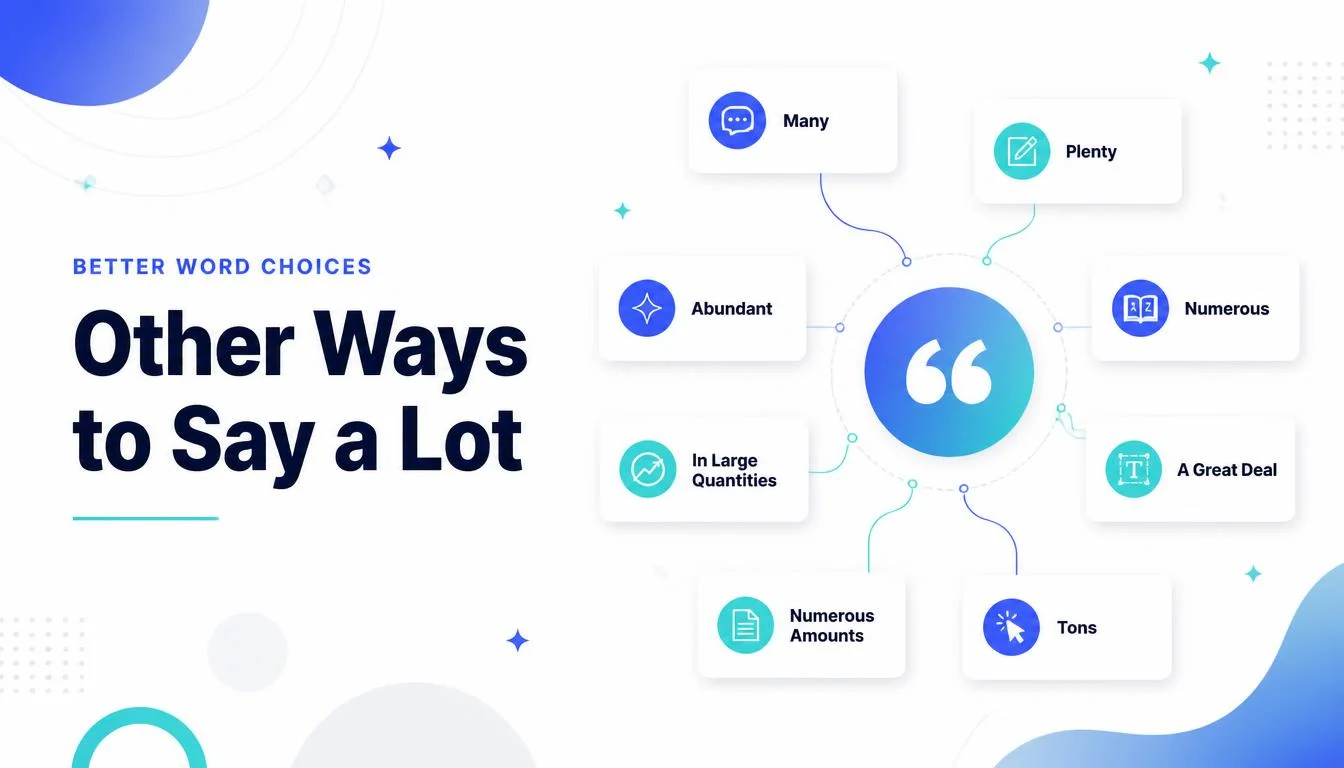
Common other ways to say a lot include many, plenty, numerous, abundant, a great deal, and a large amount.
Other Ways to Say a Lot can help you avoid repetition and make your English sound more precise and natural. The best alternative depends on whether you are describing people, things, money, time, or an abstract idea.
In this guide, you’ll find useful other ways to say a lot for formal writing, professional communication, and everyday conversation. These alternatives will help you choose the right expression for different contexts and tones.
What Is “Other Ways to Say a Lot”? Meaning, Grammar & Real Use
Imagine you are telling a colleague, “We have a lot of work to finish,” or telling a friend, “I learned a lot from that experience.” The phrase is perfectly natural, but repeating “a lot” throughout a conversation or piece of writing can make your vocabulary sound less varied. Choosing a more specific expression can make the same idea clearer and better suited to your audience.
The phrase “a lot” generally refers to a large quantity, amount, degree, or frequency. Its alternatives depend on whether you are talking about countable nouns, uncountable nouns, actions, or degree. For example, “many” works with countable nouns, while “much” is normally used with uncountable nouns.
Learning alternatives to “a lot” can improve both everyday conversations and professional writing. It can also help you express excitement in English more naturally when describing strong interest, enthusiasm, or an impressive amount of something.
Definition
“A lot” means a large amount, quantity, degree, or frequency.
Grammar Note
“A lot” can function as an adverbial expression or appear in the phrase “a lot of.” “A lot of” works with both countable and uncountable nouns.
Example: “She has a lot of experience.”
Where and Why People Use It
- Spoken English: Very common in everyday conversation.
- Informal writing: Natural in messages and personal writing.
- Professional English: Acceptable in conversation, but more precise alternatives may improve formal documents.
- Academic writing: Alternatives such as “numerous,” “considerable,” or “a significant amount of” may sound more appropriate.
When Should You Use “A Lot”?
“A lot” is useful when you want to communicate quantity or degree without specifying an exact number or measurement.
Common Contexts
- Describing a large quantity: “We received a lot of applications.”
- Talking about frequency: “She travels a lot.”
- Describing experience: “He has learned a lot.”
- Expressing appreciation: “Thank you a lot” is less natural than “Thank you very much.”
- Describing strong interest: “They care a lot about quality.”
Spoken vs Written
In spoken English, “a lot” sounds natural and conversational.
In written English, especially in academic or formal contexts, alternatives such as “numerous,” “considerable,” “substantial,” or “extensive” can provide greater precision.
Formal vs Informal
- Formal: numerous, substantial, considerable, extensive
- Neutral: plenty of, many, much, a great deal of
- Informal: tons of, loads of, heaps of
The best choice depends on your audience and the noun or idea being described.
Is It Professional or Just Polite?
“A lot” is not impolite. It is a common and understandable expression. The question is mainly whether it provides enough precision for the situation.
In professional conversation, it can be completely acceptable. In formal reports, proposals, and academic writing, a more specific expression can make your point sound clearer.
Business-style example:
“Our team has gained a lot of experience working with international clients.”
A more formal version would be:
“Our team has gained extensive experience working with international clients.”
Polite? ✔️ Yes
Professional? ✔️ Yes, in suitable contexts
Pros and Cons of Using “A Lot”
Pros
- Simple and natural: Easy for most English speakers to understand.
- Friendly tone: Works well in ordinary conversation.
- Common usage: Frequently heard in everyday English.
- Flexible: Can describe quantity, degree, and frequency.
Cons
- Can sound repetitive: Repeated use may reduce vocabulary variety.
- Less precise: It does not always explain how large or significant something is.
- Informal in some writing: Formal documents may benefit from stronger alternatives.
- Can create ambiguity: The exact quantity depends entirely on context.
Common Mistakes People Make
1. Confusing “A Lot” With “Alot”
“Alot” is not the standard spelling of the phrase.
Incorrect: “I learned alot from the course.”
Correct: “I learned a lot from the course.”
2. Confusing “A Lot” With “Allot”
“Allot” is a verb meaning to distribute or assign something.
Incorrect: “The company will a lot more resources.”
Correct: “The company will allot more resources.”
3. Using “Much” With Positive Statements Too Often
“Much” is grammatically possible, but “a lot of” is usually more natural in ordinary positive conversation.
Less natural: “I have much work today.”
Natural: “I have a lot of work today.”
4. Using “Many” With Uncountable Nouns
“Many” normally modifies plural countable nouns.
Incorrect: “We have many information.”
Correct: “We have a lot of information.”
5. Using Informal Quantity Expressions in Formal Reports
Expressions such as “tons of” can sound too casual in professional writing.
Too casual: “The company received tons of applications.”
Formal: “The company received numerous applications.”
“Small tone mistakes can make confident English sound careless.”
Alternatives by Category
Formal alternatives to “A Lot”
- Numerous
- Considerable
- Substantial
- Extensive
Pro Tip: Use “numerous” with countable plural nouns and “considerable” or “substantial” when describing amount, degree, or significance.
Casual alternatives
- Plenty of
- Loads of
- Tons of
- Heaps of
Pro Tip: Use casual quantity expressions mainly in conversations, messages, and relaxed situations where an exact quantity is not important.
Professional alternatives
- A significant amount of
- A great deal of
- A considerable amount of
- A substantial number of
Pro Tip: Choose the alternative according to whether the noun is countable or uncountable rather than selecting a synonym randomly.
Informal expressions
- Tons of
- Loads of
- Heaps of
- Plenty of
Pro Tip: Reserve highly informal expressions for relaxed communication, and replace them with precise quantity terms in reports and formal correspondence.
“Formal and informal English aren’t about correctness. They’re about context.”
Other Ways to Say “A Lot” With Examples
These 30 alternatives build vocabulary flexibility and help you express quantity, intensity, enthusiasm, admiration, or approval according to the situation.
1. Phrase: Many
Meaning: A large number of people or things.
Explanation: Use it with plural countable nouns.
Example Sentence: “Many employees attended the training session.”
Best Use: Countable nouns
Worst Use: Uncountable nouns
Tone: Neutral, clear, common
Context Variability: casual / professional / spoken
2. Phrase: Much
Meaning: A large amount of something.
Explanation: Use it mainly with uncountable nouns, especially in questions and negatives.
Example Sentence: “We don’t have much time left.”
Best Use: Uncountable nouns
Worst Use: Casual positives
Tone: Neutral, grammatical, direct
Context Variability: casual / professional / spoken
3. Phrase: Plenty of
Meaning: More than enough of something.
Explanation: It suggests an abundant or sufficient amount.
Example Sentence: “We have plenty of time to prepare.”
Best Use: Sufficient quantity
Worst Use: Precise measurements
Tone: Friendly, positive, natural
Context Variability: casual / professional / spoken
4. Phrase: Numerous
Meaning: Existing in a large number.
Explanation: A formal alternative for many.
Example Sentence: “Numerous studies support this approach.”
Best Use: Formal writing
Worst Use: Casual chat
Tone: Formal, precise, academic
Context Variability: casual / professional / spoken
5. Phrase: A Great Deal of
Meaning: A large amount of something.
Explanation: It works especially well with uncountable nouns.
Example Sentence: “The project required a great deal of planning.”
Best Use: Formal quantity
Worst Use: Casual counting
Tone: Formal, polished, measured
Context Variability: casual / professional / spoken
6. Phrase: A Significant Amount of
Meaning: A notably large amount.
Explanation: It emphasizes that the quantity is important or meaningful.
Example Sentence: “The project requires a significant amount of funding.”
Best Use: Business writing
Worst Use: Tiny quantities
Tone: Professional, precise, analytical
Context Variability: casual / professional / spoken
7. Phrase: A Large Number of
Meaning: A high quantity of countable things or people.
Explanation: It provides a clear formal replacement for “a lot of.”
Example Sentence: “A large number of customers responded to the survey.”
Best Use: Formal reports
Worst Use: Uncountable nouns
Tone: Formal, neutral, factual
Context Variability: casual / professional / spoken
8. Phrase: A Large Amount of
Meaning: A high quantity of an uncountable substance or concept.
Explanation: It is suitable for formal descriptions of quantity.
Example Sentence: “The process requires a large amount of energy.”
Best Use: Formal quantity
Worst Use: Countable items
Tone: Formal, neutral, precise
Context Variability: casual / professional / spoken
9. Phrase: A Considerable Amount of
Meaning: A fairly large and noticeable amount.
Explanation: It emphasizes significance rather than simply quantity.
Example Sentence: “The company invested a considerable amount of money.”
Best Use: Business writing
Worst Use: Casual requests
Tone: Professional, formal, measured
Context Variability: casual / professional / spoken
10. Phrase: A Substantial Amount of
Meaning: A large and significant amount.
Explanation: It is useful when the quantity has noticeable importance.
Example Sentence: “The renovation required a substantial amount of funding.”
Best Use: Formal reports
Worst Use: Everyday chat
Tone: Formal, serious, precise
Context Variability: casual / professional / spoken
11. Phrase: A Considerable Number of
Meaning: A fairly large number of people or things.
Explanation: Use it with plural countable nouns.
Example Sentence: “A considerable number of applicants met the requirements.”
Best Use: Formal writing
Worst Use: Uncountable nouns
Tone: Formal, analytical, precise
Context Variability: casual / professional / spoken
12. Phrase: A Substantial Number of
Meaning: A large and significant number.
Explanation: It emphasizes the importance of the quantity.
Example Sentence: “A substantial number of customers renewed their subscriptions.”
Best Use: Business reports
Worst Use: Casual speech
Tone: Formal, professional, factual
Context Variability: casual / professional / spoken
13. Phrase: Extensive
Meaning: Covering or involving a large amount or range.
Explanation: It works particularly well with experience, research, knowledge, or work.
Example Sentence: “She has extensive experience in project management.”
Best Use: Professional experience
Worst Use: Simple objects
Tone: Professional, polished, confident
Context Variability: casual / professional / spoken
14. Phrase: Considerable
Meaning: Large enough to be important or noticeable.
Explanation: It describes a significant degree, amount, or level.
Example Sentence: “The team made considerable progress this year.”
Best Use: Progress and impact
Worst Use: Exact quantities
Tone: Formal, measured, professional
Context Variability: casual / professional / spoken
15. Phrase: Substantial
Meaning: Large in amount, degree, or importance.
Explanation: It is common in professional and academic communication.
Example Sentence: “The company achieved substantial growth.”
Best Use: Business results
Worst Use: Casual descriptions
Tone: Professional, strong, formal
Context Variability: casual / professional / spoken
16. Phrase: Abundant
Meaning: Available in a very large quantity.
Explanation: It often describes resources, opportunities, or natural supplies.
Example Sentence: “The region has abundant natural resources.”
Best Use: Resources and supply
Worst Use: Exact figures
Tone: Formal, descriptive, positive
Context Variability: casual / professional / spoken
17. Phrase: Ample
Meaning: Enough or more than enough.
Explanation: It emphasizes sufficient quantity rather than simply a large quantity.
Example Sentence: “The team has ample time to complete the work.”
Best Use: Time and resources
Worst Use: Emotional intensity
Tone: Polished, positive, professional
Context Variability: casual / professional / spoken
18. Phrase: In Large Quantities
Meaning: In a high amount or volume.
Explanation: This expression directly emphasizes quantity.
Example Sentence: “The product is manufactured in large quantities.”
Best Use: Production contexts
Worst Use: Personal feelings
Tone: Neutral, factual, formal
Context Variability: casual / professional / spoken
19. Phrase: In Abundance
Meaning: Available in very large quantities.
Explanation: It suggests plentiful availability.
Example Sentence: “Fresh produce is available in abundance during the summer.”
Best Use: Available resources
Worst Use: Exact statistics
Tone: Descriptive, positive, polished
Context Variability: casual / professional / spoken
20. Phrase: Loads of
Meaning: A large amount or number.
Explanation: It is a casual expression commonly used in conversation.
Example Sentence: “We have loads of options to choose from.”
Best Use: Casual conversation
Worst Use: Formal reports
Tone: Casual, friendly, relaxed
Context Variability: casual / professional / spoken
21. Phrase: Tons of
Meaning: A very large amount or number.
Explanation: It is an informal expression and does not literally refer to weight.
Example Sentence: “There are tons of useful resources online.”
Best Use: Informal speech
Worst Use: Academic writing
Tone: Informal, energetic, conversational
Context Variability: casual / professional / spoken
22. Phrase: Heaps of
Meaning: A large amount or number.
Explanation: It is informal and especially common in relaxed conversation.
Example Sentence: “She has heaps of experience with the software.”
Best Use: Informal conversation
Worst Use: Formal reports
Tone: Casual, friendly, expressive
Context Variability: casual / professional / spoken
23. Phrase: A Wealth of
Meaning: A large supply or collection of something valuable.
Explanation: It commonly describes knowledge, information, experience, or resources.
Example Sentence: “The website provides a wealth of useful information.”
Best Use: Valuable resources
Worst Use: Ordinary quantities
Tone: Polished, positive, professional
Context Variability: casual / professional / spoken
24. Phrase: An Abundance of
Meaning: A very large supply of something.
Explanation: It is a formal expression emphasizing plentiful availability.
Example Sentence: “The report contains an abundance of useful data.”
Best Use: Formal descriptions
Worst Use: Casual chat
Tone: Formal, descriptive, positive
Context Variability: casual / professional / spoken
25. Phrase: A Plethora of
Meaning: A very large number or amount.
Explanation: It is often used in formal writing, although it can sometimes sound overly elaborate.
Example Sentence: “The market offers a plethora of choices.”
Best Use: Formal variety
Worst Use: Simple statements
Tone: Formal, elaborate, expressive
Context Variability: casual / professional / spoken
26. Phrase: Countless
Meaning: Too many to count or an extremely large number.
Explanation: It emphasizes an exceptionally high quantity rather than an exact figure.
Example Sentence: “She has helped countless students improve their writing.”
Best Use: Very high numbers
Worst Use: Exact statistics
Tone: Expressive, strong, polished
Context Variability: casual / professional / spoken
27. Phrase: A Myriad of
Meaning: A very large number or wide variety of things.
Explanation: It is often used to emphasize extensive choice or variety.
Example Sentence: “The platform offers a myriad of learning opportunities.”
Best Use: Wide variety
Worst Use: Simple quantities
Tone: Formal, literary, sophisticated
Context Variability: casual / professional / spoken
28. Phrase: A Host of
Meaning: A large number or collection of people or things.
Explanation: It works well when referring to several related possibilities, issues, or benefits.
Example Sentence: “The new policy offers a host of benefits.”
Best Use: Benefits and options
Worst Use: Exact measurements
Tone: Formal, polished, descriptive
Context Variability: casual / professional / spoken
29. Phrase: A Wide Range of
Meaning: Many different types or varieties of something.
Explanation: It emphasizes diversity rather than quantity alone.
Example Sentence: “The course covers a wide range of communication skills.”
Best Use: Variety and choice
Worst Use: Single items
Tone: Professional, neutral, clear
Context Variability: casual / professional / spoken
30. Phrase: A High Degree of
Meaning: A strong or significant level of a quality or condition.
Explanation: It works well with abstract nouns such as confidence, accuracy, or interest.
Example Sentence: “The role requires a high degree of attention to detail.”
Best Use: Abstract qualities
Worst Use: Physical quantities
Tone: Formal, precise, professional
Context Variability: casual / professional / spoken
Comparison Table: Top 10 Alternatives at a Glance
| Phrase | Tone | Best Use |
|---|---|---|
| Many | Neutral | Countable nouns |
| Much | Neutral | Uncountable nouns |
| Plenty of | Friendly | Everyday quantity |
| Numerous | Formal | Reports and essays |
| A great deal of | Formal | Abstract amounts |
| Significant amount of | Professional | Business writing |
| Extensive | Professional | Experience and knowledge |
| Considerable | Formal | Progress and impact |
| Substantial | Professional | Results and growth |
| Wide range of | Neutral | Variety and choice |
Quick Self-Check
1. Which option best completes the sentence?
“The report contains _____ useful information.”
A. many
B. much
C. numerous
D. a large number of
Answer: B. “Much” can modify the uncountable noun “information.”
2. Which phrase is most appropriate for a formal business report?
“The company received _____ applications.”
A. tons of
B. heaps of
C. numerous
D. loads of
Answer: C. “Numerous” is a concise formal alternative for a large number of applications.
3. Which expression emphasizes variety rather than simply quantity?
A. A wide range of
B. Much
C. A large amount of
D. A substantial amount of
Answer: A. “A wide range of” focuses on different types or choices.
4. Which sentence is most natural in casual conversation?
A. “We have a plethora of snacks.”
B. “We have loads of snacks.”
C. “We have a substantial number of snacks.”
D. “We have numerous snacks.”
Answer: B. “Loads of” is an informal expression that fits relaxed spoken English.
FAQs
What are the best alternatives to “a lot”?
Useful alternatives include “many,” “much,” “plenty of,” “numerous,” “a great deal of,” and “a significant amount of.” The correct choice depends on the noun and context.
What is a formal way to say “a lot”?
Formal alternatives include “numerous,” “considerable,” “substantial,” “extensive,” and “a significant amount of.” Choose the expression that accurately matches the type of quantity.
What is a professional way to say “a lot”?
In professional English, you can use “extensive,” “considerable,” “substantial,” “numerous,” or “a significant amount of.” These often sound more precise in reports and presentations.
Can I use “a lot” in academic writing?
Yes, but repeated use can make academic writing less precise. Depending on the sentence, “numerous,” “considerable,” “substantial,” or “a significant amount of” may be more suitable.
What is the difference between “many” and “much”?
“Many” is normally used with plural countable nouns, such as “many students.” “Much” is used with uncountable nouns, such as “much information.”
conclusion
Knowing different ways to express a large quantity gives you greater control over your English. Instead of relying on one familiar expression, you can choose “numerous” for formal writing, “plenty of” for a positive sense of sufficiency, “extensive” for experience, or “a wide range of” when variety is the main idea.
Daily practice is the easiest way to make these alternatives feel natural. When editing your writing, look for repeated uses of “a lot” and consider whether a more precise expression would communicate your meaning better. Pay attention to register, noun type, and audience before making the substitution.
Read More Related Articles:
- Other Ways to Say Keep in Mind | From Casual to Professional Phrases In 2026
- Other Ways to Say Tell Me More | Fresh Phrases for Any Situation In 2026
- Other Ways to Say “Works for Me” | Say Yes Without Repeating Yourself In 2026

Victoria Hughes is a content writer dedicated to making communication clearer and more effective. Through TextsResponse.com, she shares practical insights and thoughtfully crafted response ideas that help readers express themselves with confidence.