Quick Answer
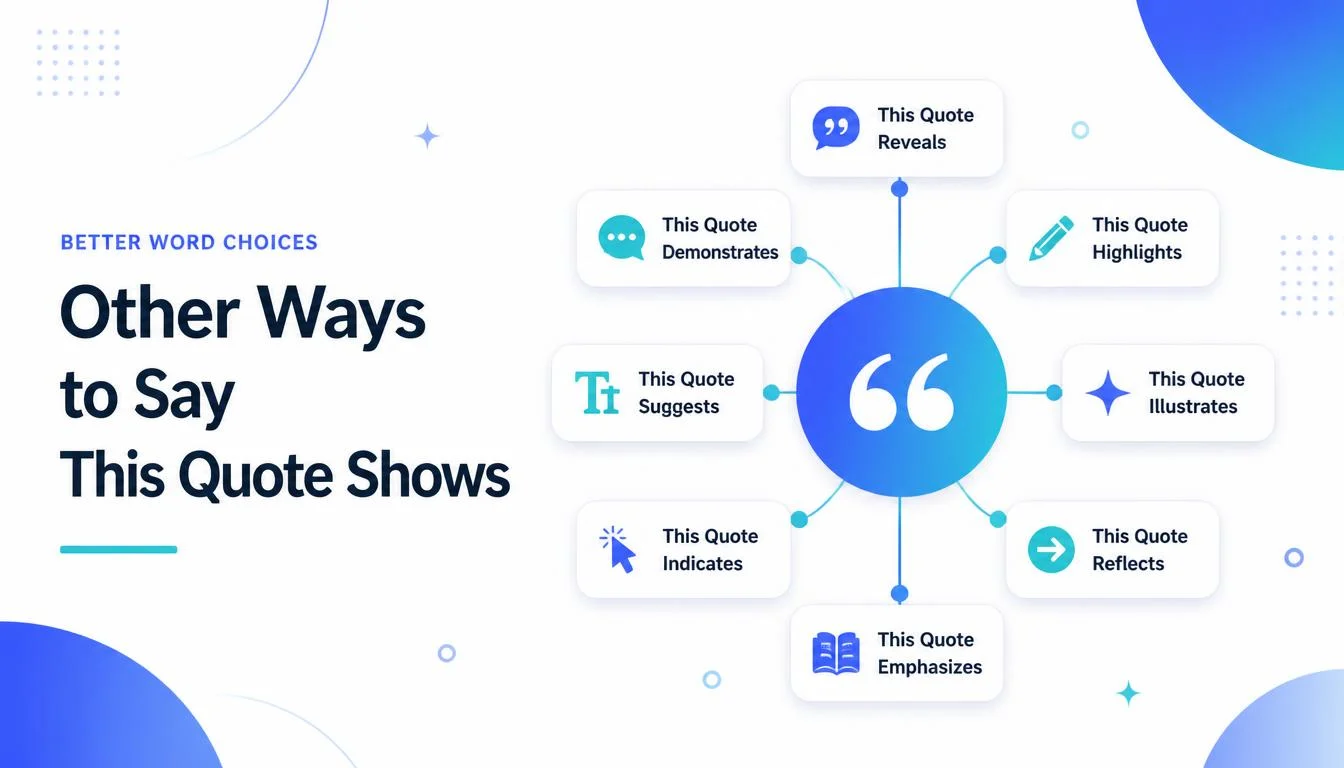
Other ways to say “this quote shows” include this quote demonstrates, this quote illustrates, this quote reveals, this quote highlights, and this quote suggests.
Finding effective other ways to say this quote shows can make your writing more precise, polished, and engaging. Different alternatives can help you explain what a quotation demonstrates, reveals, emphasizes, or suggests.
Whether you are writing an essay, literary analysis, research paper, or professional piece, choosing the right other ways to say this quote shows helps you connect quotations to your main argument more naturally and confidently.
What Is “This Quote Shows”? Meaning, Grammar & Real Use
Imagine you are writing a literature essay and need to explain what a character’s words reveal about their personality. You might write, “This quote shows that the character is afraid.” The sentence is clear and grammatically correct, but repeating the same structure throughout an essay can make your analysis sound basic or predictable.
Learning alternatives to this quote shows gives you more control over tone and meaning. For example, “This quote demonstrates” can emphasize evidence, while “This quote reveals” works well when a quotation uncovers a hidden feeling or characteristic. “This quote suggests” is useful when the evidence supports an interpretation without proving it completely.
These expressions are especially valuable for students, teachers, writers, and professionals who need precise English. They can also help you express excitement in English when discussing a powerful quotation, meaningful statement, or memorable line.
The phrase means that a quotation provides evidence or information about a particular idea, feeling, theme, or situation.
Grammar: “Shows” is a present tense verb. The expression is neutral and works in both spoken and written English, although more precise alternatives are often preferred in formal analysis.
Example: “This quote shows that the character values honesty.”
The phrase is most common in literary analysis, essays, presentations, classroom discussions, reviews, and general explanations.
When Should You Use “This Quote Shows”?
Use the expression when you want to explain what a quotation communicates or what evidence it provides.
Common contexts
- Literary analysis: Explain what a character’s words reveal.
- Essay writing: Connect a quotation to your argument.
- Text analysis: Explain a theme, message, or attitude.
- Classroom discussion: Describe the meaning of a quotation.
- Presentations: Explain why a quotation supports your point.
- Professional communication: Explain what a statement indicates about a situation.
Spoken vs Written
In spoken English, “This quote shows” sounds natural and straightforward.
In academic writing, alternatives such as “This quote demonstrates,” “This quote indicates,” or “This quote suggests” can make your analysis more precise.
Formal vs Informal
The original expression is neutral rather than strongly formal or informal. Its suitability depends largely on the surrounding sentence.
For academic work, choose a verb that communicates the exact relationship between the quotation and your interpretation.
Is It Professional or Just Polite?
“This quote shows” is both understandable and grammatically appropriate. It is not inherently unprofessional, but it can sound repetitive when used several times in formal writing.
Politeness: ✔️ Yes
Professional: ✔️ Yes, when used appropriately
For polished business, academic, or analytical writing, a more specific verb can communicate your point more effectively.
Business style example: “This quote indicates that the organization places considerable value on customer trust.”
Pros and Cons of Using “This Quote Shows”
Pros
- Simple and natural: Readers understand it immediately.
- Clear meaning: It directly connects the quotation with your interpretation.
- Common usage: English learners can use it confidently in everyday analysis.
- Easy to understand: It requires no advanced vocabulary.
Cons
- Can become repetitive: Repeating it throughout an essay reduces variety.
- Less precise: “Shows” does not always communicate whether the quote proves, suggests, reveals, or emphasizes something.
- Basic academic style: Frequent use may make literary analysis sound less sophisticated.
- Limited analytical range: More specific verbs can better express different relationships between evidence and interpretation.
Common Mistakes People Make
1. Treating “Shows” as Proof
“Shows” can introduce evidence, but it does not always mean something is proven.
Incorrect: “This quote shows that everyone agrees with the decision.”
Correct: “This quote suggests that many people support the decision.”
2. Using “Proves” Too Strongly
“Proves” implies conclusive evidence, which may not be justified by one quotation.
Incorrect: “This quote proves that the character is dishonest.”
Correct: “This quote suggests that the character may be dishonest.”
3. Repeating the Same Phrase
Using the same expression in every paragraph can make an essay repetitive.
Incorrect: “This quote shows fear. This quote shows anger. This quote shows conflict.”
Correct: “This quote reveals fear, highlights anger, and suggests internal conflict.”
4. Choosing a Synonym Without Considering Meaning
Not every alternative has exactly the same meaning.
Incorrect: “This quote confirms that the character feels uncertain,” when the quotation only suggests uncertainty.
Correct: “This quote indicates that the character feels uncertain.”
5. Using Casual Expressions in Formal Analysis
Some expressions are natural in conversation but less suitable for academic writing.
Incorrect: “This quote points out that the character is lonely.”
Correct: “This quote highlights the character’s loneliness.”
“Small tone mistakes can make confident English sound careless.”
Alternatives by Category
Formal alternatives to “This Quote Shows”
- This quote demonstrates
- This quote indicates
- This quote reveals
- This quote illustrates
Pro Tip: Choose “demonstrates” for strong evidence, “indicates” for evidence that points toward a conclusion, and “reveals” for information that becomes apparent.
Casual alternatives
- This quote makes clear
- This quote points to
- This quote brings out
- This quote gives us a glimpse of
Pro Tip: Use conversational alternatives when discussing a quotation aloud or explaining an idea to someone informally.
Professional alternatives
- This quote highlights
- This quote suggests
- This quote reflects
- This quote underscores
Pro Tip: Match the verb to your evidence. Use “suggests” for cautious interpretation and “underscores” when emphasizing importance.
Informal expressions
- This quote makes it clear
- This quote brings to light
- This quote shows us
- This quote gives insight into
Pro Tip: Informal expressions in English can make explanations more conversational, but academic writing usually benefits from concise and precise alternatives.
“Formal and informal English are not about correctness. They are about context.”
Other Ways to Say “This Quote Shows” With Examples
These 30 alternatives build fluency and help you express excitement, admiration, or approval depending on the tone and context.
1. Phrase: This Quote Demonstrates
Meaning: Shows something clearly through evidence.
Explanation: Ideal when the quotation strongly supports an interpretation.
Example Sentence: “This quote demonstrates the character’s commitment to justice.”
Best Use: Academic analysis
Worst Use: Casual chat
Tone: Formal, confident, precise
Context Variability: Casual / professional / spoken
2. Phrase: This Quote Indicates
Meaning: Points toward a particular conclusion.
Explanation: Useful when evidence suggests something without proving it absolutely.
Example Sentence: “This quote indicates that the speaker feels uncertain.”
Best Use: Evidence analysis
Worst Use: Casual storytelling
Tone: Analytical, neutral, formal
Context Variability: Casual / professional / spoken
3. Phrase: This Quote Reveals
Meaning: Makes hidden information or feelings apparent.
Explanation: Works especially well for character emotions and motivations.
Example Sentence: “This quote reveals the character’s fear of rejection.”
Best Use: Character analysis
Worst Use: Simple facts
Tone: Analytical, expressive, formal
Context Variability: Casual / professional / spoken
4. Phrase: This Quote Illustrates
Meaning: Makes an idea clear through an example.
Explanation: Useful when connecting a quotation to a broader concept.
Example Sentence: “This quote illustrates the importance of personal freedom.”
Best Use: Essay analysis
Worst Use: Casual greetings
Tone: Educational, formal, clear
Context Variability: Casual / professional / spoken
5. Phrase: This Quote Highlights
Meaning: Draws attention to an important point.
Explanation: Excellent for themes, conflicts, or significant ideas.
Example Sentence: “This quote highlights the conflict between duty and desire.”
Best Use: Key themes
Worst Use: Minor details
Tone: Professional, focused, clear
Context Variability: Casual / professional / spoken
6. Phrase: This Quote Suggests
Meaning: Gives an indication without establishing certainty.
Explanation: Use it when presenting an interpretation cautiously.
Example Sentence: “This quote suggests that the speaker regrets the decision.”
Best Use: Literary interpretation
Worst Use: Certain facts
Tone: Cautious, analytical, neutral
Context Variability: Casual / professional / spoken
7. Phrase: This Quote Reflects
Meaning: Represents a particular feeling, attitude, or condition.
Explanation: Useful when connecting words with a broader attitude or situation.
Example Sentence: “This quote reflects the character’s growing frustration.”
Best Use: Emotional analysis
Worst Use: Numerical proof
Tone: Thoughtful, analytical, professional
Context Variability: Casual / professional / spoken
8. Phrase: This Quote Emphasizes
Meaning: Gives particular importance to an idea.
Explanation: Use it when the quotation strongly reinforces a central point.
Example Sentence: “This quote emphasizes the value of trust.”
Best Use: Key arguments
Worst Use: Minor observations
Tone: Formal, direct, focused
Context Variability: Casual / professional / spoken
9. Phrase: This Quote Underscores
Meaning: Strongly emphasizes an important idea.
Explanation: Particularly effective in formal and professional analysis.
Example Sentence: “This quote underscores the importance of accountability.”
Best Use: Formal analysis
Worst Use: Casual conversation
Tone: Formal, emphatic, professional
Context Variability: Casual / professional / spoken
10. Phrase: This Quote Confirms
Meaning: Supports something already believed or established.
Explanation: Use it when the quotation provides additional evidence for an existing conclusion.
Example Sentence: “This quote confirms the speaker’s commitment to equality.”
Best Use: Supporting evidence
Worst Use: New speculation
Tone: Confident, factual, formal
Context Variability: Casual / professional / spoken
11. Phrase: This Quote Makes Clear
Meaning: Makes an idea easy to understand.
Explanation: A natural option when the meaning is direct and obvious.
Example Sentence: “This quote makes clear that the character values loyalty.”
Best Use: Clear explanations
Worst Use: Technical proof
Tone: Direct, natural, accessible
Context Variability: Casual / professional / spoken
12. Phrase: This Quote Points To
Meaning: Directs attention toward a particular idea or conclusion.
Explanation: Useful when interpreting what a quotation implies.
Example Sentence: “This quote points to a deeper conflict within the character.”
Best Use: Interpretation
Worst Use: Certain conclusions
Tone: Conversational, analytical, clear
Context Variability: Casual / professional / spoken
13. Phrase: This Quote Brings Out
Meaning: Makes a quality or feeling more noticeable.
Explanation: Works well when discussing emotions or personality traits.
Example Sentence: “This quote brings out the character’s compassion.”
Best Use: Character traits
Worst Use: Statistical analysis
Tone: Natural, expressive, friendly
Context Variability: Casual / professional / spoken
14. Phrase: This Quote Gives Us a Glimpse Of
Meaning: Provides a brief view of something.
Explanation: Useful when a quotation offers limited but meaningful insight.
Example Sentence: “This quote gives us a glimpse of her private struggles.”
Best Use: Character insight
Worst Use: Formal proof
Tone: Conversational, descriptive, engaging
Context Variability: Casual / professional / spoken
15. Phrase: This Quote Gives Insight Into
Meaning: Helps explain or understand something more deeply.
Explanation: Suitable for analyzing motives, beliefs, or experiences.
Example Sentence: “This quote gives insight into the character’s motivations.”
Best Use: Deeper analysis
Worst Use: Simple description
Tone: Professional, thoughtful, analytical
Context Variability: Casual / professional / spoken
16. Phrase: This Quote Brings To Light
Meaning: Reveals something previously unnoticed or hidden.
Explanation: Use it when the quotation exposes an important issue or idea.
Example Sentence: “This quote brings to light the social pressures facing the character.”
Best Use: Hidden issues
Worst Use: Obvious facts
Tone: Expressive, analytical, engaging
Context Variability: Casual / professional / spoken
17. Phrase: This Quote Makes It Clear
Meaning: Makes the meaning or implication obvious.
Explanation: A conversational variation that works well in spoken analysis.
Example Sentence: “This quote makes it clear that the speaker feels betrayed.”
Best Use: Spoken analysis
Worst Use: Formal research
Tone: Friendly, direct, conversational
Context Variability: Casual / professional / spoken
18. Phrase: This Quote Shows Us
Meaning: Helps us understand or recognize something.
Explanation: More conversational than formal analytical alternatives.
Example Sentence: “This quote shows us how strongly the character values family.”
Best Use: Classroom discussion
Worst Use: Formal essays
Tone: Conversational, simple, friendly
Context Variability: Casual / professional / spoken
19. Phrase: This Quote Demonstrates That
Meaning: Presents evidence supporting a specific conclusion.
Explanation: Strong choice when the quotation directly supports your argument.
Example Sentence: “This quote demonstrates that the speaker understands the consequences.”
Best Use: Argument support
Worst Use: Weak evidence
Tone: Formal, confident, precise
Context Variability: Casual / professional / spoken
20. Phrase: This Quote Indicates That
Meaning: Suggests a particular meaning or conclusion.
Explanation: Useful when analyzing evidence without overstating certainty.
Example Sentence: “This quote indicates that the character has changed.”
Best Use: Evidence interpretation
Worst Use: Absolute proof
Tone: Analytical, measured, formal
Context Variability: Casual / professional / spoken
21. Phrase: This Quote Highlights The Fact That
Meaning: Draws special attention to a specific fact.
Explanation: Works when the quotation reinforces an important observation.
Example Sentence: “This quote highlights the fact that trust is essential.”
Best Use: Important findings
Worst Use: Minor details
Tone: Formal, emphatic, focused
Context Variability: Casual / professional / spoken
22. Phrase: This Quote Reflects The Idea That
Meaning: Represents or supports a particular idea.
Explanation: Useful for connecting quotations with themes or broader concepts.
Example Sentence: “This quote reflects the idea that freedom requires responsibility.”
Best Use: Theme analysis
Worst Use: Simple facts
Tone: Analytical, thoughtful, formal
Context Variability: Casual / professional / spoken
23. Phrase: This Quote Supports The Idea That
Meaning: Provides evidence for an interpretation.
Explanation: A clear choice when linking evidence to an argument.
Example Sentence: “This quote supports the idea that education creates opportunity.”
Best Use: Argument building
Worst Use: Unrelated claims
Tone: Academic, clear, logical
Context Variability: Casual / professional / spoken
24. Phrase: This Quote Reinforces
Meaning: Makes an existing idea or message stronger.
Explanation: Use it when the quotation supports a point already established.
Example Sentence: “This quote reinforces the novel’s central theme of resilience.”
Best Use: Theme development
Worst Use: New ideas
Tone: Formal, analytical, confident
Context Variability: Casual / professional / spoken
25. Phrase: This Quote Establishes
Meaning: Clearly supports or sets out a particular point.
Explanation: Stronger than “suggests” and suitable when evidence is well established.
Example Sentence: “This quote establishes the speaker’s commitment to fairness.”
Best Use: Strong evidence
Worst Use: Uncertain claims
Tone: Authoritative, formal, precise
Context Variability: Casual / professional / spoken
26. Phrase: This Quote Portrays
Meaning: Presents a person, situation, or idea in a particular way.
Explanation: Especially useful when discussing characterization or representation.
Example Sentence: “This quote portrays the speaker as determined and courageous.”
Best Use: Character analysis
Worst Use: Statistical evidence
Tone: Descriptive, analytical, formal
Context Variability: Casual / professional / spoken
27. Phrase: This Quote Depicts
Meaning: Represents or describes something.
Explanation: Often used for scenes, experiences, characters, or social conditions.
Example Sentence: “This quote depicts the character’s isolation from society.”
Best Use: Descriptive analysis
Worst Use: Direct proof
Tone: Formal, descriptive, analytical
Context Variability: Casual / professional / spoken
28. Phrase: This Quote Expresses
Meaning: Communicates a feeling, thought, or attitude.
Explanation: Use it when the main focus is what the speaker feels or believes.
Example Sentence: “This quote expresses the speaker’s frustration with injustice.”
Best Use: Emotional analysis
Worst Use: Numerical evidence
Tone: Clear, expressive, analytical
Context Variability: Casual / professional / spoken
29. Phrase: This Quote Communicates
Meaning: Conveys a particular message or idea.
Explanation: Useful when discussing the overall message of a quotation.
Example Sentence: “This quote communicates a strong message about personal responsibility.”
Best Use: Message analysis
Worst Use: Simple description
Tone: Professional, neutral, clear
Context Variability: Casual / professional / spoken
30. Phrase: This Quote Conveys
Meaning: Communicates a feeling, idea, or message.
Explanation: A polished alternative that works especially well in analytical writing.
Example Sentence: “This quote conveys the speaker’s deep sense of regret.”
Best Use: Formal analysis
Worst Use: Casual chat
Tone: Formal, expressive, precise
Context Variability: Casual / professional / spoken
Comparison Table: Top 10 Alternatives at a Glance
| Phrase | Tone | Best Use |
|---|---|---|
| This quote demonstrates | Formal | Strong evidence |
| This quote indicates | Analytical | Evidence interpretation |
| This quote reveals | Formal | Hidden meaning |
| This quote illustrates | Educational | Explaining ideas |
| This quote highlights | Professional | Key points |
| This quote suggests | Neutral | Cautious interpretation |
| This quote reflects | Analytical | Themes and attitudes |
| This quote emphasizes | Formal | Important ideas |
| This quote supports the idea that | Academic | Argument building |
| This quote conveys | Professional | Feelings and messages |
For additional vocabulary practice, see also: Other Ways to Say “Amazing”.
For workplace language development, see also: Professional English Communication Guide.
Quick Self Check
1. You are writing a formal essay and the quotation provides strong evidence for your argument. Which option fits best?
- A. This quote shows us
- B. This quote demonstrates
- C. This quote gives us a glimpse of
- D. This quote brings out
Answer: B. “This quote demonstrates” clearly connects strong evidence with an interpretation.
2. A quotation suggests that a character may be hiding something, but the evidence is not conclusive. Which verb is most appropriate?
A. Confirms
B. Establishes
C. Suggests
D. Proves
Answer: C. “Suggests” avoids claiming more certainty than the evidence provides.
3. You are discussing a quotation that reveals a character’s previously hidden fear. Which option is most precise?
- A. This quote reveals
- B. This quote presents
- C. This quote lays out
- D. This quote shows off
Answer: A. “Reveals” emphasizes the discovery of hidden information.
4. You are explaining a quotation during a casual classroom discussion. Which expression sounds natural?
- A. This quote shows us
- B. This quote establishes conclusively
- C. This quote documents
- D. This quote substantiates
Answer: A. “This quote shows us” is conversational and easy to understand in spoken discussion.
FAQs
What are the best alternatives to “this quote shows”?
Useful alternatives include “this quote demonstrates,” “this quote indicates,” “this quote reveals,” “this quote illustrates,” and “this quote highlights.” The best choice depends on the relationship between the quotation and your interpretation.
What is a formal way to say “this quote shows”?
“This quote demonstrates,” “this quote indicates,” and “this quote reveals” are strong formal choices for academic and analytical writing.
How can I avoid repeating “this quote shows” in an essay?
Replace it with a precise verb based on your meaning. Use “reveals” for hidden information, “suggests” for cautious interpretation, and “highlights” for important points.
Is “this quote shows” grammatically correct?
Yes. “Shows” is the correct third person singular form of “show.” The expression is grammatically correct in both spoken and written English.
What professional reaction phrases can replace “this quote shows”?
Professional reaction phrases include “this quote demonstrates,” “this quote indicates,” “this quote highlights,” “this quote underscores,” and “this quote conveys.” Each communicates a slightly different relationship between the quotation and your analysis.
conclusion
Learning different ways to discuss quotations makes your English more flexible, precise, and engaging. Instead of relying on one repeated expression, you can choose verbs such as “demonstrates,” “reveals,” “suggests,” “highlights,” and “conveys” according to your evidence and intended meaning.
Daily practice will help you recognize these differences naturally. Pay attention to whether you are presenting evidence, suggesting an interpretation, revealing information, or emphasizing a theme. This awareness is especially useful in essays, presentations, professional reaction phrases, and informal expressions in English.
Read More Related Articles:
- Other Ways to Say “It Was a Pleasure Meeting You” | Make a Strong Final Impression In 2026
- Other Ways to Say Looking Forward to Seeing You | Leave a Great Impression In 2026
- Other Ways to Say “LOL” | When Something Is Actually Hilarious In 2026

Daniel Murphy is a professional writer and blogger specializing in digital communication and messaging trends. As a contributor to TextsResponse.com, he creates reader-focused content designed to help people find the right words at the right time.