Quick Answer
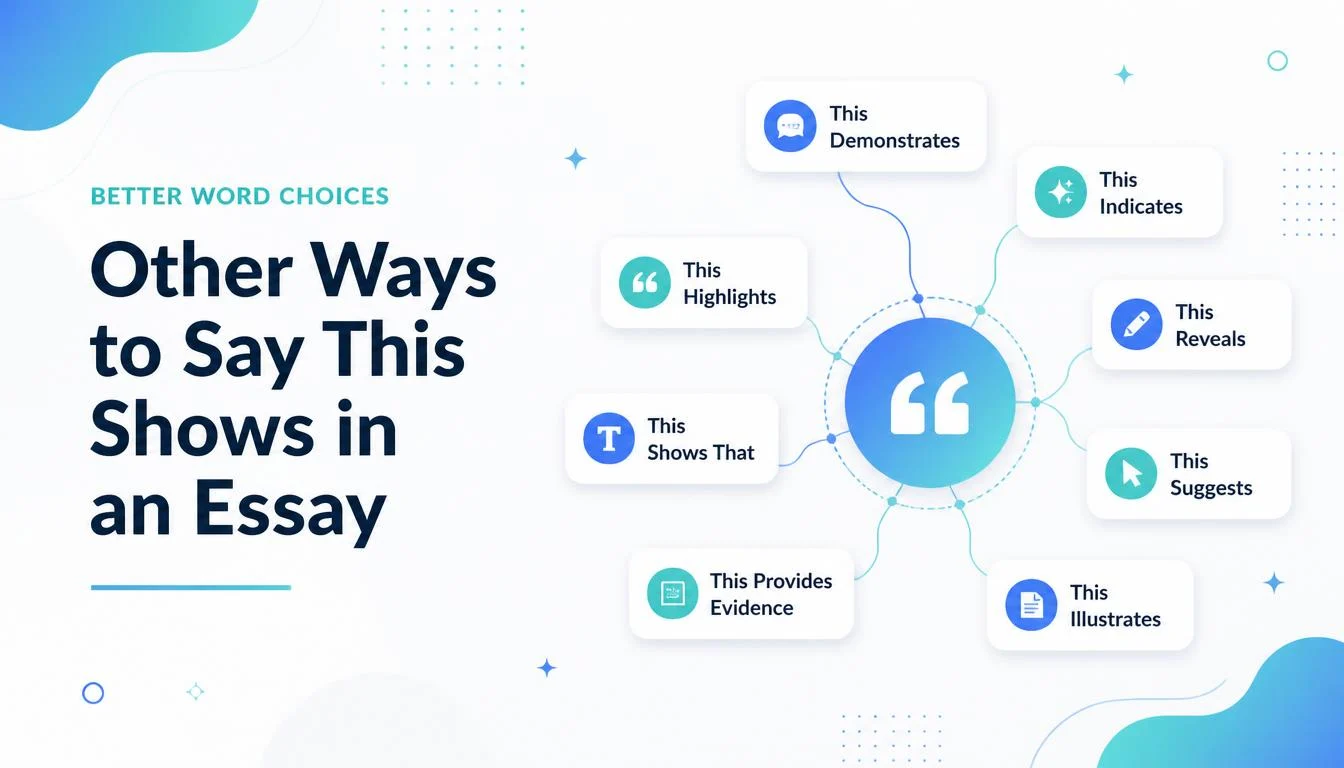
Other ways to say “this shows” in an essay include this demonstrates, this indicates, this illustrates, this reveals, this suggests, this highlights, and this establishes.
Finding the right alternatives to “this shows” can make your essay more engaging, precise, and professional. Using varied academic expressions helps you communicate your ideas clearly while avoiding repetitive language.
In this guide, you’ll discover 30 other ways to say “this shows” in an essay, with meanings and example sentences. These alternatives will help you strengthen your arguments, explain evidence, and express your ideas more effectively in academic writing.
Quick Categories of Alternatives
Formal alternatives to “Other Ways to Say This Shows in an Essay”
- This demonstrates
- This indicates
- This substantiates
- This illustrates
Pro Tip: Use formal expressions when analyzing research, presenting evidence, or writing academic assignments.
Casual alternatives
- This makes it clear
- This points to
- This helps explain
- This makes it evident
Pro Tip: Use these expressions in reflective essays or less formal writing when a conversational tone feels appropriate.
Professional alternatives
- This establishes
- This reinforces
- This confirms
- This highlights
Pro Tip: Choose precise expressions that directly connect your evidence to your central argument.
Informal expressions
- This shows that
- This tells us
- This gives us an idea
- This makes it obvious
Pro Tip: These informal expressions in English are more suitable for discussions, personal reflections, and informal explanations than for formal academic writing.
“Strong academic writing does more than present evidence. It explains what that evidence means.”
Common Mistakes When Using “This Shows” in an Essay
1. Repeating the same phrase
Using “this shows” in every paragraph makes your writing repetitive.
Example: “The character feels isolated. This shows his loneliness. This shows his sadness.”
Better: “The character feels isolated. This highlights his loneliness and reveals his emotional distress.”
2. Using vague evidence analysis
The phrase may not explain exactly what the evidence proves.
Example: “The statistics are important. This shows the issue.”
Better: “The statistics demonstrate the growing scale of the issue.”
3. Making unsupported claims
Using “this proves” when the evidence only suggests a possibility can weaken your argument.
Example: “One survey proves that all students prefer online learning.”
Better: “The survey suggests that many students prefer online learning.”
4. Choosing an overly complicated alternative
Unnecessarily complex expressions can make a sentence harder to understand.
Example: “This serves to substantiate the aforementioned conceptualization.”
Better: “This supports the main argument.”
5. Using informal expressions in academic writing
Expressions such as “this tells us” may sound too conversational in a formal essay.
Example: “This tells us that the policy worked.”
Better: “This indicates that the policy was effective.”
What Does “This Shows” Mean?
“This shows” is a phrase used to explain what a piece of evidence, observation, example, or event reveals about a particular subject.
Grammatically, “this” is a demonstrative pronoun referring to an idea or piece of evidence, while “shows” is the present-tense verb that introduces the result, meaning, or implication.
Example: “The character repeatedly avoids social interaction. This shows that he feels isolated.”
In academic writing, the phrase connects evidence to interpretation. However, the writer should explain precisely what the evidence reveals rather than relying on a vague statement.
When to Use “This Shows” in an Essay
The phrase is useful in several types of writing and communication.
- Literary analysis: Explaining what a character’s actions, dialogue, or symbolism reveal.
- Research essays: Interpreting statistics, survey results, and findings.
- Argumentative essays: Connecting supporting evidence to a central claim.
- Expository writing: Explaining how examples support an explanation.
- Reflective essays: Describing what an experience reveals about a person or situation.
Spoken vs. Written Usage
Spoken English: “This shows that we need a better solution.”
Written English: “This demonstrates the need for a more effective solution.”
Formal vs. Informal Usage
- Formal: This demonstrates, this indicates, this substantiates.
- Informal: This shows, this tells us, this makes it clear.
“Choose a phrase that explains the strength of your evidence, not just one that sounds sophisticated.”
Is It Professional or Polite to Say “This Shows”?
Polite? Yes.
Professional? Yes, in many contexts, but it may be too vague for formal academic writing.
“This shows” is grammatically correct and understandable. It is appropriate in everyday conversation, classroom discussions, and many types of essays. In professional reports or academic assignments, a more specific alternative can make your analysis clearer.
Business-style example:
“The customer feedback indicates that the updated service has improved satisfaction.”
This sentence sounds professional because it identifies what the evidence indicates rather than relying on a broad expression.
Pros and Cons of Using “This Shows”
Pros
- Simple and natural: Easy to understand and use.
- Friendly tone: Creates a straightforward, accessible style.
- Common usage: Familiar to readers across different levels of English.
- Easy to understand: Connects evidence to an explanation without unnecessary complexity.
Cons
- Too informal for some work: May sound basic in highly formal academic writing.
- Overused: Repetition can make essays monotonous.
- Limited emotional range: Does not always convey the precise relationship between evidence and interpretation.
- Not suitable for every formal context: More precise academic verbs may be needed for research analysis.
Other Ways to Say “This Shows” in an Essay (With Examples)
These alternatives will help you sound more fluent, confident, and natural in different situations.
Use them according to tone, context, and audience to express excitement, admiration, or approval when relevant, while keeping academic analysis focused on evidence and meaning.
Formal and Academic Alternatives
1. Phrase: This Demonstrates
- Meaning: This clearly illustrates or establishes a particular point.
- Explanation: Use it when evidence provides strong support for an argument.
- Example Sentence: “The results demonstrate the effectiveness of the new teaching method.”
- Best Use: Academic analysis
- Worst Use: Weak evidence
- Tone: Formal, confident, analytical
- Context Variability: Casual: This demonstrates the problem. Professional: The data demonstrate improvement. Spoken: This demonstrates why it matters.
2. Phrase: This Indicates
- Meaning: This suggests that something is likely or evident.
- Explanation: Use it to interpret evidence without claiming absolute certainty.
- Example Sentence: “The increase in attendance indicates growing student engagement.”
- Best Use: Research analysis
- Worst Use: Certain proof
- Tone: Formal, objective, analytical
- Context Variability: Casual: This indicates a change. Professional: The findings indicate progress. Spoken: This indicates a possible issue.
3. Phrase: This Suggests
- Meaning: This points toward a possible conclusion or interpretation.
- Explanation: Use it when evidence supports an idea but does not conclusively establish it.
- Example Sentence: “The character’s silence suggests that he is hiding something.”
- Best Use: Literary interpretation
- Worst Use: Conclusive proof
- Tone: Cautious, academic, analytical
- Context Variability: Casual: This suggests a problem. Professional: The results suggest improvement. Spoken: This suggests another possibility.
4. Phrase: This Reveals
- Meaning: This makes a previously hidden fact, quality, or meaning apparent.
- Explanation: Use it to uncover deeper meaning in evidence or behavior.
- Example Sentence: “The character’s reaction reveals his fear of rejection.”
- Best Use: Literary analysis
- Worst Use: Obvious facts
- Tone: Analytical, insightful, formal
- Context Variability: Casual: This reveals the truth. Professional: The report reveals a trend. Spoken: This reveals what happened.
5. Phrase: This Highlights
- Meaning: This draws attention to an important point.
- Explanation: Use it to emphasize a significant detail or issue.
- Example Sentence: “The study highlights the importance of early childhood education.”
- Best Use: Key arguments
- Worst Use: Minor details
- Tone: Professional, emphatic, analytical
- Context Variability: Casual: This highlights the issue. Professional: The report highlights key risks. Spoken: This highlights the main point.
6. Phrase: This Illustrates
- Meaning: This provides a clear example of an idea or concept.
- Explanation: Use it when a specific example makes a broader point easier to understand.
- Example Sentence: “The protagonist’s decision illustrates the conflict between duty and desire.”
- Best Use: Supporting examples
- Worst Use: Unsupported claims
- Tone: Formal, explanatory, clear
- Context Variability: Casual: This illustrates the problem. Professional: The case illustrates the risk. Spoken: This illustrates what I mean.
7. Phrase: This Establishes
- Meaning: This sets out or firmly supports a particular point.
- Explanation: Use it when evidence provides a foundation for a claim.
- Example Sentence: “The opening paragraph establishes the central conflict of the novel.”
- Best Use: Argument development
- Worst Use: Weak evidence
- Tone: Formal, authoritative, precise
- Context Variability: Casual: This establishes the point. Professional: The evidence establishes a pattern. Spoken: This establishes the basic idea.
8. Phrase: This Substantiates
- Meaning: This provides supporting evidence for a claim.
- Explanation: Use it when facts or research strengthen an existing argument.
- Example Sentence: “The additional data substantiate the author’s central argument.”
- Best Use: Evidence-based writing
- Worst Use: Personal opinions
- Tone: Academic, formal, evidence-focused
- Context Variability: Casual: This supports the claim. Professional: The findings substantiate the conclusion. Spoken: This substantiates what we found.
9. Phrase: This Confirms
- Meaning: This provides further evidence that something is true or accurate.
- Explanation: Use it when evidence supports an existing conclusion.
- Example Sentence: “The second experiment confirms the initial findings.”
- Best Use: Verified findings
- Worst Use: Uncertain claims
- Tone: Confident, formal, factual
- Context Variability: Casual: This confirms the idea. Professional: The results confirm the trend. Spoken: This confirms what we expected.
10. Phrase: This Reinforces
- Meaning: This strengthens an existing idea, belief, or argument.
- Explanation: Use it when additional evidence makes a point more convincing.
- Example Sentence: “The final chapter reinforces the theme of personal responsibility.”
- Best Use: Argument support
- Worst Use: Contradictory evidence
- Tone: Analytical, persuasive, professional
- Context Variability: Casual: This reinforces the point. Professional: The evidence reinforces the recommendation. Spoken: This reinforces what I said.
Clear and Analytical Alternatives
11. Phrase: This Makes It Clear
- Meaning: This makes a particular idea easier to understand.
- Explanation: Use it when evidence clarifies a point for the reader.
- Example Sentence: “The author’s repeated references to nature make it clear that the setting reflects the character’s emotions.”
- Best Use: Clear explanations
- Worst Use: Formal research
- Tone: Direct, accessible, explanatory
- Context Variability: Casual: This makes it clear. Professional: The results make the issue clear. Spoken: This makes it clear why.
12. Phrase: This Points To
- Meaning: This suggests a particular conclusion or possibility.
- Explanation: Use it when evidence directs attention toward a likely interpretation.
- Example Sentence: “The repeated imagery points to the theme of lost innocence.”
- Best Use: Interpretive analysis
- Worst Use: Certain proof
- Tone: Analytical, neutral, cautious
- Context Variability: Casual: This points to a problem. Professional: The data point to a trend. Spoken: This points to another cause.
13. Phrase: This Helps Explain
- Meaning: This provides a reason or context for understanding something.
- Explanation: Use it when evidence clarifies why an event or situation occurs.
- Example Sentence: “The character’s childhood experiences help explain his fear of abandonment.”
- Best Use: Cause analysis
- Worst Use: Final conclusions
- Tone: Clear, explanatory, neutral
- Context Variability: Casual: This helps explain it. Professional: This helps explain the outcome. Spoken: This helps explain what happened.
14. Phrase: This Makes It Evident
- Meaning: This makes a fact or conclusion clearly noticeable.
- Explanation: Use it when the evidence makes a point particularly apparent.
- Example Sentence: “The contrast between the two characters makes it evident that they hold opposing values.”
- Best Use: Clear contrasts
- Worst Use: Ambiguous evidence
- Tone: Formal, direct, analytical
- Context Variability: Casual: This makes it evident. Professional: The results make the issue evident. Spoken: This makes it evident why.
15. Phrase: This Underscores
- Meaning: This emphasizes the importance of a particular idea.
- Explanation: Use it to draw attention to a central theme or significant finding.
- Example Sentence: “The character’s sacrifice underscores the novel’s message about loyalty.”
- Best Use: Theme analysis
- Worst Use: Minor observations
- Tone: Formal, emphatic, analytical
- Context Variability: Casual: This emphasizes the point. Professional: The report underscores the need for change. Spoken: This underscores why it matters.
16. Phrase: This Emphasizes
- Meaning: This gives special importance or attention to a point.
- Explanation: Use it when an example or detail strengthens the importance of an idea.
- Example Sentence: “The author’s use of repetition emphasizes the urgency of the situation.”
- Best Use: Key themes
- Worst Use: Neutral details
- Tone: Clear, formal, emphatic
- Context Variability: Casual: This emphasizes the issue. Professional: The findings emphasize the need for action. Spoken: This emphasizes the main point.
17. Phrase: This Reflects
- Meaning: This represents or expresses a particular quality, condition, or idea.
- Explanation: Use it when evidence mirrors a broader theme or situation.
- Example Sentence: “The empty streets reflect the community’s growing sense of fear.”
- Best Use: Thematic analysis
- Worst Use: Direct proof
- Tone: Interpretive, thoughtful, analytical
- Context Variability: Casual: This reflects the situation. Professional: The results reflect changing priorities. Spoken: This reflects what we see.
18. Phrase: This Exemplifies
- Meaning: This serves as a clear example of a particular quality or concept.
- Explanation: Use it when a specific case represents a broader idea.
- Example Sentence: “The protagonist’s courage exemplifies the theme of selflessness.”
- Best Use: Literary examples
- Worst Use: General claims
- Tone: Formal, descriptive, analytical
- Context Variability: Casual: This is a good example. Professional: The case exemplifies best practice. Spoken: This exemplifies the idea.
19. Phrase: This Demonstrates That
- Meaning: This introduces a conclusion supported by evidence.
- Explanation: Use it to connect a specific observation to a clear argument.
- Example Sentence: “The declining test scores demonstrate that the current teaching strategy needs improvement.”
- Best Use: Evidence interpretation
- Worst Use: Unsupported conclusions
- Tone: Formal, confident, logical
- Context Variability: Casual: This demonstrates that it works. Professional: The results demonstrate that the process is effective. Spoken: This demonstrates that we were right.
20. Phrase: This Provides Evidence That
- Meaning: This introduces information that supports a particular claim.
- Explanation: Use it when you want to emphasize the evidentiary basis of an argument.
- Example Sentence: “The survey provides evidence that students benefit from regular feedback.”
- Best Use: Research writing
- Worst Use: Unsupported opinions
- Tone: Formal, objective, evidence-based
- Context Variability: Casual: This gives evidence. Professional: The findings provide evidence that the policy works. Spoken: This provides evidence for the claim.
Professional and Context-Specific Alternatives
21. Phrase: This Supports
- Meaning: This strengthens or backs up a particular claim.
- Explanation: Use it when evidence contributes to the credibility of an argument.
- Example Sentence: “The historical records support the author’s interpretation of the event.”
- Best Use: Argument building
- Worst Use: Contradictory evidence
- Tone: Neutral, professional, analytical
- Context Variability: Casual: This supports my point. Professional: The data support the recommendation. Spoken: This supports what we discussed.
22. Phrase: This Validates
- Meaning: This provides support for the credibility or accuracy of an idea.
- Explanation: Use it when evidence strengthens the legitimacy of a claim or method.
- Example Sentence: “The independent findings validate the researcher’s original hypothesis.”
- Best Use: Research findings
- Worst Use: Unverified claims
- Tone: Formal, confident, evidence-focused
- Context Variability: Casual: This validates the idea. Professional: The results validate the approach. Spoken: This validates our findings.
23. Phrase: This Clarifies
- Meaning: This makes an idea or situation easier to understand.
- Explanation: Use it when evidence removes confusion or provides additional detail.
- Example Sentence: “The author’s explanation clarifies the motivation behind the character’s decision.”
- Best Use: Detailed analysis
- Worst Use: New claims
- Tone: Clear, professional, explanatory
- Context Variability: Casual: This clarifies the point. Professional: The report clarifies the requirements. Spoken: This clarifies what happened.
24. Phrase: This Demonstrates the Importance of
- Meaning: This shows why a particular issue or concept matters.
- Explanation: Use it to explain the significance of evidence in relation to a broader topic.
- Example Sentence: “The findings demonstrate the importance of access to quality education.”
- Best Use: Significance analysis
- Worst Use: Minor details
- Tone: Formal, analytical, persuasive
- Context Variability: Casual: This shows why it matters. Professional: The data demonstrate the importance of planning. Spoken: This demonstrates why we need it.
25. Phrase: This Is Indicative Of
- Meaning: This serves as a sign of a particular condition or trend.
- Explanation: Use it when a detail suggests a broader pattern or characteristic.
- Example Sentence: “The repeated delays are indicative of weaknesses in the planning process.”
- Best Use: Pattern analysis
- Worst Use: Certain proof
- Tone: Formal, analytical, cautious
- Context Variability: Casual: This is a sign of trouble. Professional: The trend is indicative of rising demand. Spoken: This is indicative of a larger issue.
26. Phrase: This Brings Attention To
- Meaning: This directs focus toward a particular issue or detail.
- Explanation: Use it when evidence draws attention to an important matter.
- Example Sentence: “The author’s description brings attention to the inequalities within the community.”
- Best Use: Issue analysis
- Worst Use: Unrelated details
- Tone: Neutral, explanatory, professional
- Context Variability: Casual: This draws attention to it. Professional: The report brings attention to key concerns. Spoken: This brings attention to the problem.
27. Phrase: This Sheds Light On
- Meaning: This provides new understanding of a subject or issue.
- Explanation: Use it when evidence helps explain something that was previously unclear.
- Example Sentence: “The interview sheds light on the social pressures faced by the protagonist.”
- Best Use: Deeper understanding
- Worst Use: Obvious facts
- Tone: Thoughtful, analytical, accessible
- Context Variability: Casual: This sheds light on the issue. Professional: The findings shed light on customer behavior. Spoken: This sheds light on what happened.
28. Phrase: This Points Toward
- Meaning: This suggests a possible direction, explanation, or conclusion.
- Explanation: Use it when evidence indicates a potential outcome without establishing certainty.
- Example Sentence: “The character’s changing behavior points toward a gradual transformation.”
- Best Use: Emerging patterns
- Worst Use: Certain conclusions
- Tone: Analytical, cautious, interpretive
- Context Variability: Casual: This points toward a solution. Professional: The data point toward a new trend. Spoken: This points toward another explanation.
29. Phrase: This Makes the Case For
- Meaning: This provides reasons or evidence in favor of an argument.
- Explanation: Use it when evidence helps justify a particular position.
- Example Sentence: “The research makes the case for introducing more inclusive teaching practices.”
- Best Use: Persuasive essays
- Worst Use: Neutral summaries
- Tone: Persuasive, professional, assertive
- Context Variability: Casual: This supports the idea. Professional: The report makes the case for investment. Spoken: This makes the case for change.
30. Phrase: This Leads To the Conclusion That
- Meaning: This introduces a conclusion drawn from the available evidence.
- Explanation: Use it when several pieces of evidence collectively support a reasoned conclusion.
- Example Sentence: “The consistent decline in participation leads to the conclusion that the program requires revision.”
- Best Use: Concluding analysis
- Worst Use: Weak evidence
- Tone: Formal, logical, analytical
- Context Variability: Casual: This suggests that. Professional: The evidence leads to the conclusion that changes are needed. Spoken: This leads us to conclude that.
“The most effective alternative is the one that accurately describes what your evidence actually supports.”
Mini Quiz: Test Your Understanding
Choose the most suitable phrase for each situation.
1. You have strong research evidence supporting a claim. Which phrase fits best?This demonstratesThis might suggestThis tells us
2. A character’s silence hints at a possible hidden fear. Which phrase is most appropriate?This confirmsThis suggestsThis proves
3. You want to emphasize the importance of a theme in a formal essay.This underscoresThis tells usThis makes it obvious
4. A survey provides supporting information for your argument. Which phrase is most precise?This provides evidence thatThis makes it obviousThis tells usCheck Answers
Comparison Table: Top Alternatives
| Phrase | Tone | Best Use |
|---|---|---|
| This demonstrates | Formal | Strong evidence |
| This indicates | Academic | Interpreting results |
| This suggests | Cautious | Possible conclusions |
| This reveals | Analytical | Hidden meanings |
| This highlights | Professional | Emphasizing key points |
| This illustrates | Explanatory | Giving examples |
| This establishes | Authoritative | Building arguments |
| This substantiates | Academic | Supporting claims |
| This reinforces | Professional | Strengthening arguments |
| This underscores | Formal | Emphasizing significance |
FAQs
1. What is another way to say “this shows” in an essay?
You can use “this demonstrates,” “this indicates,” “this suggests,” “this reveals,” or “this highlights,” depending on the meaning and strength of your evidence.
2. What is the most formal alternative to “this shows”?
“This demonstrates,” “this substantiates,” and “this establishes” are formal alternatives suitable for academic writing when used accurately.
3. How can I avoid repeating “this shows” in an essay?
Vary your wording with precise alternatives such as “this reveals,” “this illustrates,” and “this reinforces.” Focus on the relationship between your evidence and your argument.
4. Can I use “this suggests” instead of “this shows”?
Yes. “This suggests” is appropriate when evidence points toward a possible conclusion but does not prove it conclusively.
5. Is “this demonstrates” better than “this shows” in academic writing?
Both expressions are grammatically correct. “This demonstrates” often sounds more formal, while “this shows” is simpler and more conversational. Choose the phrase that best reflects your evidence.
Conclusion
Learning other ways to say this shows in an essay helps you write with greater clarity, precision, and variety. Expressions such as “this demonstrates,” “this suggests,” and “this reveals” allow you to explain evidence more effectively while maintaining an appropriate academic tone.
Practice using these alternatives in your daily writing. Pay attention to the strength of your evidence, your audience, and the purpose of your essay. With regular practice, you can make your writing more natural, engaging, and professional.
Read More Related Articles:
- Other Ways to Say Also in an Essay | Make Your Writing Shine In 2026
- Other Ways to Say “This Shows That” | Express Your Ideas with Confidence In 2026
- Other Ways to Say “Which” in English | Beyond the Common Choices In 2026

Henry Walker is an American writer and blogger with a keen interest in communication, language and digital content. At TextsResponse.com, he creates informative and reader-focused resources designed to help people communicate with clarity, confidence and authenticity.