Quick Answer
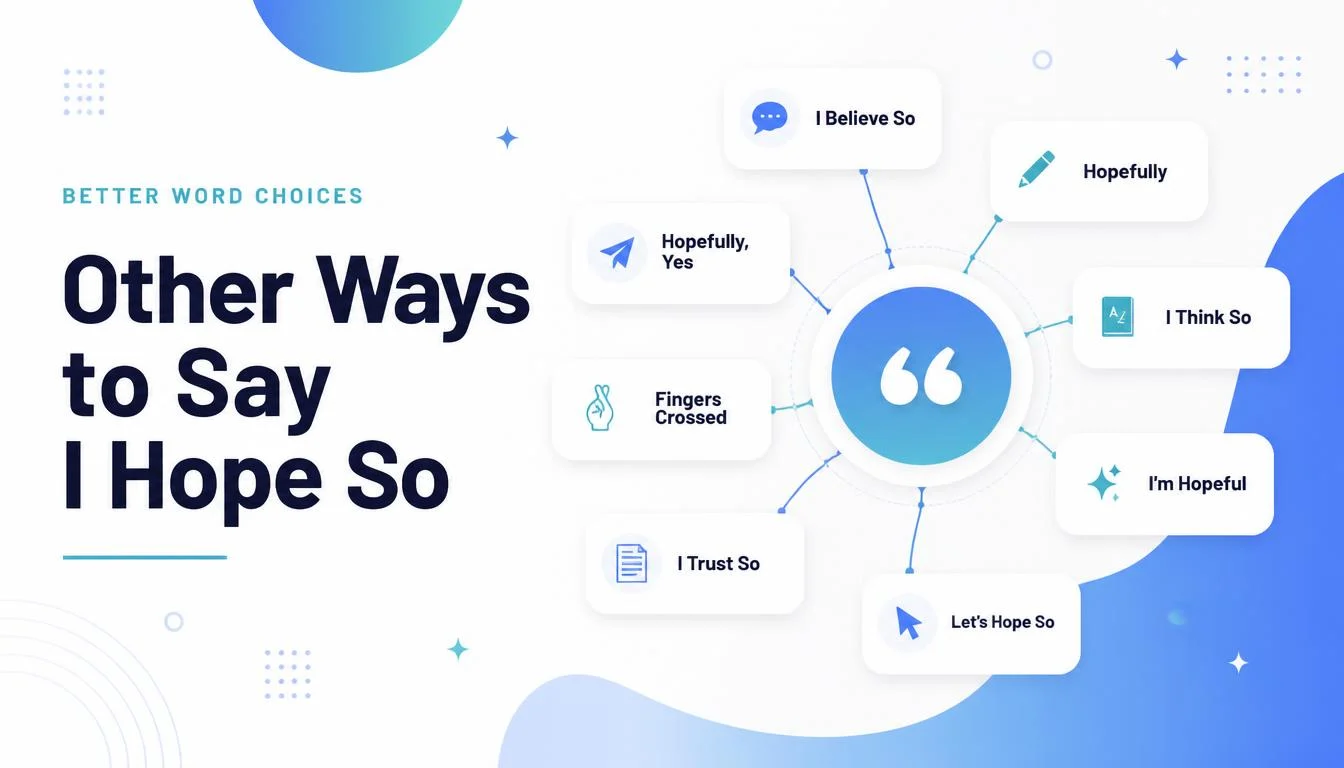
Other ways to say I hope so include I certainly hope so, I believe so, I’m optimistic, Let’s hope so, and Hopefully.
When you want to express optimism or a positive expectation, there are many natural other ways to say I hope so. Choosing the right expression can help you sound more confident, polite, or conversational depending on the situation.
These other ways to say I hope so work across casual conversations, workplace communication, and everyday English. Some phrases show stronger confidence, while others communicate hope without sounding too certain.
What Is “I Hope So”? Meaning, Grammar & Real Use
Imagine a colleague asks, “Do you think the client will approve the proposal?” You might naturally reply, “I hope so.” The phrase is useful because it communicates a positive desire without claiming that something will definitely happen.
For English learners, learning alternatives to I hope so can make conversations more flexible and natural. Depending on the context, you may want to sound more confident, cautious, formal, or enthusiastic. This is especially useful when you want to express excitement in English without making a promise or stating an uncertain outcome as a fact.
“I hope so” means that you want something to happen and believe it may happen, although you are not certain.
Grammatically, “hope” is a verb, while “so” replaces a previously mentioned idea or situation.
Example: “Will you get the promotion?” “I hope so.”
People commonly use it in spoken English, casual messages, conversations, and friendly professional interactions. In highly formal writing, a more specific expression can sound clearer.
When Should You Use “I Hope So”?
Use “I hope so” when you want to express a positive expectation without presenting it as certain.
Spoken vs Written
- Spoken: Very natural in everyday conversations.
- Written: Fine for emails, messages, and informal correspondence.
- Formal writing: A more precise phrase may be preferable.
- Professional conversation: Appropriate when the tone is friendly and the situation is not highly formal.
Formal vs Informal
- Formal: “I sincerely hope that is the case.”
- Professional: “I hope that will be possible.”
- Neutral: “I hope so.”
- Informal: “I’m hoping so.”
Is It Professional or Just Polite?
I hope so” is both polite and acceptable in many professional conversations, but it does not always sound strongly professional. Its suitability depends on the situation and the level of certainty you need to communicate.
In business communication, a more specific phrase can make your response clearer.
Business example: “Do you expect the revised proposal to receive approval?”
“I hope that will be the case.”
Polite? ✔️ Yes
Professional? ✔️ Yes, in suitable contexts
Pros and Cons of Using “I Hope So”
Pros
- Simple: Easy to understand and use.
- Natural: Common in everyday English.
- Positive: Communicates a hopeful attitude.
- Flexible: Works in many conversational situations.
Cons
- Can sound uncertain: It does not communicate confidence or certainty.
- Limited detail: It does not explain why you are hopeful.
- Can become repetitive: Frequent use may make your English sound less varied.
- Less precise in formal writing: Specific wording may communicate your intended meaning more clearly.
Common Mistakes People Make
1. Using “I hope so” when certainty is intended
Incorrect: “The payment will arrive today. I hope so.”
Better: “The payment should arrive today.”
Use “I hope so” when the outcome remains uncertain.
2. Confusing “I hope so” with “I think so”
Incorrect: “Will she attend? I hope so.” when you mean you believe she will attend.
Better: “I think so.”
“I hope so” expresses desire, while “I think so” expresses belief.
3. Using it when you actually mean “I wish”
Incorrect: “I hope I had more free time.”
Correct: “I wish I had more free time.”
Use “hope” for desired possibilities and “wish” for unreal or difficult situations.
4. Making “hope” too certain
Incorrect: “I hope so, so it will definitely happen.”
Better: “I hope so, but we will have to wait and see.”
Hope does not guarantee an outcome.
5. Repeating the phrase in every response
Less natural: “I hope so” repeated several times in the same conversation.
Better: Vary your language with expressions such as “Hopefully” or “I certainly hope so.”
Pull Quote: “Small tone mistakes can make confident English sound careless.
Alternatives by Category
Formal alternatives to “I Hope So”
- I sincerely hope that is the case.
- I certainly hope so.
- I hope that will be possible.
Pro Tip: Use precise formal alternatives when the outcome matters and your writing needs a polished tone.
Casual alternatives
- Hopefully.
- I’m hoping so.
- I think so.
Pro Tip: Choose short expressions for everyday conversations when the surrounding context already makes your meaning clear.
Professional alternatives
- I hope that will be the case.
- I am optimistic that it will happen.
- I trust that will be possible.
Pro Tip: In workplace communication, connect your hope to a specific outcome whenever possible.
Informal expressions
- Fingers crossed.
- Let’s hope so.
- I really hope so.
Pro Tip: Use these expressions with people who are comfortable with conversational English.
Other Ways to Say “I Hope So”: Full List with Examples
These 30 alternatives help build fluency and let you express hope, confidence, excitement, admiration, or approval according to tone and context.
1. Phrase: I Certainly Hope So
Meaning: Strongly expresses hope.
Explanation: Adds confidence and emphasis.
Example Sentence: “Will the event be successful? I certainly hope so.”
Best Use: Strong hope
Worst Use: Negative certainty
Tone: Confident, hopeful
Context Variability: professional / spoken
2. Phrase: Hopefully
Meaning: Expresses a desired outcome.
Explanation: A concise and natural alternative in everyday English.
Example Sentence: “Hopefully, we will receive good news tomorrow.”
Best Use: Everyday conversation
Worst Use: Formal precision
Tone: Positive, neutral
Context Variability: casual / spoken
3. Phrase: I’m Hoping So
Meaning: Shows that you expect a positive outcome.
Explanation: Sounds conversational and slightly more personal.
Example Sentence: “Are you expecting approval? I’m hoping so.”
Best Use: Friendly conversation
Worst Use: Formal reports
Tone: Warm, hopeful
Context Variability: casual / spoken
4. Phrase: I Hope That’s the Case
Meaning: Expresses hope that something is true.
Explanation: Useful when responding to a specific claim or possibility.
Example Sentence: “They may finish today. I hope that’s the case.”
Best Use: Specific situations
Worst Use: Casual excitement
Tone: Neutral, polite
Context Variability: professional / spoken
5. Phrase: I Hope That Will Be the Case
Meaning: Expresses hope about a future outcome.
Explanation: Slightly more formal than “I hope so.”
Example Sentence: “The project may finish early. I hope that will be the case.”
Best Use: Work discussions
Worst Use: Casual chat
Tone: Polished, hopeful
Context Variability: professional / spoken
6. Phrase: I Really Hope So
Meaning: Shows strong personal hope.
Explanation: “Really” adds emotional emphasis.
Example Sentence: “Will you be able to join us? I really hope so.”
Best Use: Personal situations
Worst Use: Formal reports
Tone: Warm, sincere
Context Variability: casual / spoken
7. Phrase: I Truly Hope So
Meaning: Expresses sincere and strong hope.
Explanation: “Truly” makes the response sound heartfelt.
Example Sentence: “Will everything work out? I truly hope so.”
Best Use: Sincere responses
Worst Use: Routine updates
Tone: Sincere, warm
Context Variability: casual / spoken
8. Phrase: I Very Much Hope So
Meaning: Strongly expresses hope.
Explanation: A slightly formal and emphatic alternative.
Example Sentence: “Will the negotiations succeed? I very much hope so.”
Best Use: Formal conversation
Worst Use: Casual texting
Tone: Formal, sincere
Context Variability: professional / spoken
9. Phrase: Let’s Hope So
Meaning: Suggests shared hope.
Explanation: Invites another person to hope for the same outcome.
Example Sentence: “Do you think the weather will improve? Let’s hope so.”
Best Use: Shared uncertainty
Worst Use: Formal writing
Tone: Friendly, hopeful
Context Variability: casual / spoken
10. Phrase: I’m Optimistic About It
Meaning: Shows positive expectations.
Explanation: More confident than simply expressing hope.
Example Sentence: “Will the campaign succeed? I’m optimistic about it.”
Best Use: Professional settings
Worst Use: Uncertain facts
Tone: Positive, confident
Context Variability: professional / spoken
11. Phrase: I’m Confident It Will
Meaning: Shows strong belief in an outcome.
Explanation: Communicates more certainty than “I hope so.”
Example Sentence: “Will the plan work? I’m confident it will.”
Best Use: Positive predictions
Worst Use: Unsupported claims
Tone: Confident, positive
Context Variability: professional / spoken
12. Phrase: I Believe So
Meaning: Indicates that you believe something is true.
Explanation: Focuses more on belief than desire.
Example Sentence: “Will the team finish today? I believe so.”
Best Use: Careful agreement
Worst Use: Expressing desire
Tone: Neutral, confident
Context Variability: professional / spoken
13. Phrase: I Think So
Meaning: Indicates a tentative belief.
Explanation: Useful when you believe something is likely but are not certain.
Example Sentence: “Will she attend the meeting? I think so.”
Best Use: Tentative answers
Worst Use: Strong certainty
Tone: Casual, uncertain
Context Variability: casual / spoken
14. Phrase: I Expect So
Meaning: Indicates that something is reasonably expected.
Explanation: More focused on expectation than hope.
Example Sentence: “Will the shipment arrive tomorrow? I expect so.”
Best Use: Practical situations
Worst Use: Emotional support
Tone: Neutral, confident
Context Variability: professional / spoken
15. Phrase: I Trust That Will Happen
Meaning: Shows confidence in a future outcome.
Explanation: Appropriate when you have reason to expect something.
Example Sentence: “I trust that the issue will be resolved soon.”
Best Use: Business communication
Worst Use: Casual chat
Tone: Formal, confident
Context Variability: professional / written
16. Phrase: I’m Keeping My Fingers Crossed
Meaning: Expresses hope for good luck.
Explanation: A common informal expression for uncertain outcomes.
Example Sentence: “I’m keeping my fingers crossed for your interview.”
Best Use: Friendly support
Worst Use: Formal reports
Tone: Informal, hopeful
Context Variability: casual / spoken
17. Phrase: Fingers Crossed
Meaning: Expresses hope that something succeeds.
Explanation: Short and familiar in informal English.
Example Sentence: “Fingers crossed, we get the approval today.”
Best Use: Casual support
Worst Use: Formal emails
Tone: Informal, positive
Context Variability: casual / spoken
18. Phrase: Let’s Stay Hopeful
Meaning: Encourages continued optimism.
Explanation: Useful when an outcome is uncertain.
Example Sentence: “The results are not final yet, so let’s stay hopeful.”
Best Use: Encouraging others
Worst Use: Formal decisions
Tone: Supportive, positive
Context Variability: casual / spoken
19. Phrase: I’m Hopeful That It Will
Meaning: Expresses positive expectation.
Explanation: Works well when discussing a particular future result.
Example Sentence: “Will the changes help? I’m hopeful that they will.”
Best Use: Professional discussion
Worst Use: Casual reactions
Tone: Positive, measured
Context Variability: professional / spoken
20. Phrase: I Have High Hopes
Meaning: Shows strong expectations for success.
Explanation: Suggests substantial optimism about an outcome.
Example Sentence: “I have high hopes for the new project.”
Best Use: Positive expectations
Worst Use: Negative situations
Tone: Optimistic, confident
Context Variability: professional / spoken
21. Phrase: I’m Counting on It
Meaning: Shows that you strongly expect something.
Explanation: More confident and sometimes stronger than “I hope so.”
Example Sentence: “Will you be there tomorrow? I’m counting on it.”
Best Use: Strong expectation
Worst Use: Uncertain outcomes
Tone: Confident, direct
Context Variability: casual / spoken
22. Phrase: That Would Be Wonderful
Meaning: Shows positive approval of a possible outcome.
Explanation: Focuses on enthusiasm rather than uncertainty.
Example Sentence: “Could the project finish early? That would be wonderful.”
Best Use: Positive reactions
Worst Use: Direct answers
Tone: Warm, enthusiastic
Context Variability: casual / spoken
23. Phrase: That Would Be Great
Meaning: Expresses approval or enthusiasm.
Explanation: A natural conversational response to a desirable possibility.
Example Sentence: “Could you join us? That would be great.”
Best Use: Friendly responses
Worst Use: Formal reports
Tone: Friendly, positive
Context Variability: casual / spoken
24. Phrase: I’m Looking Forward to It
Meaning: Expresses positive anticipation.
Explanation: Works when the future event is expected to happen.
Example Sentence: “Will you attend the conference? I’m looking forward to it.”
Best Use: Confirmed plans
Worst Use: Uncertain events
Tone: Positive, professional
Context Variability: professional / spoken
25. Phrase: I’m Positive About It
Meaning: Shows strong confidence.
Explanation: Suitable when you have a strong reason to expect success.
Example Sentence: “Do you think they will agree? I’m positive about it.”
Best Use: Confident opinions
Worst Use: Uncertain facts
Tone: Confident, direct
Context Variability: professional / spoken
26. Phrase: I Have a Good Feeling About It
Meaning: Expresses an intuitive positive expectation.
Explanation: Suggests optimism based on your overall impression.
Example Sentence: “Will the interview go well? I have a good feeling about it.”
Best Use: Personal situations
Worst Use: Formal evidence
Tone: Friendly, optimistic
Context Variability: casual / spoken
27. Phrase: I’m Hoping for the Best
Meaning: Expresses hope despite uncertainty.
Explanation: Often used when the final result is unknown.
Example Sentence: “We don’t know the result yet, so I’m hoping for the best.”
Best Use: Uncertain outcomes
Worst Use: Guaranteed results
Tone: Hopeful, cautious
Context Variability: casual / spoken
28. Phrase: I’m Looking on the Bright Side
Meaning: Focuses on positive possibilities.
Explanation: More about maintaining optimism than directly answering a question.
Example Sentence: “The delay is frustrating, but I’m looking on the bright side.”
Best Use: Difficult situations
Worst Use: Direct answers
Tone: Positive, resilient
Context Variability: casual / spoken
29. Phrase: I Sincerely Hope So
Meaning: Expresses genuine and serious hope.
Explanation: Appropriate when the desired outcome matters significantly.
Example Sentence: “Will the negotiations succeed? I sincerely hope so.”
Best Use: Serious situations
Worst Use: Casual banter
Tone: Sincere, formal
Context Variability: professional / written
30. Phrase: I Hope It Works Out
Meaning: Expresses hope for a successful result.
Explanation: Common when discussing plans, problems, or uncertain situations.
Example Sentence: “I hope the new job works out for you.”
Best Use: Personal support
Worst Use: Certain outcomes
Tone: Warm, supportive
Context Variability: casual / spoken
Comparison Table: Top 10 Alternatives at a Glance
| Phrase | Tone | Best Use |
|---|---|---|
| I Certainly Hope So | Confident, hopeful | Strong hope |
| Hopefully | Positive, neutral | Everyday conversation |
| I’m Hoping So | Warm, hopeful | Friendly conversation |
| I Hope That’s the Case | Neutral, polite | Specific situations |
| I Hope That Will Be the Case | Polished, hopeful | Work discussions |
| I Really Hope So | Warm, sincere | Personal situations |
| I Believe So | Neutral, confident | Careful agreement |
| I Think So | Casual, uncertain | Tentative answers |
| I Expect So | Neutral, confident | Practical situations |
| I Sincerely Hope So | Sincere, formal | Serious situations |
Quick Self-Check
1. Your colleague asks, “Do you think the client will approve the proposal?” Which response sounds professional and appropriately hopeful?
A. Fingers crossed!
B. I hope that will be the case.
C. Whatever happens, happens.
D. That’s awesome!
Answer: B
2. A friend asks whether you think you will get the job. You are hopeful but uncertain. Which response is natural?
A. I’m hoping so.
B. I hereby confirm so.
C. I guarantee it.
D. I expect that is the case according to policy.
Answer: A
3. Someone says, “The results could be announced tomorrow.” Which response expresses shared hope?
A. I believe so.
B. Let’s hope so.
C. I demand so.
D. I know so.
Answer: B
4. Which phrase communicates belief more than desire?
A. I hope so.
B. I really hope so.
C. I think so.
D. I sincerely hope so.
Answer: C
FAQs
What are some other ways to say “I hope so”?
Useful alternatives include “I certainly hope so,” “hopefully,” “I’m hoping so,” “I believe so,” “I think so,” and “I hope that will be the case.”
What is a professional way to say “I hope so”?
“I hope that will be the case” is a polished option. “I sincerely hope so” can also work when the situation is serious or important.
Is “I hope so” formal or informal?
“I hope so” is neutral and widely used in spoken English. It can appear in professional conversations, although more specific wording may suit formal writing better.
What is the difference between “I hope so” and “I think so”?
“I hope so” expresses a desired outcome, while “I think so” expresses your belief that something is likely to be true.
How can I express excitement in English without saying “I hope so”?
Depending on the situation, you can say “That would be wonderful,” “That would be great,” or “I’m really looking forward to it.” These expressions emphasize enthusiasm rather than uncertainty.
conclusion
Learning other ways to say i hope so gives you more control over tone, certainty, and emotional expression. Instead of relying on one phrase, you can choose language that fits a friendly conversation, workplace discussion, formal message, or supportive response.
The best approach is to practice these alternatives in realistic situations. Notice whether you are expressing hope, belief, confidence, enthusiasm, or encouragement, then select the phrase that communicates that meaning naturally.
Read More Related Articles:
- Other Ways to Say Circle Back | Improve Your Workplace Communication In 2026
- Other Ways to Say Welcome to the Team | Warm First Impression In 2026
- Other Ways to Say I Hope All Is Well | Make a Better First Impression In 2026

Daniel Murphy is a professional writer and blogger specializing in digital communication and messaging trends. As a contributor to TextsResponse.com, he creates reader-focused content designed to help people find the right words at the right time.