Quick Answer
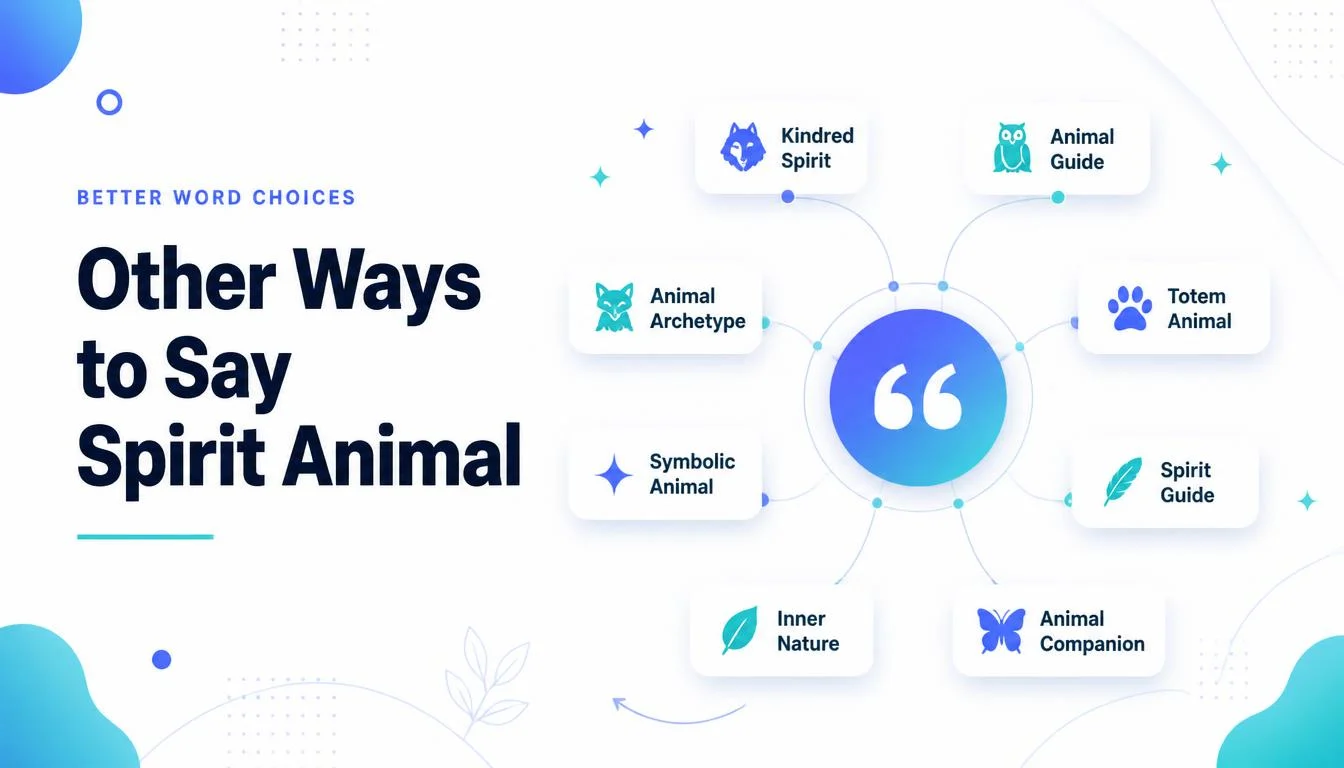
Other ways to say spirit animal include kindred spirit, personal mascot, animal counterpart, symbolic animal, and animal alter ego. Choose an alternative that fits your meaning and respects Indigenous cultural traditions.
Finding other ways to say spirit animal can help you express a strong connection with an animal, describe your personality, or explain why a particular creature represents your values. Depending on the context, phrases such as “kindred spirit,” “personal mascot,” and “animal counterpart” can communicate a similar idea in everyday conversations, social media posts, and creative writing.
However, the phrase “spirit animal” has spiritual and cultural significance in some Indigenous traditions, so it is worth choosing your words thoughtfully. If you simply mean an animal that reflects your personality or that you strongly relate to, alternatives such as “favorite animal,” “animal inspiration,” or “personal symbol” can communicate your meaning more clearly and respectfully.
What Is “Spirit Animal”? (Meaning, Grammar & Real Use)
Imagine talking with a friend who loves cats, shares your sense of humor, and reacts to everyday situations exactly as you do. You might be tempted to call a cat your “spirit animal” because its behavior reminds you of your personality. The expression has become popular in casual conversations, social media captions, memes, and discussions about personal preferences.
However, the phrase has cultural and spiritual associations beyond its popular internet meaning. In some Indigenous traditions, relationships with animals have specific spiritual significance. Using the expression casually can therefore feel inappropriate or insensitive to some people.
Learning alternatives to spirit animal helps you communicate the same idea more precisely. You can describe someone you relate to, an animal you admire, or a person who inspires you without suggesting a spiritual connection you do not intend.
Meaning and Definition
In casual contemporary English, “spirit animal” often refers metaphorically to an animal, person, or character that represents someone’s personality, preferences, or feelings. In spiritual contexts, its meaning may be more specific and culturally significant.
Grammar and Register
The phrase is a noun phrase. It commonly appears after the verb “be” or with possessive words.
Example: “That fictional character is so relatable; she feels like my kindred spirit.”
The expression is informal in its popular internet usage. It is not generally appropriate for formal academic writing or professional communication when a more precise expression would work better.
Where and Why People Use It
People often use the phrase to communicate identification, admiration, humor, or a feeling of belonging. For example, someone might compare their personality with a sleepy cat or identify with a character who loves books.
When you want to express excitement in English or describe a strong personal connection, choose words that communicate your intended meaning accurately. A phrase such as “my favorite animal” describes a preference, while “kindred spirit” describes a connection between people.
When Should You Use “Spirit Animal”?
The best alternative depends on the message you want to communicate.
Common Contexts
- Personality comparisons: Use “kindred spirit” when describing someone whose personality resembles yours.
- Personal admiration: Choose “role model” for someone whose behavior or achievements inspire you.
- Animal preferences: Say “favorite animal” when you simply mean an animal you particularly like.
- Personal identity: Use “personal symbol” when an animal or object represents an aspect of your identity.
- Humorous conversations: Try “my kind of person” when someone shares your humor, habits, or interests.
- Spiritual discussions: Use the specific terminology preferred by the relevant tradition or community rather than assuming all animal-related spiritual beliefs mean the same thing.
Spoken vs. Written English
Spoken English: Natural alternatives include “kindred spirit,” “my kind of person,” and “I really relate to that character.
Written English: Expressions such as “personal inspiration,” “symbol of identity,” and “guiding influence” are often clearer in essays, articles, and professional documents.
Formal vs. Informal English
Formal language prioritizes precision and context. Informal language allows more humor, emotion, and personal expression.
For a social media caption, “This character is so me” may communicate your meaning effectively. In a workplace presentation, “This person reflects my values” sounds more appropriate.
Is It Professional or Just Polite?
The phrase “spirit animal” is not inherently rude, but its popular metaphorical use can be culturally sensitive. In professional settings, precise and respectful wording is generally a safer choice.
Politeness vs. Professionalism
Politeness means communicating with consideration for other people. Professionalism also involves choosing language suited to the audience, workplace, and purpose.
For example, instead of saying, “Our founder is my spirit animal,” you could say, “Our founder is a professional role model whose leadership inspires me.
Polite? Yes, depending on context.
Professional? Usually better to choose a precise alternative.
Pros and Cons of Using “Spirit Animal”
Pros
- Easy to understand in casual settings: Many English speakers recognize the expression from online conversations.
- Expressive: It can communicate identification with a personality, character, or behavior.
- Conversational: It often sounds playful among people who understand the intended meaning.
- Memorable: The image of an animal can make a personality comparison vivid.
Cons
- Cultural sensitivity: Its spiritual associations may make casual use inappropriate in some contexts.
- Limited precision: It can refer to an animal preference, a personality match, admiration, or identification.
- Informal register: It may not fit academic writing, business communication, or formal presentations.
- Potential misunderstanding: Listeners may interpret the expression spiritually rather than metaphorically.
Common Mistakes People Make
1. Using the Phrase in Every Context
The expression does not fit every conversation.
Incorrect: “The project manager is my spirit animal because she organizes meetings well.”
Better: “The project manager is my role model because she organizes meetings effectively.”
2. Confusing Admiration With Similarity
Admiring someone does not necessarily mean sharing their personality.
Incorrect: “My favorite athlete is my kindred spirit because I admire his achievements.”
Better: “My favorite athlete is a role model because I admire his achievements.”
3. Using It in Formal Academic Writing
Casual metaphors can weaken the precision of an academic argument.
Incorrect: “The owl is my spirit animal because I value knowledge.”
Better: “The owl symbolizes wisdom and reflects my appreciation for knowledge.”
4. Assuming Every Animal Symbol Has the Same Meaning
Animal symbolism varies across cultures, communities, and individuals.
Incorrect: “Every culture considers the wolf a symbol of leadership.”
Better: “The wolf can symbolize leadership in some contexts, although its meaning varies across cultures.”
5. Treating Every Alternative as an Exact Synonym
Different phrases describe different relationships.
Incorrect: “My favorite animal is my role model.”
Better: “My favorite animal is a red panda, and my role model is my science teacher.”
Small tone mistakes can make confident English sound careless.
Alternatives by Category
These selected phrases offer a preview of the full list below. Choose the expression that best matches your meaning and audience.
Formal Alternatives to “Spirit Animal”
- Guiding influence: A person, principle, or idea that shapes your decisions.
- Personal inspiration: Something or someone who motivates you.
- Symbol of identity: An image or idea that represents who you are.
Pro Tip: Use these expressions in academic writing, presentations, and reflective essays when you want a clear, neutral tone.
Casual Alternatives
- Kindred spirit: Someone who shares your outlook or personality.
- My kind of person: Someone whose personality or interests appeal to you.
- Personal favorite: A person, character, or animal you particularly like.
Pro Tip: Match the phrase to the relationship you want to describe instead of relying on a general metaphor.
Professional Alternatives
- Role model: Someone whose behavior or achievements you admire.
- Professional inspiration: Someone who motivates you in your career.
- Guiding principle: A belief or value that influences your actions.
Pro Tip: In workplace conversations, identify the specific quality you admire, such as creativity, integrity, or leadership.
Informal Expressions
- That’s so me: A casual way to identify with a behavior or personality.
- I really relate to that: A direct expression of personal connection.
- My favorite character: A clear choice when discussing fiction.
Pro Tip: Use informal expressions with friends or in relaxed online conversations, and switch to more precise language for formal audiences.
“Formal and informal English aren’t about correctness. They’re about context.”
Other Ways to Say “Spirit Animal”: Full List With Examples
The following 30 alternatives help you describe personality, admiration, belonging, and personal preferences more accurately. They also help you express emotions and reactions without relying on a culturally sensitive expression.
1. Phrase: Kindred Spirit
Meaning: Someone with a similar personality or outlook.
Explanation: Best when you feel a strong connection with another person.
Example Sentence: “My new colleague is a kindred spirit who shares my love of literature.”
Best Use: Personal connections
Worst Use: Animal preferences
Tone: Warm, friendly
Context Variability: casual / professional / spoken
2. Phrase: Personal Inspiration
Meaning: Someone or something that motivates you.
Explanation: Suitable for discussing people, experiences, art, or ideas that encourage you.
Example Sentence: “My grandmother remains a personal inspiration.”
Best Use: Reflective writing
Worst Use: Casual jokes
Tone: Respectful, positive
Context Variability: professional / written / spoken
3. Phrase: Role Model
Meaning: Someone whose behavior you admire and want to emulate.
Explanation: A precise choice for expressing respect and identifying positive qualities.
Example Sentence: “My former teacher is a role model for patience and dedication.”
Best Use: Career development
Worst Use: Simple preferences
Tone: Respectful, professional
Context Variability: professional / written / spoken
4. Phrase: Guiding Influence
Meaning: A person, belief, or experience that shapes your choices.
Explanation: Use it when something consistently influences your behavior or decisions.
Example Sentence: “My father’s advice has been a guiding influence throughout my career.”
Best Use: Personal reflection
Worst Use: Casual memes
Tone: Formal, thoughtful
Context Variability: professional / written / spoken
5. Phrase: Favorite Animal
Meaning: The animal you like most.
Explanation: The clearest option when you mean an animal preference rather than a spiritual connection.
Example Sentence: “The red panda is my favorite animal because it looks playful and curious.”
Best Use: Personal preferences
Worst Use: Human admiration
Tone: Neutral, friendly
Context Variability: casual / professional / spoken
6. Phrase: Personal Symbol
Meaning: An image or object that represents an aspect of your identity.
Explanation: Useful when an animal represents a quality, value, or personal experience.
Example Sentence: “The butterfly is a personal symbol of growth and transformation for me.”
Best Use: Personal identity
Worst Use: Formal definitions
Tone: Reflective, neutral
Context Variability: professional / written / spoken
7. Phrase: Guiding Principle
Meaning: A belief or value that directs your actions.
Explanation: Best when the intended meaning concerns values rather than a person or animal.
Example Sentence: “Honesty is my guiding principle in every professional relationship.
Best Use: Ethical decisions
Worst Use: Animal comparisons
Tone: Professional, serious
Context Variability: professional / written / spoken
8. Phrase: Personal Hero
Meaning: Someone you deeply admire.
Explanation: Communicates strong admiration for a person’s actions, character, or achievements.
Example Sentence: “My mother is my personal hero because of her resilience.”
Best Use: Deep admiration
Worst Use: Minor preferences
Tone: Emotional, positive
Context Variability: casual / professional / spoken
9. Phrase: My Kind of Person
Meaning: Someone whose personality or interests appeal to you.
Explanation: A natural expression for shared humor, hobbies, or attitudes.
Example Sentence: “Anyone who loves quiet bookstores is my kind of person.”
Best Use: Casual conversations
Worst Use: Formal reports
Tone: Friendly, informal
Context Variability: casual / spoken
10. Phrase: Personal Favorite
Meaning: A person, animal, or thing you particularly like.
Explanation: Useful when expressing preference without implying a deeper connection.
Example Sentence: “Among all the animated characters, this fox is my personal favorite.”
Best Use: Expressing preferences
Worst Use: Spiritual discussions
Tone: Neutral, conversational
Context Variability: casual / professional / spoken
11. Phrase: Professional Inspiration
Meaning: Someone who motivates your career development.
Explanation: Appropriate for discussing mentors, leaders, and respected colleagues.
Example Sentence: “Our department director is a professional inspiration to the entire team.”
Best Use: Workplace discussions
Worst Use: Casual entertainment
Tone: Professional, respectful
Context Variability: professional / written / spoken
12. Phrase: Source of Inspiration
Meaning: Something or someone that motivates creativity or action.
Explanation: Can refer to a person, place, experience, animal, or idea.
Example Sentence: “The natural world is a constant source of inspiration for my paintings.
Best Use: Creative projects
Worst Use: Brief preferences
Tone: Positive, thoughtful
Context Variability: professional / written / spoken
13. Phrase: Symbol of Identity
Meaning: Something that represents who a person is.
Explanation: Suitable for explaining the personal significance of an animal or image.
Example Sentence: “The eagle serves as a symbol of identity in her artwork.”
Best Use: Identity discussions
Worst Use: Casual banter
Tone: Formal, descriptive
Context Variability: professional / written / spoken
14. Phrase: Personal Mascot
Meaning: A character, animal, or symbol associated with a person.
Explanation: Works well in humorous settings, personal branding, or group activities.
Example Sentence: “The cheerful penguin has become my personal mascot during exam season.”
Best Use: Lighthearted contexts
Worst Use: Serious spirituality
Tone: Playful, informal
Context Variability: casual / written / spoken
15. Phrase: Personality Match
Meaning: Someone or something whose characteristics resemble yours.
Explanation: A straightforward choice when you want to emphasize similar traits.
Example Sentence: “That energetic cartoon character is a personality match for me.”
Best Use: Character comparisons
Worst Use: Formal research
Tone: Neutral, casual
Context Variability: casual / written / spoken
16. Phrase: Kindred Soul
Meaning: Someone who shares your feelings, values, or outlook.
Explanation: Similar to “kindred spirit,” but often more emotional or poetic.
Example Sentence: “I found a kindred soul in my friend from the writing group.”
Best Use: Close friendships
Worst Use: Business emails
Tone: Warm, expressive
Context Variability: casual / written / spoken
17. Phrase: Source of Motivation
Meaning: Something or someone that encourages you to act.
Explanation: Emphasizes the effect on your effort rather than similarity in personality.
Example Sentence: “Watching my coach overcome challenges is a source of motivation.”
Best Use: Goal setting
Worst Use: Casual preferences
Tone: Encouraging, professional
Context Variability: professional / written / spoken
18. Phrase: Personal Guide
Meaning: Someone or something that helps direct your decisions.
Explanation: Use it for a mentor, trusted influence, or source of practical direction.
Example Sentence: “Her advice has served as a personal guide during difficult decisions.”
Best Use: Personal development
Worst Use: Funny captions
Tone: Thoughtful, respectful
Context Variability: professional / written / spoken
19. Phrase: Inspirational Figure
Meaning: Someone whose actions encourage or influence others.
Explanation: Appropriate for people admired for their achievements, courage, or values.
Example Sentence: “The scientist became an inspirational figure for young researchers.”
Best Use: Public recognition
Worst Use: Simple preferences
Tone: Formal, positive
Context Variability: professional / written / spoken
20. Phrase: Spiritual Guide
Meaning: A person who offers guidance in spiritual matters.
Explanation: This is a genuinely spiritual expression, not a general substitute for an animal you like.
Example Sentence: “She consulted a spiritual guide while exploring her beliefs.”
Best Use: Spiritual contexts
Worst Use: Casual comparisons
Tone: Serious, respectful
Context Variability: professional / written / spoken
21. Phrase: Personal Totem
Meaning: An animal or symbol associated with personal or cultural significance.
Explanation: Use caution because totems have specific cultural meanings, particularly in some Indigenous traditions. It is not a universal replacement.
Example Sentence: “The artwork explores the cultural meaning of a family totem.”
Best Use: Cultural discussions
Worst Use: Casual slang
Tone: Cultural, specific
Context Variability: professional / written / spoken
22. Phrase: Animal Symbol
Meaning: An animal used to represent an idea or quality.
Explanation: A neutral alternative when describing symbolism in literature, design, or personal artwork.
Example Sentence: “The fox serves as an animal symbol of cleverness in the story.”
Best Use: Literary analysis
Worst Use: Human role models
Tone: Neutral, descriptive
Context Variability: professional / written / spoken
23. Phrase: Personal Emblem
Meaning: A symbol representing an individual or their values.
Explanation: More formal than “personal mascot” and useful for branding or design.
Example Sentence: “She chose a mountain as her personal emblem of perseverance.”
Best Use: Personal branding
Worst Use: Everyday banter
Tone: Formal, polished
Context Variability: professional / written / spoken
24. Phrase: Shared Spirit
Meaning: A common attitude, feeling, or sense of purpose.
Explanation: Best for groups united by enthusiasm or shared values, not as an exact synonym for an individual.
Example Sentence: “The volunteers worked with a shared spirit of generosity.”
Best Use: Team collaboration
Worst Use: Animal preferences
Tone: Positive, collective
Context Variability: professional / written / spoken
25. Phrase: Kindred Mind
Meaning: Someone who thinks in ways similar to yours.
Explanation: Emphasizes shared ideas and intellectual compatibility.
Example Sentence: “I found a kindred mind in my new research partner.”
Best Use: Intellectual connections
Worst Use: Casual jokes
Tone: Thoughtful, literary
Context Variability: professional / written / spoken
26. Phrase: Personal Archetype
Meaning: A recognizable model or pattern that reflects a person’s traits.
Explanation: Useful in literary analysis, character development, and discussions of personality frameworks.
Example Sentence: “The independent explorer is the personal archetype she uses in her stories.”
Best Use: Character analysis
Worst Use: Everyday conversation
Tone: Analytical, formal
Context Variability: professional / written / spoken
27. Phrase: Favorite Character
Meaning: The fictional person you like most in a story.
Explanation: Ideal when you identify with a character in a book, movie, show, or game.
Example Sentence: “The thoughtful detective is my favorite character because we approach problems similarly.”
Best Use: Fiction discussions
Worst Use: Workplace praise
Tone: Casual, neutral
Context Variability: casual / written / spoken
28. Phrase: Personal Connection
Meaning: A feeling of identification, understanding, or attachment.
Explanation: Broad enough for people, stories, animals, places, and experiences.
Example Sentence: “I feel a personal connection to stories about overcoming adversity.”
Best Use: Reflective discussions
Worst Use: Naming preferences
Tone: Neutral, thoughtful
Context Variability: professional / written / spoken
29. Phrase: That’s So Me
Meaning: An informal way to say something reflects your personality.
Explanation: Common in relaxed conversation and online captions when a behavior feels familiar.
Example Sentence: “Sleeping through a rainy afternoon? That’s so me.”
Best Use: Casual reactions
Worst Use: Formal writing
Tone: Playful, informal
Context Variability: casual / spoken
30. Phrase: I Really Relate to That
Meaning: You understand or identify with a person, character, or experience.
Explanation: One of the clearest alternatives when the intended meaning is personal identification.
Example Sentence: “I really relate to that character because she prefers quiet evenings and creative hobbies.”
Best Use: Shared experiences
Worst Use: Formal reports
Tone: Friendly, conversational
Context Variability: casual / professional / spoken
Comparison Table: Top 10 Alternatives at a Glance
| Phrase | Tone | Best Use |
|---|---|---|
| Kindred spirit | Warm, friendly | Shared personality |
| Personal inspiration | Thoughtful, positive | Personal reflection |
| Role model | Professional, respectful | Career development |
| Guiding influence | Formal, thoughtful | Decision-making |
| Favorite animal | Neutral, friendly | Animal preferences |
| Personal symbol | Reflective, neutral | Identity and symbolism |
| My kind of person | Informal, friendly | Casual conversations |
| Professional inspiration | Respectful, formal | Workplace communication |
| Favorite character | Casual, neutral | Books and entertainment |
| I really relate to that | Conversational | Shared experiences |
Quick Self-Check: Mini Quiz
Test your understanding by choosing the most appropriate expression for each situation.
Question 1
You want to describe a manager whose leadership skills you admire. Which phrase fits best?
A. Favorite animal
B. Role model
C. That’s so me
D. Personal mascot
Correct answer: B. Role model.
Question 2
You want to explain that an owl represents your love of knowledge in an essay. Which phrase is most appropriate?
A. My kind of person
B. That’s so me
C. Personal symbol
D. Personal mascot
Correct answer: C. Personal symbol.
Question 3
A friend shares your humor and interests. What is a natural casual expression?
A. My kind of person
B. Guiding principle
C. Professional inspiration
D. Inspirational figure
Correct answer: A. My kind of person.
Question 4
You are writing a formal reflection about a scientist who motivates your career. Which phrase is most suitable?
A. Favorite character
B. Personal mascot
C. That’s so me
D. Professional inspiration
Correct answer: D. Professional inspiration.
FAQs
1. What Are the Best Alternatives to “Spirit Animal”?
Useful alternatives include “kindred spirit,” “personal inspiration,” “role model,” “guiding influence,” and “personal symbol.” Choose according to whether you mean admiration, similarity, or representation.
2. Is “Spirit Animal” Appropriate in Professional English?
It is generally better to use precise expressions in professional settings. Role model,” “professional inspiration,” and “guiding influence” communicate admiration without relying on the phrase’s cultural and spiritual associations.
3. What Can I Say Instead of “Spirit Animal” in Casual Conversations?
Try “my kind of person,” “that’s so me,” or “I really relate to that.” If you mean an animal you like, simply say “my favorite animal.”
4. Is “Kindred Spirit” the Same as “Spirit Animal”?
No. “Kindred spirit” usually describes a person with similar feelings, interests, or values. “Spirit animal” has a broader popular metaphorical use and can also carry specific spiritual or cultural meanings.
5. How Can I Describe an Animal That Represents My Personality?
You can say, “I relate to this animal,” “this animal reflects my personality,” or “this animal is a personal symbol for me.” These expressions clearly communicate your meaning without assuming a spiritual connection.
Conclusion
Choosing an appropriate alternative helps you communicate personality, admiration, identity, and shared interests with greater accuracy. Expressions such as “kindred spirit,” “role model,” and “personal symbol” offer different meanings, so consider what you actually want to express before selecting a phrase.
Practice these expressions in everyday conversations, social media captions, and professional writing. Pay attention to your audience and the context, especially when a phrase has cultural or spiritual significance.
Read More Related Articles:
- Other Ways to Say You’re Beautiful | Beyond the Ordinary Compliment In 2026
- Other Ways to Say I Love You in Spanish | Beyond the Usual Phrase In 2026
- Other Ways to Say I Love You in Other Languages | Beyond the Classic Three Words In 2026

Daniel Murphy is a professional writer and blogger specializing in digital communication and messaging trends. As a contributor to TextsResponse.com, he creates reader-focused content designed to help people find the right words at the right time.