Quick Answer
Looking for alternatives to “that’s good”? Native and fluent speakers often swap this phrase depending on tone and setting.
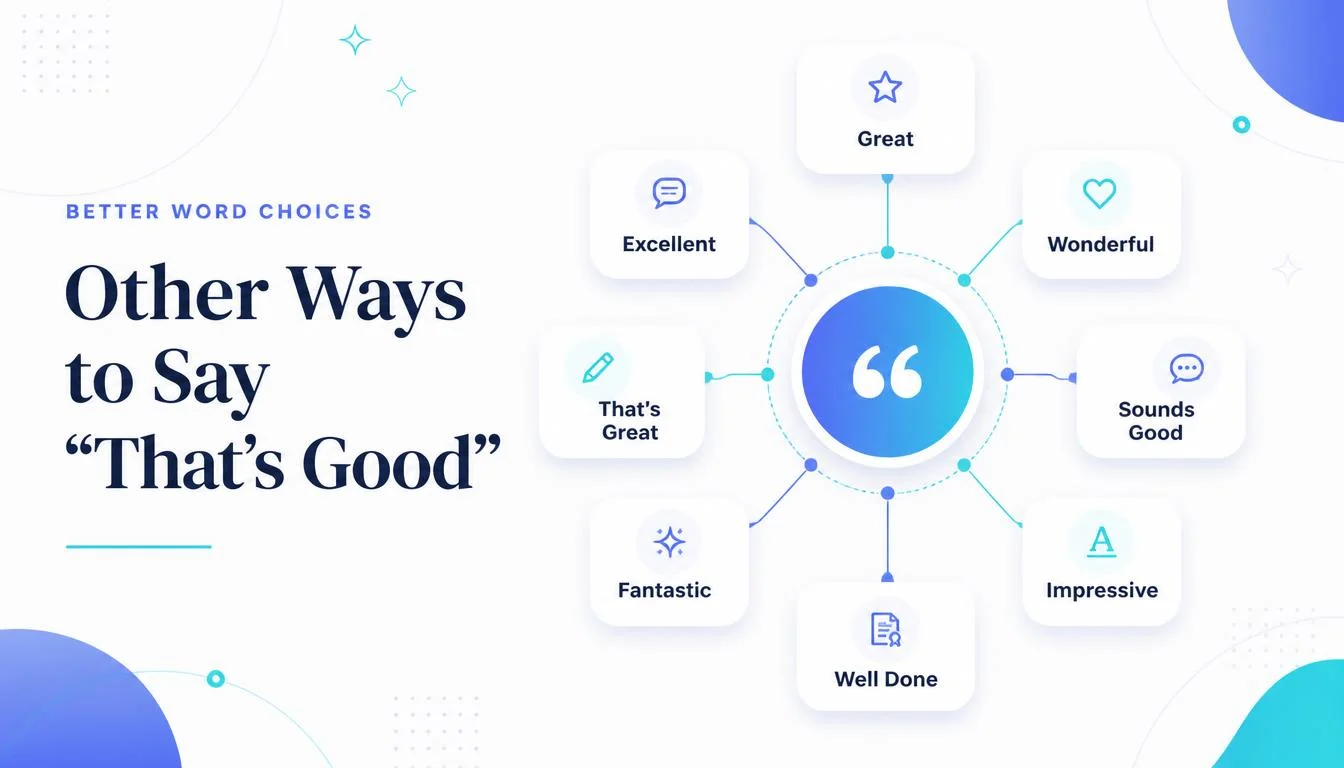
Five top alternatives are: excellent, well done, that’s great, impressive, and nicely done. Choosing the right one instantly makes your English sound more natural and confident.
Other Ways to Say “That’s Good” is one of the most common phrases in English. People use it to react to news, praise someone’s work, or simply agree that something is fine. It works in almost any casual conversation, which is exactly why it gets overused.
Learning alternatives to “that’s good” helps you sound more precise and less repetitive. Whether you want to express excitement in English, sound more professional in meetings, or simply vary your vocabulary in daily conversation, having a wider range of expressions gives your English more color and confidence.
This guide breaks down formal, casual, professional, and informal expressions in English, so you always know which version fits the moment. By the end, you will have 30 practical alternatives ready to use in speech and writing.
The right tone makes your English sound professional and confident.”
Quick Categories
Formal alternatives to “That’s Good”
- Excellent
- That is satisfactory
- Well executed
- Highly commendable
Pro Tip: Save formal alternatives for reports, emails, and workplace feedback where precision matters more than enthusiasm.
Casual alternatives
- Nice
- Sweet
- Cool
- Awesome
Pro Tip: Casual alternatives work best with friends or close colleagues, not in written business communication.
Professional alternatives
- Well done
- Great work
- Solid effort
- Impressive results
Pro Tip: Pair professional alternatives with a specific detail, such as “Great work on the deadline,” to sound genuine rather than generic.
Informal expressions
- That’s dope
- Sounds good
- Not bad at all
- That rocks
Pro Tip: Informal expressions in English are great for texting and casual chats but can sound unprofessional in emails or interviews.
Vocabulary variety is the fastest shortcut to sounding fluent.”
Common Mistakes
Many learners misuse “that’s good” without realizing it changes meaning or tone. Here are five common errors.
- Using it sarcastically without context Example: “Oh, that’s good” (said flatly after bad news) confuses listeners about your real reaction.
- Overusing it in professional emails Example: “That’s good, please proceed” sounds vague compared to “This looks solid, please proceed.”
- Using it when something is actually excellent Example: Saying “that’s good” about a perfect presentation undersells real achievement.
- Mixing formal and casual tone in the same message Example: “That’s good bro, well received” mismatches register and confuses the reader.
- Repeating the same phrase in every response Example: Replying “that’s good” to five different messages makes conversation feel robotic.
What Does “That’s Good” Mean?
That’s good” is a short, informal English phrase used to express approval, satisfaction, or mild positive agreement. Grammatically, it is a demonstrative pronoun (“that”) plus a linking verb (“is”) and an adjective (“good”), forming a simple evaluative statement.
Example Sentence: “You finished the report early? That’s good.”
When to Use “That’s Good”
Common contexts where this phrase naturally appears:
- Reacting to everyday news or updates
- Approving a simple plan or suggestion
- Responding briefly in casual conversation
- Acknowledging someone’s effort without strong emphasis
Spoken vs Written
- Spoken: Very common and natural in daily conversation.
- Written: Acceptable in casual messages, but often replaced with stronger vocabulary in emails or reports.
Formal vs Informal
- Formal: Rarely used as-is; usually replaced with “satisfactory” or “commendable.”
- Informal: Extremely common among friends, family, and casual coworkers.
Is It Professional or Polite to Say “That’s Good”?
“That’s good” is polite, but it is not always professional. In business writing or formal feedback, it can sound underwhelming or vague, especially when stronger, more specific language is expected.
Business-style example: Instead of “That’s good, thanks for sending it,” a more professional version would be, “This looks solid, thank you for sending it over.”
Polite? Yes Professional? No, in most formal contexts
Pros and Cons of Using “That’s Good”
Pros
- Simple and natural
- Friendly tone
- Common usage
- Easy to understand
Cons
- Too informal for work
- Overused
- Limited emotional range
- Not suitable for formal writing
“Fluency isn’t about big words, it’s about the right word at the right moment.”
Other Ways to Say “That’s Good”
These alternatives will help you sound more fluent, confident, and natural in different situations. Use them according to tone, context, and audience to express excitement, admiration, or approval.
1. Phrase: Excellent
Meaning: Something is of very high quality.
Explanation: Used to show strong approval, often in formal settings.
Example Sentence: “Excellent, the numbers look exactly right.”
Best Use: Formal feedback
Worst Use: Casual texting
Tone: Formal, confident, polished
Context Variability: professional
2. Phrase: Well done
Meaning: Recognizing effort or achievement.
Explanation: A direct way to praise someone’s performance.
Example Sentence: “Well done on closing that deal.”
Best Use: Workplace praise
Worst Use: Sarcastic contexts
Tone: Encouraging, respectful
Context Variability: professional, spoken
3. Phrase: Great work
Meaning: Acknowledging strong performance.
Explanation: Common in team and workplace settings.
Example Sentence: “Great work on the presentation today.”
Best Use: Team feedback
Worst Use: Formal written reports
Tone: Warm, appreciative
Context Variability: professional, spoken
4. Phrase: Impressive
Meaning: Something that creates admiration.
Explanation: Highlights a higher level of achievement than “good.”
Example Sentence: “That’s impressive, you finished ahead of schedule.”
Best Use: Notable achievements
Worst Use: Minor everyday tasks
Tone: Admiring, formal-leaning
Context Variability: professional, spoken
5. Phrase: Nicely done
Meaning: A friendly acknowledgment of good work.
Explanation: Slightly casual but still respectful.
Example Sentence: “Nicely done on fixing that bug so fast.”
Best Use: Casual workplace praise
Worst Use: Formal documents
Tone: Friendly, approving
Context Variability: casual, professional
6. Phrase: Sounds good
Meaning: Agreement with a plan or idea.
Explanation: Common response to confirm plans.
Example Sentence: “Sounds good, let’s meet at noon.”
Best Use: Quick confirmations
Worst Use: Formal proposals
Tone: Easygoing, neutral
Context Variability: casual, spoken
7. Phrase: That’s great
Meaning: A stronger version of “that’s good.”
Explanation: Adds more enthusiasm to a positive reaction.
Example Sentence: “That’s great, I’m really happy for you.”
Best Use: Personal good news
Worst Use: Serious business updates
Tone: Enthusiastic, warm
Context Variability: casual, spoken
8. Phrase: Fantastic
Meaning: Extremely good or exciting.
Explanation: Used to express excitement in English strongly.
Example Sentence: “Fantastic, the client approved the proposal.”
Best Use: Big wins
Worst Use: Minor updates
Tone: Energetic, positive
Context Variability: casual, professional
9. Phrase: Solid
Meaning: Reliable and well done.
Explanation: Often used to describe dependable quality.
Example Sentence: “That’s a solid plan for next quarter.”
Best Use: Strategy discussions
Worst Use: Emotional reactions
Tone: Confident, practical
Context Variability: professional
10. Phrase: Nice one
Meaning: A casual compliment.
Explanation: Common among friends or informal coworkers.
Example Sentence: “Nice one, you nailed that interview.”
Best Use: Friendly chats
Worst Use: Client emails
Tone: Playful, informal
Context Variability: casual, spoken
11. Phrase: Awesome
Meaning: Very impressive or exciting.
Explanation: A popular informal way to show enthusiasm.
Example Sentence: “Awesome, I can’t wait to see the results.”
Best Use: Casual excitement
Worst Use: Formal writing
Tone: Energetic, informal
Context Variability: casual, spoken
12. Phrase: Commendable
Meaning: Deserving of praise.
Explanation: A formal word often used in evaluations.
Example Sentence: “Your dedication is commendable.”
Best Use: Performance reviews
Worst Use: Casual texting
Tone: Formal, respectful
Context Variability: professional
13. Phrase: Well executed
Meaning: Carried out skillfully.
Explanation: Focuses on the process, not just the result.
Example Sentence: “The launch was well executed.”
Best Use: Project reviews
Worst Use: Everyday small talk
Tone: Formal, precise
Context Variability: professional
14. Phrase: That’s satisfactory
Meaning: Meets expectations, without extra praise.
Explanation: A neutral, formal approval.
Example Sentence: “The results are satisfactory for now.”
Best Use: Formal evaluations
Worst Use: Personal celebrations
Tone: Neutral, formal
Context Variability: professional
15. Phrase: Not bad
Meaning: Mildly positive, understated approval.
Explanation: Common in casual, relaxed conversation.
Example Sentence: “Not bad for your first attempt.”
Best Use: Casual feedback
Worst Use: Formal praise
Tone: Understated, casual
Context Variability: casual, spoken
16. Phrase: Sweet
Meaning: A casual way to show approval.
Explanation: Popular in informal, youthful conversation.
Example Sentence: “Sweet, the tickets are confirmed.”
Best Use: Friend groups
Worst Use: Business meetings
Tone: Informal, playful
Context Variability: casual, spoken
17. Phrase: Cool
Meaning: A relaxed way to show agreement or approval.
Explanation: Extremely common in everyday speech.
Example Sentence: “Cool, let’s go with that idea.”
Best Use: Casual agreement
Worst Use: Formal writing
Tone: Relaxed, informal
Context Variability: casual, spoken
18. Phrase: That rocks
Meaning: Something is very exciting or impressive.
Explanation: A slang-leaning expression for strong approval.
Example Sentence: “That rocks, congrats on the promotion.”
Best Use: Informal celebrations
Worst Use: Client communication
Tone: Enthusiastic, slangy
Context Variability: casual, spoken
19. Phrase: That’s dope
Meaning: Something is impressive or cool.
Explanation: Slang term popular among younger speakers.
Example Sentence: “That’s dope, I didn’t know you could do that.”
Best Use: Casual conversation
Worst Use: Professional settings
Tone: Slang, energetic
Context Variability: casual, spoken
20. Phrase: Superb
Meaning: Extremely good or excellent.
Explanation: A strong formal word for high praise.
Example Sentence: “The report quality was superb.”
Best Use: Formal praise
Worst Use: Everyday small talk
Tone: Formal, elevated
Context Variability: professional
21. Phrase: Outstanding
Meaning: Exceptionally good, above expectations.
Explanation: Often used in evaluations and awards.
Example Sentence: “Her performance this year was outstanding.”
Best Use: Performance reviews
Worst Use: Minor tasks
Tone: Formal, impressive
Context Variability: professional
22. Phrase: Well received
Meaning: Positively accepted by others.
Explanation: Focuses on audience reaction rather than quality alone.
Example Sentence: “The proposal was well received by the board.”
Best Use: Business updates
Worst Use: Personal compliments
Tone: Formal, neutral
Context Variability: professional
23. Phrase: Right on
Meaning: An informal expression of agreement or approval.
Explanation: Common in relaxed, friendly speech.
Example Sentence: “Right on, that’s exactly what we needed.”
Best Use: Casual encouragement
Worst Use: Formal documents
Tone: Casual, supportive
Context Variability: casual, spoken
24. Phrase: That works
Meaning: Something is acceptable or suitable.
Explanation: A neutral, practical way to approve an idea.
Example Sentence: “That works, let’s finalize the schedule.”
Best Use: Planning conversations
Worst Use: Emotional praise
Tone: Practical, neutral
Context Variability: casual, professional
25. Phrase: Admirable
Meaning: Deserving respect and approval.
Explanation: Often used to describe character or effort.
Example Sentence: “Her patience during the crisis was admirable.”
Best Use: Character praise
Worst Use: Casual banter
Tone: Formal, respectful
Context Variability: professional
26. Phrase: On point
Meaning: Accurate and well done.
Explanation: Informal expression for precision or quality.
Example Sentence: “Your analysis was on point.”
Best Use: Casual professional feedback
Worst Use: Formal reports
Tone: Confident, informal
Context Variability: casual, professional
27. Phrase: Top notch
Meaning: Of the highest quality.
Explanation: Common in both casual and semi-formal praise.
Example Sentence: “The customer service here is top notch.
Best Use: Quality reviews
Worst Use: Serious formal writing
Tone: Approving, upbeat
Context Variability: casual, professional
28. Phrase: That’s reassuring
Meaning: Something reduces worry or doubt.
Explanation: Used when good news relieves concern.
Example Sentence: “That’s reassuring to hear before the deadline.”
Best Use: Reducing concern
Worst Use: General small talk
Tone: Calm, thoughtful
Context Variability: professional, spoken
29. Phrase: Nailed it
Meaning: Did something perfectly.
Explanation: Popular informal phrase for success.
Example Sentence: “You nailed it in the interview.”
Best Use: Casual celebration
Worst Use: Formal writing
Tone: Playful, confident
Context Variability: casual, spoken
30. Phrase: Highly commendable
Meaning: Very deserving of praise.
Explanation: A stronger, more formal version of “commendable.”
Example Sentence: “Your commitment to the project is highly commendable.”
Best Use: Formal recognition
Worst Use: Everyday chat
Tone: Formal, respectful
Context Variability: professional
“Small vocabulary shifts create a big difference in how confident you sound.”
Mini Quiz / Self-Check
1. Which alternative is most appropriate in a formal performance review?
a) Nice one
b) Outstanding
c) Sweet
d) That rocks
2. You want to casually agree to a friend’s weekend plan. Which phrase fits best?
a) Commendable
b) Sounds good
c) Well executed
d) Highly commendable
3. Which phrase focuses on how an audience reacted, not just the quality itself?
a) Well received
b) Nailed it
c) That’s dope
d) Cool
4. Which phrase would sound out of place in a client email?
a) Excellent
b) That’s dope
c) Well done
d) Impressive
Answers
1-b, 2-b, 3-a, 4-b
Comparison Table: Top Alternatives
| Phrase | Tone | Best Use |
|---|---|---|
| Excellent | Formal, confident | Formal feedback |
| Well done | Encouraging, respectful | Workplace praise |
| Great work | Warm, appreciative | Team feedback |
| Impressive | Admiring | Notable achievements |
| Nicely done | Friendly | Casual workplace praise |
| Sounds good | Neutral, easygoing | Quick confirmations |
| Outstanding | Formal, elevated | Performance reviews |
| Solid | Confident, practical | Strategy discussions |
| Top notch | Approving, upbeat | Quality reviews |
| Nailed it | Playful, confident | Casual celebration |
FAQs
1. What is a formal way to say “that’s good”?
Formal alternatives include “excellent,” “commendable,” and “satisfactory,” which suit workplace or academic feedback.
2. What is a casual way to say “that’s good”?
Casual options like “nice,” “sweet,” or “cool” work well in everyday conversation with friends.
3. Is “that’s good” appropriate in a business email?
It is understandable, but professional alternatives to “that’s good” such as “well received” or “solid work” sound more polished.
4. How can I express excitement in English beyond “that’s good”?
Try stronger reactions like “fantastic,” “amazing,” or “that’s impressive” to convey more energy.
5. Why should I learn other ways to say “that’s good”?
Learning alternatives to “that’s good” prevents repetition, improves fluency, and helps match tone to context.
Conclusion
Mastering alternatives to “that’s good” gives your English more depth, whether you are chatting casually or writing a professional email. From formal words like “commendable” to informal expressions like “sweet,” each phrase carries a slightly different tone and impact.
Practice using a few new alternatives daily, and pay close attention to tone before choosing a phrase. Over time, this small habit builds noticeable fluency and confidence in both spoken and written English.
Read More Related Articles:
- Other Ways to Say I’m Happy for You | Say It With More Heart and Meaning In 2026
- Other Ways to Say Never Give Up | Encouraging Messages In 2026
- Other Ways to Say “You’re Proud of Someone” | Sweet and Powerful Ways In 2026

Victoria Hughes is a content writer dedicated to making communication clearer and more effective. Through TextsResponse.com, she shares practical insights and thoughtfully crafted response ideas that help readers express themselves with confidence.