Quick Answer
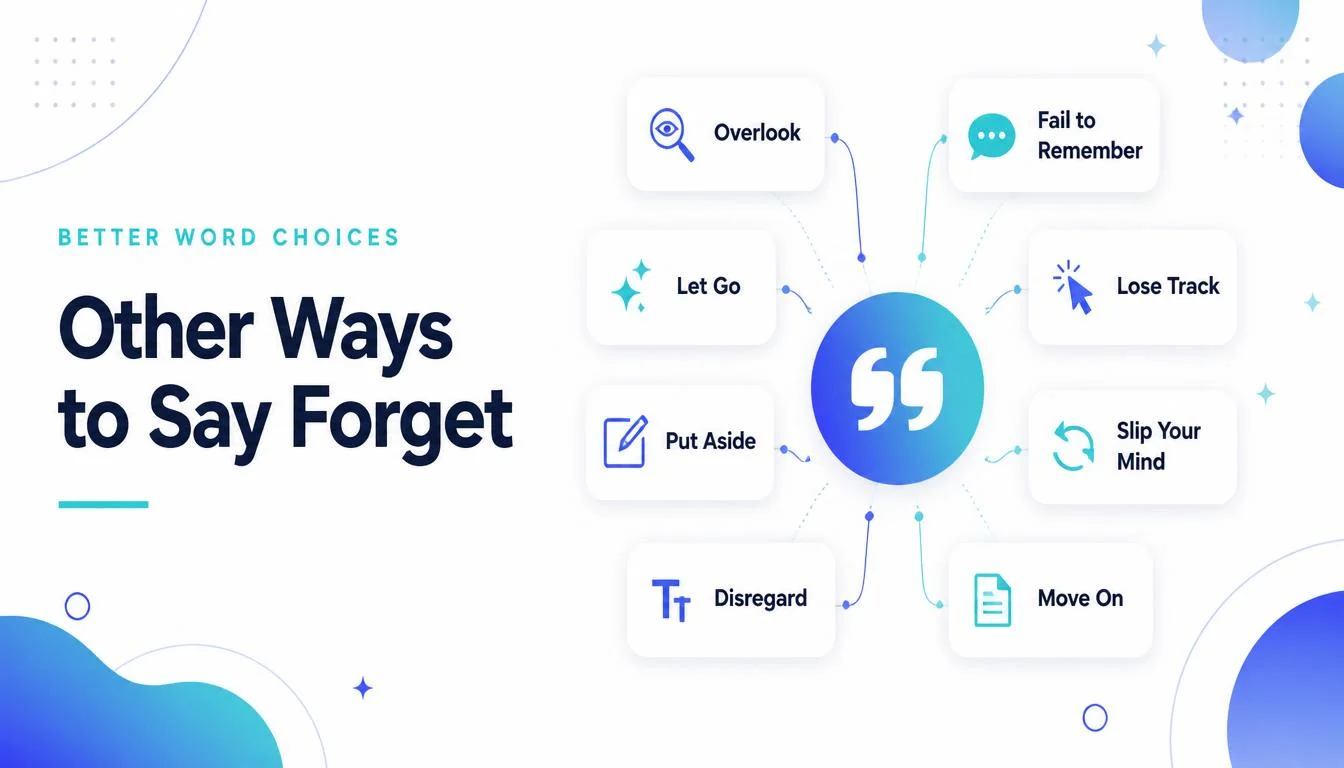
Other ways to say forget include overlook, neglect, disregard, fail to remember, lose track of, and let slip.
Knowing other ways to say forget can help you express yourself more naturally and precisely in English. The best alternative depends on whether you mean failing to remember something, accidentally leaving something behind, or intentionally ignoring something.
Learning other ways to say forget also improves your vocabulary for everyday conversations, writing, and professional communication. These alternatives can help you sound clearer and choose the right expression for each situation.
What Is “Other Ways to Say Forget”? (Meaning, Grammar & Real Use)
Imagine you are in a meeting and suddenly realize you forgot to send an important document. You could simply say, “I forgot to send it,” but a more professional sentence might be, “I overlooked sending the document.” The second option sounds more precise and appropriate in a workplace setting.
Knowing different alternatives to “forget” helps you communicate the exact meaning you intend. Sometimes you forget something accidentally. At other times, you fail to remember a detail, overlook an important point, neglect a responsibility, or leave something out of a message.
These distinctions are especially useful when you want to express yourself naturally or express excitement in English without relying on the same vocabulary repeatedly. Learning other ways to say forget can also make your spoken and written English more flexible.
The verb forget means to fail to remember something, fail to do something, or accidentally leave something behind.
Example: I forgot to reply to her email.
Grammatically, “forget” is an irregular verb: forget, forgot, forgotten. It is common in both informal and formal English, although some alternatives sound more professional depending on the context.
When Should You Use “Forget”?
The word “forget” is extremely common, but different situations call for different alternatives. Consider what you mean before choosing a replacement.
Common Contexts
- When you cannot remember information
- When you fail to complete an action
- When you accidentally leave something somewhere
- When you fail to mention something
- When you fail to consider an important detail
- When you do not give something enough attention
- When you intentionally choose not to remember or consider something
- When you want to remind someone about a responsibility
Spoken vs Written
Spoken English: “I forgot to call you.”
Written English: “I failed to remember to contact you.”
In everyday conversation, “forget” is usually the most natural choice. In formal writing, alternatives such as “overlook,” “omit,” or “neglect” can provide greater precision.
Formal vs Informal
Formal alternatives are useful in reports, emails, academic writing, and workplace communication. Casual alternatives are better suited to conversations with friends, family, and people you know well.
The important point is not to replace “forget” automatically. Choose a phrase that accurately describes what happened.
Is It Professional or Just Polite?
“Forget” is both polite and professional in many situations. There is nothing inherently informal about the word. However, some alternatives communicate a more specific professional meaning.
For example, “I forgot to attach the file” is acceptable at work, while “I overlooked the attachment” can sound more polished when acknowledging a mistake.
Business-style example:
“I apologize for overlooking the attachment in my previous email.”
Verdict
Polite? ✔️ Yes
Professional? ✔️ Yes
The word itself is professional enough for most workplace situations. The main difference comes from context, sentence structure, and the alternative you select.
Pros and Cons of Using “Forget”
Pros
- Simple: Everyone understands the meaning immediately.
- Natural: It is one of the most common verbs in everyday English.
- Versatile: It works for people, facts, tasks, objects, and memories.
- Easy to use: Its meaning is usually clear without additional explanation.
Cons
- Can be repetitive: Frequent use may make your vocabulary sound limited.
- Sometimes lacks precision: “Forget” does not always show whether something was omitted, ignored, or overlooked.
- May sound too direct: In sensitive professional situations, a more specific expression can sound tactful.
- Does not always explain responsibility: “Neglect” or “fail to remember” may communicate a more precise reason.
Common Mistakes People Make
Learning alternatives is useful only when you also know how to use them correctly. Here are five common errors involving “forget” and related expressions.
1. Using the wrong verb pattern
❌ I forgot calling her yesterday.
✔️ I forgot to call her yesterday.
Use forget to + verb when you fail to perform an action.
2. Confusing “forget” with “leave behind”
❌ I forgot my phone at the office.
✔️ I left my phone at the office.
“Forget” can be understood, but “leave” is often more precise when an object remains somewhere.
3. Using “omit” for every type of forgetting
❌ I omitted my keys at home.
✔️ I left my keys at home.
“Leave out” or “omit” usually relates to information, details, names, or items included in a list.
4. Using “neglect” for accidental mistakes
❌ I neglected to bring my umbrella because I accidentally forgot it.
✔️ I forgot to bring my umbrella.
“Neglect” often suggests a failure to give something proper attention or care, so it can sound stronger than “forget.”
5. Using “disregard” when you simply cannot remember
❌ I disregarded her name.
✔️ I forgot her name.
“Disregard” usually means intentionally ignoring something, not accidentally failing to remember it.
Small tone mistakes can make confident English sound careless.
Alternatives by Category
The best alternatives depend on what you mean by “forget.” Some phrases describe memory problems, while others describe omissions, missed responsibilities, or deliberate disregard.
Formal alternatives to “forget”
- Fail to remember
- Overlook
- Omit
- Neglect
Pro Tip: Use formal alternatives when precision matters, especially in reports, academic writing, and formal correspondence.
Casual alternatives
- Leave it out
- Lose track of
- It slipped my mind
- Can’t remember
Pro Tip: Choose natural conversational phrases when speaking with friends or colleagues in relaxed situations.
Professional alternatives
- Overlook
- Fail to remember
- Miss
- Neglect
Pro Tip: In professional communication, select the alternative that describes the actual mistake rather than simply making your sentence sound formal.
Informal expressions
- It slipped my mind
- I blanked
- I spaced it
- I lost track of it
Pro Tip: Save highly informal expressions for conversations where a relaxed tone is appropriate.
“Formal and informal English aren’t about correctness. They’re about context.”
Other Ways to Say “Forget” (Full List with Examples)
These 30 alternatives can build vocabulary and help you describe memory, omissions, missed responsibilities, and changes in attention more precisely.
1. Phrase: Fail to Remember
Meaning: Not remember something.
Explanation: A formal and precise alternative.
Example Sentence: I failed to remember her name.
Best Use: Formal writing
Worst Use: Casual chat
Tone: Formal, neutral
Context Variability: professional
2. Phrase: Overlook
Meaning: Miss something unintentionally.
Explanation: Common when a detail, task, or mistake was missed.
Example Sentence: I overlooked the final attachment.
Best Use: Workplace emails
Worst Use: Memory problems
Tone: Professional, neutral
Context Variability: professional
3. Phrase: Neglect
Meaning: Fail to give proper attention.
Explanation: Often suggests responsibility or lack of care.
Example Sentence: He neglected to update the records.
Best Use: Responsibilities, duties
Worst Use: Simple memories
Tone: Formal, serious
Context Variability: professional
4. Phrase: Omit
Meaning: Leave something out.
Explanation: Best for information, details, names, or items.
Example Sentence: She omitted his name from the report.
Best Use: Written information
Worst Use: Personal memories
Tone: Formal, precise
Context Variability: professional
5. Phrase: Leave Out
Meaning: Not include something.
Explanation: A natural alternative to “omit” in everyday English.
Example Sentence: Don’t leave out the final paragraph.
Best Use: Instructions, writing
Worst Use: Formal reports
Tone: Neutral, casual
Context Variability: casual
6. Phrase: It Slipped My Mind
Meaning: I unintentionally forgot.
Explanation: A common conversational expression for accidental forgetting.
Example Sentence: Sorry, it slipped my mind.
Best Use: Friendly apologies
Worst Use: Formal reports
Tone: Casual, polite
Context Variability: spoken
7. Phrase: Lose Track Of
Meaning: Stop remembering or monitoring something.
Explanation: Often describes time, tasks, progress, or events.
Example Sentence: I lost track of the deadline.
Best Use: Time, progress
Worst Use: Names, facts
Tone: Casual, neutral
Context Variability: casual
8. Phrase: Miss
Meaning: Fail to notice or attend.
Explanation: Useful when something is overlooked or not noticed.
Example Sentence: I missed an important detail.
Best Use: Details, events
Worst Use: Formal apologies
Tone: Neutral, concise
Context Variability: professional
9. Phrase: Fail to Recall
Meaning: Be unable to remember.
Explanation: A precise expression for memory-related situations.
Example Sentence: I fail to recall the exact date.
Best Use: Formal statements
Worst Use: Friendly conversation
Tone: Formal, careful
Context Variability: professional
10. Phrase: Can’t Remember
Meaning: Not be able to recall.
Explanation: A direct and natural everyday expression.
Example Sentence: I can’t remember where I put it.
Best Use: Everyday conversation
Worst Use: Formal reports
Tone: Casual, direct
Context Variability: spoken
11. Phrase: Not Recall
Meaning: Not remember something.
Explanation: “I do not recall” is especially common in formal speech and writing.
Example Sentence: I do not recall receiving the message.
Best Use: Formal communication
Worst Use: Casual chat
Tone: Formal, neutral
Context Variability: professional
12. Phrase: Leave Something Behind
Meaning: Accidentally not take something.
Explanation: More precise than “forget” when an object remains somewhere.
Example Sentence: I left my notebook behind.
Best Use: Personal belongings
Worst Use: Facts, names
Tone: Neutral, natural
Context Variability: spoken
13. Phrase: Fail to Mention
Meaning: Not mention something.
Explanation: Useful when important information was unintentionally excluded.
Example Sentence: I failed to mention the schedule change.
Best Use: Workplace communication
Worst Use: Physical objects
Tone: Professional, polite
Context Variability: professional
14. Phrase: Pass Over
Meaning: Skip or fail to consider.
Explanation: Can describe something receiving insufficient attention.
Example Sentence: We passed over an important concern.
Best Use: Discussions, reviews
Worst Use: Simple memories
Tone: Neutral, formal
Context Variability: professional
15. Phrase: Disregard
Meaning: Ignore or pay no attention.
Explanation: Stronger than accidental forgetting because it often implies deliberate action.
Example Sentence: Please disregard my previous email.
Best Use: Corrections, notices
Worst Use: Accidental errors
Tone: Formal, direct
Context Variability: professional
16. Phrase: Pay No Attention To
Meaning: Not give something attention.
Explanation: Describes lack of attention rather than a memory failure.
Example Sentence: I paid no attention to the warning.
Best Use: Behavior, warnings
Worst Use: Names, dates
Tone: Neutral, direct
Context Variability: spoken
17. Phrase: Let Slip
Meaning: Accidentally reveal or fail to control information.
Explanation: Usually relates to something unintentionally revealed rather than forgotten.
Example Sentence: She let slip the surprise plans.
Best Use: Sensitive information
Worst Use: Forgotten tasks
Tone: Informal, natural
Context Variability: casual
18. Phrase: Blank On
Meaning: Suddenly be unable to remember.
Explanation: Common in conversational English when memory temporarily fails.
Example Sentence: I blanked on his name.
Best Use: Casual conversation
Worst Use: Formal emails
Tone: Informal, casual
Context Variability: spoken
19. Phrase: Draw a Blank
Meaning: Be unable to remember.
Explanation: A conversational expression used when someone cannot recall an answer or fact.
Example Sentence: I drew a blank when asked her name.
Best Use: Conversation, quizzes
Worst Use: Business reports
Tone: Informal, friendly
Context Variability: spoken
20. Phrase: Slip One’s Mind
Meaning: Be accidentally forgotten.
Explanation: A variation of “it slipped my mind.”
Example Sentence: The appointment slipped my mind.
Best Use: Casual apologies
Worst Use: Legal documents
Tone: Casual, polite
Context Variability: spoken
21. Phrase: Let Something Slip
Meaning: Fail to remember or control something.
Explanation: Depending on context, it can mean accidentally reveal information.
Example Sentence: I let the deadline slip.
Best Use: Deadlines, information
Worst Use: Formal definitions
Tone: Informal, flexible
Context Variability: casual
22. Phrase: Lose Sight Of
Meaning: Stop considering or remembering something important.
Explanation: Often describes goals, priorities, or important ideas.
Example Sentence: We lost sight of our main objective.
Best Use: Goals, priorities
Worst Use: Names, objects
Tone: Professional, reflective
Context Variability: professional
23. Phrase: Fail To Account For
Meaning: Not consider something.
Explanation: Useful when planning or analysis fails to include a relevant factor.
Example Sentence: The estimate failed to account for delays.
Best Use: Planning, analysis
Worst Use: Daily memories
Tone: Formal, analytical
Context Variability: professional
24. Phrase: Neglect To Mention
Meaning: Fail to mention something important.
Explanation: Stronger and more formal than simply saying you forgot.
Example Sentence: He neglected to mention the additional cost.
Best Use: Formal explanations
Worst Use: Friendly reminders
Tone: Formal, serious
Context Variability: professional
25. Phrase: Miss Out
Meaning: Fail to include or experience something.
Explanation: Often used when someone loses an opportunity or fails to participate.
Example Sentence: Don’t miss out on this opportunity.
Best Use: Opportunities, events
Worst Use: Memory details
Tone: Casual, encouraging
Context Variability: spoken
26. Phrase: Let It Escape Your Memory
Meaning: Fail to retain something in memory.
Explanation: A less common but expressive way to describe forgetting.
Example Sentence: The details escaped my memory.
Best Use: Reflective writing
Worst Use: Quick work emails
Tone: Literary, formal
Context Variability: written
27. Phrase: Have a Memory Lapse
Meaning: Temporarily fail to remember.
Explanation: Useful when describing a brief inability to recall something.
Example Sentence: I had a memory lapse and forgot the address.
Best Use: Memory situations
Worst Use: Simple instructions
Tone: Neutral, formal
Context Variability: spoken
28. Phrase: Fail to Keep in Mind
Meaning: Not remember or consider something.
Explanation: Useful when someone fails to consider an important factor.
Example Sentence: We failed to keep the deadline in mind.
Best Use: Planning, advice
Worst Use: Casual memories
Tone: Formal, thoughtful
Context Variability: professional
29. Phrase: Put Out of Mind
Meaning: Stop thinking about something.
Explanation: Often suggests deliberately removing an idea from one’s thoughts.
Example Sentence: She tried to put the disappointment out of her mind.
Best Use: Emotional situations
Worst Use: Workplace reminders
Tone: Reflective, formal
Context Variability: written
30. Phrase: Erase From Memory
Meaning: Completely stop remembering something.
Explanation: Usually figurative and often dramatic or emotional.
Example Sentence: He wanted to erase the painful experience from memory.
Best Use: Creative writing
Worst Use: Business emails
Tone: Dramatic, literary
Context Variability: written
Comparison Table: Top 10 Alternatives at a Glance
| Phrase | Tone | Best Use |
|---|---|---|
| Overlook | Professional, neutral | Workplace mistakes |
| Fail to remember | Formal, neutral | Formal writing |
| Neglect | Formal, serious | Responsibilities |
| Omit | Formal, precise | Written information |
| Leave out | Neutral, casual | Everyday writing |
| It slipped my mind | Casual, polite | Friendly apologies |
| Lose track of | Casual, neutral | Time and progress |
| Miss | Neutral, concise | Details and events |
| Do not recall | Formal, careful | Professional communication |
| Have a memory lapse | Neutral, formal | Memory situations |
The table shows why choosing the right expression matters. “Overlook” works well for a missed detail, while “it slipped my mind” is more natural when admitting an accidental memory lapse.
For professional communication, precise vocabulary can make an apology or explanation sound more measured. For casual conversation, simpler expressions often sound more natural.
Quick Self-Check (Mini Quiz)
1. You forgot to attach a document to a professional email. Which option sounds most appropriate?
- A. I blanked on the document.
- B. I overlooked the attachment.
- C. I spaced the attachment.
- D. I drew a blank.
Answer: B. “I overlooked the attachment” is professional and clearly describes an accidental omission.
2. A friend asks why you did not call yesterday. Which sounds most natural?
A. I failed to recall calling you.
B. I neglected to call you.
C. It slipped my mind.
D. I omitted the call.
Answer: C. “It slipped my mind” is natural, friendly, and appropriate for casual conversation.
3. You did not include a name in a report. Which verb is most precise?
A. Omit
B. Blank
C. Forget behind
D. Draw a blank
Answer: A. “Omit” means to leave something out, especially information in written material.
4. You intentionally choose not to follow a warning. Which word fits best?
A. Forget
B. Overlook
C. Disregard
D. Slip
Answer: C. “Disregard” often suggests deliberately ignoring something rather than accidentally forgetting it.
FAQs
What are the best alternatives to “forget”?
Some of the most useful alternatives are overlook, fail to remember, neglect, omit, leave out, miss, and it slipped my mind. The best choice depends on the situation and tone.
What is a professional way to say “I forgot”?
In professional communication, you can say “I overlooked it,” “I failed to remember,” or “I neglected to include it.” Choose based on whether the issue involved a detail, memory, or responsibility.
Is “overlook” the same as “forget”?
Not exactly. “Overlook” usually means failing to notice or consider something, while “forget” more broadly means failing to remember something or failing to do something.
Is “it slipped my mind” professional?
It can be acceptable in friendly workplace communication, especially with familiar colleagues. However, “I overlooked it” or “I failed to remember” may sound more formal in important business correspondence.
How can I avoid repeating “forget” in English?
First, identify what actually happened. Use “omit” when information was left out, “overlook” when a detail was missed, “neglect” when a responsibility was not handled, and “it slipped my mind” for casual accidental forgetting.
conclusion
Learning different alternatives to “forget” gives you more control over tone and meaning. Instead of using one verb for every situation, you can distinguish between missing information, overlooking a detail, neglecting a responsibility, or simply experiencing a temporary memory lapse.
Practice these expressions in short sentences related to your daily life, work, studies, and conversations. Over time, choosing the right phrase will become more automatic and your English will sound more precise and natural.
Read More Related Articles:
- Other Ways to Say Circle Back | Improve Your Workplace Communication In 2026
- Other Ways to Say Welcome to the Team | Warm First Impression In 2026
- Other Ways to Say I Hope All Is Well | Make a Better First Impression In 2026

Victoria Hughes is a content writer dedicated to making communication clearer and more effective. Through TextsResponse.com, she shares practical insights and thoughtfully crafted response ideas that help readers express themselves with confidence.