Quick Answer:
The most common alternatives to “husband” are spouse, partner, hubby, significant other, and better half. The best choice depends on whether you are writing a legal document, speaking casually with friends, or introducing your partner in a professional setting.
The word “husband” is a standard term used to describe a married man. However, using the same word repeatedly can make your English sound repetitive or overly formal in casual settings. Learning other ways to say husband allows you to navigate social situations with ease, whether you are filling out a tax form or chatting with a neighbor.
Many learners struggle to find the right balance between love, respect, and professionalism when referring to their partner. This guide provides you with 30 alternatives to husband, ranging from legal terms to terms of endearment. By mastering these, you can better express excitement in English when talking about your relationship or handle a serious business lunch with confidence.
Quick Categories
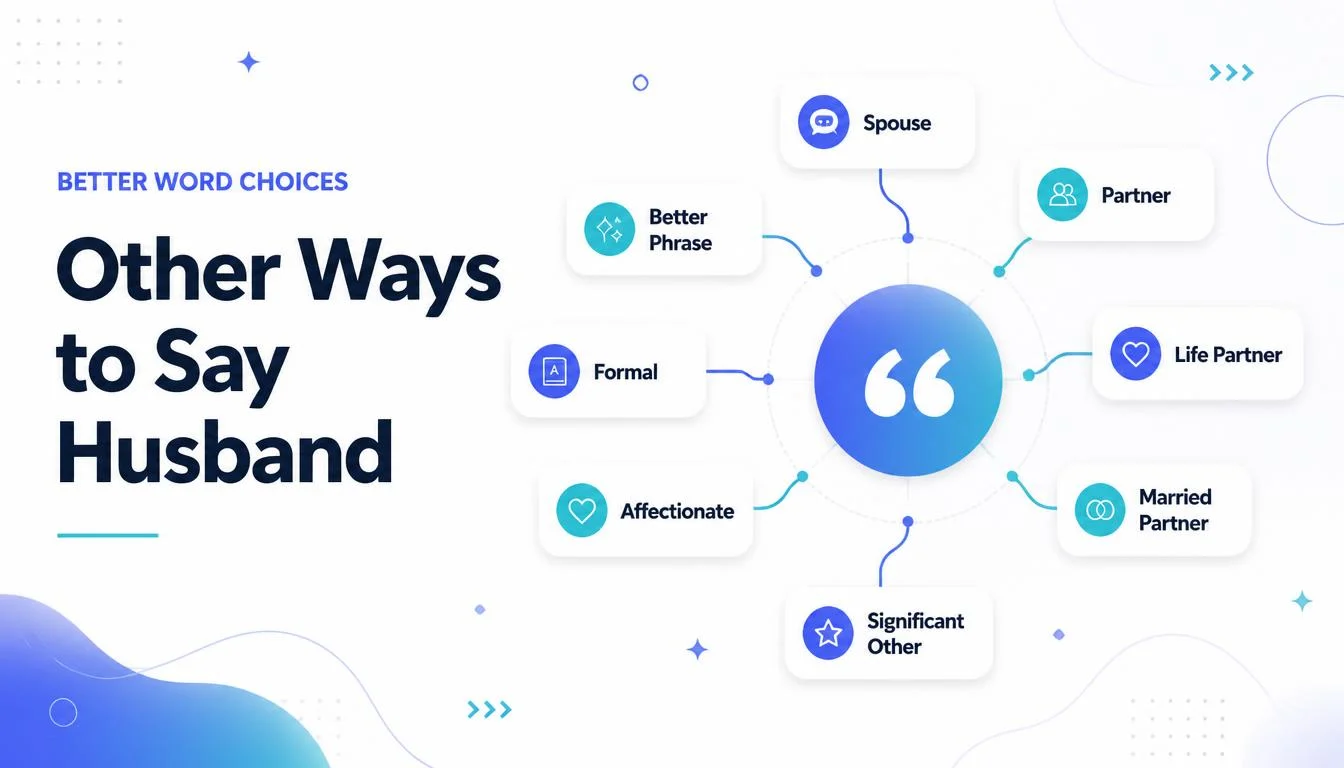
Formal alternatives to “Husband”
Use these in legal documents, official correspondence, or when speaking to authority figures.
- Spouse: Gender-neutral term used in legal and formal contexts.
- Life Partner: Emphasizes the permanence of the relationship without focusing on legal status.
- Husband: The standard formal term.
Pro Tip: Use “spouse” when you do not know the gender of the person you are referring to or in legal paperwork.
Casual alternatives
Use these in everyday conversation with friends, family, or peers.
- Hubby: An affectionate, slightly playful shortening of husband.
- Better Half: A humorous and endearing way to say your partner is your superior half.
- Old Man: Slang used affectionately (though sometimes risky depending on tone).
Pro Tip: “Hubby” is great for text messages but avoid it in formal emails.
Professional alternatives
Use these in the workplace or business networking events.
- Partner: The most common professional alternative to husband.
- Significant Other: A safe, inclusive term for any serious relationship.
- Mr. [Last Name]: Referring to him by his formal name.
Pro Tip: In a business setting, “partner” is safer than “husband” as it keeps the focus on your personal stability without oversharing.
Informal expressions
Use these with close friends or in relaxed social settings.
- The Mister: A slightly retro, playful term.
- My Man: A confident, casual term showing ownership and pride.
- Hubs: Short, punchy, and very modern.
Pro Tip: Ensure your tone is friendly when using terms like “Old Man” so it is not misunderstood as an insult.
Common Mistakes
- Using “Hubby” in a Business Email
- Mistake: “My hubby will attend the meeting.”
- Correction: Use “My husband” or “My spouse” in professional writing.
- Assuming “Partner” Means Business Partner
- Mistake: “I am meeting my partner for lunch.” (Ambiguous)
- Correction: Clarify by saying “My life partner” if the context is confusing.
- Using “Old Man” with Strangers
- Mistake: “This is my old man.”
- Correction: Strangers may think you are referring to your father. Use “husband” for clarity.
- Overusing “Better Half”
- Mistake: Using it in every sentence.
- Correction: Use it sparingly. It is a compliment, but overuse sounds cliché.
- Forgetting the “Possessive”
- Mistake: “Husband is coming.”
- Correction: “My husband is coming.” (Unless you are referring to “Husband” as a title, which is rare).
What Does “Husband” Mean?
Definition: A married man considered in relation to his spouse.
Grammar: It is a countable noun. You must use a determiner (my, your, her) before it.
Example: “Her husband is a doctor.”
When to Use “Husband”
- Spoken: Very common and natural in almost all spoken contexts.
- Written: Used in fiction, news articles, and personal letters.
- Formal: Acceptable, but “spouse” is preferred in legal docs.
- Informal: Perfectly fine, though “hubby” is often used for affection.
Is It Professional or Polite to Say “Husband”?
- Polite? ✔️ Yes. It is a respectful term.
- Professional? ❌ No. (In most cases). It is better to say “partner” or “spouse” to maintain a neutral business tone.
Business Example: “I would like to introduce my spouse, John, who works in finance.” (Better than “This is my husband, John.”)
Pros and Cons of Using “Husband”
Pros:
- Simple and natural.
- Friendly tone.
- Common usage.
- Easy to understand.
Cons:
- Too informal for work.
- Overused.
- Limited emotional range.
- Not suitable for formal writing.
Other Ways to Say “Husband”
These alternatives will help you sound more fluent, confident, and natural in different situations. Use them according to tone, context, and audience to express excitement, admiration, or approval.
1. Phrase: Spouse
Meaning: A legal term for a married partner.
Explanation: The most formal and gender-neutral option.
Example Sentence: “Please bring your spouse to the company dinner.”
Best Use: Legal/HR
Worst Use: Slang
Tone: Formal, neutral, legal
Context Variability: Formal written and spoken.
2. Phrase: Partner
Meaning: A person who shares a life with another.
Explanation: Excellent for professional settings or long-term relationships.
Example Sentence: “My partner and I are planning a trip.”
Best Use: Business/Social
Worst Use: Casual slang
Tone: Modern, neutral, respectful
Context Variability: Professional and casual.
3. Phrase: Hubby
Meaning: Affectionate nickname for husband.
Explanation: Cute and casual, best for people you know well.
Example Sentence: “My hubby is cooking dinner tonight.”
Best Use: Social media
Worst Use: Office meeting
Tone: Cute, playful, informal
Context Variability: Casual/spoken.
4. Phrase: Better Half
Meaning: A humorous way to say your partner is superior.
Explanation: Shows affection and humility.
Example Sentence: “I need to ask my better half before I make plans.”
Best Use: Friendly chat
Worst Use: Serious bio
Tone: Humorous, warm, affectionate
Context Variability: Casual/spoken.
5. Phrase: Significant Other
Meaning: A gender-neutral term for a serious partner.
Explanation: Safe for nearly any situation, though a bit wordy.
Example Sentence: “Can I bring my significant other to the party?”
Best Use: Inclusive events
Worst Use: Poetry
Tone: Safe, formal, clinical
Context Variability: Professional and casual.
6. Phrase: The Mister
Meaning: A playful way to refer to a husband.
Explanation: Often used by older generations or in a retro style.
Example Sentence: “I’m waiting for the Mister to get home.”
Best Use: Humor
Worst Use: Formal writing
Tone: Retro, playful, distinct
Context Variability: Casual/spoken.
7. Phrase: My Man
Meaning: A confident and possessive term.
Explanation: Shows pride in your relationship.
Example Sentence: “That’s my man over there.”
Best Use: Social settings
Worst Use: Professional bio
Tone: Confident, casual, bold
Context Variability: Casual/spoken.
8. Phrase: Hubs
Meaning: Shortened slang for husband.
Explanation: Very modern and quick to type.
Example Sentence: “Hubs just texted me.”
Best Use: Texting
Worst Use: Speeches
Tone: Trendy, quick, casual
Context Variability: Casual written.
9. Phrase: Old Man
Meaning: Slang for husband (or father).
Explanation: Can be affectionate if tone is right, but risky.
Example Sentence: “The old man and I are going fishing.”
Best Use: Very casual
Worst Use: New acquaintances
Tone: Rugged, slang, familiar
Context Variability: Informal spoken.
10. Phrase: Life Partner
Meaning: A person you share your life with.
Explanation: Emphasizes commitment over legal status.
Example Sentence: “He is my life partner in every sense.”
Best Use: Deep talks
Worst Use: Quick intro
Tone: Serious, deep, committed
Context Variability: Formal and emotional.
11. Phrase: Mate
Meaning: UK/Australian term for a friend or partner.
Explanation: Context depends heavily on region.
Example Sentence: “I’m going to the pub with me mate.”
Best Use: UK/Aussie chat
Worst Use: US Business
Tone: Regional, friendly, casual
Context Variability: Informal spoken.
12. Phrase: Fella
Meaning: A casual term for a boyfriend or husband.
Explanation: Common in informal conversation.
Example Sentence: “Her fella is picking her up.”
Best Use: Gossip
Worst Use: Formal writing
Tone: Informal, regional, casual
Context Variability: Spoken.
13. Phrase: Beau
Meaning: A boyfriend or suitor (old-fashioned).
Explanation: Romantic and slightly vintage.
Example Sentence: “She brought her beau to the dance.”
Best Use: Romantic story
Worst Use: Modern office
Tone: Vintage, romantic, sweet
Context Variability: Written/Storytelling.
14. Phrase: Consort
Meaning: A companion or spouse (often royal).
Explanation: Very formal, often associated with royalty.
Example Sentence: “The King and his consort attended the gala.”
Best Use: Historical
Worst Use: Coffee shop
Tone: Royal, archaic, formal
Context Variability: Formal written.
15. Phrase: Man
Meaning: Simple term for “my man.”
Explanation: Very direct and casual.
Example Sentence: “I love my man.”
Best Use: Songs/Pop culture
Worst Use: Academic paper
Tone: Direct, simple, casual
Context Variability: Casual spoken.
16. Phrase: Baby Daddy
Meaning: The father of one’s child (not necessarily married).
Explanation: Specifically for unmarried couples with children.
Example Sentence: “He is my baby daddy.”
Best Use: Specific social
Worst Use: Formal events
Tone: Slang, modern, specific
Context Variability: Informal spoken.
17. Phrase: Roommate
Meaning: Someone you live with.
Explanation: Often used humorously or to hide relationship status.
Example Sentence: “This is my roommate, Dave.”
Best Use: Privacy
Worst Use: Confusing
Tone: Dry, secretive, casual
Context Variability: Informal.
18. Phrase: Escort
Meaning: A person who accompanies another.
Explanation: Usually refers to a date for an event.
Example Sentence: “He was her escort for the evening.”
Best Use: Formal events
Worst Use: Everyday talk
Tone: Formal, temporary, polite
Context Variability: Formal spoken.
19. Phrase: The Breadwinner
Meaning: The person who earns the money.
Explanation: Focuses on the financial role.
Example Sentence: “My husband is the breadwinner of the family.”
Best Use: Economic talk
Worst Use: Romance
Tone: Practical, functional
Context Variability: Formal/Informal.
20. Phrase: My Rock
Meaning: A person who provides support.
Explanation: Metaphorical and emotional.
Example Sentence: “My husband is my rock.”
Best Use: Emotional
Worst Use: Casual intro
Tone: Emotional, grateful
Context Variability: Emotional/Personal.
21. Phrase: Soulmate
Meaning: A person ideally suited to another.
Explanation: Deeply romantic and spiritual.
Example Sentence: “I married my soulmate.”
Best Use: Romantic
Worst Use: Casual
Tone: Romantic, deep, spiritual
Context Variability: Personal.
22. Phrase: The Ball and Chain
Meaning: Humorous (sometimes negative) slang for wife/husband.
Explanation: Implies marriage is a restriction. Use with caution.
Example Sentence: “I have to check with the ball and chain.”
Best Use: Jokes
Worst Use: Serious talk
Tone: Sarcastic, humorous, risky
Context Variability: Informal spoken.
23. Phrase: Main Squeeze
Meaning: The most important romantic partner.
Explanation: Very slangy and fun.
Example Sentence: “She’s out with her main squeeze.”
Best Use: Fun chat
Worst Use: Professional
Tone: Slang, fun, youthful
Context Variability: Casual spoken.
24. Phrase: The King
Meaning: A term of admiration.
Explanation: Elevates the husband’s status.
Example Sentence: “He treats me well; he is the king.”
Best Use: Compliments
Worst Use: Modesty
Tone: Admiring, playful
Context Variability: Casual.
25. Phrase: My Everything
Meaning: A person who is central to your life.
Explanation: Very intense and romantic.
Example Sentence: “To me, he is my everything.”
Best Use: Love letters
Worst Use: Small talk
Tone: Intense, romantic
Context Variability: Personal.
26. Phrase: Companion
Meaning: A person who travels with or spends time with another.
Explanation: Formal and polite.
Example Sentence: “He has been my companion for 20 years.”
Best Use: Formal writing
Worst Use: Slang
Tone: Formal, polite, distant
Context Variability: Formal.
27. Phrase: Father of My Children
Meaning: The biological father of one’s kids.
Explanation: Focuses on the parenting role.
Example Sentence: “He is the father of my children.”
Best Use: Specific context
Worst Use: Dating
Tone: Respectful, specific
Context Variability: Formal/Personal.
28. Phrase: Boo
Meaning: Slang for boyfriend or husband.
Explanation: Very modern and affectionate.
Example Sentence: “I’m hanging with my boo.”
Best Use: Social media
Worst Use: Business
Tone: Slang, cute, young
Context Variability: Informal spoken.
29. Phrase: Man of the House
Meaning: The male head of the household.
Explanation: Traditional and authoritative.
Example Sentence: “He is the man of the house.”
Best Use: Traditional
Worst Use: Modern feminist
Tone: Traditional, authoritative
Context Variability: Casual/Formal.
30. Phrase: My Love
Meaning: A direct term of address.
Explanation: Used to speak to him, but can be used to refer to him.
Example Sentence: “I am waiting for my love to arrive.”
Best Use: Romantic
Worst Use: Neutral
Tone: Affectionate, intimate
Context Variability: Personal.
Pull Quote
The right tone makes your English sound professional and confident.”
Mini Quiz / Self-Check
1. You are writing an email to your boss. How do you refer to your husband?
A) My hubby
B) My spouse
C) My old man
Correct Answer: B (Professional context).
2. You are texting your best friend. Which is most natural?
A) My spouse is here.
B) My hubs is here.
C) My consort is here.
Correct Answer: B (Casual context).
3. Which term is gender-neutral?
A) Husband
B) Spouse
C) Beau
Correct Answer: B (Spouse).
4. Which phrase implies a negative view of marriage?
A) Better half
B) Ball and chain
C) Significant other
Correct Answer: B (Ball and chain).
Comparison Table: Top Alternatives
| Phrase | Tone | Best Use |
| Spouse | Formal, Legal | Documents, HR |
| Partner | Professional, Neutral | Business, Social |
| Hubby | Cute, Informal | Texting, Friends |
| Better Half | Humorous, Warm | Parties, Jokes |
| Significant Other | Safe, Inclusive | Events, Introductions |
| Hubs | Trendy, Quick | Social Media |
| Old Man | Slang, Rugged | Very Close Friends |
| Life Partner | Serious, Deep | Emotional Speeches |
| My Man | Confident, Casual | Social Settings |
| The Mister | Retro, Playful | Humor |
FAQs
1. Is it okay to say “partner” instead of “husband?
Yes, “partner” is widely accepted in professional and social settings. It is often preferred because it is gender-neutral and emphasizes the relationship over the legal title.
2. What is a formal synonym for husband?
“Spouse” is the most formal synonym. It is used in legal documents, medical forms, and official correspondence.
3. Can I use “hubby” in an email?
You should avoid “hubby” in professional emails. It is considered too informal and affectionate for the workplace. Use “husband” or “spouse” instead.
4. What does “better half” mean?
“Better half” is a humorous and affectionate term for a husband or wife. It implies that the partner is the “better” or more capable part of the couple.
5. Is “old man” a rude way to say husband?
It depends on the tone. Among close friends, it can be affectionate. However, in formal settings or with strangers, it can sound disrespectful or confusing (as it also means “father”).
Conclusion
Mastering other ways to say husband is about more than just vocabulary; it is about understanding context. Whether you are writing a legal document or joking with a friend, the right word helps you communicate clearly and appropriately. Using professional reaction phrases in the office and informal expressions in English at home shows true fluency.
Practice these alternatives daily. Try swapping “husband” for “partner” in your next work meeting, or use “hubby” in your next text. Being aware of tone is the key to sounding like a native speaker.
Read More Related Articles:
- Other Ways to Say You’re Beautiful | Beyond the Ordinary Compliment In 2026
- Other Ways to Say I Love You in Spanish | Beyond the Usual Phrase In 2026
- Other Ways to Say I Love You in Other Languages | Beyond the Classic Three Words In 2026

Daniel Murphy is a professional writer and blogger specializing in digital communication and messaging trends. As a contributor to TextsResponse.com, he creates reader-focused content designed to help people find the right words at the right time.